What you'll learn
- How religion can act as a conservative force that supports social stability.
- How religion can also be a force for social change, including economic and political change.
- How to apply theorists such as Durkheim, Marx, Weber, feminists, Bruce and Maduro.
- How to evaluate using contemporary UK examples, secularisation, power and social inequality.
The big question: does religion preserve society or transform it?
This topic asks you to avoid a simple “religion does one thing” answer. Sociologists disagree because religion can support social stability in one context and encourage social change in another.
A useful essay argument is: religion’s impact depends on the beliefs, practices and organisations involved, and on wider social factors such as class, gender, ethnicity, secularisation and political power.
Core terms
- Social change means significant alteration in society’s structures, norms, values or power relations over time.
- Social stability means the maintenance of social order, shared values and existing institutions.
- Religious beliefs are ideas about the sacred, morality, salvation, God or ultimate meaning.
- Religious practices are actions such as worship, prayer, fasting, pilgrimage, charity, rituals or dress codes.
- Religious organisations are organised groups such as churches, denominations, sects, faith schools, charities and social movements.
The two-sided question
Religion can be both integrating and disruptive: it may socialise people into shared moral identities, but it may also mobilise people to challenge injustice and unequal power.
Classifying religion's effect
Imagine a church runs a food bank and campaigns against local child poverty.
- The food bank can support stability because it reduces hardship and helps people cope within the existing system.
- The campaigning can support change because it challenges government policy and draws attention to class inequality.
- A strong answer would argue that the same religious organisation may do both: it provides practical welfare while also creating pressure for wider reform.
Religion as a force for social stability
Functionalism: religion creates solidarity
Functionalism is a consensus perspective which sees society as a system of institutions working together to maintain order. Functionalists argue that religion helps integrate people into society.
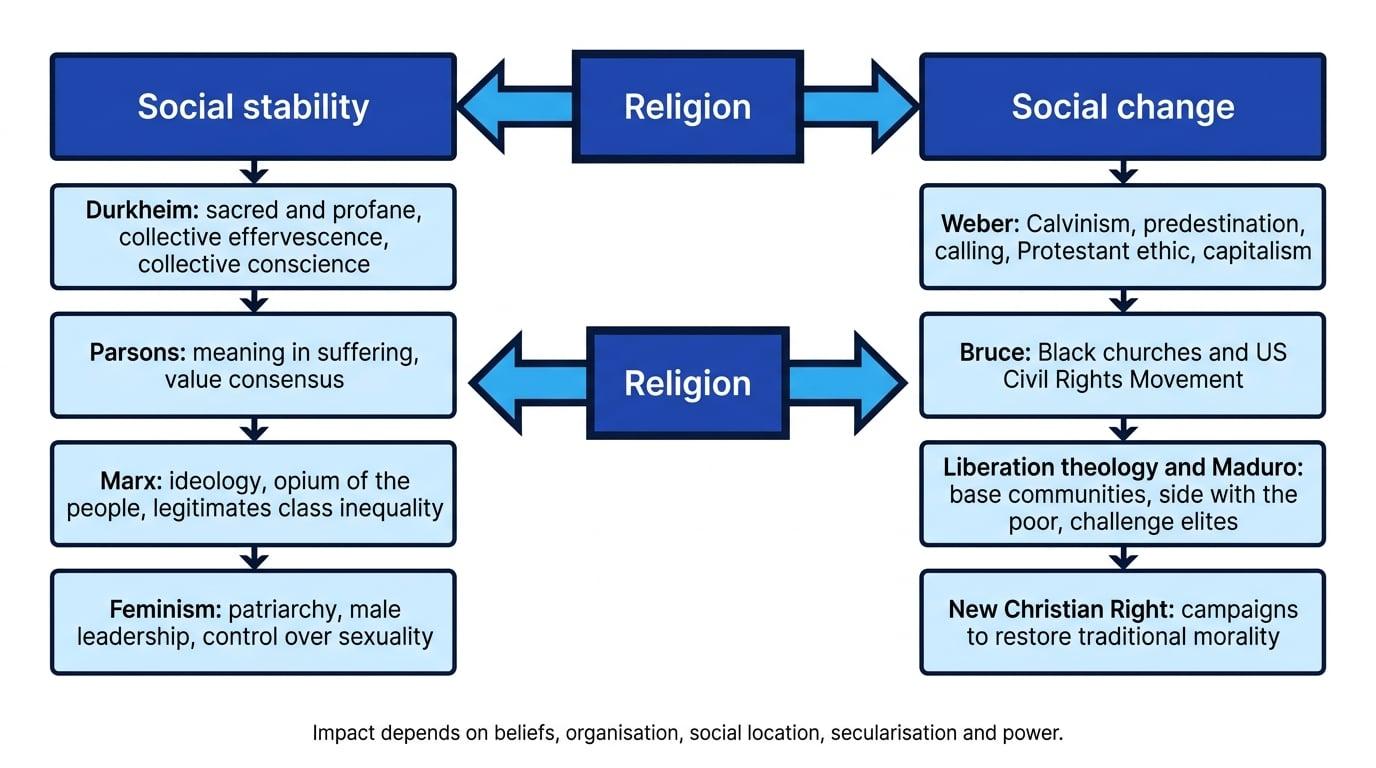
Durkheim studied totemism among Aboriginal Australian groups. He argued that religion divides the world into the sacred and the profane. The sacred refers to things treated as special, powerful or set apart; the profane refers to ordinary everyday life. Through shared rituals, people experience collective effervescence, a feeling of belonging to something larger than themselves.
For Durkheim, when people worship sacred symbols, they are really worshipping society itself. Religion strengthens the collective conscience, meaning society’s shared moral beliefs.
In the UK, religious and quasi-religious rituals can still create solidarity. Examples include Remembrance Sunday, coronations involving the Church of England, and local faith groups organising charity work. These practices can reinforce national identity, community belonging and moral values.
Parsons also sees religion as stabilising. He argues that religion gives meaning to life’s difficult moments, such as death or suffering, and supports core social values. This links to socialisation, culture and identity because religious rituals teach people who they are, what matters and how they should behave.
Evaluation of functionalism
Functionalists are useful for explaining how rituals create belonging, but they may exaggerate value consensus. In a religiously diverse and increasingly secular UK, not everyone shares the same sacred symbols. The 2021 Census for England and Wales found that fewer than half of the population identified as Christian, while “no religion” increased. This weakens the claim that religion provides one shared moral framework.
Functionalism also underplays power and stratification. A ritual may unite some groups while excluding others. For example, an established Church of England can symbolise tradition, but it may also raise questions about privilege because bishops sit in the House of Lords.
Treating stability as automatically good
In sociology, “stability” simply means social order is maintained. It does not necessarily mean society is fair, equal or democratic.
Marxism: religion legitimates inequality
Marxism is a conflict perspective which sees society as based on class inequality between the bourgeoisie, who own the means of production, and the proletariat, who sell their labour.
Marx argued that religion can act as an ideology. An ideology is a set of ideas that justifies the interests of a powerful group and makes inequality appear natural or acceptable. His famous phrase “the opium of the people” means that religion can comfort the oppressed while discouraging them from challenging capitalism.
Religion may stabilise class inequality by promising rewards in an afterlife, encouraging obedience, or presenting poverty as spiritually meaningful. Historically, ideas such as the “divine right of kings” helped legitimate hierarchy. In contemporary society, some critics argue that religious charity may relieve suffering without tackling the structural causes of poverty.
However, Marx also described religion as the “sigh of the oppressed creature”, suggesting it expresses real suffering. This opens the door to a more complex view: religion can be conservative, but it can also become a language of protest.
Feminism: religion can support patriarchy
Feminism examines gender inequality and patriarchy. Patriarchy means male domination in social institutions, culture and everyday life.
Feminists argue that many religions have historically reinforced gender hierarchy through male religious leadership, rules around sexuality, expectations of motherhood, and teachings about modesty or obedience. Simone de Beauvoir argued that religion can encourage women to accept second-class status by promising compensation for suffering.
In the UK, debates around women bishops in the Church of England show how religious organisations can reproduce or challenge gender inequality. The first women bishops were approved in 2014, suggesting religious organisations are not fixed; they can change under pressure from wider society.
Evaluation matters here. Not all women experience religion as oppressive. Woodhead argues that some women use religion to gain respect, community and identity. For example, religious dress or participation in women’s faith networks may be experienced as empowerment, depending on context.
Religion as a force for social change
Weber: the Protestant ethic and capitalism
Weber argued that religious ideas can help create major social change. In The Protestant Ethic and the Spirit of Capitalism (1905), he claimed that Calvinist Protestant beliefs helped encourage the development of modern capitalism.
Calvinists believed in predestination, the idea that God had already chosen who would be saved. Because believers could not know whether they were saved, they looked for signs of God’s favour. Hard work, discipline and success in a calling became possible signs.
This created the Protestant ethic: self-discipline, hard work, thrift and rejection of luxury. Weber argued that this fitted well with the “spirit of capitalism”, where profit is reinvested rather than spent on pleasure.
Applying the Protestant ethic
- Start with the belief: Calvinists believed salvation was predetermined, creating anxiety about whether they were among the saved.
- Link belief to practice: they worked hard, avoided waste and treated economic success as a possible sign of God’s favour.
- Link practice to social change: repeated across a group, these habits encouraged saving, reinvestment and rational business activity, helping capitalism develop.
Weber is important because he challenges Marx. For Marx, economic structure shapes religion; for Weber, religious ideas can shape economic behaviour.
Evaluation: Weber does not prove religion was the only cause of capitalism. Critics such as Kautsky argue that capitalism began before Calvinism in some places. However, Weber’s argument is still valuable because it shows an elective affinity: a close fit between religious beliefs and economic change.
Religious movements and political change
Religion can also create change through organisations, leadership and collective identity.
Bruce argues that Black churches played a major role in the US Civil Rights Movement. Churches provided meeting places, networks, moral language, leadership and practical resources. Martin Luther King Jr used Christian ideas of justice to challenge racial segregation.
Liberation theology developed in Latin America, especially from the 1960s. It combined Catholic Christianity with a concern for the poor and oppressed. Base communities encouraged ordinary people to read the Bible in relation to poverty and injustice. Maduro argues that religion can become revolutionary when religious leaders are relatively independent from ruling elites and side with oppressed groups.
Religion can also encourage conservative change. The New Christian Right in the USA has campaigned on issues such as abortion, school prayer and sexuality. Its aim is often to restore “traditional” morality, so it is a movement for change that seeks a more stable or traditional social order. Bruce argues it has had limited success because modern societies are pluralistic, meaning there are many competing beliefs and lifestyles.
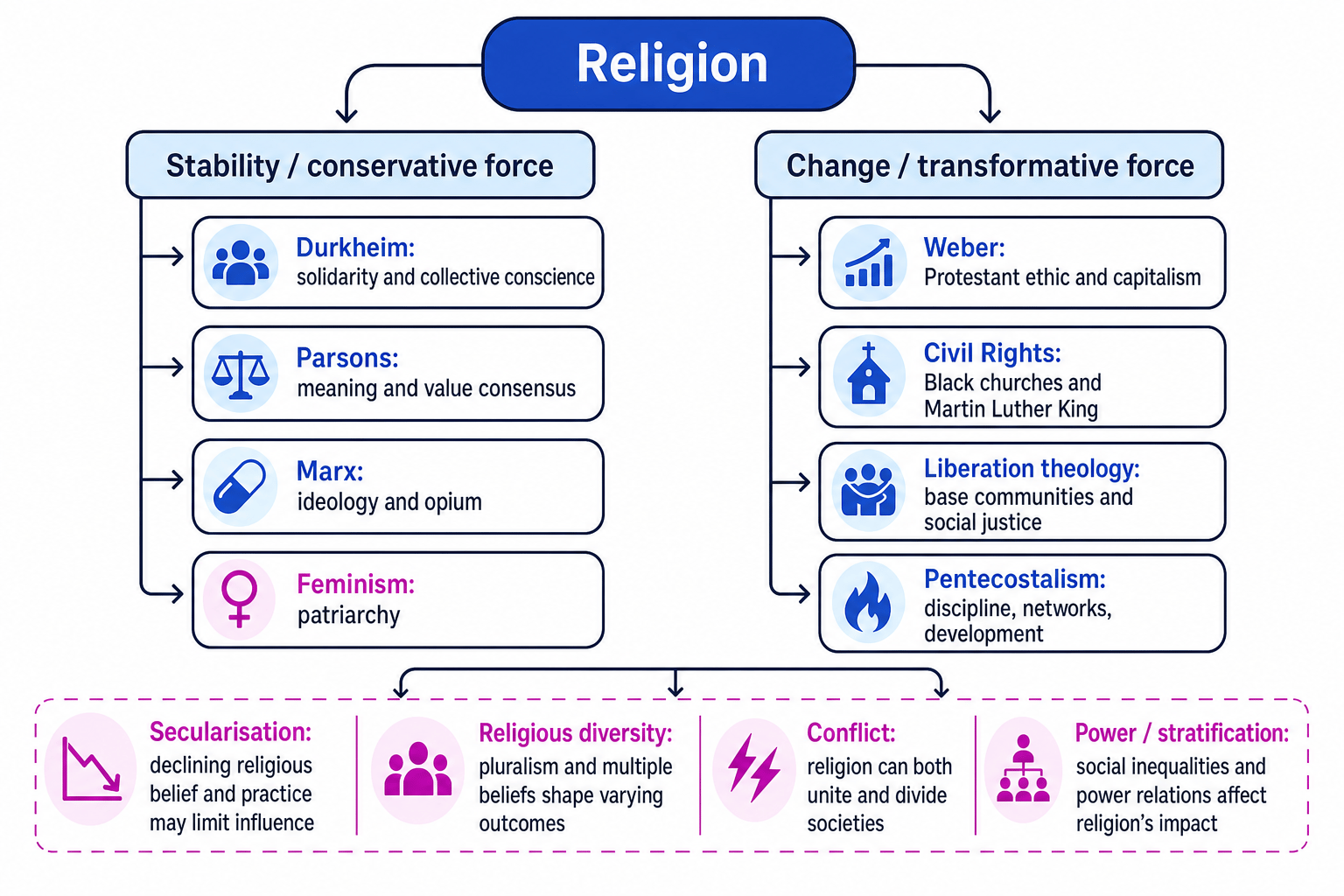
In the Global South, Pentecostalism has been linked to social and economic change. Sociologists such as Berger and Martin argue that Pentecostal beliefs may encourage self-discipline, sobriety, mutual support and entrepreneurship. Critics respond that this can individualise poverty by focusing on personal morality rather than global inequality.
Why religion’s impact varies
You can explain different outcomes by looking at several conditions.
First, look at the content of beliefs. Some beliefs stress obedience and tradition; others stress justice, equality or liberation.
Second, look at organisation. A large established church may be closely connected to the state, while a minority sect or movement may be more oppositional.
Third, look at social location. Religion may mean different things to different classes, ethnic groups and genders. For migrants, for example, a mosque, gurdwara or church may preserve cultural identity while also helping adaptation to British society.
Fourth, look at secularisation. If religious authority declines, religion may have less power to stabilise society as a whole. However, secularisation does not mean religion disappears. Religious organisations still influence education, charity, welfare, public ceremonies and moral debates.
Build paragraphs around direction of impact
For each paragraph, be clear whether religion is mainly promoting stability, promoting change, or doing both in different ways. Then use theory, example and evaluation to prove it.
Evidence and methods: how do sociologists know?
When using evidence, add a little methodological evaluation.
Official statistics such as the Census are useful because they are large-scale and representative. They help you apply secularisation to contemporary UK society. However, they may lack validity because ticking “Christian”, “Muslim” or “no religion” does not show strength of belief, attendance or private spirituality.
Historical-comparative evidence, such as Weber’s work, helps explain long-term social change. But it is hard to prove causation because many economic, political and cultural changes happen at the same time.
Qualitative research on religious communities can give high validity because it explores meanings and identities in depth. The weakness is that small samples may not be representative of all believers.
Pulling it together for essays
A strong answer should not say “religion causes stability” or “religion causes change” as if these are opposites. Instead, argue that religion is a cultural resource. Powerful groups may use it to legitimate inequality, but oppressed groups may use it to organise resistance.
This is where the two core themes fit clearly. Religion shapes socialisation, culture and identity by teaching values and belonging. It also connects to social differentiation, power and stratification because religious ideas and organisations can either justify or challenge inequalities of class, gender, ethnicity and nation.
In the exam
- Start with a clear judgement: religion can be conservative, radical, or both depending on context.
- Use paired perspectives: for example, Durkheim or Marx for stability, then Weber, Bruce or Maduro for change.
- Evaluate with contemporary application: mention secularisation, religious diversity, UK Census trends, faith schools, the Church of England, or faith-based charity and campaigning.
Check yourself
- How would Durkheim and Marx explain religion as a force for stability differently?
- Why does Weber’s Protestant ethic argument challenge a simple Marxist view of religion?
- What contemporary UK examples could you use to show religion still matters despite secularisation?