What you'll learn
- How ideology, science and religion can all be understood as belief systems.
- How Marxists, functionalists, Weberians, feminists, postmodernists and interactionists explain belief.
- How Christian and non-Christian religious traditions can support both social order and social change.
- How to evaluate these debates for AO3, not just describe them for AO1.
Starting point: belief systems
A belief system is a set of ideas that helps people interpret the world. It gives answers to questions like: What is true? What is right? Who has authority? Why is society organised as it is?
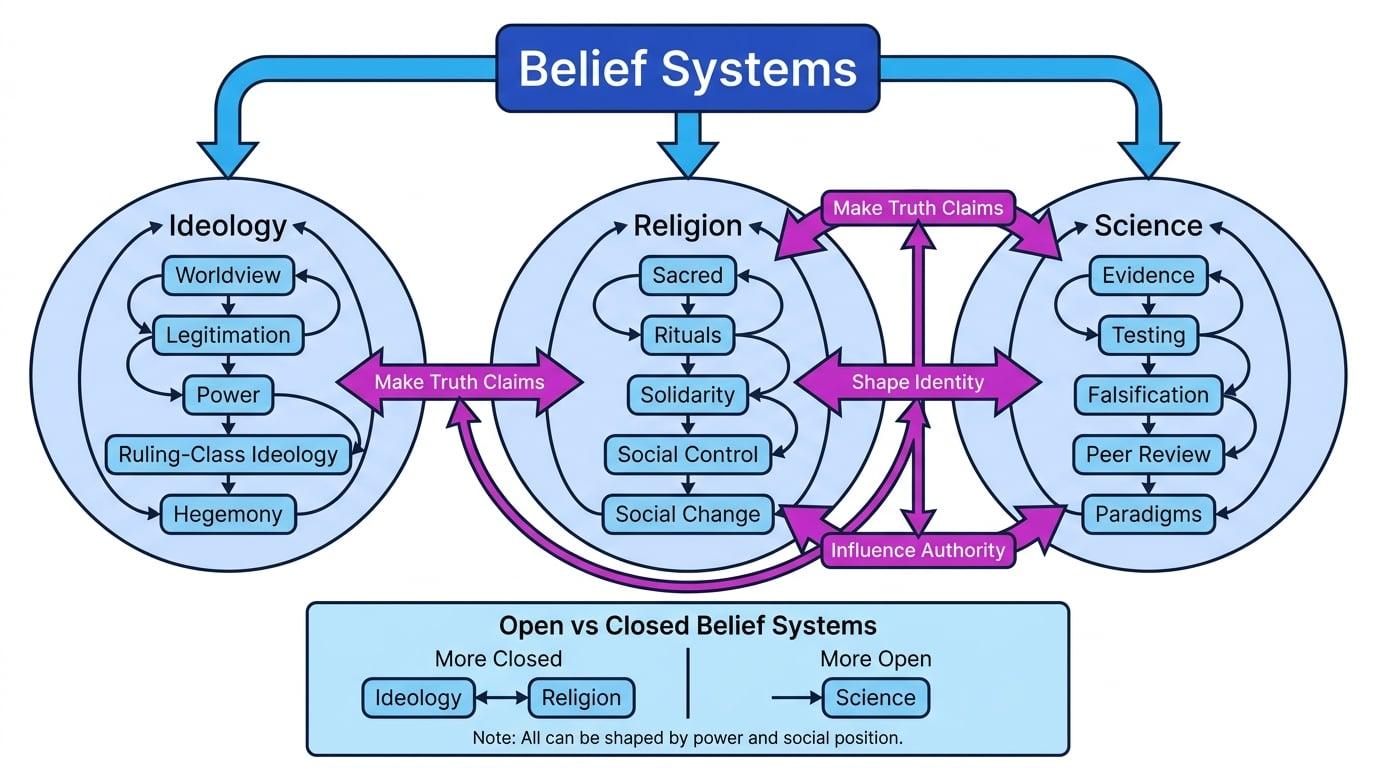
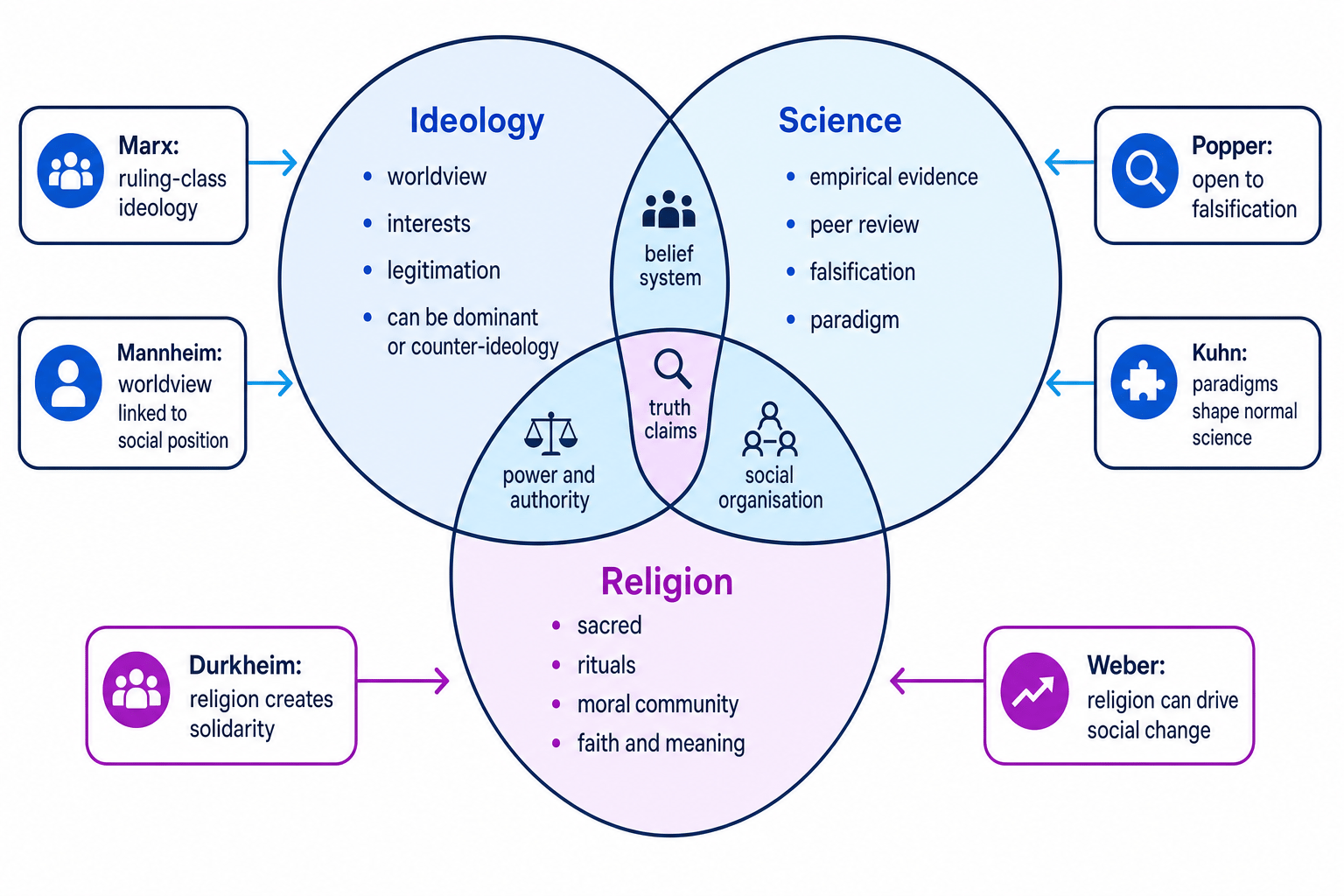
In this topic, you compare three major kinds of belief system: ideology, science and religion. They are not completely separate. All three make truth claims, influence identity, and can be linked to power.
Belief system
A belief system is a connected set of ideas, values and assumptions that explains the world and guides behaviour.
The big sociological question
Sociologists ask not only whether a belief is “true”, but who benefits from it, how it is learned through socialisation, and how it shapes power, culture and identity.
Ideology: beliefs and power
An ideology is a worldview: a set of ideas and values about how society is, and how it should be. Ideologies can be political, economic, religious, nationalist, feminist, environmentalist or scientific.
A key word here is legitimation, which means making something appear right, fair or natural. For example, the idea that “anyone can succeed if they work hard enough” may legitimate inequality by making class differences seem deserved.
Ideology
An ideology is a set of ideas and values that explains society and often justifies the interests of a particular group.
Marxism: ruling-class ideology
For Marx, capitalist society is divided between the bourgeoisie who own the means of production and the proletariat who sell their labour. Marx argued that the ruling class also controls the main ideas in society.
This produces ruling-class ideology: beliefs that make capitalism seem natural, fair or inevitable. Religion, for Marx, can act as the “opium of the people” because it comforts the oppressed and distracts them from challenging exploitation.
Later Marxists developed this. Althusser argued that institutions such as education, the media and religion are ideological state apparatuses: they spread ideas that reproduce capitalism. Gramsci used the term hegemony to describe ruling-class leadership through consent rather than just force.
Evaluation: is ideology always dominant?
Abercrombie, Hill and Turner criticised the “dominant ideology thesis”. They argued that in capitalist societies many working-class people are not deeply convinced by ruling-class ideology. They may conform because of practical pressures, not because they fully believe the system is fair.
This is useful AO3: Marxism shows how beliefs link to power and stratification, but it can overstate how successfully dominant ideas control people.
Applying ideology to meritocracy
Suppose you are asked whether belief in meritocracy can be seen as ideological.
- Identify the belief. Meritocracy is the idea that people gain rewards such as income, status and qualifications because of talent and effort.
- Link it to power. A Marxist would argue this can legitimate class inequality by making unequal outcomes appear deserved rather than structurally produced.
- Apply it to UK society. If privately educated pupils are over-represented in elite universities or top professions, this suggests class advantages still matter.
- Evaluate the claim. The belief is not simply “false”: some social mobility exists, and people do make choices. However, the ideology may hide unequal starting points.
Mannheim: ideology and social position
Karl Mannheim argued that ideas are linked to the social position of the people who produce them. This is sometimes called the sociology of knowledge: the study of how social context shapes what counts as knowledge.
Mannheim distinguished between:
- Ideological thought, which supports the existing order.
- Utopian thought, which imagines a radically different society.
For example, conservative beliefs may defend tradition and hierarchy, while socialist or feminist beliefs may challenge existing inequalities.
Mannheim’s approach is broader than Marx’s because he does not say only the ruling class has ideology. Every group sees the world from a particular social location.
AO3 shortcut
A simple comparison: Marx asks whose interests ideology serves; Mannheim asks how all knowledge is shaped by social position.
Religion as a belief system
Religion is a belief system based on the sacred, meaning things set apart as special, holy or spiritually significant. This contrasts with the profane, which means ordinary everyday life.
Religion usually involves beliefs, rituals, moral rules, symbols and communities. In the UK, this includes Christian traditions such as Anglicanism, Catholicism, Pentecostalism and Methodism, as well as non-Christian traditions such as Islam, Hinduism, Sikhism, Judaism and Buddhism.
Religion
Religion is a system of beliefs and practices focused on the sacred, often involving moral codes, rituals and a community of believers.
Durkheim: religion creates social solidarity
Durkheim saw religion as a force for social solidarity, meaning social unity and shared belonging. He argued that when people worship sacred symbols, they are really worshipping society itself.
Religion strengthens the collective conscience, the shared moral values that bind people together. This links strongly to the core theme of socialisation, culture and identity: religion teaches people who they are, what matters, and how to behave.
AO2 examples include Christian churches marking life events such as baptism, marriage and funerals, or Sikh gurdwaras organising langar, the shared community meal open to all.
Parsons: meaning and stability
Parsons argued that religion helps people cope with uncertainty, suffering and death. It provides meaning when events seem unfair or random. This can stabilise society because people are less likely to see suffering as meaningless.
For example, religious beliefs about heaven, karma, reincarnation or divine justice may help believers interpret loss or hardship.
Marxism and feminism: religion can legitimate inequality
Marxists argue religion can legitimate class inequality by promising rewards in the afterlife rather than encouraging change in this life.
Feminists argue some religious traditions have been used to legitimate patriarchy, a system of male dominance. For example, male leadership in some churches, mosques, synagogues or temples may be defended as tradition or divine order.
However, this must be handled carefully. Religious traditions are internally diverse. Many women are religious leaders, activists and scholars, and many believers use faith to challenge injustice.
Treating religion as one thing
Do not write as if “religion” always means Christianity or always supports conservatism. AQA expects awareness of both Christian and non-Christian traditions, and of religion as both conservative and radical.
Comparing consensus and conflict views of religion
To answer “religion supports social order”, you could reason like this:
- Use a consensus view. Durkheim would argue religion creates shared rituals and moral values, helping people feel part of a community.
- Apply it. A church, mosque, gurdwara or temple can provide identity, charity, youth groups and support networks.
- Add a conflict view. Marxists and feminists would argue the same religious beliefs may legitimate class inequality or patriarchy.
- Reach a balanced judgement. Religion can support order, but whether that order is beneficial depends on whose interests it serves.
Weber: religion and social change
Weber disagreed with the idea that religion only supports the status quo. In The Protestant Ethic and the Spirit of Capitalism, he argued that some forms of Calvinist Protestant Christianity encouraged disciplined work, saving and reinvestment.
Weber linked this to the growth of capitalism. This is important because it shows religion can be a force for social change, not just stability.
Other examples support this wider point. Liberation theology in Latin America used Christian ideas to challenge poverty and oppression. In the USA, Black churches were significant in the Civil Rights Movement. In the UK, religious organisations often campaign on poverty, asylum, racism and climate justice.
Non-Christian traditions can also support social action. Sikh principles of service, Islamic charity through zakat, Hindu reform movements and Buddhist peace activism can all provide moral resources for change.
Science as a belief system
Science is a belief system based on observation, evidence, testing and reason. It claims authority because its conclusions are meant to be checked against empirical evidence.
Empirical evidence means evidence gathered through observation or experience. Peer review is when other experts examine research before publication. Falsification, associated with Popper, means a scientific claim must be testable in a way that could prove it wrong.
Science
Science is a systematic way of producing knowledge through evidence, testing, criticism and revision.
Popper: science as an open belief system
Popper argued that science is an open belief system because scientific claims are always open to criticism. A theory is scientific if it could, in principle, be falsified.
For example, a medical claim about whether a vaccine reduces illness can be tested using evidence. If the evidence repeatedly contradicts the claim, the claim should be rejected or revised.
By contrast, Popper saw some religious and ideological claims as closed belief systems because they may explain away contradictory evidence rather than accept refutation.
Merton: science as a social institution
Merton argued that science is organised around norms sometimes summarised as CUDOS:
- Communism: scientific knowledge should be shared.
- Universalism: claims should be judged by evidence, not by who makes them.
- Disinterestedness: scientists should seek truth, not personal gain.
- Organised scepticism: claims should be critically examined.
This is useful because it shows science is not just a method; it is also a social institution with norms and values.
Kuhn: paradigms and scientific communities
Kuhn challenged the view that science is always open and objective. He argued that scientists usually work within a paradigm, meaning a shared framework of assumptions, methods and key questions.
During normal science, researchers solve puzzles inside the existing paradigm. Evidence that does not fit may be ignored until a crisis leads to a scientific revolution, where one paradigm is replaced by another.
This gives you strong AO3: Popper presents science as open and critical, while Kuhn shows that scientific communities can be conservative.
Using Popper and Kuhn together
If asked whether science is different from religion, you could build the argument like this:
- Start with Popper. Science differs from religion because scientific theories should be falsifiable and open to testing.
- Apply it. Claims about climate change, disease or nutrition can be checked through data, replication and peer review.
- Complicate with Kuhn. Scientists may still defend existing paradigms and resist evidence that threatens their professional worldview.
- Evaluate the difference. Science has stronger institutional mechanisms for correction, but it is still shaped by funding, power and scientific communities.
Is science free from ideology?
Sociologists are interested in how science can be shaped by society. Funding, government priorities, corporations, universities and military interests can influence what research is done.
For example, pharmaceutical research, artificial intelligence, climate science and genetic research may all involve questions about profit, regulation and public trust.
Historically, some claims presented as “scientific” have supported racism, colonialism, sexism or eugenics. This does not mean science is worthless. It means sociologists distinguish between the ideals of scientific method and the social context in which science operates.
Postmodernists such as Lyotard argue that contemporary society is suspicious of metanarratives, which are big stories claiming universal truth. From this view, science is one powerful narrative among others. Critics reply that this can go too far: scientific knowledge has produced reliable technologies, medicine and evidence about the natural world.
Open and closed belief systems
An open belief system accepts criticism and changes in response to evidence. A closed belief system protects itself from criticism by rejecting, absorbing or explaining away challenges.
Science is often presented as more open because of peer review, replication and falsification. Religion and ideology are often presented as more closed because they may rely on faith, authority or sacred texts.
But avoid making this too simplistic. Some religious communities debate interpretation and adapt to social change. Some scientific institutions resist new ideas. Some political ideologies encourage criticism, while others suppress it.
Best evaluative line
The strongest answer is not “science is open, religion is closed”. It is: all belief systems make truth claims, but they differ in how far they institutionalise criticism, evidence and revision.
Comparing ideology, science and religion
| Belief system | Main source of authority | Key sociological issue | Possible AO2 example |
|---|---|---|---|
| Ideology | Political values, class interests, social position | Does it legitimate power or challenge it? | Meritocracy, nationalism, feminism, environmentalism |
| Religion | Sacred beliefs, tradition, revelation, community | Does it create solidarity, control or change? | Anglican rituals, Islamic charity, Sikh langar, Hindu festivals |
| Science | Evidence, testing, expert communities | Is it objective, or socially shaped? | Vaccine research, climate science, medical research |
Bringing in the two core themes
For socialisation, culture and identity, belief systems teach people what is normal, moral and meaningful. Religious upbringing, school science education, national identity and political values all shape the self.
For social differentiation, power and stratification, belief systems can justify or challenge inequality. Ideology may legitimate class divisions; religion may reinforce or resist patriarchy; science may challenge superstition but can also be shaped by elite funding and institutional power.
Essay structure
A strong essay usually compares at least two belief systems. For example: ideology and religion both legitimate power, but science claims authority through evidence and organised criticism.
In the exam
- Define the key term early: ideology, science, religion, open belief system, or closed belief system.
- Use named theorists in pairs: for example, Marx with Mannheim, Durkheim with Weber, or Popper with Kuhn.
- Apply beyond Christianity by including examples from Islam, Sikhism, Hinduism, Judaism, Buddhism or other traditions where relevant.
- Evaluate throughout: ask whether the belief system supports consensus, reflects conflict, or enables social change.
- Link to power and identity so your answer covers the core themes, not just isolated theory.
Check yourself
- How would Marx and Mannheim define ideology differently?
- Why might Popper see science as more open than religion or ideology?
- How can religion be both conservative and a force for social change?