What you'll learn
- How identity is formed through culture, socialisation and interaction.
- How identity relates to age, disability, ethnicity, gender, nationality, sexuality and social class.
- Why sociologists see social categories as linked to power, inequality and stratification.
- How to build AO1, AO2 and AO3 points for essays on identity.
Starting point: what is identity?
Identity
Identity means your sense of who you are, and how others see and define you. It includes personal features, such as personality and interests, and social features, such as class, gender, ethnicity or nationality.
Identity is not just something “inside” you. Sociologists argue that it is shaped by culture — the shared meanings, values, norms and practices of a group or society.
Social categories
Social categories are socially recognised groupings, such as age, disability, ethnicity, gender, nationality, sexuality and social class. They matter because they can affect how people are treated, what opportunities they have, and how they understand themselves.
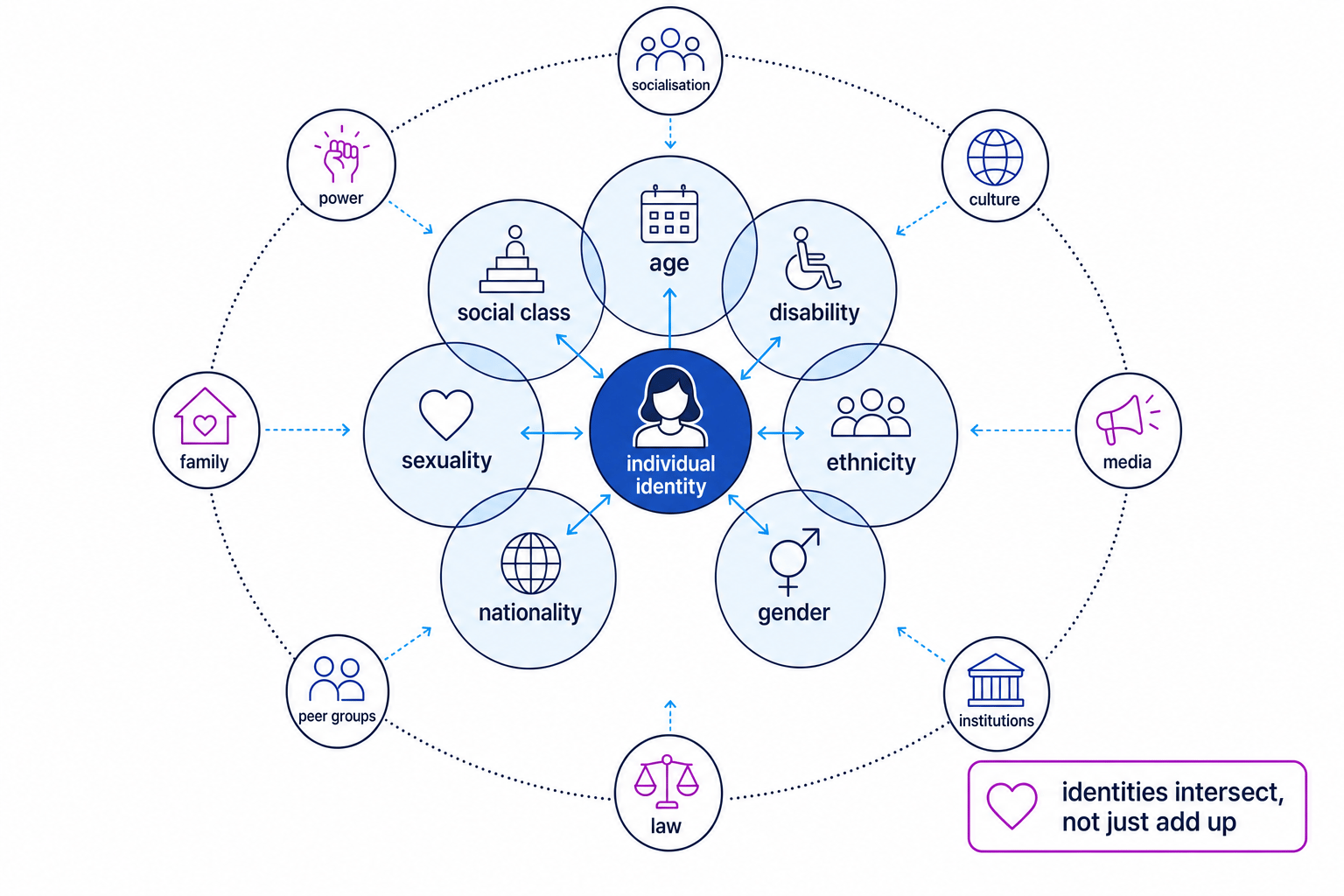
A key idea in this topic is that identities are both chosen and constrained. You may choose clothes, music, online profiles and friendship groups, but these choices happen within wider structures such as family, education, media, law, religion, workplaces and the economy.
Socialisation: how identities are learned
Socialisation
Socialisation is the process through which people learn the norms, values and expected behaviour of their society or social group.
Primary socialisation happens mainly in the family during early childhood. Secondary socialisation happens later through institutions such as school, peer groups, the media, religion and work.
For example, children may learn gender expectations through toys, clothes, language and role models. Teenagers may form youth identities through music, fashion, social media and friendship groups.
Identity is socially constructed
A social construction is an idea that seems natural but is actually created and maintained by society. Categories such as “child”, “teenager”, “masculine”, “respectable” or “British” can change across time and between cultures.
Identity, power and inequality
Sociologists do not only ask, “What identities do people have?” They also ask, “Who has the power to define identities?”
Social differentiation, stratification and power
Social differentiation means society is divided into different groups. Social stratification means these groups are ranked unequally. Power is the ability to influence others or shape outcomes, even when there is resistance.
Some identities are privileged. Others may be stigmatised or marginalised. For example, middle-class accents may be treated as more “professional”, heterosexuality may be assumed as the norm, and disabled people may face barriers in buildings, workplaces or public attitudes.
Intersectionality
Intersectionality, associated with Crenshaw, means social categories overlap and interact. A person’s experience is not just “gender plus class plus ethnicity”; the combination can create specific forms of advantage or disadvantage.
Applying intersectionality to identity
- Start with one person’s social location: for example, a young working-class British Pakistani Muslim woman.
- Consider how each category may shape identity: age may affect how seriously she is taken, class may affect educational opportunities, ethnicity and religion may influence cultural belonging, and gender may shape expectations around behaviour.
- Look at the interaction between categories: she may experience stereotypes that are not the same as those faced by young men, white working-class women, or older Pakistani women.
- Add power: institutions such as schools, employers, media and the law may either challenge or reproduce these stereotypes.
Treating categories as separate boxes
Do not write as if age, class, gender, ethnicity and sexuality operate in isolation. Stronger answers show how identities overlap and how power affects which identities are valued.
Age and identity
Age is partly biological, but age identity is socially shaped. Society attaches meanings to life stages such as childhood, youth, adulthood and old age.
Aries argued that childhood is not a universal, fixed stage; it has changed historically. In contemporary UK society, children are often seen as vulnerable and in need of protection, while teenagers may be represented as either creative consumers or as a “problem” group.
Age can also shape power. Young people may have limited political and economic power, while older people may face ageism in employment, healthcare or media representation. However, older people are not a single group: class, health, gender and ethnicity affect experiences of ageing.
AO2 examples include the voting age debate, youth unemployment, student debt, pension policy, social media youth cultures, and media panics about anti-social behaviour.
Disability and identity
Disability
Disability refers to the social disadvantages and barriers experienced by people with physical, sensory, mental health or learning impairments.
The medical model of disability sees disability mainly as an individual physical or mental limitation. The social model of disability, associated with Oliver, argues that society disables people through barriers such as inaccessible buildings, inflexible workplaces and negative attitudes.
Goffman’s concept of stigma is useful here. Stigma means a label or attribute that society treats as discrediting. Disabled identities may be shaped by exclusion, but also by resistance, pride and campaigning.
AO2 examples include the Equality Act 2010, wheelchair access, hidden disabilities, neurodiversity, disability benefit debates, and media coverage of Paralympic athletes.
AO3 evaluation: the social model is powerful because it shifts blame away from individuals and towards social barriers. However, Shakespeare argues that impairment itself can still affect everyday life, so a balanced view should consider both bodily experience and social organisation.
Ethnicity and nationality
Ethnicity and nationality
Ethnicity refers to shared cultural heritage, such as language, religion, ancestry, customs or collective history. Nationality refers to belonging to a nation-state, often linked to citizenship, passports, law and ideas of national culture.
Ethnic identities can be strong sources of belonging, community and pride. They can also be shaped by racism, stereotyping and exclusion. Hall argued that cultural identities are not fixed; they are constantly produced through history, representation and power.
Nationality is also socially constructed. “Britishness”, for example, may be linked to monarchy, sport, language, multiculturalism, colonial history, migration, or civic values. Different groups may experience national identity differently.
AO2 examples include the Windrush scandal, debates about immigration, census categories, Black Lives Matter, Islamophobia, multicultural festivals, and football as a symbol of national belonging.
AO3 evaluation: postmodernists argue that globalisation creates hybrid identities, where people combine cultural influences. However, conflict theorists stress that racism and state power still shape who is accepted as “belonging”.
Gender and identity
Gender
Gender means the socially constructed expectations, roles and identities associated with being masculine, feminine, non-binary or other gender identities.
Gender is learned through socialisation. Families, schools, peer groups and media may encourage different behaviour in boys and girls. Connell’s idea of hegemonic masculinity refers to the dominant cultural form of masculinity, often associated with toughness, heterosexuality and authority.
Feminists argue that gender identity is linked to patriarchy, meaning a system of male power. Walby describes patriarchy as structured through areas such as paid work, household labour, sexuality, culture, violence and the state.
AO2 examples include gender pay gap reporting, school subject choices, childcare expectations, online misogyny, beauty standards, and debates about transgender rights.
AO3 evaluation: there is more legal equality than in the past, but gender remains unequal in practice. Postmodernists may highlight greater choice in gender expression, while feminists emphasise continuing structural constraints.
Sexuality and identity
Sexuality
Sexuality refers to sexual orientation, desire and sexual identity, such as heterosexual, gay, lesbian, bisexual, queer or asexual identities.
Sexuality is personal, but sociologists focus on how societies regulate and label it. Heteronormativity means the assumption that heterosexuality is normal, natural and preferred.
In the UK, sexuality identities have changed significantly through decriminalisation, civil partnerships, same-sex marriage, anti-discrimination law and increased media visibility. However, LGBTQ+ people may still experience bullying, hate crime, family rejection or unequal treatment.
AO3: interactionists would focus on labelling and everyday identity management, while feminists and queer theorists examine power, norms and resistance. A strong answer avoids assuming that legal change automatically removes social inequality.
Social class and identity
Social class
Social class refers to groups based on economic position, especially occupation, income, wealth and life chances. It can also involve culture, taste, accent, education and lifestyle.
Marxists see class as rooted in economic relations between those who own the means of production and those who sell their labour. Weber added that class interacts with status, meaning social prestige, and party, meaning political power.
Bourdieu is especially useful for identity. He argued that class is reproduced through economic capital such as money, cultural capital such as knowledge and tastes, and social capital such as useful networks. His concept of habitus means deeply learned dispositions: ways of speaking, acting and judging that feel natural.
AO2 examples include accent discrimination, private schooling, university access, housing inequality, food and leisure choices, and the “chav” stereotype.
AO3 evaluation: some argue class identity has weakened because people define themselves through consumption, lifestyle or individual choice. However, inequalities in housing, education, health and wealth suggest class remains highly significant.
A strong class point
Do not only say “class affects identity”. Explain the mechanism: income shapes choices, education shapes confidence and qualifications, cultural capital shapes tastes and speech, and social networks shape opportunities.
Contemporary society: more choice, but not total freedom
Late modern and postmodern sociologists argue that identity has become more flexible. Giddens describes identity as a reflexive project, meaning people actively work on who they are through choices about relationships, bodies, careers and lifestyles. Beck’s idea of individualisation suggests people are expected to construct their own biographies rather than simply follow tradition. Bauman’s liquid modernity suggests identities are more fluid and changeable.
But structural theories challenge this. Marxists stress class inequality, feminists stress patriarchy, anti-racist sociology stresses racism, and disability theorists stress social barriers. So the best view is usually balanced: contemporary identities may be more open than in the past, but choices are still shaped by unequal resources and power.
Building an evaluative paragraph
- Make the AO1 point: postmodernists argue that identity is increasingly chosen through consumption, media and lifestyle.
- Apply it with AO2: a young person in the UK may express identity through TikTok, fashion, music, pronouns, friendship groups and political causes.
- Add AO3 limitation: this freedom is unequal because class affects money and opportunities, gender affects safety and expectations, and ethnicity may affect experiences of racism.
- Reach a judgement: identity is more fluid in contemporary society, but it is not freely chosen by everyone to the same extent.
In the exam
- Cover several categories, but do not list them mechanically; link them to socialisation, culture, power and inequality.
- Use named sociologists selectively: for example, Goffman for stigma, Bourdieu for class, Connell or Walby for gender, Hall for ethnicity, and Giddens or Bauman for late modern identity.
- For AO3, compare “identity as choice” with “identity as structured by inequality”, then give a clear judgement.
Check yourself
- How is ethnicity different from nationality?
- Why does intersectionality improve an answer about identity?
- Which social category do you think most strongly shapes identity in contemporary UK society, and why?
