What you'll learn
- How events are selected and turned into “news” through gatekeeping and news values.
- How news is presented through headlines, images, language, sources and framing.
- How sociologists explain news production using pluralist, Marxist, feminist and postmodernist perspectives.
- How to evaluate news as a product of power, culture, identity and social inequality.
The big idea: news is constructed
News can feel like a simple mirror of reality: something happens, journalists report it, audiences learn about it. Sociologically, it is more complicated. At any moment, thousands of events could be reported, but only a tiny number become news stories.
Selection and presentation of news
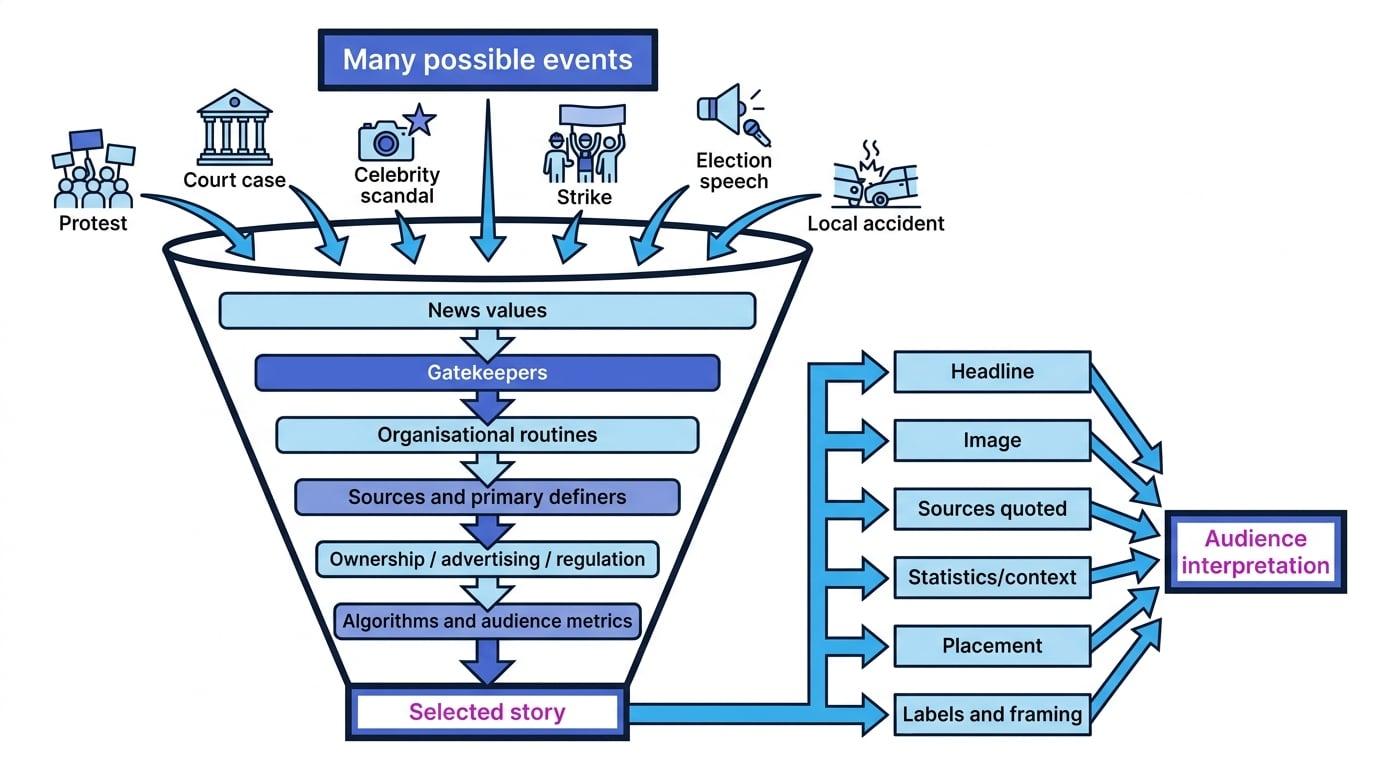
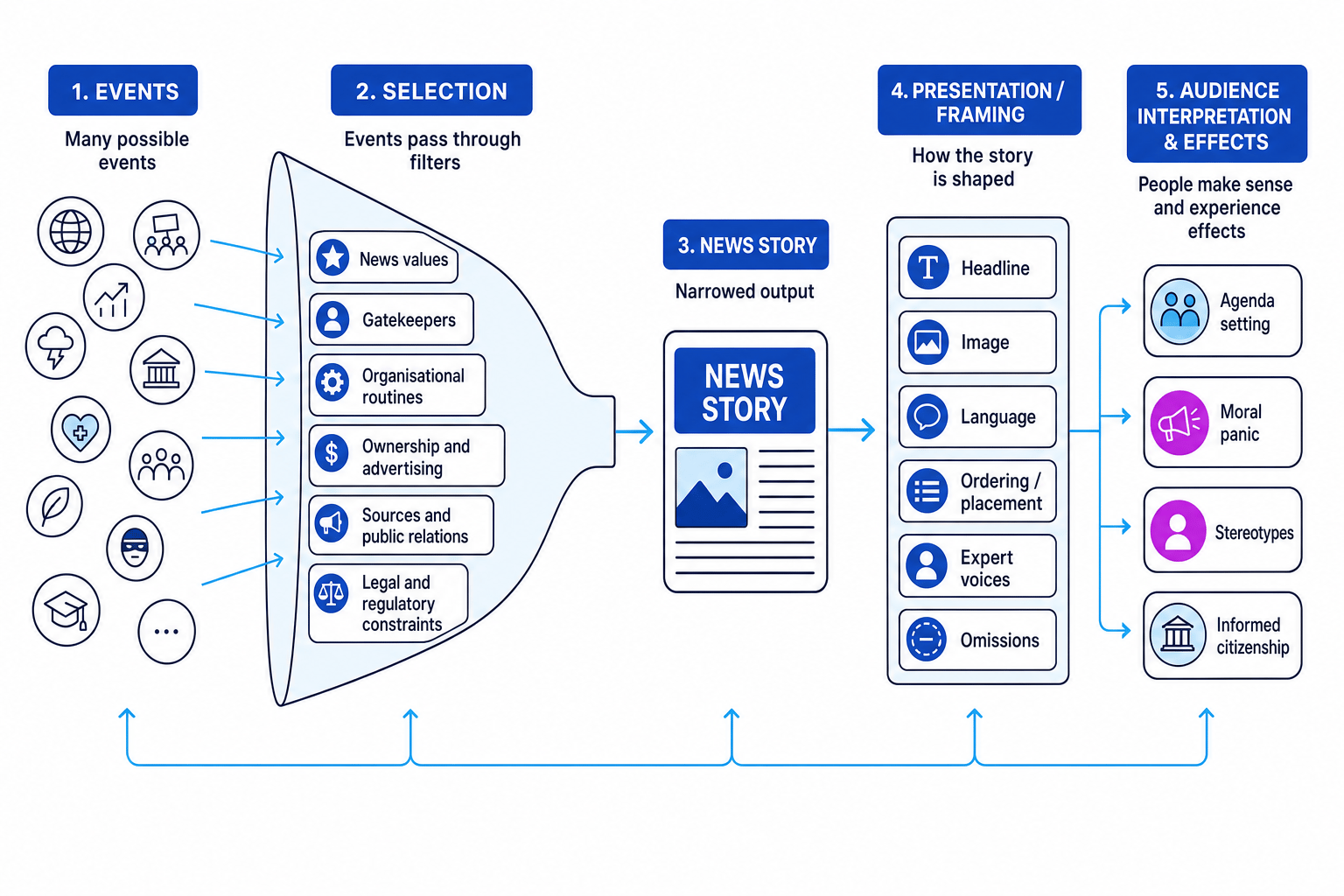
Selection means the process by which some events, people and issues are chosen as newsworthy while others are ignored. Presentation means the way selected stories are shaped through language, images, sources, ordering, emphasis and omissions.
This matters because news is an agent of socialisation: it teaches audiences what is important, normal, threatening or admirable. It also links to social differentiation, power and stratification, because powerful groups often have more influence over which stories are told and how different social groups are represented.
A useful way to picture the process is as a funnel: many possible events enter, but only some pass through the filters of news production.
News is not neutral raw reality
For essays, avoid writing as if news simply “shows what happened”. News is a social construction: it is produced by organisations, professionals, economic pressures, political contexts and cultural assumptions.
Selection: why some events become news
Gatekeeping
Gatekeeping
Gatekeeping is the process by which editors, journalists, media owners, producers and digital platforms decide what information passes through to audiences.
The term comes from early media sociology, including White’s (1950) study of a newspaper editor nicknamed “Mr Gates”. White found that personal judgement, organisational routines and assumptions about audience interest shaped what was included or rejected.
Today, gatekeeping also includes algorithms on platforms such as TikTok, X, Instagram and Google News. These systems prioritise stories likely to gain engagement, meaning news selection is influenced not only by journalists but also by data, clicks and sharing patterns.
News values
Galtung and Ruge (1965) argued that events are more likely to become news if they fit certain news values.
News values
News values are the criteria used, consciously or unconsciously, to judge whether an event is newsworthy.
Important news values include:
- Negativity — bad news, conflict, death and scandal are more likely to be reported.
- Threshold — the bigger the event, the more likely it is to become news.
- Immediacy — recent events are prioritised.
- Meaningfulness — stories closer to the audience culturally or geographically are more newsworthy.
- Elite people and elite nations — powerful individuals and countries receive more coverage.
- Personalisation — stories focused on individuals are easier to tell than abstract processes.
- Continuity — once a story is already in the news, follow-up stories become more likely.
- Unambiguity — clear, simple narratives are often preferred to complex ones.
Jewkes later applied news values especially to crime reporting, adding ideas such as risk, violence, children, celebrity, spectacle and visual drama.
Applying news values to a climate protest story
-
A protest blocking a major London road has threshold because it disrupts many people and affects a recognisable location.
-
It has negativity because the disruption can be presented as conflict between protesters, police, drivers and the public.
-
It has visual drama because images of arrests, queues of traffic or angry confrontations are easy to use in television and online news.
-
However, the wider issue of climate policy may receive less attention because it is slower, more complex and less personalised than the immediate conflict.
Treating news values as fixed rules
News values are not a checklist that automatically decides every story. They are useful patterns, but selection also depends on ownership, political context, audience, technology, regulation and newsroom culture.
Organisational routines and sources
News organisations work under deadlines. Journalists need quick, reliable-looking information, so they often rely on established sources such as the police, government departments, businesses, charities, think tanks and press offices.
Tuchman (1978) described the “news net”: news organisations place reporters where news is expected to happen, such as Parliament, courts, police briefings and major institutions. This makes official sources more visible and routine.
Primary definers
Primary definers are powerful or official groups whose interpretation of events is treated as authoritative, especially at the start of a news story.
Hall et al. (1978), in Policing the Crisis, argued that the media often used police and political sources as primary definers in reporting “mugging”. They claimed this helped construct a moral panic around young Black men and street crime, linking media representation to race, class and state power.
Nick Davies (2008) used the term churnalism to describe journalism that heavily recycles press releases, agency copy and public relations material rather than carrying out independent investigation. This matters because organisations with strong PR resources can gain more influence over what becomes news.
Presentation: how meaning is shaped
Once a story is selected, it still has to be presented. Presentation affects how audiences interpret the event.
Framing
Framing means selecting certain aspects of reality and making them more noticeable, so that a story suggests particular causes, moral judgements or solutions. Entman (1993) is often linked with this concept.
Presentation includes:
- Headlines — the first wording can define the issue before the article is read.
- Images and video — a photo of a victim, suspect, crowd or damaged property can guide emotional reaction.
- Labels — terms such as “protester”, “activist”, “rioter”, “migrant”, “refugee” or “illegal immigrant” carry different meanings.
- Ordering and placement — front-page stories or lead items seem more important.
- Sources quoted — official voices may be treated as more credible than ordinary citizens.
- Statistics and context — numbers can clarify, exaggerate or mislead depending on what is included.
- Omissions — what is left out can be as important as what is included.
Framing an immigration story
-
If a story uses the phrase “small boats crisis”, the issue is framed mainly as disorder, threat and border control.
-
If the same story focuses on “asylum delays and dangerous crossings”, the frame shifts towards state capacity, human rights and policy failure.
-
If the sources are mainly ministers and police, the story may privilege official definitions; if it includes asylum seekers, lawyers and charities, it offers a wider range of interpretations.
-
An evaluative answer should note that neither frame is automatically “the truth”: sociologists ask how each frame selects evidence, constructs identity and distributes sympathy or blame.
Agenda-setting and moral panics
McCombs and Shaw (1972) developed the idea of agenda-setting. The media may not directly tell people what to think, but it can strongly influence what people think about by giving some issues repeated attention.
Moral panic
A moral panic is an exaggerated social reaction to a group or behaviour seen as a threat to society’s values. Cohen (1972) used this concept in his study of Mods and Rockers.
Moral panics involve folk devils, meaning groups portrayed as dangerous outsiders. Presentation techniques include exaggeration, dramatic headlines, symbolic images and predictions of further decline.
UK examples you might apply carefully include media coverage of youth crime, knife crime, football hooliganism, “benefit scroungers”, asylum seekers or certain music subcultures. The key is not to say the issue is imaginary, but to ask whether the media response is disproportionate and whether it reinforces stereotypes.
A strong AO3 move
When evaluating moral panic, write: “The issue may be real, but the sociological question is whether media selection and presentation distort its scale, causes or typical participants.”
Theoretical perspectives
Pluralist view
Pluralists argue that news content reflects audience choice in a competitive media market. Newspapers, broadcasters and online outlets must attract audiences, so they select stories people want to read, watch or share.
From this view, diversity of media outlets means audiences can compare perspectives. In the UK, regulation by Ofcom, BBC impartiality rules and IPSO for much of the press can also be used as evidence that news is not simply controlled by one ruling group.
However, pluralism can underestimate inequalities in ownership, advertising power and access to professional journalism. It may also overstate audience freedom if algorithms repeatedly show users similar content.
Marxist and neo-Marxist view
Marxists focus on power and ideology. Traditional Marxists argue that owners and advertisers influence news by shaping the limits of acceptable debate. Herman and Chomsky’s propaganda model suggests news is filtered through ownership, advertising, sourcing, “flak” or criticism, and dominant ideologies.
Neo-Marxists, influenced by Gramsci’s idea of hegemony, are more subtle. They argue that journalists may see themselves as independent, but news routines still often reproduce dominant assumptions. Hall et al.’s work on primary definers fits here: official voices help shape the “common sense” interpretation of events.
This view is strong for analysing class power, racism, policing, strikes and welfare coverage. However, it can be criticised for underplaying investigative journalism, public service broadcasting and examples where media organisations challenge governments or corporations.
Feminist view
Feminists examine how news selection and presentation reproduce patriarchy. Tuchman (1978) used the phrase symbolic annihilation to describe the underrepresentation, trivialisation or stereotyping of women in media.
News may focus more on male politicians, male experts and male sports, while presenting women through appearance, family roles or victimhood. Intersectional feminists add that women’s experiences differ by class, ethnicity, religion, sexuality, age and disability.
There has been change: social media and campaigns such as #MeToo have challenged older patterns of silence and under-reporting. But feminist sociologists would point out that online abuse, victim-blaming and unequal expert representation still shape news culture.
Postmodernist view
Postmodernists argue that in a digital media environment, the boundary between news, entertainment, advertising and opinion is increasingly blurred. Baudrillard’s idea of hyperreality suggests audiences may experience media images and simulations as more powerful than direct reality.
This fits 24-hour news, viral clips, memes, deepfakes and personalised feeds. However, a weakness is that postmodernism can understate continuing structural power: ownership, state regulation, platform algorithms and inequality still shape which voices are amplified.
Comparing pluralist and Marxist explanations of a front page
-
A pluralist explanation would ask how the front page attracts its target audience: the story may be selected because readers find crime, scandal or conflict interesting.
-
A Marxist explanation would ask whose interests the story serves: for example, whether it distracts from inequality, supports law-and-order politics, or presents business and state voices as neutral.
-
A balanced evaluation would compare evidence: audience demand matters, but demand is shaped within a media system where ownership, advertising, official sources and newsroom routines are unequally distributed.
Studying selection and presentation sociologically
Sociologists use several methods to study news.
Content analysis counts patterns in media content, such as how often different groups appear, which sources are quoted, or how many headlines use negative language. It can be reliable and useful for large samples, but it may miss deeper meanings.
Discourse analysis studies how language constructs reality. It is useful for exploring framing, ideology and identity, but it can be less reliable because interpretation may vary between researchers.
Semiotic analysis studies signs and symbols, especially images. For example, it might examine how camera angles, clothing, police imagery or national flags shape meaning.
Newsroom ethnography involves observing journalists and editors at work. This can reveal real gatekeeping processes, but access is difficult and there may be ethical issues around confidentiality.
Confusing media content with media effects
Showing that news presents a group negatively does not automatically prove audiences believe it. To study effects, sociologists need audience research, such as interviews, surveys, experiments or focus groups.
Bringing AO1, AO2 and AO3 together
For this topic, strong answers usually combine:
- AO1 — concepts such as gatekeeping, news values, framing, agenda-setting, primary definers and moral panic.
- AO2 — application to real news examples, such as crime, immigration, climate protest, elections, industrial action, welfare, gender violence or public health.
- AO3 — evaluation through perspectives, evidence, methodological critique and awareness of change in digital media.
In the exam
-
Start each paragraph with a clear concept, such as news values, gatekeeping, framing or primary definers.
-
Apply it to a concrete example: name the type of story, the outlet if useful, and the likely effect of the selection or presentation.
-
Evaluate by comparing perspectives: pluralists stress audience choice, while Marxists, feminists and neo-Marxists stress unequal power and representation.
Check yourself
- What is the difference between selection and presentation of news?
- How could the same event be framed in two different ways?
- Why might official sources have more influence over news than ordinary citizens?