Welcome to one of the most dynamic and heavily examined topics in your A-Level Sociology Media unit. In this section, we look beyond the screen to understand how the media constructs our reality.
Media representations are not neutral windows on the world; they are active selections that shape how we perceive ourselves and others. This topic connects directly to core sociological themes of power, stratification, and identity.
What you'll learn
- How different social groups (gender, class, age, ethnicity, sexuality, and disability) are depicted in contemporary media.
- The key theoretical debates (Marxist, Feminist, Pluralist, and Postmodernist) that explain these representations.
- How traditional stereotypes are being challenged, negotiated, or reinforced in a digital and globalised world.
Core Concepts of Representation
Before examining specific social groups, we must establish our analytical tools. Media texts do not simply mirror reality. Instead, they produce representations, which are constructed versions of people, groups, and events.
Media Representation
A media representation is the process by which media texts construct and present images of people, events, places, or ideas to an audience. These constructions are heavily influenced by the values, ideologies, and interests of media owners and producers.
When analyzing representations, sociologists look for patterns of bias. A key concept here is symbolic annihilation, a term coined by Gerbner and Gross (1976) and later applied by feminists like Tuchman (1978).
Symbolic Annihilation
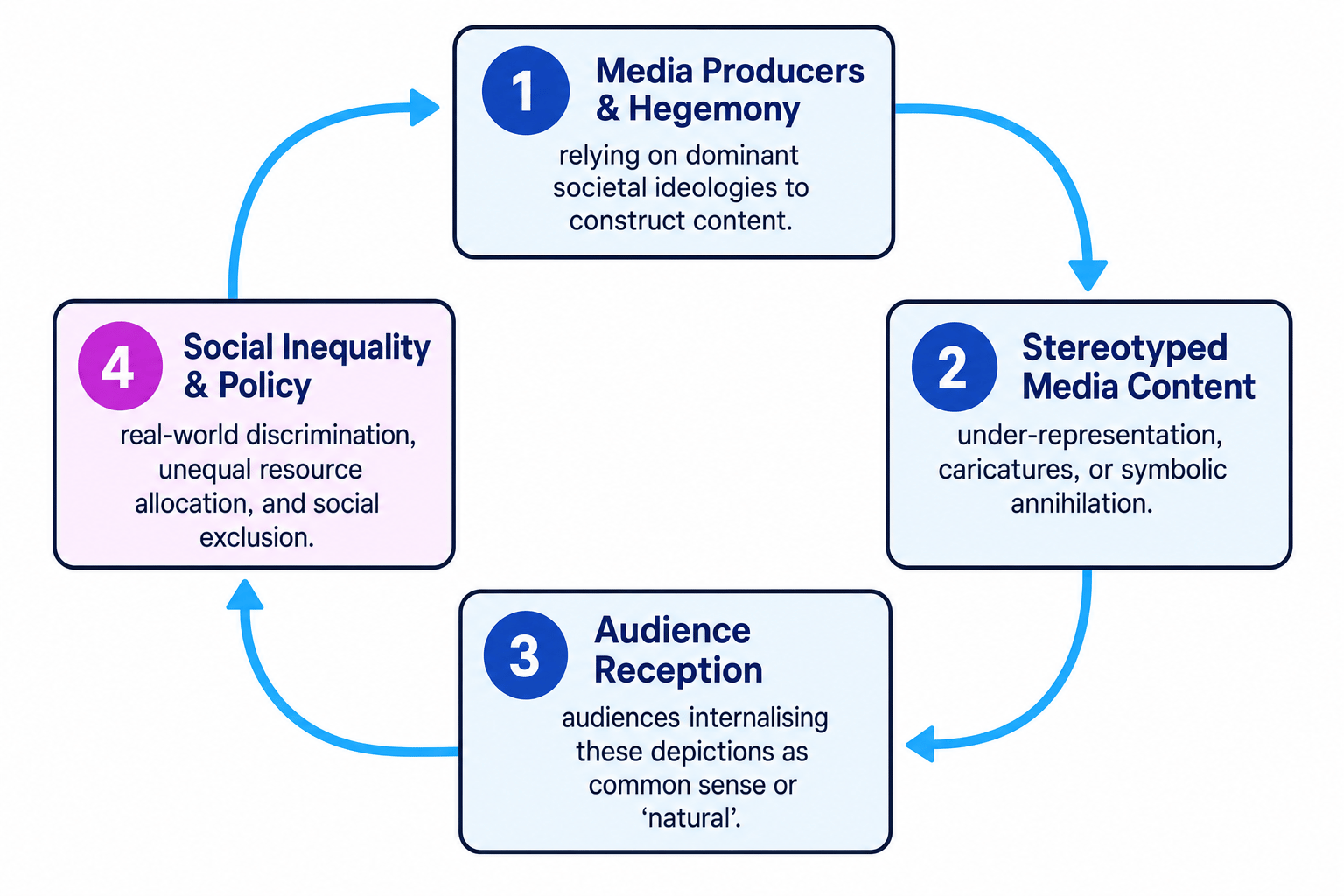
Symbolic annihilation refers to the way in which certain social groups are systematically ignored, excluded, trivialised, or condemned by the media, effectively rendering them invisible or socially insignificant.
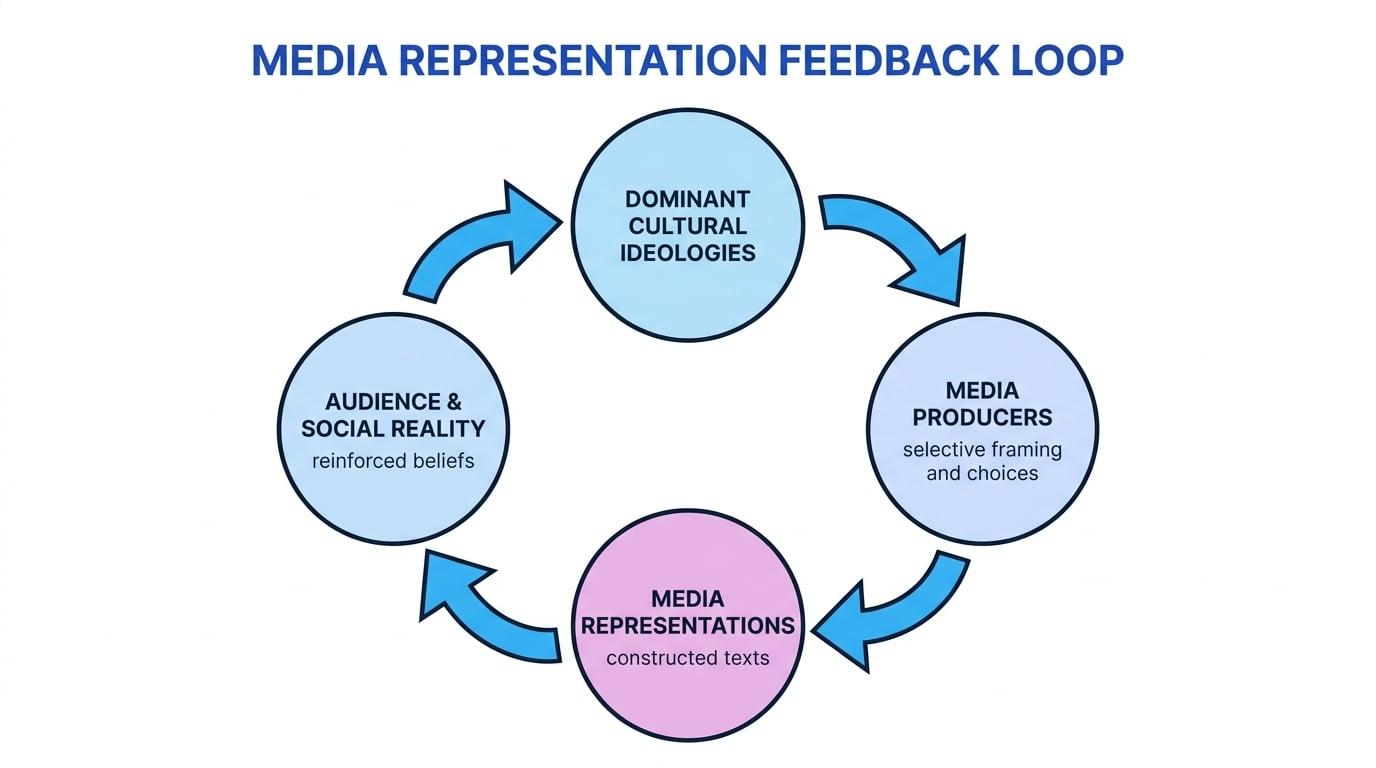
To understand how representations operate as a cycle of power, we can map this out as a continuous loop. Media producers do not operate in a vacuum; they draw on dominant cultural ideologies, which are then reinforced back into social reality.
1. Gender Representations
Media representations of gender have historically been highly polarised, reinforcing traditional, patriarchal ideas about masculinity and femininity.
Femininity: From Domesticity to the Male Gaze
Historically, women were subjected to symbolic annihilation (Tuchman, 1978), presented almost exclusively in domestic settings as wives, mothers, or passive consumers.
- The Male Gaze: Radical feminist film theorist Laura Mulvey (1975) argued that media texts are constructed from the perspective of a heterosexual man. Women are presented as sexual objects to be looked at, rather than active agents with their own narratives.
- The Beauty Myth: Naomi Wolf (1990) highlighted how the media promotes an unrealistic, idealized body image for women. This "beauty myth" acts as a form of social control, keeping women preoccupied with physical perfection and consuming beauty products.
Changing Femininity: Active Consumers and Empowerment
In contemporary media, representations have evolved. We see more diverse roles, such as independent career women and powerful female protagonists (e.g., in action or sci-fi genres).
However, feminists remain critical:
- Angela McRobbie (2009) argues that we are seeing a "post-feminist" retreat. While female empowerment is celebrated, it is often tied to consumerism and sexual assertiveness, which still serves patriarchal interests.
- Gill (2007) describes a shift from passive sexual objectification to active sexual subjectification, where women are presented as willingly choosing to present themselves as sexual objects, under the illusion of personal empowerment.
Masculinity: The "New Man" vs. "Retributive Man"
Traditional representations of men focused on the hegemonic masculine ideal: strong, unemotional, dominant, and breadwinning.
- The "New Man": Emerging in the 1980s and 1990s, this representation depicts men who are emotionally sensitive, comfortable with vulnerability, and actively involved in domestic life and childcare.
- The "Retributive Man": In response to shifting gender roles, some media has seen a resurgence of aggressive, traditional masculinity. This style reasserts male dominance through violence, physical strength, and misogyny (often seen in action films or lad-culture magazines).
2. Social Class Representations
Social class representations in the UK media tend to defend the interests of the powerful while marginalising or mocking the working class.
The Working Class: Pathologisation and the "Chav" Stereotype
Working-class individuals are rarely depicted as complex or self-determining. Instead, they are often subjected to two main types of representations:
- The Romanticised Working Class: Depicted in soap operas (like EastEnders or Coronation Street) as warm, tight-knit, and community-spirited, yet politically passive and resigned to their low status.
- The Pathologised Working Class: Owen Jones (2011), in his book Chavs: The Demonisation of the Working Class, argues that the media actively vilifies the working class. Shows like Benefits Street or talk shows like Jeremy Kyle represent the working class as lazy, criminal, aggressive, and culturally deficient. This process of chavification serves to justify social inequality by blaming the poor for their own poverty (individualisation of systemic problems).
The Middle and Upper Classes: Normalisation and Aspiration
In contrast, the middle class is presented as the "norm" in UK society.
- The Normalised Middle Class: Middle-class lifestyles, tastes, and values are framed as universal and desirable. Their achievements are portrayed as the result of hard work and individual merit, ignoring structural advantages.
- The Benevolent Upper Class: Nairn (1988) points out that the monarchy and aristocracy are presented in a highly protective, positive light. They are framed as national treasures, symbolizing unity and tradition, which distracts from their immense wealth and power.
3. Ethnicity Representations
Media representations of ethnic minority groups are often deeply tied to historical imperialistic legacies and contemporary political agendas.
Minorities as "Folk Devils" and Threats
Historically, and continuing today, ethnic minorities are disproportionately associated with negative news stories. Akinti (2003) argued that television coverage of Black people focuses overwhelmingly on crime, gang culture, and educational underachievement, ignoring positive contributions.
- The "Threat": British-Asian populations, particularly Muslims, have been subject to intense media moral panics since 2001. They are routinely framed as an internal threat to national security or Western values (a form of "othering" explained by Edward Said's concept of Orientalism).
- Moral Panics: In their classic study Policing the Crisis (1978), Stuart Hall et al. demonstrated how the media created a moral panic around Black "muggers" in the 1970s to divert public attention away from a crisis in capitalism and justify increased policing in inner-city areas.
The Ideological Role of Moral Panics
Media moral panics targeting minority groups are rarely accidental. From a Neo-Marxist perspective, they serve as ideological smoke screens (scapegoats) that split the working class and protect the ruling elite during economic or political crises.
4. Age, Sexuality, and Disability
To secure top marks, you must also be ready to discuss representations of age, sexuality, and disability, as these are frequently paired in exam questions.
Age: Troublemakers and Burdens
- Youth: Young people are frequently constructed as "folk devils" (Cohen). Media moral panics often target youth subcultures, framing them as anti-social, drug-addled, or violent.
- The Elderly: Older people are often represented as a physical and economic burden on society (the "demographic time bomb"). Alternatively, they are stereotyped as physically frail, forgetful, or cognitively declining. However, with the rise of the "grey pound" (the disposable income of retirees), we are seeing more active, affluent representations of the elderly.
Sexuality: Heteronormativity and the "Pink Pound"
Historically, LGBTQ+ individuals were subjected to symbolic annihilation or presented as predatory, tragic, or purely comedic caricatures (e.g., the camp best friend).
While visibility has increased significantly, sociologists like Gill (2007) note that contemporary media representation of homosexuality is often sanitized and commodified. It is designed to appeal to a wealthy, consumption-oriented demographic (the "pink pound") while avoiding radical political critiques of heteronormative society.
Disability: The Medical Model and Stereotypes
Colin Barnes (1992) identified several recurring media stereotypes of disabled people:
- The Pitiable/Charity Case: Passive victims who rely on non-disabled people for salvation (often seen in charity telethons).
- The Sinister or Evil: Characters whose physical disfigurements or disabilities are used to signify moral corruption or villainy (e.g., classic Bond villains).
- The "Super-Cripple": Individuals who are celebrated solely because they have achieved ordinary tasks despite their disability, framing disability as an individual hurdle to overcome rather than a structural issue.
Theoretical Perspectives on Media Representations
To evaluate these representations effectively (AO3), you must contrast the major sociological theories.
| Perspective | View on Representations | Key Mechanisms | Evaluation |
|---|---|---|---|
| Marxist / Neo-Marxist | Representations protect ruling-class interests and maintain hegemony. | Scapegoating, pathologising the working class, promoting consumerism. | Underestimates the ability of active audiences to reject dominant messages. |
| Feminist | Representations reinforce patriarchy and reduce women to subordinate roles. | Male gaze, beauty myth, symbolic annihilation. | Overlooks the rise of powerful, diverse female roles in modern media. |
| Pluralist | Representations reflect what the audience wants to see; the market is democratic. | Consumer demand, media diversity, active market competition. | Ignores the concentrated ownership of media, which limits whose voices get heard. |
| Postmodernist | Representations are fluid, playful, and no longer reflect a single "reality." | Hyperreality (Baudrillard), pick-and-mix identities (Gauntlett). | Glosses over the persistent, structured inequalities (class, race, gender) that still shape media access. |
Applying Your Knowledge
When writing A-Level essays, you will need to demonstrate your application skills (AO2) by taking a specific media text or trend and dissecting it using sociological concepts.
Sociologically analyzing representations of social class in reality television
Suppose you are asked to analyze how contemporary British reality television represents the working class. Here is how you should structure your sociological analysis step-by-step:
- Identify the explicit representation: Select a concrete UK media example, such as the reality series Benefits Street or Gogglebox. Observe that Benefits Street selectively films chaotic households, fly-tipping, and welfare dependency.
- Apply a sociological concept: Use Owen Jones's concept of "chavification" and the individualisation of poverty. Explain that by focusing on individual behaviour rather than structural unemployment or industrial decline, the show frames poverty as a moral failure of the working class.
- Analyze the ideological function (AO3): Apply a Neo-Marxist framework. Argue that this representation serves a dominant-class hegemony by dividing the working class. It encourages middle-class and working-class viewers to direct their anger downward at the "undeserving poor" rather than upward at corporate tax evasion or government austerity.
- Evaluate with an alternative perspective (AO3): Counter this with a Pluralist perspective. Pluralists would argue that such shows simply reflect public interest and document real aspects of British life. They might argue that the success of working-class characters on shows like Gogglebox shows that audiences feel a warm, democratic affinity with authentic working-class voices.
Slipping into 'Media Studies' mode
In this topic, it is very easy to write an essay that reads like a Media Studies or English Literature analysis of a movie or TV show. Remember, you are a sociologist. Every media example you bring up must be linked directly to social structures, power dynamics, inequalities, and named sociological theorists. Do not spend a whole paragraph describing a plot; use the plot briefly to illustrate a sociological concept like hegemony, symbolic annihilation, or orientalism.
The 'Golden Thread' of Identity and Inequality
Always tie media representations back to identity. For example, explain how media stereotypes of ethnic minorities or gender affect the self-concept of young people, potentially leading to a self-fulfilling prophecy or systemic barriers in the workplace.
In the exam
- Unpack the question carefully: If the question asks about "social groups," ensure you do not just write about gender. Cover at least two or three different groups (e.g., gender, class, and ethnicity) to show breadth, and link them together where possible (intersectionality).
- Use contemporary examples: While classic studies (like Tuchman or Mulvey) are vital for AO1, you must bring in modern examples (social media influencers, modern streaming shows, drill music moral panics) to gain high AO2 marks.
- Structure around theoretical debates: Frame your essay as a debate. For instance, structure your paragraphs around the clash between Pluralists (who believe media reflects reality and audience choices) and Marxists/Feminists (who see media as an ideological tool of control).
Check yourself
- What did Gerbner mean by the term "symbolic annihilation," and how does it apply to representations of disabled people in the media?
- Contrast how a Neo-Marxist and a Pluralist would explain the media's focus on "chav" stereotypes in reality television.
- Explain Laura Mulvey's concept of the "male gaze" and identify one way it is being challenged by contemporary media representations. </selfreview