What you'll learn
- How globalisation changes the production, distribution and consumption of media.
- The difference between popular culture, mass culture, high culture and folk culture.
- Key sociological debates: cultural imperialism, global village, hybridisation and glocalisation.
- How to evaluate media globalisation using examples from contemporary UK society.
Starting point: culture, media and identity
Before you can analyse global media, you need three building blocks: culture, media and identity.
Culture, media and identity
- Culture means the shared norms, values, beliefs, symbols, language and practices of a social group.
- Media are the channels through which messages, images and information are communicated, such as television, newspapers, film, radio, streaming platforms and social media.
- Identity means how people understand and present who they are, including class, gender, ethnicity, age, nationality, sexuality, religion and lifestyle.
The media are a major agency of secondary socialisation: they help teach people ideas about beauty, success, gender roles, national identity, consumerism and “normal” lifestyles. In a globalised society, those messages do not only come from your local community or nation-state — they may come from Hollywood, TikTok, Korean pop music, global football, Netflix dramas, YouTube influencers or international news feeds.
Media as cultural socialisation
The media do not just reflect culture; they help produce it by circulating images, stories and identities that people may copy, resist, remix or challenge.
What is popular culture?
Popular culture refers to cultural products and activities enjoyed by large numbers of people, especially those associated with everyday life rather than elite institutions. Examples include pop music, reality television, football, gaming, fashion, memes, celebrity culture, streaming dramas and social media trends.
It helps to compare it with other forms of culture.
| Type of culture | Meaning | Example |
|---|---|---|
| High culture | Culture often associated with elites, education and “refined” taste | Opera, classical music, fine art galleries |
| Folk culture | Traditional culture rooted in local communities | Morris dancing, local festivals, oral storytelling |
| Mass culture | Standardised culture produced for mass consumption by media industries | Blockbuster films, chart music, global advertising |
| Popular culture | Culture widely enjoyed by ordinary people; may be commercial, participatory or resistant | TikTok trends, grime, football fandom, Love Island |
Sociologists disagree over how to interpret popular culture. Some see it as shallow and manipulated by capitalist media industries. Others see it as creative, active and meaningful for audiences.
Popular does not mean unimportant
Do not write as if popular culture is automatically “low quality”. In sociology, the key question is not whether you personally like it, but how it shapes identity, power and social relationships.
What is globalisation?
Globalisation
Globalisation is the increasing interconnectedness of societies across national borders through economic, political, cultural and technological flows.
Media globalisation means that images, news, music, films, memes and lifestyles travel rapidly across the world. A teenager in Manchester might watch a Korean drama, use an American-owned platform, follow a Nigerian musician, discuss a footballer from Argentina and buy clothes influenced by Japanese street fashion.
This is linked to what Giddens calls time-space distanciation: social relationships are stretched across distance, so events far away can shape everyday life locally. Harvey similarly describes time-space compression, where technology makes the world feel smaller and faster.
How media drive global popular culture
The media globalise popular culture in several ways.
Transnational media corporations
A transnational corporation is a company that operates across national borders. In media, examples include Disney, Netflix, Amazon, Meta, Alphabet/Google and Warner Bros. Discovery. These organisations have huge power to produce, distribute and promote cultural content globally.
This matters for social differentiation and power because not all groups have equal ability to shape global culture. Wealthy corporations and powerful countries can make their culture more visible than poorer communities.
Digital platforms
Platforms such as TikTok, YouTube, Instagram, X and Spotify allow cultural trends to spread quickly. They also encourage user-generated content, meaning content made by ordinary users rather than professional media producers.
However, platforms are not neutral. Algorithms decide what becomes visible, profitable or viral. This means popular culture is shaped by hidden systems of ranking and recommendation.
Audience participation
Audiences are not simply passive. They share, remix, parody, subtitle, review and reinterpret media. Jenkins describes this as participatory culture, where fans help circulate and transform media content.
Applying globalisation concepts to Netflix in the UK
- Identify the global media process: Netflix distributes content across many countries through one digital platform, so British audiences can access American, Korean, Spanish, Indian and British productions in the same media space.
- Apply cultural imperialism: Netflix is a powerful US-based corporation, so it may spread American business models, English-language dominance and consumerist values into other societies.
- Apply hybridisation: the same platform also promotes non-American texts such as Squid Game, Lupin and British-made dramas, which British audiences interpret through their own local tastes and identities.
- Evaluate the balance: a strong answer says both processes can happen together — global media power is unequal, but audiences and producers are not completely passive.
Debate one: the global village
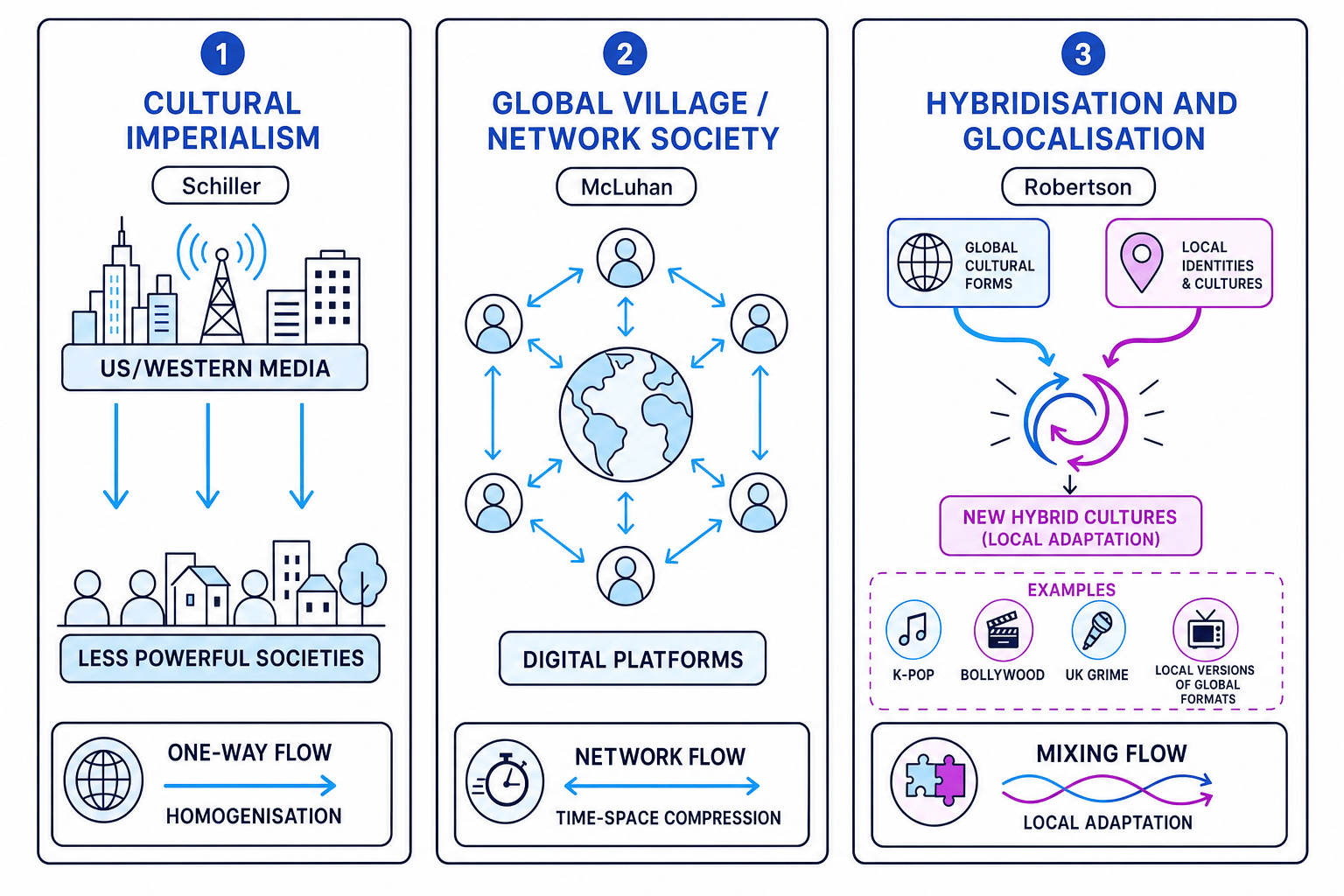
McLuhan argued that electronic media create a global village: people across the world become connected through shared communication and shared events. Today, this seems relevant to live-streamed news, global sporting events, viral campaigns and social media activism.
For example, movements such as #MeToo and Black Lives Matter spread through global media networks. UK audiences did not only consume American news; they applied those debates to British institutions, policing, workplaces and education.
AO3 evaluation: the global village idea can be too optimistic. Not everyone has equal access to digital media, and connection does not always create understanding. Online spaces can produce misinformation, polarisation, racism, misogyny and national conflict as well as solidarity.
Debate two: cultural imperialism
Neo-Marxist sociologists argue that global media can create cultural imperialism.
Cultural imperialism
Cultural imperialism is the process by which powerful countries or corporations spread their culture, values and worldview to less powerful societies, often weakening local cultures.
Schiller argued that US media exports spread capitalist values such as consumerism, individualism and competition. Tunstall famously claimed that “the media are American”, referring to the dominance of US film, television and advertising in the global media market.
From this perspective, popular culture is not just entertainment. It is ideological: it helps normalise capitalism and Western lifestyles. Global advertising encourages people to desire the same brands, bodies, homes, celebrities and consumer goods.
AO2 examples include Hollywood franchises, Disney, global fast-food advertising, English-language pop music and influencer culture promoting luxury consumption. These can shape aspirations among UK audiences, especially young people.
AO3 evaluation: cultural imperialism can overstate one-way Western domination. Global media flows are now more complex. Bollywood, Nollywood, K-pop, anime, Turkish dramas, Al Jazeera and TikTok challenge the idea that culture only travels from the USA to the rest of the world.
Debate three: hybridisation and glocalisation
Hybridisation means the mixing of cultural elements from different societies to create new cultural forms. Glocalisation, associated with Robertson, means global products are adapted to fit local cultures.
For example, UK grime developed from influences including hip-hop, dancehall, garage and local London youth culture. K-pop blends Korean language, American R&B and hip-hop, Japanese idol culture, global fashion and digital fandom. Reality TV formats such as Got Talent are adapted for national audiences.
Global culture is not always the same culture
Globalisation can produce sameness, but it can also produce mixing, adaptation and new identities.
Analysing K-pop as global popular culture
- Start with the global element: K-pop is distributed through YouTube, Spotify, TikTok and global fan networks, so it depends on global digital media.
- Identify the hybrid element: it combines Korean language and performance styles with influences from US pop, hip-hop, fashion and global dance culture.
- Analyse power: its success challenges the claim that Western media always dominate, but it is still part of a highly commercial global entertainment industry.
- Link to identity: UK fans may use K-pop fandom to form online communities, learn language, express style and build identities beyond national boundaries.
Postmodern views: choice, signs and hyperreality
Postmodernists argue that media-saturated societies blur the boundary between reality and representation. Baudrillard uses the term hyperreality to describe situations where media images feel more real or important than the reality they supposedly represent.
Celebrity culture is a useful example. Audiences may feel they “know” influencers they have never met. A person’s online image can become more socially powerful than their offline life. Popular culture becomes a world of signs, brands and performances.
This links strongly to identity. In global media culture, people can construct identities through fashion, music taste, fandoms, filters, usernames and online communities. Identity becomes more fluid and chosen.
AO3 evaluation: postmodernism captures the speed and complexity of digital culture, but it can underplay material inequalities. Class, gender, ethnicity, disability and global wealth still shape who gets represented, who gets abused online and who profits from media attention.
Popular culture, power and inequality
Global popular culture can be empowering, but it is also stratified.
Class
Middle-class audiences may have more access to paid subscriptions, devices, private space, fast broadband and cultural capital. Bourdieu’s concept of cultural capital is useful here: some tastes are treated as more legitimate than others. For example, opera may be seen as “cultured”, while reality TV may be dismissed as “trash”, even though both are socially meaningful.
Gender
Global media can spread feminist campaigns and challenge sexism, but it can also circulate narrow beauty standards, sexualised images and misogynistic influencer content. Young women may experience both empowerment and surveillance through platforms such as Instagram and TikTok.
Ethnicity and nationality
Diasporic audiences can use global media to maintain connections with heritage cultures, such as British Asian audiences engaging with Bollywood, Punjabi music or BBC Asian Network. At the same time, minority cultures may be stereotyped, commodified or appropriated by dominant groups.
Age
Young people are often early adopters of global digital culture, but they are also exposed to online harms, commercial targeting and pressure to perform identity publicly. Older people may be excluded by digital skills gaps or platform design.
Link every essay to the two core themes
For this topic, keep asking: How does global media shape culture and identity? Then ask: Who has the power to produce, control, profit from or resist that culture?
Researching global media and popular culture
Sociologists study this topic using several methods.
Content analysis can measure patterns in media texts, such as how often certain ethnic groups appear in global advertising or how women are represented in music videos. It can be reliable because categories can be repeated, but it may miss how audiences interpret meanings.
Interviews and ethnography can explore how fans actually use media in everyday life. This may produce valid, detailed data about identity and belonging, but samples are often small and less representative.
Platform data can show large-scale trends, such as views, shares and hashtags. However, access is often controlled by corporations, and there are ethical issues around consent, privacy and surveillance.
Overall evaluation: domination or diversity?
A strong A-Level answer avoids a one-sided conclusion.
Cultural imperialism is useful because global media power is unequal. US and Western corporations still dominate many markets, and global capitalism shapes what is produced and promoted.
However, hybridisation and active audience approaches show that people reinterpret media. Global popular culture is not simply imposed from above. Audiences create memes, fandoms, subcultures and political movements.
The best judgement is usually that global media create both homogenisation and diversity. They spread similar brands, formats and lifestyles, but they also enable new mixtures, identities and forms of resistance.
In the exam
- Define the key concept early: for example, globalisation, popular culture, cultural imperialism or glocalisation.
- Use named sociologists accurately: McLuhan for the global village, Schiller for cultural imperialism, Robertson for glocalisation, Baudrillard for hyperreality.
- Apply every point to a concrete example, such as Netflix, TikTok, K-pop, Disney, Black Lives Matter, grime, global football or influencer culture.
- Evaluate by comparing perspectives: ask whether the example shows domination, audience activity, hybridisation or inequality.
- Link back to the core themes of culture and identity, plus power and stratification.
Check yourself
- How is popular culture different from high culture, folk culture and mass culture?
- Why might Schiller see global media as a form of cultural imperialism?
- How does glocalisation challenge the idea that globalisation simply makes all cultures the same?
