When we look at the modern world, development is no longer just a project managed by individual governments. Instead, a complex web of global actors shapes the economic, social, and cultural landscapes of developing countries.
These actors can drive industrial growth, deliver life-saving aid, or, conversely, entrench global inequality and poverty. To master this topic for your A-Level exam, you must understand who these actors are, how they operate, and how different sociological theories evaluate their impact.
What you'll learn
- The definitions and roles of Transnational Corporations (TNCs), Non-Governmental Organisations (NGOs), and Intergovernmental Organisations (IGOs).
- The contrasting theoretical perspectives (primarily Modernisation/Neo-liberalism vs. Dependency/Neo-Marxist theories) on their contributions to global development.
- The differences between top-down and bottom-up strategies for development.
Defining the Global Actors
Before evaluating their success, we must first define the three core actors.
Transnational Corporation (TNC)
A Transnational Corporation (TNC) is a commercial business that owns or controls economic production and operations in more than one country. Typically, their headquarters are in high-income countries (the Global North), while their manufacturing or extraction sites are located in low-income countries (the Global South).
Non-Governmental Organisation (NGO)
A Non-Governmental Organisation (NGO) is a non-profit, voluntary citizens' group organized on a local, national, or international level. They are independent of governments and are usually driven by humanitarian, environmental, or social-justice goals (e.g., Oxfam, WaterAid, Red Cross).
Intergovernmental Organisation (IGO)
An Intergovernmental Organisation (IGO), often referred to in the spec as an international agency, is an entity created by treaty, involving two or more nations, to work on issues of common interest. Key examples include the International Monetary Fund (IMF), the World Bank, and the United Nations (UN).
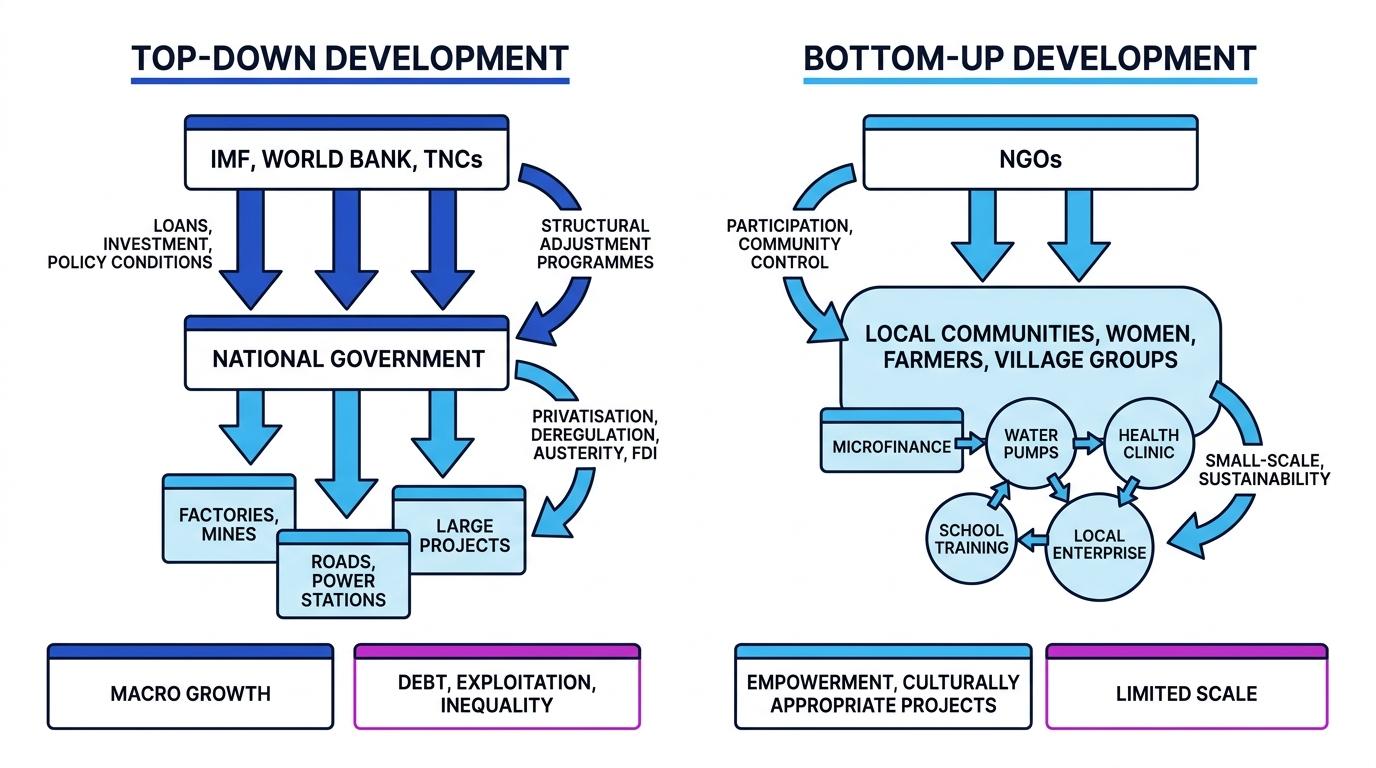
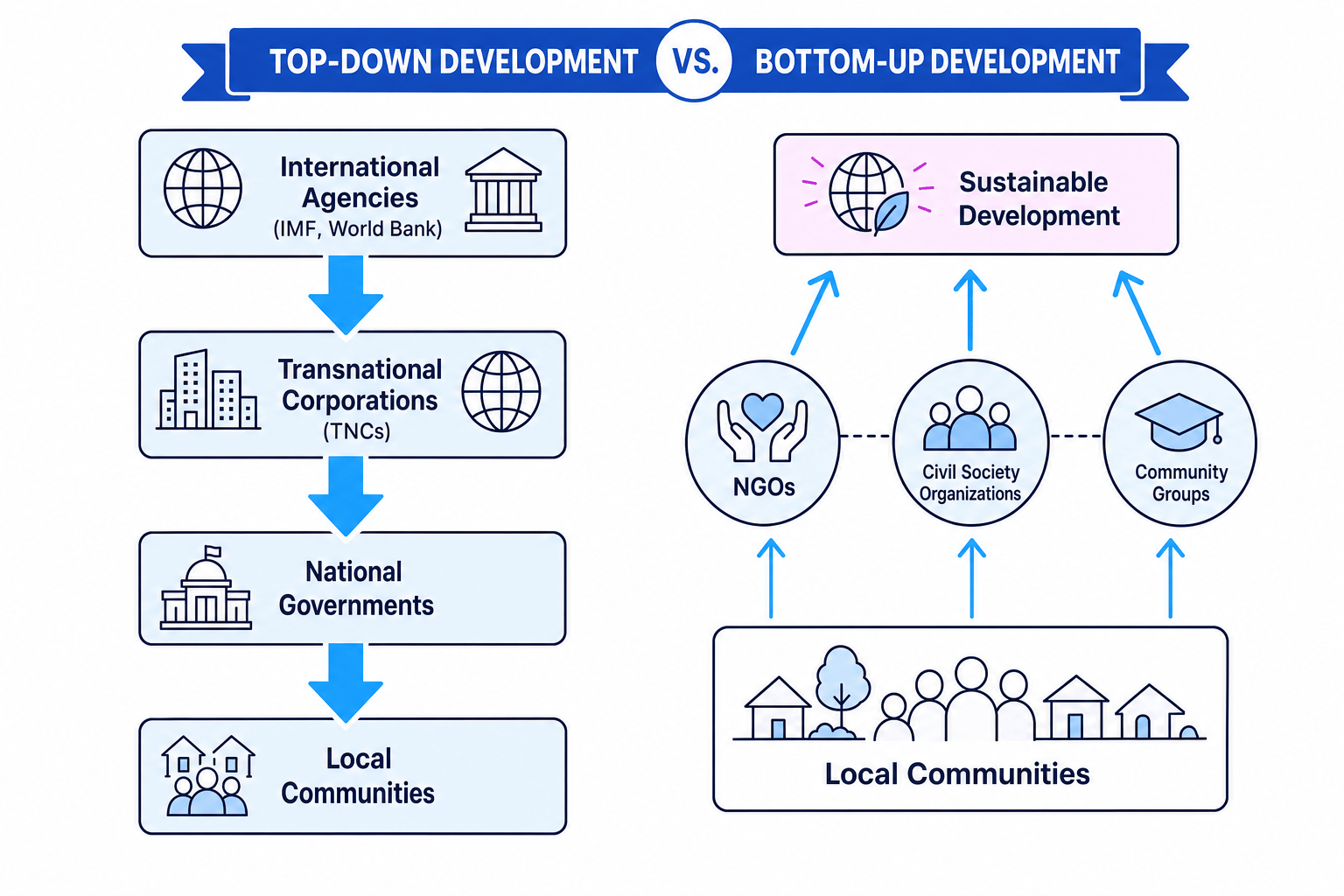
These actors generally divide into two major strategic pathways: top-down (macro-level, capital-intensive strategies driven by TNCs and IGOs) and bottom-up (micro-level, participatory strategies driven by NGOs and local communities).
1. Transnational Corporations (TNCs)
TNCs are the primary engines of economic globalisation. Sociologists are deeply divided on whether their global spread represents a force for development or a new form of exploitation.
The Modernisation and Neo-liberal Perspective: Engines of Growth
Modernisation theorists (like Rostow) and neo-liberals argue that TNCs are essential for moving countries through the stages of economic growth. They argue that TNCs foster development in several ways:
- Foreign Direct Investment (FDI): TNCs inject vital capital into developing economies, building factories, roads, and telecommunications networks.
- Employment and Skills: They provide formal employment, offering wages that are often higher than local agricultural rates. Workers gain valuable technical and managerial skills.
- The "Multiplier Effect": TNC presence stimulates local supply chains, boosting local businesses and generating tax revenue for host governments to spend on education and healthcare.
- Technology Transfer: TNCs introduce modern technology, machinery, and working practices to developing nations, modernising their domestic industries.
The Dependency and Neo-Marxist Perspective: Neo-Colonial Exploitation
Dependency theorists (like Frank and Wallerstein) argue that TNCs do not develop poorer nations; rather, they exploit them to enrich the core (the Global North). They highlight several critical issues:
- The "Race to the Bottom": TNCs exploit their immense power by forcing developing countries to compete for investment by lowering environmental protections, working standards, and corporate tax rates.
- Profit Repatriation: Rather than reinvesting profits back into the host country, TNCs send their wealth back to shareholders in the West.
- Human Rights and Labour Exploitation: Critics like Joel Bakan (The Corporation, 2004) argue that TNCs behave like psychopaths, prioritising profit over human life. This leads to sweatshop labour, child labour, and hazardous working conditions (e.g., the Rana Plaza factory collapse in Bangladesh, 2013).
- Environmental Destruction: TNCs frequently locate highly polluting industries in the Global South where regulations are lax (e.g., Shell's devastating oil spills in the Niger Delta).
The Power Imbalance
TNCs often hold more economic power than the host nations themselves. For instance, the annual revenue of corporations like Apple or Walmart exceeds the entire Gross Domestic Product (GDP) of many small developing nations, allowing these firms to dictate national policies.
2. Intergovernmental Organisations (IGOs)
The most prominent international agencies are the World Bank and the International Monetary Fund (IMF), both founded in 1944.
Neo-liberalism and the Washington Consensus
Since the 1980s, the IMF and World Bank have operated under a neo-liberal framework known as the Washington Consensus. When developing nations faced debt crises, these agencies offered loans on the strict condition that countries implement Structural Adjustment Programmes (SAPs). These programmes required:
- Privatisation: Selling off state-owned industries (water, electricity, railways) to private corporations.
- Deregulation: Removing restrictions on foreign investment and trade.
- Austerity: Slashing government spending on public services like health, welfare, and education.
Critical Evaluation of IGOs
Neo-liberals argue these reforms were necessary medicine to curb corruption, reduce inefficient state bureaucracies, and integrate developing nations into the global free market.
However, critics like Joseph Stiglitz (former Chief Economist of the World Bank) argue that SAPs have been disastrous. By forcing governments to cut healthcare and education spending, SAPs systematically undermined the social foundations of development, plunging millions back into poverty.
Furthermore, Ha-Joon Chang (Kicking Away the Ladder, 2002) argues that rich nations are using IGOs to force free-market policies on poor countries to prevent them from protecting their own infant industries—rules that Western countries themselves never followed when they were developing.
3. Non-Governmental Organisations (NGOs)
As disillusionment with state-led and top-down development grew in the late 20th century, NGOs emerged as a popular alternative.
Bottom-Up Development
NGOs typically focus on bottom-up development, working directly with local communities. Their strategies offer several distinct advantages:
- Targeting the Neediest: Unlike TNCs, which go where profit is highest, NGOs target the poorest, most marginalised groups (e.g., rural women, minority indigenous communities).
- Participatory Approaches: They involve local people in the design and management of projects, ensuring that interventions are culturally appropriate and sustainable (e.g., training locals to maintain water pumps rather than just installing them).
- Cost-Effectiveness: NGOs operate with lower overheads than massive IGOs and utilize local resources and labour, making their projects highly cost-effective.
Critical Evaluation of NGOs
While highly praised, sociologists have identified several limitations of the NGO sector:
- Scale and Fragmentation: NGO projects are often small-scale and localized. They rarely have the capacity to build national infrastructure, like highways or national health systems.
- "NGO-isation" of the State: By stepping in to provide healthcare and education, NGOs can inadvertently relieve pressure on national governments to build functional public services, letting governments off the hook.
- Accountability Issues: NGOs are not democratically elected. They are often accountable to their Western donors and fundraisers rather than the local communities they aim to serve. This can lead to "agenda-setting," where projects are tailored to what looks good in Western advertising campaigns rather than what is actually needed.
Comparing the Approaches
To score highly on AO3 (Evaluation) in your essays, you must be able to directly contrast these actors' methods and outcomes.
Evaluating development initiatives
Compare how a TNC-led industrial project and an NGO-led community project would impact gender equality in a developing rural community.
- Identify the TNC impact on gender dynamics: A TNC sets up a textile manufacturing plant. It employs a high percentage of local women. Neo-liberals would argue this provides financial independence, delays marriage ages, and elevates women's social status.
- Identify the counter-argument (Dependency/Feminist): However, critics would point out that TNCs often exploit gender inequalities. They may hire women because they are paid lower wages than men, work on temporary contracts without maternity rights, and are subject to hazardous, exhausting working conditions. This is a form of "gendered exploitation."
- Identify the NGO impact on gender dynamics: An NGO runs a micro-finance scheme, offering small loans directly to women to start local businesses (e.g., weaving or poultry farming).
- Identify the counter-argument/limitations: While this directly empowers women within their communities and respects local culture, it operates on a very small scale. It does not provide the massive infrastructure or macro-level economic growth that could pull the entire region out of structural poverty.
- Synthesise the evaluation: Conclude that while TNCs offer macro-level wealth creation at the expense of severe inequality and exploitation, NGOs offer high-quality, targeted empowerment but lack the structural capacity to transform national economies.
Use Specific Theorists
In your essays, don't just say "some sociologists say...". Use names! Contrast Rostow's modernisation stages with Frank's dependency theory, and mention Chang or Stiglitz when evaluating the IMF and World Bank. This will instantly elevate your AO1 and AO3 marks.
Confusing IGOs and NGOs
Students often write "NGO" when they actually mean "IGO". Remember:
- IGOs (IMF, World Bank, UN) are run by governments. They have massive, top-down funding and structural power.
- NGOs (Oxfam, WaterAid) are non-governmental charity organisations funded by donations and grants. They work at the grassroots level.
In the exam
When writing an essay on the role of TNCs, NGOs, and international agencies in development, structure your answer using these steps:
- Deconstruct the prompt: Ensure you address all three actors if they are named in the question, or contrast top-down (TNCs/IGOs) vs. bottom-up (NGOs) strategies.
- Contrast theoretical perspectives early: Frame your paragraphs around the clash between Neo-liberal/Modernisation theories (which view these actors as vital modernising forces) and Dependency/Marxist theories (which view them as neo-colonial exploiters).
- Integrate real-world examples: Use specific case studies (e.g., the impact of SAPs in Sub-Saharan Africa, Shell in Nigeria, or microfinance schemes in Bangladesh) to provide the AO2 application marks that examiners look for.
- Evaluate systematically: Rather than just listing pros and cons, conclude each section by weighing up why these actors succeed or fail. For instance, explain how the lack of democratic accountability limits both TNCs and NGOs, albeit in very different ways.
Check yourself
- What is the difference between a top-down and a bottom-up development strategy?
- Why do Dependency theorists argue that TNCs engage in a "race to the bottom"?
- How did Structural Adjustment Programmes (SAPs) implemented by the IMF affect public services in developing nations?