Welcome to your study notes for Section 4.2.6.2 of the AQA A-Level Sociology specification. This topic is part of the Global Development unit. Here, we investigate how the processes of globalisation shape the ways different societies interact with each other. We will unpack whether globalisation brings countries closer together in a shared global village, or whether it deepens the inequalities between the wealthy "Core" and the developing "Periphery".
What you'll learn
- How globalisation affects the economic, political, and cultural relationships between societies.
- The key debates between hyperglobalists, sceptics, and transformationalists regarding national sovereignty.
- Diverse sociological theories (including Modernisation Theory, Dependency Theory, and Postmodernism) that explain global connections.
- How to apply and evaluate these theories in your exam responses.
What is Globalisation?
Before exploring how societies interact, we must establish a clear definition of globalisation. In simple terms, the world has become more interconnected. Actions in one part of the world have rapid, significant consequences for people living thousands of miles away.
Globalisation
Globalisation is the process by which national borders become less significant as social, economic, cultural, and political activities become increasingly interconnected and interdependent on a global scale.
Sociologist David Harvey (1989) describes this as time-space compression. Technological advances in transport and communications have effectively "shrunk" the world, making physical distance less of a barrier to human interaction.
Economic Relationships: The Global Economy
Economic globalisation has transformed how societies produce, trade, and consume goods. At the heart of this transformation is the rise of Transnational Corporations (TNCs)—companies that operate in more than one country (such as Apple, Nike, or Unilever).
The Global Division of Labour
TNCs have created a global division of labour. They often locate their corporate headquarters and research facilities in high-income countries (the Global North) while outsourcing manufacturing and extraction to low-income countries (the Global South), where labour costs are lower and environmental regulations may be weaker.
To understand these economic connections, sociologists look to two main competing perspectives:
1. Modernisation and Neoliberal Perspectives (Optimistic)
Neoliberals argue that global economic integration is beneficial for all societies. By adopting free-market policies, removing trade barriers (tariffs), and welcoming foreign investment from TNCs, developing societies can experience economic growth. This is often described as a "trickle-down" effect, where the wealth generated at the top eventually benefits the wider population.
2. Dependency and World-Systems Perspectives (Pessimistic)
Marxist-influenced theorists, such as Immanuel Wallerstein (1974), reject the optimistic view. Wallerstein's World-Systems Theory argues that globalisation has locked societies into an exploitative structural relationship. He divides the global economy into three regions:
- The Core: Highly developed, industrialised nations (e.g., the UK, USA, Japan) that control global capital and exploit the rest of the world.
- The Periphery: Low-income, resource-rich developing nations (e.g., many Sub-Saharan African countries) that provide cheap raw materials and low-wage labour.
- The Semi-Periphery: Industrialising, middle-income nations (e.g., Brazil, India, China) that exhibit features of both the core and periphery, acting as a buffer zone.
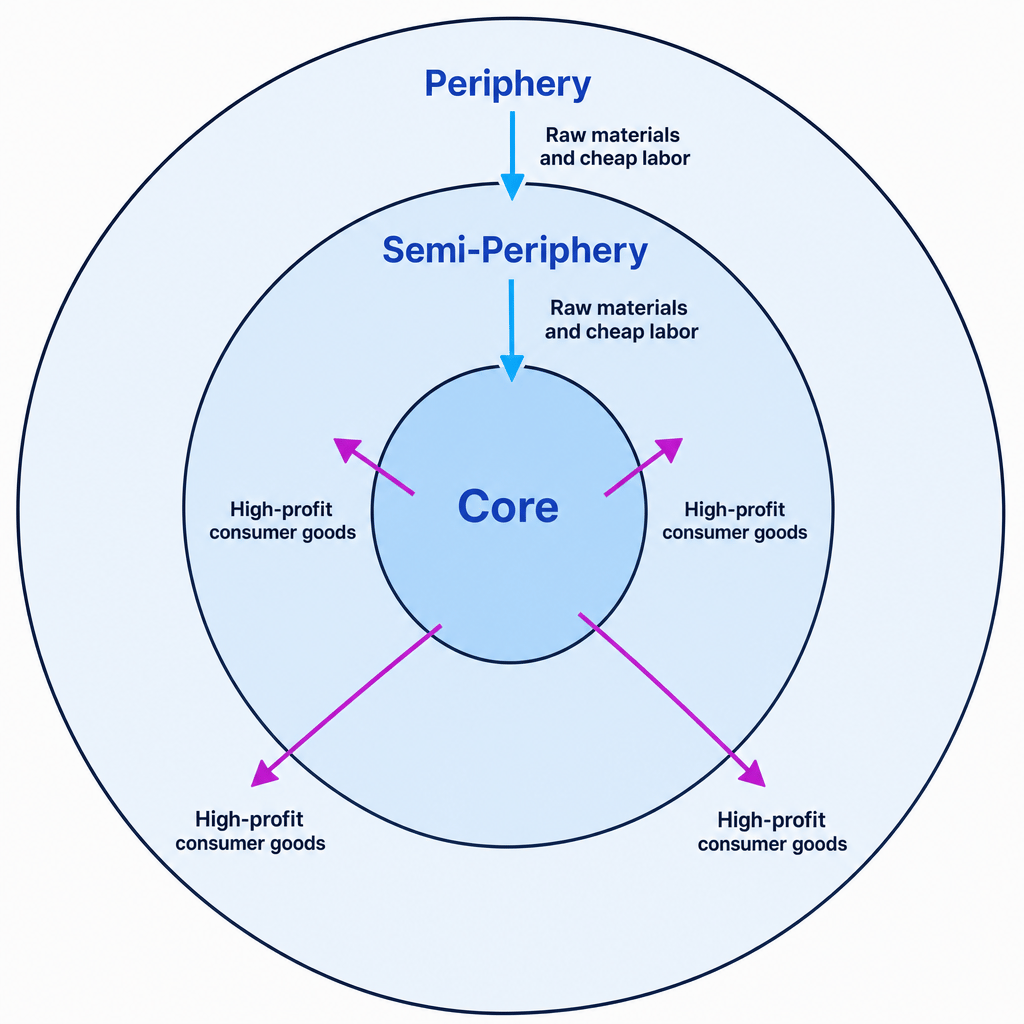
The Core-Periphery Exploitation
Under World-Systems Theory, globalisation is not a partnership of equals. Wealth is systematically drained from the Periphery to the Core. The Core sells high-profit manufactured goods back to the Periphery, keeping developing nations locked in a cycle of dependency and debt.
Political Relationships: The Power of the Nation-State
Has globalisation made the traditional nation-state obsolete? When we look at political relationships, sociologists are divided into three main camps: hyperglobalists, sceptics, and transformationalists (Held et al., 1999).
                      THE GLOBALISATION DEBATE (Held et al.)
                                      │
         ┌────────────────────────────┼────────────────────────────┐
         ▼                            ▼                            ▼
  HYPERGLOBALISTS                  SCEPTICS               TRANSFORMATIONALISTS
  "The nation-state             "Globalisation is a         "The state is changing,
   is dead or dying."            myth; states are active."   reorganising to adapt."
1. Hyperglobalists
Hyperglobalists argue that globalisation has severely weakened the power of national governments. They believe we now live in a "borderless world" where economic forces are more powerful than political ones.
- Key Idea: TNCs can easily bypass national laws. If a government tries to raise corporate taxes or improve workers' rights, the TNC can simply move its operations to a more business-friendly country.
- Global Governance: Power has shifted from national parliaments to international organisations like the International Monetary Fund (IMF), World Bank, and the World Trade Organization (WTO).
2. Sceptics
Sceptics argue that globalisation is largely a myth or is highly exaggerated. They point out that the global economy is not truly global, but rather concentrated into regional blocs (like Europe, North America, and the Asia-Pacific).
- Key Idea: Nation-states remain the primary actors on the world stage. TNCs still rely on national governments to protect intellectual property rights, build infrastructure, and bail them out during economic crises (as seen during the 2008 financial crash).
- Borders Matter: Governments still control migration, security, and military interventions.
3. Transformationalists
Transformationalists offer a middle-ground perspective. They argue that while the state has not lost all its power, its role is being radically reshaped.
- Key Idea: National governments are no longer the sole commanders of their societies, but they act as "nodes" in a complex network of global, regional, and local decision-making.
- Sovereignty is Renegotiated: States voluntarily give up some sovereignty to international bodies (like the United Nations or the European Union) to tackle global problems that no single nation can solve alone, such as climate change, pandemics, and international terrorism.
<tip title="Use "Held et al." to structure your essays">
When writing a 20-mark essay on the political impact of globalisation, use the Hyperglobalist vs. Sceptic vs. Transformationalist debate as your overall structural framework. It guarantees high-level AO3 analytical marks.
Cultural Relationships: Homogenisation vs. Hybridisation
Cultural globalisation looks at how ideas, values, consumer habits, and media flow across national borders. Do these flows create a single global culture, or do they celebrate diversity?
Cultural Imperialism (Homogenisation)
Pessimistic theorists argue that globalisation leads to cultural imperialism, where Western (particularly American) culture is forced upon the rest of the world. This is sometimes called "Americanisation".
- McDonaldization: Sociologist George Ritzer (1993) uses this term to describe how the principles of the fast-food restaurant (efficiency, calculability, predictability, and control) are dominating more and more sectors of global society.
- Cultural Homogenisation: The danger of this process is the loss of indigenous cultures, languages, and traditions, replaced by a uniform, consumerist global culture.
Confusing Homogenisation with Hybridisation
Do not write that cultural globalisation is only a one-way street of Western domination. You must show the examiner you understand both sides: homogenisation (becoming the same) and hybridisation (mixing to create something new).
Glocalisation and Hybridity (Optimistic/Transformational)
In contrast, other sociologists argue that local cultures are not passive victims of Western influence. Instead, they active interpret, adapt, and modify global cultural products. This is known as glocalisation (a blend of "global" and "local").
- Cultural Hybridity: This refers to the creation of new, mixed cultural forms. For example, Bollywood cinema combines traditional Indian dance and storytelling with Western-style Hollywood production values and distribution networks.
- Active Audiences: People in developing countries do not just blindly consume Western media; they decode it through the lens of their own cultural norms and values.
Worked Example: Analysing Global Relationships
Applying World Systems Theory to a Modern Supply Chain
Scenario: A high-end smartphone designed in California (USA) is assembled in Shenzhen (China) using cobalt mined in the Democratic Republic of Congo (DRC). The completed phone is sold worldwide, with the vast majority of the profits returning to the corporate headquarters in the USA.
Use Immanuel Wallerstein's World Systems Theory to explain the relationships between these three societies.
-
Categorise each society into Wallerstein's three-tier structure.
- The USA represents the Core: it controls the capital, high-level technology, research, brand design, and receives the bulk of the profits.
- China represents the Semi-Periphery: it is an industrialising country with advanced manufacturing capabilities, acting as the intermediary assembler.
- The DRC represents the Periphery: it provides the raw materials (cobalt) using low-wage, often unsafe manual labour, and receives the smallest share of the economic returns.
-
Analyse the direction of exploitation and flow of resources.
- Cheap raw materials (cobalt) flow from the Periphery (DRC) to the Semi-Periphery (China) for processing.
- Low-wage manufacturing labour in the Semi-Periphery (China) transforms these materials into consumer goods.
- High-profit margins and surplus value flow back to the Core (USA), maintaining its economic dominance and political influence over global trade rules.
-
Evaluate the limitations of this model using an alternative sociological perspective.
- The Sceptic or Transformationalist critique: While Wallerstein's model highlights economic exploitation, it oversimplifies power. For instance, China (Semi-Periphery) is no longer just an assembler; it is now home to its own global tech giants (like Huawei and Xiaomi), showing that societies can shift their positions in the global hierarchy, and the power of the Core is not absolute or static.
Summary of Theoretical Perspectives
To score highly on AO3 (Evaluation), you must compare how different theoretical perspectives view the relationships between societies under globalisation.
| Perspective | View of Globalisation | Impact on Developing Societies | Key Focus |
|---|---|---|---|
| Neoliberalism / Modernisation | Positive, inevitable progress | Spurs development, wealth "trickles down" through trade | Free markets, deregulation, privatisation |
| Dependency / World-Systems | Exploitative, neo-colonial | Locks developing nations into dependency and poverty | Western imperialism, TNC power, unequal exchange |
| Postmodernism / Transformationalism | Complex, multi-directional | Creates fluid, hybrid identities and new opportunities | Hybridity, glocalisation, active consumption |
In the exam
- Deconstruct the question: If the essay question asks about "economic and political relationships," make sure you do not spend 80% of your time writing about "culture" (media, food, tourism). Keep your focus tightly aligned to the specific terms in the prompt.
- Use contemporary examples: AQA examiners love real-world, up-to-date application (AO2). Mention modern global issues such as supply chain crises, international climate agreements (like COP), or the global influence of platforms like TikTok to show that your sociological knowledge is current.
- Anchor your analysis in named theorists: Do not just talk about "globalisation" in a vague, journalistic way. Explicitly mention Wallerstein (World-Systems), Ritzer (McDonaldization), and Held et al. (Hyperglobalists/Sceptics/Transformationalists) to guarantee solid AO1 marks.
Check yourself
- Why does Immanuel Wallerstein argue that the relationship between Core and Periphery societies is inherently exploitative?
- What is the difference between cultural homogenisation and cultural hybridity? Give a real-world example of each.
- How would a sceptic challenge the hyperglobalist view that the nation-state is dead?
