What you'll learn
- How aid and trade can support development, but also create dependency and inequality.
- Why industrialisation and urbanisation are often seen as routes to development.
- How environmental damage and war/conflict can block or reshape development.
- How to evaluate these issues using modernisation, dependency, world-systems, neoliberal and people-centred perspectives.
The starting point: what counts as development?
In sociology, development means more than a country becoming richer. It includes improvements in people’s life chances: health, education, housing, political rights, gender equality, safety, environmental security and freedom from poverty.
You may see economic measures such as Gross National Income, but sociologists often prefer broader measures such as the Human Development Index, which combines income, life expectancy and education.
Development
Development is the process through which societies improve people’s standard of living, life chances and freedoms. It can include economic growth, but it also involves social, political, cultural and environmental change.
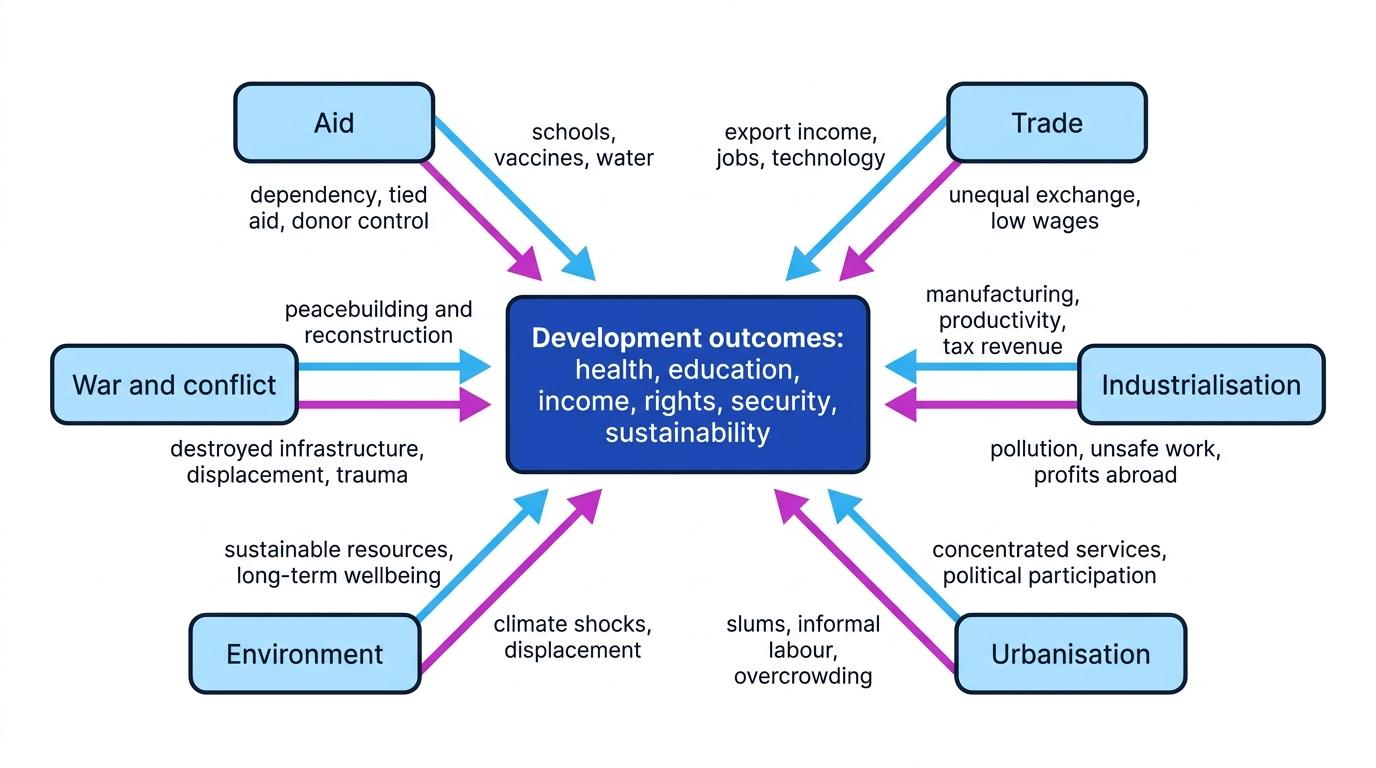
The factors in this topic interact. Aid can fund schools, but conflict may destroy them. Trade can create jobs, but industrialisation may increase pollution. Urbanisation can improve access to services, but it can also create slums and informal work.
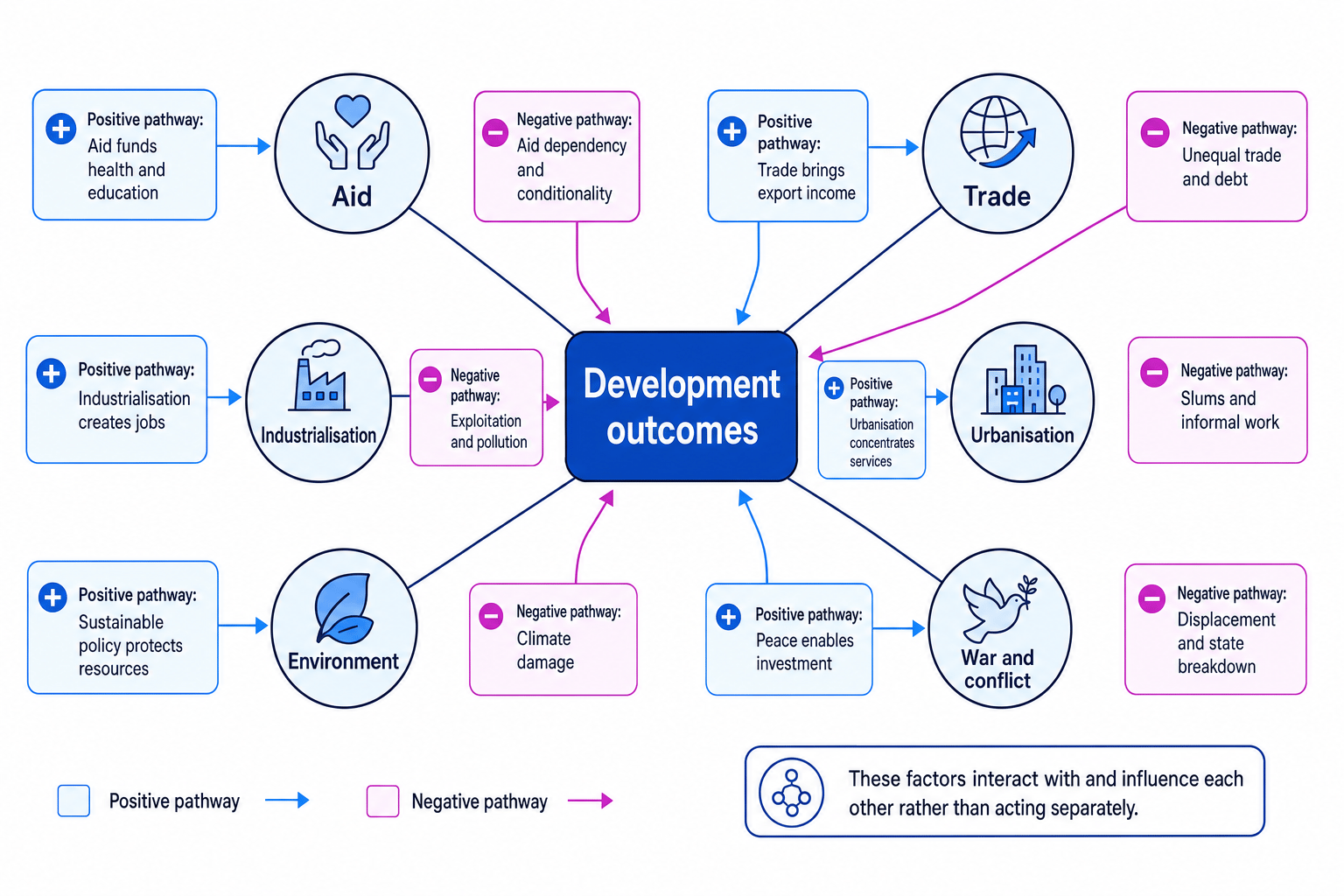
Think in chains, not lists
Strong essays explain mechanisms: how one factor leads to another. For example, trade may increase export income, which may fund infrastructure, which may improve employment — but only if profits are not extracted by foreign companies or local elites.
The theory toolkit
Modernisation theory
Modernisation theory argues that poorer societies can develop by following the path already taken by richer Western societies: industrialisation, urbanisation, education, capitalism and democratic institutions.
Rostow (1960) described development as moving through stages, from “traditional society” to “take-off” and finally “high mass consumption”. From this view:
- Aid can provide capital, technology and expertise.
- Trade can connect countries to global markets.
- Industrialisation creates jobs and raises productivity.
- Urbanisation spreads education, secular values and achievement motivation.
AO3 evaluation: this can be criticised as ethnocentric, meaning it treats Western development as the normal or superior route. It also downplays colonialism, slavery and unequal global power.
Dependency and world-systems theory
Dependency theory argues that poorer countries are not simply “behind”; they have been actively underdeveloped through colonialism, unequal trade and exploitation. Frank (1967) argued that rich “metropole” countries extract wealth from poorer “satellite” countries.
World-systems theory, associated with Wallerstein (1974), divides the global economy into:
- Core countries: rich, powerful, high-profit economies.
- Semi-periphery countries: intermediate economies, such as some newly industrialising countries.
- Periphery countries: poorer economies often dependent on exporting raw materials or cheap labour.
From this perspective, aid and trade may look helpful, but can reproduce dependency if profits, decision-making and technology remain controlled by the core.
Neoliberal and people-centred views
Neoliberalism is the belief that development is best achieved through free markets, privatisation, deregulation and open trade. Organisations such as the International Monetary Fund and World Bank have historically promoted these policies through loan conditions.
A people-centred approach focuses on human needs, rights and local participation. Sen (1999) argued that development should be understood as expanding people’s freedoms, not just increasing national income.
Interpreting an export-processing zone
-
A modernisation theorist would see an export-processing zone as evidence of industrialisation: factories create wage labour, increase exports and may help the economy “take off”.
-
A dependency theorist would ask who owns the factories, who controls the profits and whether workers remain trapped in low-paid labour for companies based in the global core.
-
A people-centred evaluation would judge the zone by workers’ real freedoms: safe conditions, union rights, gender equality, housing, environmental protection and whether local communities benefit.
Aid: help, power and dependency
Aid means resources transferred from one country or organisation to another, usually to support development or respond to crisis. Bilateral aid is given from one government to another. Multilateral aid is given through international organisations such as the United Nations or World Bank. Non-governmental organisations are charities or civil society organisations, such as Oxfam or Save the Children.
Aid
Aid is the transfer of money, goods, expertise or services to support another country or population. It may be emergency humanitarian aid, long-term development aid, military aid or technical assistance.
Aid can promote development by funding healthcare, education, clean water, vaccination programmes and infrastructure. Sachs (2005) argues that aid can help countries escape a poverty trap, where poverty itself prevents investment in development.
However, critics argue that aid can also increase dependency. Moyo (2009), in Dead Aid, argues that long-term aid may weaken accountability, encourage corruption and discourage local enterprise. Aid may also be tied aid, meaning the recipient must spend the money on goods or services from the donor country. This can benefit the donor more than the recipient.
AO2 UK application: the UK has a long-running political debate over overseas aid. The UK previously had a legal commitment to spend 0.7% of national income on official development assistance, but this was reduced to 0.5% from 2021. The merger of the Department for International Development into the Foreign, Commonwealth and Development Office also raised questions about whether aid is guided by poverty reduction or UK foreign-policy interests.
Assuming aid is automatically generous
Aid is not just charity. It can be shaped by geopolitics, trade interests, military alliances and donor priorities. Always ask: who gives it, with what conditions, and who benefits?
Evaluating a UK-funded education programme
-
The positive mechanism is that education can increase literacy, skills and employment chances, especially for girls whose life chances may be restricted by gender inequality.
-
The power question is whether the programme is locally controlled or whether funding priorities, textbooks, consultants and targets are imposed by the donor.
-
The evaluation depends on evidence: if attendance improves but jobs remain unavailable, the programme may improve human development without producing wider economic transformation.
Trade: growth or unequal exchange?
Trade means buying and selling goods and services between countries. Free trade means trade with few tariffs, quotas or restrictions. Fair trade aims to give producers better prices and working conditions.
Trade can promote development by bringing export income, foreign investment, technology and jobs. The “Asian Tigers” — South Korea, Taiwan, Singapore and Hong Kong — are often used as examples of export-led development.
But dependency theorists argue that trade is often unequal. Many poorer countries export primary commodities, such as coffee, copper or cotton, while importing expensive manufactured goods. This can create poor terms of trade, where a country must export more and more raw materials to afford manufactured imports.
AO2 UK application: UK consumers are connected to global trade through supermarkets, electronics and fast fashion. Cheap clothing in UK shops may rely on low-paid labour in countries such as Bangladesh. The Rana Plaza factory collapse in 2013 exposed unsafe working conditions in global garment supply chains.
Analysing fast-fashion supply chains
-
Trade may create development benefits because garment factories provide jobs, export earnings and wages for workers who may previously have had fewer paid opportunities.
-
A conflict perspective highlights stratification: profits are often concentrated among brands, retailers and factory owners, while workers — often women — face low pay and weak labour protection.
-
Evaluation should balance both sides: factory work may increase independence for some workers, but development is limited if wages, safety, union rights and environmental standards remain poor.
Industrialisation and urbanisation
Industrialisation is the shift from agriculture-based production to manufacturing and large-scale industry. Urbanisation is the growth of towns and cities, often as people migrate from rural areas to find work.
Industrialisation and urbanisation
Industrialisation involves the expansion of factories, manufacturing and mechanised production. Urbanisation involves an increasing proportion of the population living in towns and cities.
Modernisation theorists see industrialisation as central to development because it creates jobs, tax revenue, infrastructure and technological change. Urbanisation can concentrate schools, hospitals, transport, media and political organisation.
However, rapid industrialisation can also produce exploitation, pollution and insecure work. Rapid urbanisation can create informal settlements, overcrowding and poor sanitation. Davis (2006), in Planet of Slums, argues that many cities in the Global South have grown without enough formal jobs or infrastructure.
These processes affect the core themes of sociology. For socialisation, culture and identity, moving to cities can change family life, gender roles, religion and consumer identities. For social differentiation, power and stratification, the key question is who gains from industrial growth: workers, women, migrants and ethnic minorities, or national elites and transnational corporations?
Linking city growth to development
-
Urbanisation can improve development when people gain access to schools, clinics, transport, communications and paid work in a concentrated area.
-
It can limit development when migration is faster than housing and job creation, producing slums, informal work and unequal access to services.
-
A balanced judgement asks whether the city expands citizenship and opportunity, or whether it creates a divided urban society with wealthy gated areas alongside extreme deprivation.
The environment: sustainable development and climate inequality
The environment matters because development depends on land, water, energy, climate stability and biodiversity. Industrialisation can raise living standards, but it can also create pollution, deforestation and high carbon emissions.
Sustainable development
Sustainable development means meeting the needs of the present without compromising the ability of future generations to meet their own needs. This definition comes from the Brundtland Report (1987).
Environmental problems are also issues of power. Richer countries in the Global North have historically produced more emissions, while many poorer countries face stronger effects of climate change, such as flooding, drought and food insecurity.
A modernisation or ecological modernisation view suggests that technology, renewable energy and green growth can solve environmental problems. A dependency or climate justice view argues that this ignores the unequal responsibility of rich countries and the way pollution is often exported to poorer regions.
AO2 UK application: the UK hosted COP26 in Glasgow in 2021 and has a legal target to reach net zero emissions by 2050. However, UK consumption still relies heavily on imported goods, meaning some environmental damage occurs overseas but is linked to British lifestyles and companies.
Use climate as an inequality issue
Do not write about the environment as if it affects everyone equally. Ask who caused the damage, who profits from resource use, and who is most vulnerable to climate shocks.
War and conflict
War and conflict include organised violence between states, civil war within states, terrorism, armed repression and long-term insecurity. Conflict is both a cause and consequence of underdevelopment.
War can block development by destroying schools, hospitals, roads and housing. It displaces people, disrupts food supplies, reduces trade, increases trauma and diverts state spending towards the military. Children may miss education, and women and girls often face increased risks of sexual violence and unpaid care burdens.
Conflict can also be linked to global inequality. Collier (2007) argues that civil wars are more likely where states are poor and dependent on valuable resources. Dependency theorists would add that colonial borders, arms sales and competition for oil, minerals or land can intensify conflict.
AO2 UK application: conflicts in Syria, Afghanistan, Ukraine, Sudan and Yemen have affected UK debates about refugees, asylum, aid, arms exports and foreign policy. For example, war in Ukraine influenced global food and energy prices, showing how conflict in one region can affect households far away.
Avoid simple explanations of conflict
Do not reduce wars to “ancient ethnic hatred” or “poor countries are violent”. Strong answers consider state power, colonial history, resource competition, foreign intervention, arms trading and global markets.
Explaining a conflict-development cycle
-
Conflict destroys infrastructure and reduces state capacity, so governments struggle to provide education, healthcare, security and basic administration.
-
Weak services and unemployment can increase grievances, especially among young people, displaced groups and marginalised ethnic or religious communities.
-
External actors may worsen or reduce the cycle: arms exports and resource exploitation can prolong violence, while peacebuilding, debt relief and locally accountable aid may support recovery.
Pulling the factors together
| Factor | Can support development by… | Can limit development by… |
|---|---|---|
| Aid | Funding health, education, infrastructure and emergency relief | Creating dependency, corruption, tied aid or donor control |
| Trade | Generating export income, jobs and investment | Producing unequal exchange, exploitation and commodity dependence |
| Industrialisation | Creating manufacturing jobs, tax revenue and technology | Causing pollution, unsafe work and profits flowing abroad |
| Urbanisation | Concentrating services, education and political participation | Producing slums, overcrowding and informal labour |
| Environment | Supporting long-term wellbeing through sustainable resources | Creating climate vulnerability, displacement and resource conflict |
| War and conflict | Sometimes followed by reconstruction and peacebuilding | Destroying infrastructure, trust, investment and human security |
In the exam
-
Use theory as a lens, not as a name-drop: explain how Rostow, Frank, Wallerstein, Moyo, Sachs, Sen or Collier would interpret the same development issue differently.
-
Apply to real examples: UK aid policy, Fairtrade, fast fashion, COP26, refugee debates, global supply chains or specific conflicts can all strengthen AO2.
-
Evaluate through power and inequality: ask who benefits, who pays the costs, whether development is sustainable, and whether cultural identity and local control are respected.
Check yourself
- How might the same aid project be seen positively by modernisation theorists but negatively by dependency theorists?
- Why can trade create both jobs and exploitation in global supply chains?
- How do environmental damage and conflict show that development is about power, not just economic growth?