What you'll learn
- What sociologists mean by development, underdevelopment and global inequality.
- Why development is more than economic growth.
- How global inequality is measured — and why those measures can be criticised.
- How to apply these ideas to power, culture, identity and stratification in essay answers.
Starting point: what is “development”?
In everyday language, people often use “development” to mean a country becoming richer or more “modern”. In sociology, you need a wider definition.
Development
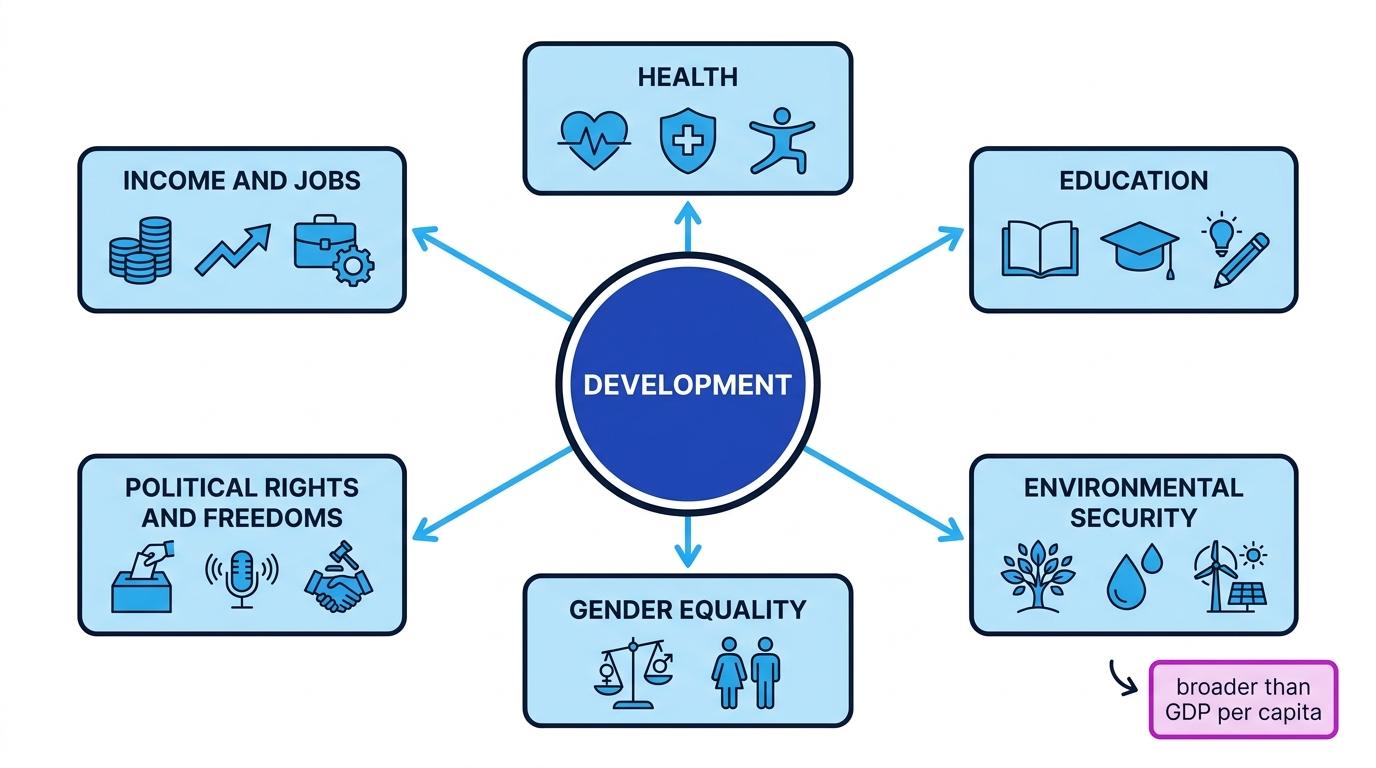
Development means long-term improvements in people’s living conditions, life chances and freedoms. It can include income, health, education, political rights, gender equality, environmental security and cultural autonomy.
This means a country can become economically richer without becoming fully “developed” in a sociological sense. For example, oil wealth may increase national income while many people still lack healthcare, education or political freedoms.
Economic growth is not the same as development
Economic growth
Economic growth means an increase in the value of goods and services produced by an economy, often measured using GDP or GNI per person.
Economic growth can help development because governments may have more money for schools, hospitals and infrastructure. However, growth can also be unequal, environmentally damaging or controlled by elites.
Development is multidimensional
For A-Level Sociology, avoid treating development as “rich country = developed”. Strong answers consider economic, social, political, cultural and environmental dimensions.
Measuring development
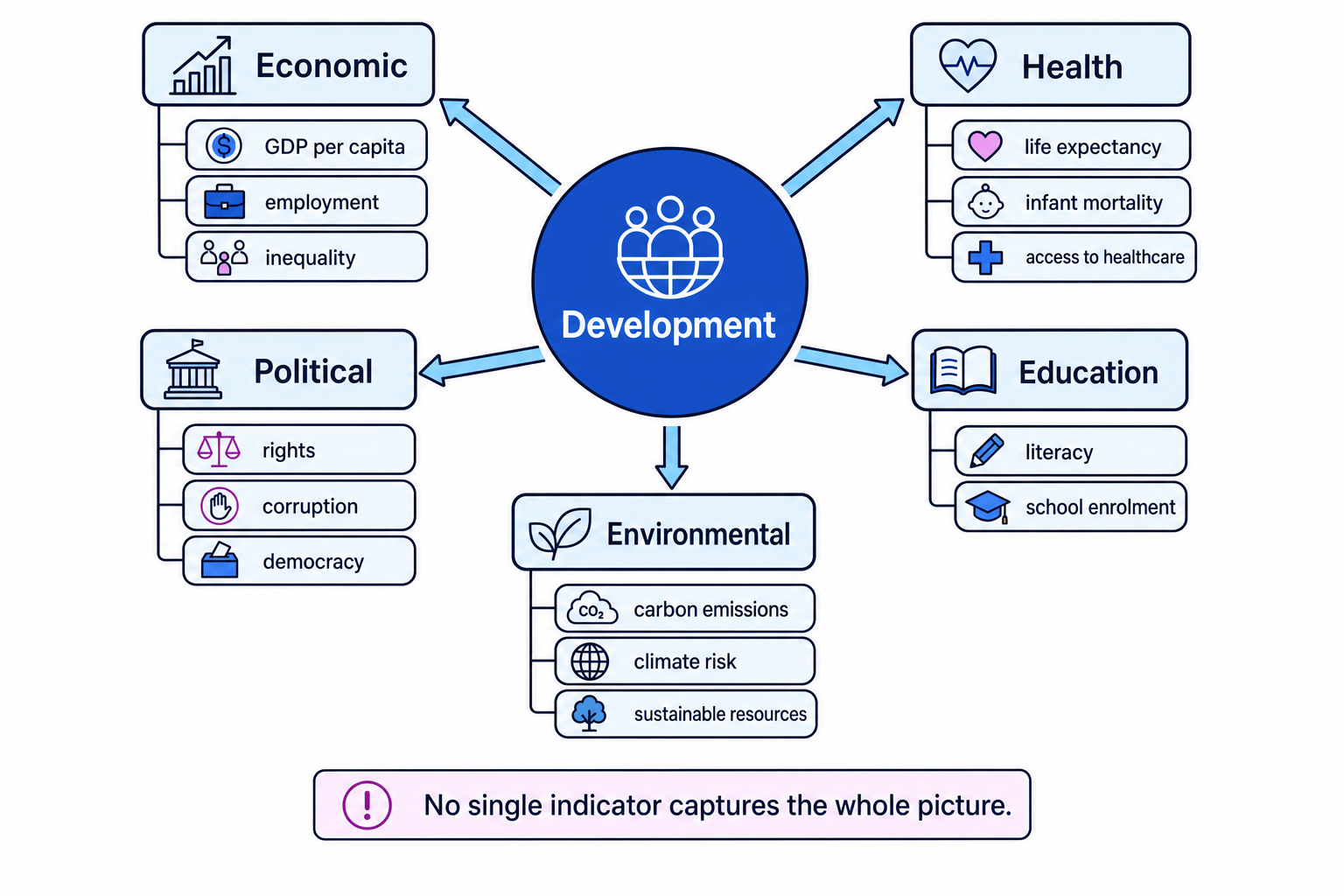
Sociologists and international organisations use indicators to compare development between countries.
Development indicator
A development indicator is a measurement used to assess some aspect of development, such as income, life expectancy, literacy, infant mortality, political rights or access to clean water.
Common indicators include:
- GDP per capita: average economic output per person.
- GNI per capita: average national income per person, including income from abroad.
- Life expectancy: how long people are expected to live on average.
- Infant mortality rate: how many babies die before their first birthday.
- Literacy rate: the percentage of people who can read and write.
- Human Development Index: a United Nations measure combining income, life expectancy and education.
- Gini coefficient: a measure of income inequality within a country.
- Multidimensional Poverty Index: a measure of overlapping disadvantages in areas such as education, health and living standards.
Using indicators to judge development
Imagine Country A has high national income because of oil exports, but low literacy, weak women’s rights and poor access to healthcare.
- Compare economic indicators first: high income suggests economic growth and possibly state revenue.
- Compare social indicators next: low literacy and poor healthcare suggest many people’s life chances remain limited.
- Add power and stratification: weak women’s rights show development is uneven across gender groups, not shared equally.
- Reach a balanced judgement: Country A may be economically wealthy but not highly developed in the wider sociological sense.
Underdevelopment: not just “not developed yet”
Underdevelopment
Underdevelopment refers to a situation where people experience poor living standards, limited life chances and restricted access to resources, rights and opportunities.
A key debate is whether underdevelopment means some countries are simply “behind” on the same path as richer countries, or whether they have been actively disadvantaged by global capitalism, colonialism and unequal power relations.
Modernisation view
Modernisation theory, associated with writers such as Rostow, argues that poorer societies can develop by moving from “traditional” to “modern” forms of economy, culture and politics. This approach often emphasises industrialisation, education, science, investment and democratic institutions.
From this view, underdevelopment may be linked to internal barriers such as lack of technology, weak infrastructure, corruption, poor education or traditional values that discourage innovation.
Dependency view
Dependency theory, associated with Frank, argues that underdevelopment is not natural or accidental. Instead, poorer countries have been made dependent through colonialism, unfair trade, debt, exploitation of labour and the extraction of raw materials.
Frank used the phrase the development of underdevelopment to suggest that rich countries became rich partly because poor countries were kept poor.
Interpreting a global supply chain
Think about cocoa grown in West Africa and sold as chocolate by companies in the UK and Europe.
- Identify where value is created: farmers produce the raw cocoa, but branding, processing, marketing and retail often capture much higher profits.
- Apply dependency theory: poorer producer countries may remain dependent on exporting low-value raw materials.
- Apply global inequality: consumers in richer countries benefit from cheaper products, while workers in poorer regions may receive low wages.
- Evaluate the explanation: dependency theory highlights power and exploitation, but it may underplay local government decisions, fair-trade reforms or the possibility of industrial growth in some countries.
Global inequality
Global inequality
Global inequality means the unequal distribution of wealth, income, power, resources, security and life chances across the world.
Global inequality exists both between countries and within countries. For example, the UK is a high-income country, but still has poverty and regional inequality. India and China include very wealthy urban elites as well as rural poverty. So you should not write as if the world is simply divided into “rich countries” and “poor countries”.
Global North and Global South
The terms Global North and Global South are often used to describe broad global inequalities. The Global North generally refers to richer, more industrialised and politically powerful countries. The Global South generally refers to countries that have experienced colonialism, lower average income and weaker global power.
Overgeneralising the Global South
Do not treat the Global South as one identical block. Countries such as Brazil, India, Nigeria, Bangladesh and Singapore have very different histories, economies, cultures and levels of inequality.
Core, periphery and semi-periphery
Wallerstein’s world-systems theory is useful for mapping global inequality. He argued that capitalism operates as a global system with unequal positions.
Core, periphery and semi-periphery
In world-systems theory, core countries are economically and politically powerful, periphery countries are exploited for labour and raw materials, and semi-periphery countries sit between the two, often industrialising but still dependent in some ways.
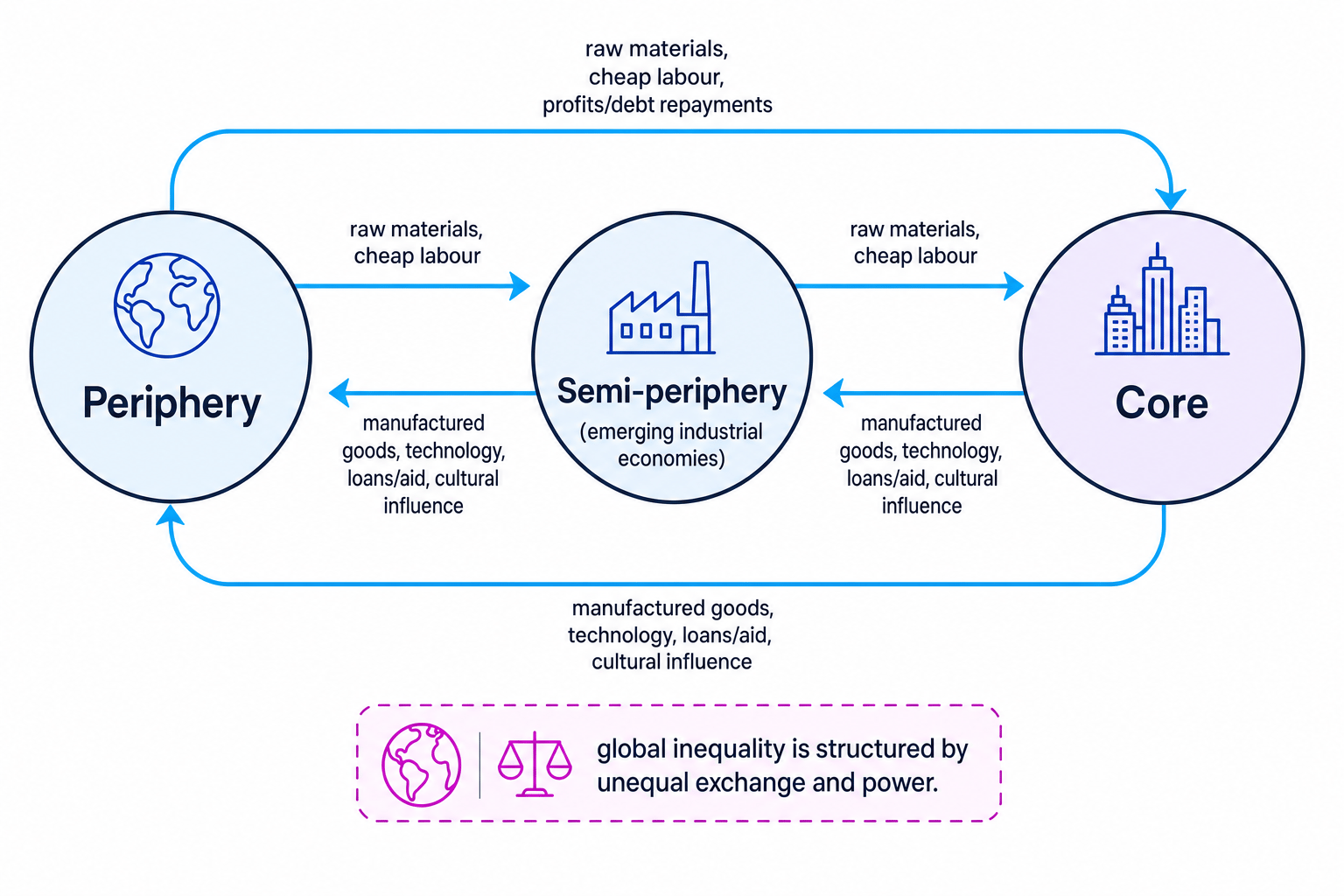
This links directly to social differentiation, power and stratification. Global inequality is not only about money; it is about who controls trade rules, technology, debt, military power, media images and international institutions.
Culture, identity and development
Development also affects socialisation, culture and identity. Schools, media, migration and consumer culture can spread global values, lifestyles and identities.
Some sociologists argue that development can become Westernisation, where Western lifestyles are treated as the model for everyone else. Postcolonial writers, influenced by ideas such as Said’s Orientalism, criticise the way poorer countries may be represented as backward, helpless or irrational.
However, you should evaluate this carefully. Criticising Western dominance does not mean romanticising all “traditional” practices. Some cultural practices may reinforce gender inequality, caste oppression or restrictions on children’s rights.
Balanced cultural analysis
A strong answer avoids both extremes: do not assume Western culture is automatically superior, but do not assume all local traditions are automatically liberating either.
Using official statistics critically
A lot of evidence on global development comes from organisations such as the World Bank, United Nations, World Health Organization, UNESCO and OECD.
These statistics are useful because they allow comparison across countries and over time. For example, PISA league tables compare educational performance, and UN data can track life expectancy or child mortality.
But there are methodological problems.
Practical issues
Data may be difficult to collect in war zones, refugee camps, informal settlements or remote rural areas. Some governments may lack reliable census systems or administrative records.
Ethical issues
Research on poverty, health or conflict may involve vulnerable populations. Researchers and aid agencies need informed consent, confidentiality and care to avoid harm.
Theoretical issues
A positivist approach values large-scale quantitative data because it appears reliable and comparable. An interpretivist approach would question whether statistics capture lived experience, meanings, culture and identity.
Assuming statistics are neutral
Official statistics are not just “facts”. They depend on definitions, categories, funding, political priorities and the ability of states to collect accurate data.
Key evaluation debates
Is global inequality getting better or worse?
There is evidence that some absolute poverty has fallen globally, especially with industrialisation in countries such as China. Modernisation theorists may use this to argue that growth, trade and technology can reduce poverty.
However, dependency and world-systems theorists argue that inequality remains deeply structured. Wealth, patents, finance, military power and decision-making are still concentrated in richer core countries and among global elites.
Is development sustainable?
Economic growth can damage the environment through carbon emissions, deforestation, pollution and resource extraction. This matters because climate change often affects poorer countries most, even though richer countries have historically produced more emissions.
This creates a major AO3 point: development for some groups may produce risk and insecurity for others.
Who benefits from development?
Development may benefit urban middle classes, political elites or transnational corporations more than rural workers, women, migrants or ethnic minorities. This links global development to stratification: class, gender, ethnicity, age and nationality shape who gains and who loses.
UK examples can help you apply this. For instance, UK consumers may benefit from cheap fast fashion, smartphones or food imports, while workers elsewhere may face low wages or unsafe working conditions. UK aid policy also matters: the reduction of the aid target from 0.7% to 0.5% of national income was criticised by some as weakening support for global development.
In the exam
- Define development broadly: include income, health, education, rights, inequality, culture and environment.
- Use theory comparatively: modernisation focuses on internal change, while dependency and world-systems theory focus on unequal global power.
- Evaluate indicators: explain what they reveal, what they hide, and how official statistics may lack validity or comparability.
Check yourself
- Why is GDP per capita an incomplete measure of development?
- How would dependency theory explain underdevelopment differently from modernisation theory?
- What is one way global inequality connects to culture, identity or socialisation?