What you'll learn
- What sociologists mean by social mobility and the main types: vertical, horizontal, intergenerational and intragenerational.
- How researchers measure the extent of mobility in the UK using class schemas, surveys and official data.
- Why mobility matters for debates about meritocracy, inequality, power and identity.
- How to evaluate different explanations, including functionalist, Marxist, Weberian, feminist and cultural-capital approaches.
Starting point: stratification, class and life chances
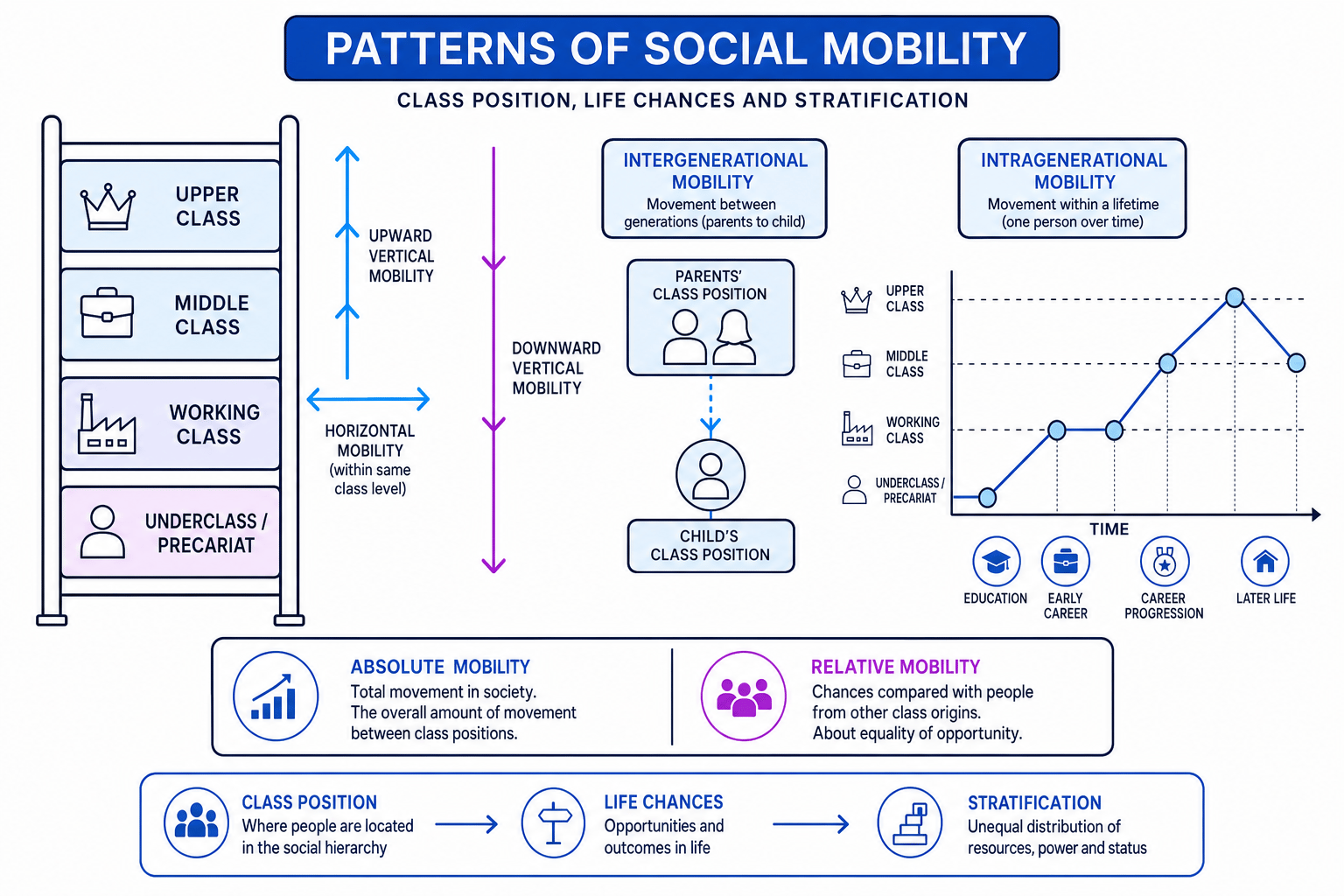
Before you study mobility, you need the idea of social stratification. This means society is organised into layers, where some groups have more wealth, power, status and opportunities than others.
Social class is one major form of stratification. In A-Level Sociology, class is usually linked to a person’s economic position: their occupation, income, wealth, job security and relationship to the labour market.
Life chances
Life chances are the opportunities people have to achieve desirable outcomes, such as good health, secure employment, high income, education, housing and influence.
Social mobility is important because it asks whether people can move between these layers — or whether their class background strongly shapes their future.
The big question
Patterns of social mobility tell us how far the UK is an open society, where people can move up or down, or a closed society, where class origins strongly shape class destinations.
What is social mobility?
Social mobility
Social mobility means movement by individuals, families or groups from one social class or status position to another.
Mobility can be about occupation, income, wealth, education or status. In practice, many sociological studies use occupation as the main indicator of class because it is easier to classify and compare across large samples.
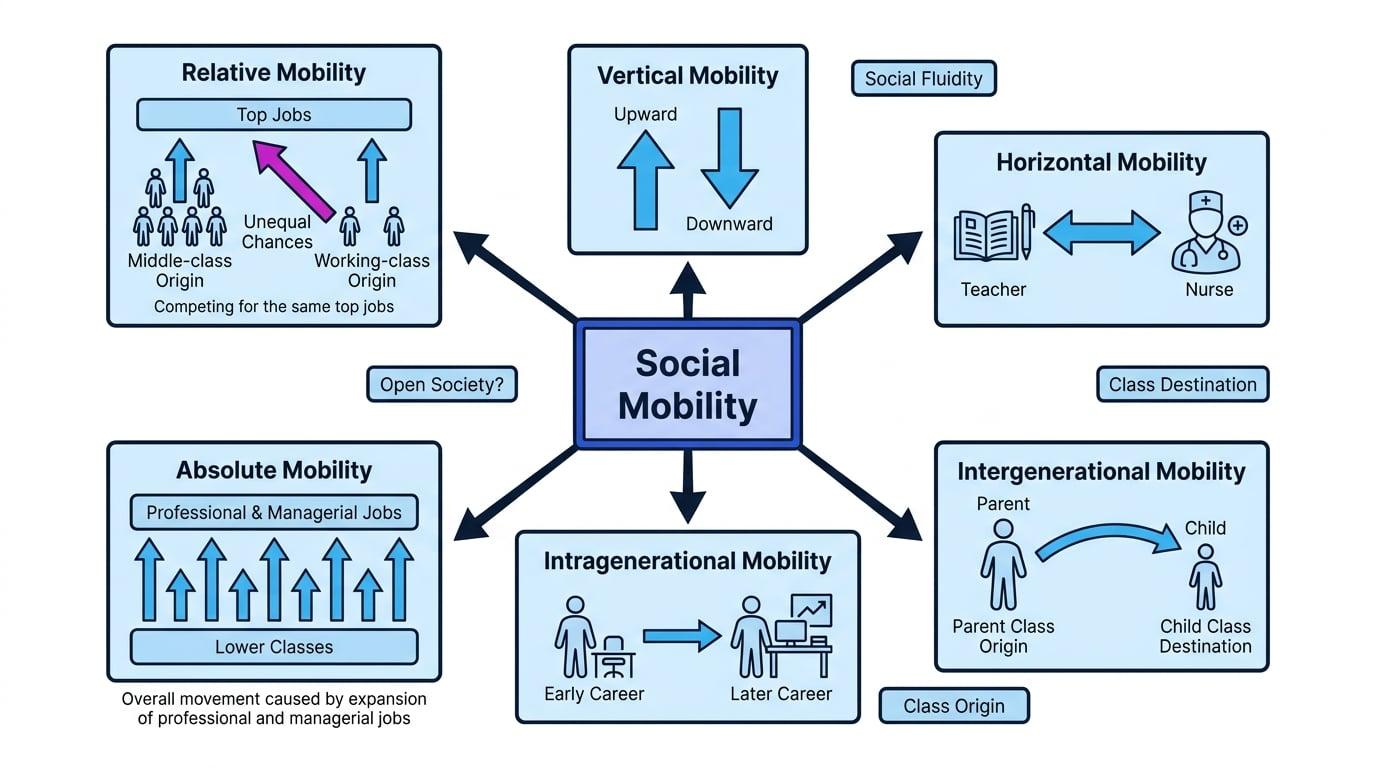
The diagram below maps the main types of mobility you need to recognise.
The nature of social mobility: main types
Vertical mobility
Vertical mobility means moving up or down the social hierarchy.
- Upward mobility: moving to a higher class position, such as a child of routine manual workers becoming a doctor.
- Downward mobility: moving to a lower class position, such as a middle-class professional losing secure employment and moving into unstable low-paid work.
Horizontal mobility
Horizontal mobility means moving to a different role or occupation at a similar class level. For example, a teacher becoming a social worker may involve a change in job, but not necessarily a large change in class position.
Intergenerational mobility
Intergenerational mobility means comparing the class position of one generation with another, usually parents and children. This is central to debates about whether class advantage is passed down through families.
Intragenerational mobility
Intragenerational mobility means movement within one person’s lifetime, such as someone starting in a low-paid service job and later becoming a manager.
Classifying a mobility pattern
- A person’s parents worked in routine manual jobs, but the person becomes a solicitor. This compares two generations, so it is intergenerational mobility.
- The person has moved from a working-class origin to a professional middle-class destination, so it is also upward vertical mobility.
- If the same person later moves from solicitor to university lecturer, this may be horizontal mobility if both jobs are similar in class status.
Mixing up the time frame
Do not confuse intergenerational and intragenerational mobility. Intergenerational means between generations; intragenerational means within one life course.
Absolute and relative mobility
Absolute mobility
Absolute mobility means the total amount of movement between class positions in society. It is strongly affected by changes in the occupational structure.
For example, after the Second World War, the UK saw growth in professional, managerial and white-collar jobs. This created more “room at the top”, so many people experienced upward mobility even if class inequalities still remained.
Relative mobility
Relative mobility means the chances of people from different class origins reaching different class destinations compared with each other. It is about equality of opportunity.
If middle-class children are still far more likely than working-class children to enter elite occupations, then relative mobility is low, even if some working-class children do move up.
Social fluidity
Social fluidity refers to how far class origins affect class destinations. High fluidity means class background matters less; low fluidity means class background strongly shapes outcomes.
Interpreting absolute and relative mobility
- Imagine a society creates many more professional jobs, so more people from all backgrounds enter middle-class occupations. This suggests high absolute mobility because there is more movement overall.
- Now compare class origins. If children of professional parents are still much more likely to get those professional jobs than children of routine workers, opportunity is still unequal.
- The conclusion is that absolute mobility can rise while relative mobility remains limited. This is a classic finding in UK mobility debates.
A simple distinction
Absolute mobility asks: “How much movement is happening?”
Relative mobility asks: “Who has the best chances of moving?”
Measuring patterns of social mobility
Sociologists need a way to classify class positions. UK studies often use occupational class schemes, such as the National Statistics Socio-economic Classification or NS-SEC, which groups people by employment relations, job security, autonomy and skill.
Researchers may use:
- Mobility tables, comparing class origins and class destinations.
- Longitudinal studies, which follow the same people over time.
- Birth cohort studies, which track people born in the same period.
- Official statistics, such as Census data, Labour Force Survey data and ONS employment data.
- Reports from organisations such as the Social Mobility Commission and the Sutton Trust.
Important studies include Glass (1954), who found Britain was not fully open, and Goldthorpe et al. (1980), whose Oxford Mobility Study argued that absolute mobility had increased but relative class inequalities persisted. Later work by Bukodi and Goldthorpe continued to question claims that Britain had become fully meritocratic.
Methods evaluation
There are practical, ethical and theoretical issues when studying mobility.
- Practical issues: large samples are expensive and difficult to follow over time; people change jobs; some have unstable or mixed employment histories.
- Ethical issues: longitudinal research must protect confidentiality because it may collect sensitive data on income, family background and education.
- Theoretical issues: positivists value large-scale data for reliability and comparison, while interpretivists argue that occupation alone may miss people’s lived experience, identity and status.
Treating occupation as the whole of class
Occupation is useful, but class also involves wealth, housing, cultural capital, networks and security. A high-status job with debt and no assets is not the same as inherited wealth.
The extent of mobility in the UK
Post-war upward mobility
In the mid-to-late twentieth century, many people experienced upward mobility because the occupational structure changed. Manufacturing declined, while professional, managerial and service-sector employment expanded.
This is called structural mobility: movement caused by changes in the economy rather than only individual effort.
Persistent class inequality
However, relative mobility has remained more limited. Class background still influences educational achievement, access to elite universities, unpaid internships, professional networks and confidence in middle-class institutions.
The Social Mobility Commission has repeatedly highlighted “stickiness” at the top and bottom:
- Top stickiness: advantaged families are good at preserving privilege.
- Bottom stickiness: disadvantaged families often face barriers to moving up.
A useful contemporary example is the over-representation of privately educated people in elite professions such as senior law, politics, journalism and finance. This supports the argument that class advantages are reproduced, not simply earned.
Downward mobility and insecurity
Mobility is not only upward. Some groups experience downward mobility through deindustrialisation, precarious employment, housing insecurity or regional economic decline.
Precarious work means insecure employment, often with low pay, unpredictable hours and limited rights. Sociologists sometimes link this to the precariat, a term associated with Guy Standing, meaning a group marked by insecure labour and unstable life chances.
Why social mobility matters
Social mobility is significant because it connects directly to the two core themes in sociology.
Socialisation, culture and identity
Families transmit values, expectations, speech styles, tastes and confidence. This shapes how young people see themselves and what futures feel “realistic”.
Bourdieu argued that middle-class families pass on cultural capital: knowledge, language, tastes and behaviours rewarded by schools and employers. They also pass on social capital, meaning useful networks and contacts, and economic capital, meaning money and assets.
This helps explain why two students with similar ability may have different outcomes depending on their class background.
Social differentiation, power and stratification
Mobility patterns reveal how resources and power are distributed. If people from privileged backgrounds dominate top jobs, they may also shape laws, media agendas, workplace cultures and definitions of “merit”.
This links to Weber, who argued that class affects market situation and life chances, but status and power also matter. It also links to Marxist approaches, which stress that class inequality is built into capitalism because wealth and control over production are unequally distributed.
Theoretical explanations
| Perspective | Main view of mobility | Evaluation |
|---|---|---|
| Functionalism | Society rewards talent and effort; mobility helps allocate people to roles. Davis and Moore argue unequal rewards motivate achievement. | Can underestimate inherited advantage and structural barriers. |
| New Right / Saunders | Britain is broadly meritocratic; intelligence and effort explain much mobility. | Critics argue this blames individuals and ignores unequal schooling, wealth and networks. |
| Marxism | Mobility is limited because capitalism reproduces class inequality. Some mobility may create the illusion of fairness. | May underplay real individual movement and changes in the class structure. |
| Weberian theory | Mobility depends on class, status, market position and power. | Useful because it captures more than ownership, but can be complex to apply. |
| Bourdieu | Class advantage is reproduced through economic, cultural and social capital. | Strong for explaining subtle barriers, but measuring cultural capital can be difficult. |
| Feminism | Mobility is gendered; women’s careers are shaped by childcare, pay gaps, sexism and occupational segregation. | Needs intersectional analysis because class, ethnicity and gender combine differently. |
Applying Bourdieu to mobility
- A working-class student gets strong GCSEs but has limited knowledge of university admissions, no family contacts in professional careers and pressure to earn quickly.
- A middle-class student with similar grades receives help with applications, unpaid work experience through family networks and confidence in interviews.
- Bourdieu would argue the second student has more cultural and social capital, so “merit” is not judged on ability alone.
Evaluation: is Britain meritocratic?
A meritocracy is a society where people achieve positions based on ability and effort rather than background.
There is evidence of openness: education has expanded, more women enter professional employment, and some people from disadvantaged backgrounds do achieve upward mobility.
However, there is also strong evidence of continuing closure. Housing wealth, private schooling, parental income, regional inequality and social networks all affect opportunities. The “class ceiling” idea, associated with Friedman and Laurison, suggests that even when working-class people enter elite occupations, they may earn less and progress more slowly than colleagues from privileged backgrounds.
Balanced judgement
The UK is not a completely closed society, but neither is it fully meritocratic. The strongest answers show that absolute mobility has often increased while relative chances remain unequal.
How to use this in essays
For AO1, define the types of mobility and use named studies such as Glass, Goldthorpe, Bourdieu, Saunders or the Social Mobility Commission.
For AO2, apply the ideas to UK examples: private schooling, Russell Group access, regional inequality, professional internships, housing wealth, deindustrialisation or precarious work.
For AO3, evaluate whether mobility proves meritocracy or whether it hides deeper inequalities in power, wealth and cultural advantage.
In the exam
- Start by separating absolute and relative mobility; this immediately gives your answer precision.
- Use at least one named study or theorist, then apply it to a contemporary UK example such as elite professions, education or regional inequality.
- Evaluate by asking whether the evidence shows real openness or simply limited movement within a still unequal class structure.
Check yourself
- What is the difference between intergenerational and intragenerational mobility?
- How can absolute mobility increase while relative mobility remains unequal?
- Why might Bourdieu argue that education does not create equal opportunity on its own?