What you'll learn
- How sociologists distinguish social differences from structured inequalities.
- Why globalisation has changed class, work, wealth and power in the UK.
- What the transnational capitalist class is, especially in Sklair’s work.
- How to evaluate the implications for essay-style answers using AO1, AO2 and AO3.
1. Start with the basics: what is a structure of inequality?
A social structure is a patterned set of social relationships, institutions and rules that shape people’s behaviour and opportunities. In this topic, you are not just describing who is rich or poor — you are explaining how society is organised so that some groups repeatedly gain more wealth, status and power than others.
Social differentiation means dividing people into social categories, such as class, gender, ethnicity, age, disability or nationality. Social stratification means those categories become ranked, producing unequal rewards and unequal life chances: people’s chances of gaining valued outcomes such as health, education, income, security and influence.
Structures of inequality
A structure of inequality is a patterned system in which resources, status and power are distributed unequally between social groups, shaping their life chances over time.
The key point is that inequality is not random. It is produced through institutions such as the labour market, education system, family, welfare state, media, law, housing market and global economy.
Difference becomes inequality when power is attached
A social difference only becomes a structure of inequality when it affects access to resources, respect, security or decision-making power.
2. From a national class pyramid to a global network
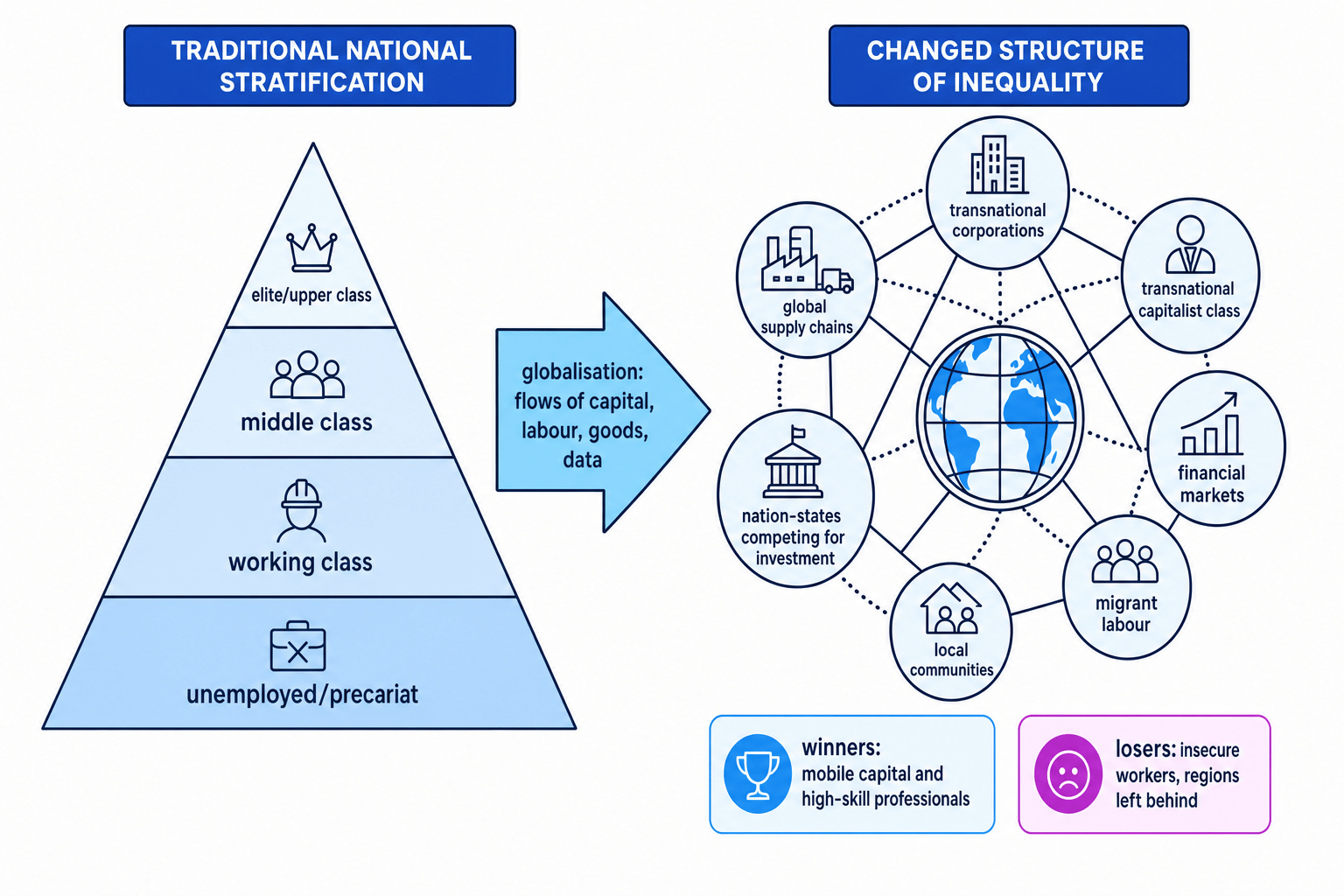
For much of industrial Britain, sociologists often described inequality through a mainly national class structure. This meant focusing on social classes within one country: an upper class of owners, a middle class of managers and professionals, a working class of manual workers, and groups excluded from secure employment.
Marx explained class through ownership of the means of production: the factories, land, technology and capital needed to produce goods. For Marxists, the bourgeoisie own capital, while the proletariat sell their labour. Exploitation means owners make profit from workers’ labour.
Weber gave a broader view. He argued that inequality also depends on status, meaning social honour or prestige, and party, meaning organised power through politics or pressure groups. This is useful today because inequality is shaped not only by ownership, but also by qualifications, credentials, citizenship, networks and cultural respect.
Since the late twentieth century, the UK class structure has changed in several linked ways:
- Deindustrialisation: the decline of manufacturing, mining and heavy industry.
- Growth of a post-industrial economy: an economy dominated by services, finance, technology, education, care and information work.
- Flexible labour markets: more temporary, part-time, zero-hours, agency and gig-economy work.
- Financialisation: the growing power of banks, investment funds, property and financial markets.
- Rising importance of asset inequality: unequal ownership of housing, pensions, shares and inheritance.
- Decline of some traditional working-class institutions, such as trade unions and occupational communities.
Savage et al.’s Great British Class Survey (2013) argued that class in contemporary Britain is multidimensional. It measured economic capital such as income and wealth, social capital such as useful networks, and cultural capital such as tastes, knowledge and credentials. It identified groups including an elite, established middle class and precariat. However, its online self-selecting sample creates validity problems because some groups were more likely to take part than others.
This diagram summarises the shift from seeing inequality mainly as a national class pyramid to seeing it as a global network of firms, workers, states and elites.
Saying class has disappeared
Do not argue that class no longer matters. A stronger answer is that class has been restructured: ownership, wealth and credentials still matter, but they operate through more global, flexible and fragmented systems.
3. Globalisation: why inequality is no longer just national
Globalisation means the increasing interconnectedness of societies through flows of money, goods, people, information, culture and political decisions. It has economic, political and cultural dimensions.
Globalisation
Globalisation is the process by which economies, cultures, technologies and political decisions become increasingly connected across national borders.
A transnational corporation or TNC is a company that operates in more than one country. TNCs can organise production through global supply chains, where different stages of production happen in different countries. For example, a product may be designed in the UK, assembled in Asia, marketed through a US platform and delivered by workers on insecure contracts.
Several processes matter here:
- Offshoring means moving production or services to another country.
- Outsourcing means contracting work to another organisation, often to reduce costs.
- Labour migration means workers moving between countries for employment.
- Neoliberalism means a political-economic approach favouring markets, competition, privatisation, deregulation and reduced trade barriers.
- Tax competition means states competing to attract investment by offering lower taxes or favourable rules.
In the UK, globalisation can be applied to the City of London’s role in finance, multinational technology firms, fast fashion, international students, migrant labour in care work, and platform companies such as delivery and ride-hailing apps.
Applying globalisation to fast fashion inequality
-
Map the supply chain: design, branding and online marketing may be controlled from wealthy countries, while manufacturing may take place in lower-wage economies and delivery may involve warehouse or courier workers in the UK.
-
Identify who gains most: shareholders, senior managers, brand owners and investors often capture high profits because they control capital, data, marketing and intellectual property.
-
Identify who carries risk: garment workers, warehouse workers and delivery workers may face low pay, insecure hours, weak union protection or intense monitoring.
-
Connect to social differentiation: the workforce may be stratified by gender, ethnicity, migration status and global location, so class inequality overlaps with other inequalities.
-
Evaluate the claim: globalisation may create jobs and cheaper consumer goods, but it can also hide exploitation across borders and weaken workers’ bargaining power.
4. The transnational capitalist class
A major concept in this topic is the transnational capitalist class or TCC. “Transnational” means operating across national borders. “Capitalist” refers to control of capital, investment and profit-making resources. “Class” means a group sharing a similar position in relation to economic power.
Leslie Sklair (2001) argues that global capitalism is shaped by a transnational capitalist class whose interests are not limited to one nation-state. This is not simply “rich people abroad”. It is a globally connected elite with shared interests in free trade, investment opportunities, consumer culture and policies favourable to capital.
Transnational capitalist class
The transnational capitalist class is a globally connected elite whose economic, political and cultural power comes from controlling or supporting transnational capitalism across national borders.
Sklair identifies several “fractions” of the TCC: corporate executives and owners, globalising politicians and officials, technical professionals such as lawyers and consultants, and media or advertising elites who promote consumerist values.
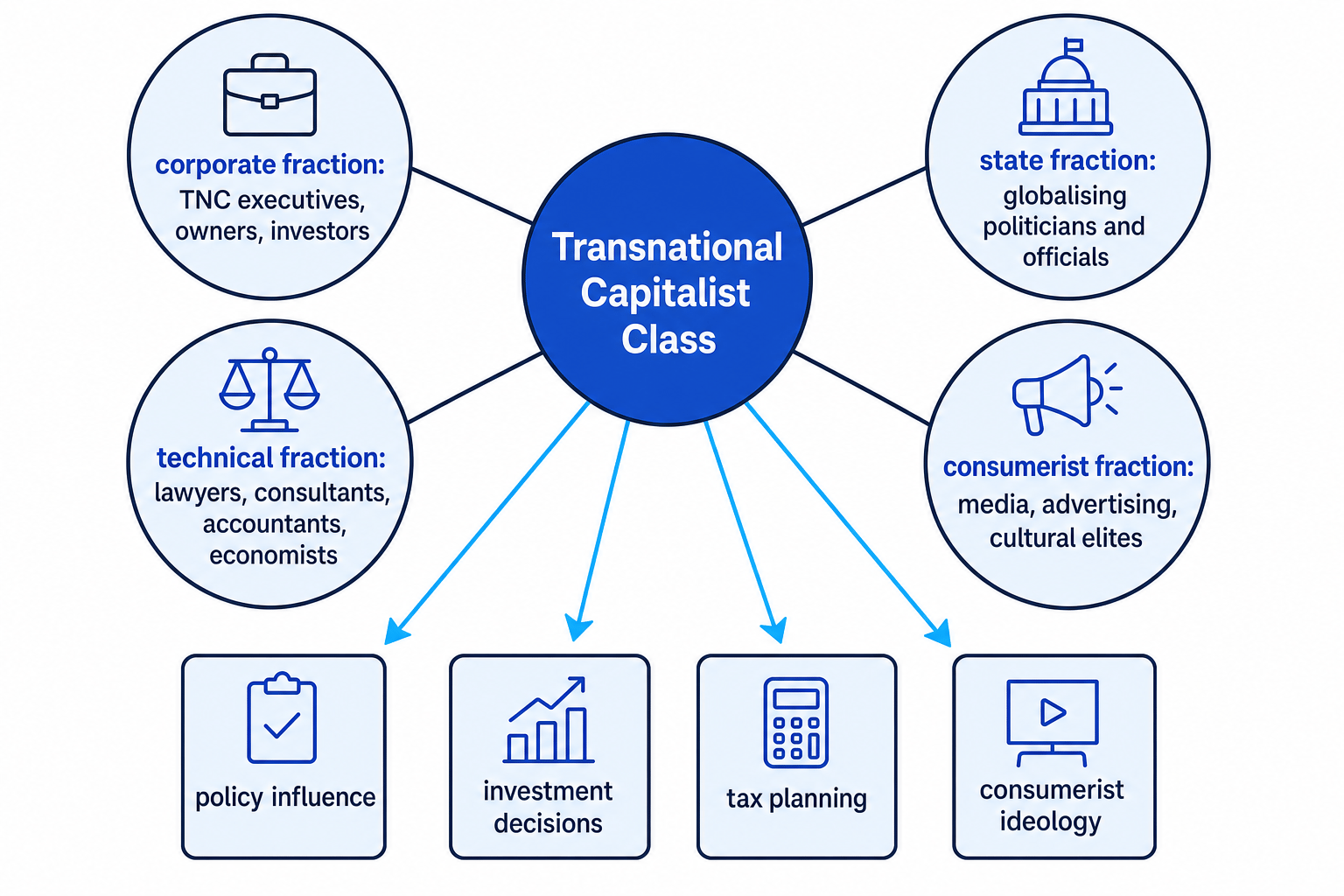
The TCC matters because power becomes less contained within the nation-state. Investment decisions, tax planning, lobbying and media influence may be organised globally. This can make it harder for any single government to regulate inequality.
Tracing transnational class power in a policy choice
-
Start with capital mobility: a TNC can often choose between several countries when deciding where to locate investment, production, data centres or headquarters.
-
Analyse the state’s position: a government may offer tax incentives, infrastructure, skilled labour or lighter regulation to attract or keep that investment.
-
Link to elite networks: corporate leaders, consultants, lobbyists and policy advisers can shape what governments see as “business-friendly” or “competitive”.
-
Identify the inequality effect: jobs may be created, but the largest rewards may go to investors, executives and high-skill professionals, while tax revenue or worker protections may be limited.
-
Add evaluation: states are not powerless, because voters, courts, unions, welfare policies and international agreements can still constrain corporate power.
Do not make the state disappear
Globalisation changes the power of nation-states, but it does not abolish them. Governments still control taxation, welfare, education, migration law, minimum wage rules and public spending.
5. Implications of these changes
Class polarisation and the precariat
Polarisation means the gap between advantaged and disadvantaged groups becomes sharper. Globalisation may create highly paid work in finance, technology, law and management, while also expanding low-paid service work, insecure contracts and platform labour.
Guy Standing (2011) uses the term precariat for workers living with insecurity, unstable income, weak employment rights and limited occupational identity. In the UK, this can be applied to zero-hours contracts, gig-economy delivery work, insecure private renting and in-work poverty.
This also affects socialisation, culture and identity. In the past, class identity might have been built around stable workplaces, unions and local communities. Today, individuals may be encouraged to see insecurity as a personal responsibility rather than a structural problem. Beck and Giddens call this individualisation: people are expected to manage risks that were once handled more collectively.
Regional and asset inequality
Globalisation benefits some places more than others. London’s role as a global financial and professional-services centre has increased wealth for some groups, while former industrial areas may experience job loss, weaker local economies and lower social mobility. Social mobility means movement between social classes, either within one lifetime or across generations.
Housing also matters. People who own valuable property, especially in high-demand regions, may accumulate wealth faster than renters. This means inequality is increasingly about assets and inheritance, not just wages.
Gender, ethnicity and migration
Intersectionality means inequalities overlap and shape each other. Globalisation is not experienced equally by all workers. Migrant workers may be concentrated in care, cleaning, agriculture, hospitality or delivery work. Women often do paid care work as well as unpaid domestic labour. Ethnic minority groups may face discrimination in employment, housing and policing alongside class disadvantage.
Feminist sociologists argue that global capitalism depends on both paid and unpaid labour. For example, the UK care sector relies heavily on migrant and female workers, while families still depend on unpaid caring work, often done by women.
Culture and consumer identity
Sklair argues that the TCC promotes a culture-ideology of consumerism, meaning the idea that happiness, success and identity are achieved through buying goods and lifestyles. This links inequality to culture: people may be socialised into global consumer identities even when their economic security is weak.
Bourdieu’s ideas are useful here. Economic capital, social capital and cultural capital shape who feels confident in elite spaces, who gains educational advantage, and who can convert networks into opportunities.
The main implication
Globalisation does not remove inequality; it reorganises it. Some people gain mobility, assets, credentials and global networks, while others face insecurity, weaker collective power and decisions made far beyond their local community.
6. Evaluating the argument
A strong AO3 answer compares perspectives rather than simply listing changes.
A Marxist or global capitalism approach is strong because it highlights ownership, exploitation and the power of TNCs. It explains why mobile capital can pressure workers and governments. However, it may overstate how united the TCC is, because elites and states often compete with each other.
A Weberian approach is useful because it looks beyond ownership. It shows how market position, qualifications, status, citizenship and political organisation shape life chances. This fits contemporary inequality, where credentials, professional networks and legal status matter.
A feminist and intersectional approach improves class analysis by showing that global inequality is gendered and racialised. It explains why migrant women, care workers and ethnic minority workers may be especially vulnerable. However, essays still need to connect these inequalities to wider economic structures, not treat them as separate issues.
A postmodern or late-modern view argues that identities are more fluid and shaped by consumption, media and lifestyle. This captures real cultural change, but it can underplay the continuing importance of wealth, housing, education and inherited advantage.
Methodologically, evidence comes from sources such as the Census, ONS labour market data, the Wealth and Assets Survey, social mobility research, ethnographies and interviews. Official statistics can be reliable and representative, but may miss hidden wealth, offshore assets, undocumented migrant workers or elite non-response. Interpretivist research can reveal lived experiences of insecurity, but may be harder to generalise.
Method evaluation shortcut
For evidence on global inequality, ask: Who is missing from the data? The richest may hide wealth, the most insecure may be hard to reach, and global supply chains may make responsibility difficult to trace.
Building an evaluative judgement
-
Compare the main claim: Marxists argue globalisation strengthens capitalist power by allowing capital to move across borders and search for cheaper labour.
-
Apply it to the UK: deindustrialisation, insecure service work and global finance support the view that inequality has become more polarised and transnational.
-
Add a counter-perspective: Weberians would argue that qualifications, professional status and citizenship also structure inequality, so ownership alone is not enough.
-
Reach a balanced judgement: globalisation is a major driver of change, but its effects are mediated by state policy, trade unions, welfare systems, gender, ethnicity and local labour markets.
In the exam
-
Start by defining the key change: inequality has shifted from a mainly national class hierarchy to a more global, networked structure.
-
Use named concepts and theorists: globalisation, TNCs, Sklair’s transnational capitalist class, Standing’s precariat, and Bourdieu’s forms of capital are all useful.
-
Apply to concrete examples: use UK finance, fast fashion, gig work, migration, housing wealth, deindustrialised regions or global care work.
-
Evaluate throughout: show both the power of global capitalism and the continuing importance of nation-states, welfare policy, gender, ethnicity and local context.
Check yourself
- How does globalisation change the bargaining power of workers and nation-states?
- What are Sklair’s main fractions of the transnational capitalist class?
- Give one example of how class inequality intersects with gender, ethnicity or migration status.
