In modern society, we are constantly saturated with media. But have you ever stopped to ask: Who actually decides what we see, hear, and read?
In A-Level Sociology, the debate over ownership and control is central to understanding the role of the media in contemporary society. We will examine how media ownership has become concentrated in the hands of a few powerful corporations, and explore the competing theoretical perspectives that explain the relationship between those who own the media and the content that gets produced.
What you'll learn
- How media ownership has become highly concentrated globally and in the UK.
- The key differences between the Instrumentalist (Marxist), Hegemonic (Neo-Marxist), and Pluralist perspectives on media control.
- How to evaluate these theoretical frameworks using contemporary real-world examples.
1. The Landscape of Media Ownership
To understand who controls the media, we first need to look at who owns it. Over the last few decades, the ownership of global media has shifted from a diverse range of local, independent companies into a small number of massive, multinational corporations.
Concentration of Media Ownership
Concentration of media ownership refers to the process where progressively fewer individuals or organisations control increasing shares of the mass media market.
Sociologist Ben Bagdikian (2004) tracked this trend in the USA. He found that in 1983, 50 corporations controlled the vast majority of all news media. By 2004, this number had shrunk to just 5 dominant conglomerates—what he termed the "Lords of the Global Village".
In the UK, a similar concentration exists. Research by the Media Reform Coalition consistently shows that just three companies (such as Reach, News UK, and DMG Media) dominate the UK national newspaper market.
How Media Companies Grow
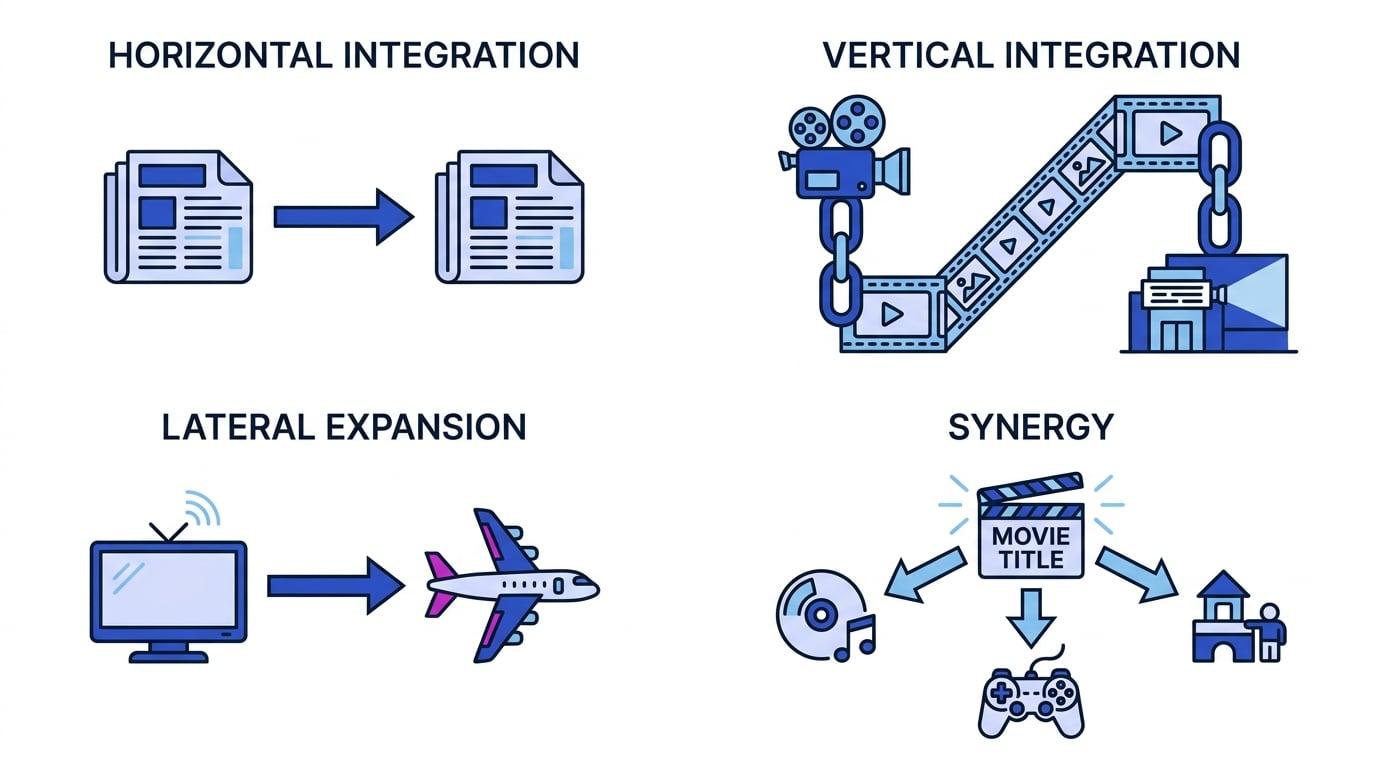
To achieve this level of concentration, media corporations use several integration strategies:
- Horizontal Integration: When a media company buys up its competitors in the same sector (e.g., a newspaper publisher buying another newspaper company to reduce competition).
- Vertical Integration: When a company controls different stages of the production and distribution process within a single industry (e.g., a film studio owning the production company, the special effects studio, and the cinema chain where the movie is shown).
- Lateral Expansion (Diversification): When a company diversifies into different, unrelated business areas to spread economic risk (e.g., a media company owning a television channel, a record label, and an airline).
- Synergy: Using different assets of a conglomerate to package and market a product in multiple ways to maximise profit (e.g., a movie release accompanied by a soundtrack, a video game, toys, and fast-food tie-ins).
- Technological Convergence: Merging different media technologies into a single delivery system or device, such as a smartphone, which acts as a camera, newspaper, television, and gaming console.
The Economic Imperative
Modern media companies are profit-seeking multinational conglomerates. Their structures are designed to maximise efficiency, eliminate competition, and cross-promote products globally.
2. Theories of Media Ownership and Control
Who actually holds the power to shape media content? Sociologists divide this debate into three main schools of thought: Instrumentalist Marxism, Hegemonic Neo-Marxism, and Pluralism.
Theory A: The Instrumentalist (Manipulative) Marxist Perspective
This traditional Marxist approach is associated with sociologists like Ralph Miliband and the classic work of Curran and Seaton (2018).
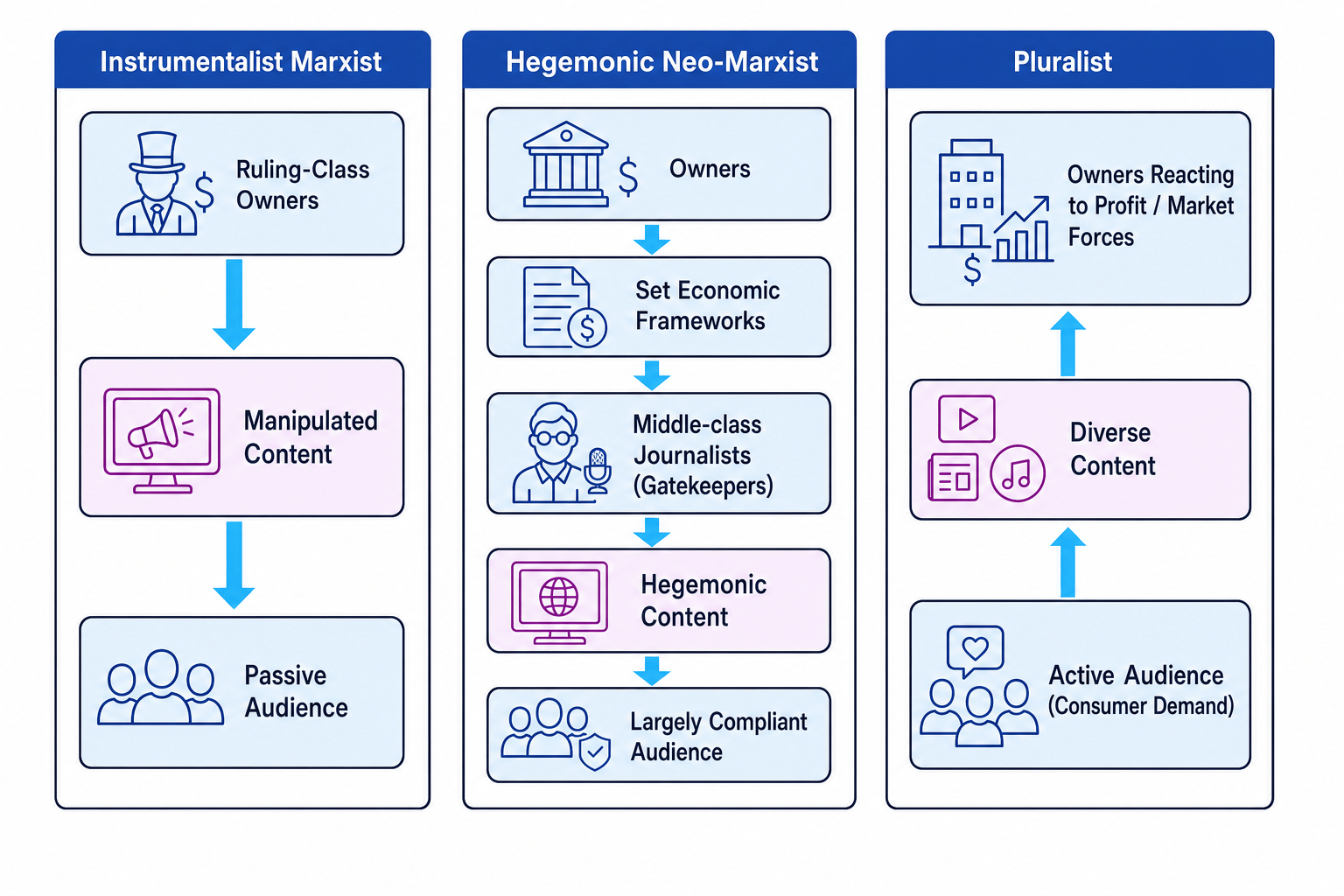
Instrumentalists argue that the media is an instrument of the ruling class (the bourgeoisie). They believe that media owners directly intervene in media content to manipulate public opinion and protect their own wealth and class interests.
- Direct Control: Owners are active, hands-on proprietors. They hire, fire, and brief editors to ensure the political output of their outlets aligns with their own right-wing, pro-capitalist views.
- Ideological Control: The media is used to transmit ruling-class ideology. By presenting capitalism as natural and fair, and scapegoating marginalised groups (such as immigrants or welfare claimants), the media creates a state of false class consciousness. This prevents the working class (the proletariat) from realising their exploitation and rebelling.
- Audience Viewpoint: The audience is viewed as a passive, uncritical mass (often compared to a biological sponge) that accepts whatever dominant message is "injected" into them.
The UK Press and the Iraq War
Let's see how an Instrumentalist Marxist would analyse the political influence of media owners.
- Identify the media owner: Rupert Murdoch, the billionaire owner of News Corporation (which owned The Sun, The Times, and Fox News).
- Observe the owner's political stance: Murdoch was a public, outspoken supporter of the 2003 invasion of Iraq.
- Analyse the editorial output: Across the globe, all 175 newspapers owned by Murdoch editorialised in favour of the war.
- Draw the sociological conclusion: This uniformity of political messaging across multiple continents demonstrates direct, top-down owner intervention to shape public opinion in support of capitalist geopolitical interests.
Evaluation of the Instrumentalist Perspective
- Strength: It highlights how media owners occasionally make blatant, politically motivated interventions (such as Rupert Murdoch famously admitting he exerted editorial control over The Sun on key political matters).
- Weakness: It is overly conspiratorial and simplistic. It ignores the fact that media companies must compete for profits, and sometimes publishing anti-capitalist material is highly lucrative. It also treats the audience as incredibly gullible.
Theory B: The Hegemonic (Neo-Marxist) Perspective
Associated with the Glasgow Media Group (GMG) and the concept of hegemony developed by Marxist theorist Antonio Gramsci, this view offers a more subtle explanation.
Neo-Marxists argue that media owners do not have direct, day-to-day control over media content. Instead, control is indirect and exercised through media professionals (journalists, editors, and producers).
- Social Background of Journalists: Journalists are not forced by owners to write biased articles. Rather, they tend to share a similar socio-economic background to owners (disproportionately white, male, middle-class, and privately educated). Consequently, they naturally share the same conservative, pro-capitalist worldviews.
- Cultural Hegemony: The media projects the dominant ideology as "common sense" not through force or direct command, but because journalists subconsciously believe this is the normal way to view the world.
- Economic Constraints: Journalists must operate within the economic limits set by owners (budgets, target audiences).
- Gatekeeping and Agenda Setting: The media controls what gets discussed and how. Issues that threaten the capitalist system are ignored or marginalised (gatekeeping), while debate is kept within narrow, "acceptable" boundaries (agenda setting).
- Audience Viewpoint: The audience is not completely passive, but the media heavily restricts the choices of ideas they are exposed to, making alternative political ideas seem "extreme" or unrealistic.
Differentiating the Marxist Perspectives
- Instrumentalists believe owners actively manipulate content to brainwash the public.
- Hegemonics believe journalists subconsciously filter content to match dominant societal values because they share the same class background.
Evaluation of the Hegemonic Perspective
- Strength: It is highly realistic. It explains how media bias can occur without a literal, top-down conspiracy or the owner constantly breathing down the editor's neck.
- Weakness: It underestimates the power of the owners. Owners still retain the power to fire editors who stray too far from their desired political line.
Theory C: The Pluralist Perspective
Pluralists, such as James Whale (1977), present a starkly different, non-Marxist view of the media. They argue that power in democratic societies is shared among a wide variety of competing groups, rather than concentrated in a single ruling class.
- Consumer Sovereignty: The ultimate power lies with the audience. Media companies are businesses that must make a profit to survive. If they do not produce the content that audiences want to buy or watch, they will go out of business. Therefore, the audience dictates media content.
- Diversity of Content: Because society is made up of diverse groups with different interests, the media market offers a vast range of views. Even if some newspapers are right-wing, others are left-wing, liberal, or apolitical to cater to different market segments.
- Journalistic Objectivity: Journalists are seen as objective, professional truth-tellers who are bound by codes of ethics and the need to investigate stories to maintain credibility. They are not ideologically driven puppets.
- Democratic Check on Power: Rather than serving the elite, the media acts as a "fourth estate"—a watchdog that holds those in power accountable.
- Audience Viewpoint: The audience is active, critical, and highly capable of selecting, interpreting, and rejecting media messages.
Confusing 'Plurality' with 'Pluralism'
Do not confuse "plurality" (which just means having lots of different outlets) with the sociological perspective of Pluralism. Pluralism is a theory claiming that power is evenly distributed and that the consumer is in charge of content, regardless of whether the physical ownership of those outlets is concentrated.
Evaluation of the Pluralist Perspective
- Strength: It recognises the active role of consumers in a digital age where social media allows audiences to talk back and generate their own content (user-generated content).
- Weakness: It is highly idealistic. It ignores how difficult it is for ordinary people or minor political groups to start up national media companies due to the massive capital costs involved (barriers to entry). It also ignores how advertising pressures can limit the diversity of media content, as advertisers do not want to fund radical or controversial programs.
3. Postmodernism and the Digital Age
To achieve top marks (AO3) in your exam, you should bring the debate into the 21st century by discussing how new media and digital technology have transformed ownership and control.
Postmodernists like Jean Baudrillard argue that the distinction between media owners, producers, and audiences has collapsed.
- Active Prosumers: In the digital age, we are no longer just consumers of media; we are "prosumers" (producers + consumers) who create, edit, and share content via platforms like TikTok, YouTube, and X (formerly Twitter).
- Hyperreality: We live in a media-saturated world where the media does not merely represent reality; it creates it. This is called a hyperreality, where images and "simulacra" (copies with no original) become more real than the physical world itself.
- No Central Control: Because of the internet, it is incredibly difficult for any single media mogul or ruling class to control the flow of information. Ideas spread virally, bypassing traditional gatekeepers.
The Illusion of Postmodern Freedom
While postmodernists celebrate user-generated content, Marxists argue that this is an illusion. The actual digital infrastructure (the servers, algorithms, and code) of platforms like Google, Meta (Facebook/Instagram), and Amazon are owned by an incredibly tiny, elite group of tech billionaires who exert immense control over what content is prioritised.
In the exam
If you face an essay question on ownership and control (such as a 10-mark or 20-mark essay), use these core strategies:
- Lead with the core debate: Immediately frame your answer around the clash between the Marxist approaches (who see media as a tool of elite ideological power) and the Pluralist approach (who see media as consumer-driven and democratic).
- Explicitly apply key concepts: Make sure you use and define structural concepts (such as synergy, vertical integration, and diversification) alongside your theoretical concepts (false class consciousness, hegemony, gatekeeping, consumer sovereignty).
- Evaluate using contemporary context: Do not just rely on historical examples. Mention modern tech conglomerates (Meta, Alphabet/Google, ByteDance) to show how traditional concepts apply to the digital era.
Check yourself
- Can you explain the difference between horizontal and vertical integration using a hypothetical media company?
- Why do Neo-Marxists argue that journalists do not need to be told what to write by their employers?
- How would a Pluralist respond to the Marxist claim that billionaire media owners brainwash the working class? </selfreview