Welcome to your study notes on the New Media! This topic sits at the heart of contemporary sociology. It looks at how rapid technological change has transformed not only how we communicate, but also how our identities are constructed, how power is distributed, and how inequality is reinforced in the UK and globally.
What you'll learn
- The defining characteristics of the "new media" and how they differ from "traditional" media.
- How access to and use of these technologies are stratified by age, class, gender, and geography (the digital divide).
- The core sociological debate between Neophiliacs (technological optimists) and Cultural Pessimists (technological critics).
1. What is the "New Media"?
To understand the social impact of modern technology, we first need to define exactly what makes "new" media different from "traditional" (or "old") media like print newspapers, terrestrial television, and radio.
New Media
New Media refers to screen-based, digital communication technologies that emerged in the late 20th and early 21st centuries. It is characterised by its digital format, interactivity, integration of different media forms, and user-generated content.
Sociologists identify five key characteristics that define the new media:
- Digitality: Almost all new media data is processed as digital code (binary code). This allows vast amounts of information to be compressed, stored, and transmitted rapidly across networks.
- Interactivity: Unlike traditional media, where the audience is a passive receiver (a one-way flow of information), new media is a two-way flow. Users can actively engage, customise, comment, and collaborate.
- Hypertextuality: This is the use of hyperlinks to connect different pieces of information. It allows users to navigate information non-linearly, forging their own pathways through content rather than following a pre-determined narrative.
- Dispersal (or Decentralisation): Media production is no longer concentrated solely in the hands of massive professional organizations. It has become dispersed, allowing everyday users to become content creators.
- Convergence: This is perhaps the most significant structural change. Devices and industries have merged.
Media Convergence
Media Convergence is the process whereby different types of media technologies, content, and industries merge into a single delivery system or platform.
Sociologist Henry Jenkins (2006) argues that convergence is both technological (e.g., your smartphone is a camera, music player, TV, and GPS) and cultural. Culturally, convergence has led to participatory culture, where consumers are active participants who shape, share, and remix media content.
This shift has turned media consumers into prosumers (a term originally coined by Alvin Toffler and widely used in sociology)—people who both consume and produce media content (for example, uploading a TikTok or writing a Wikipedia entry).
The Digital Public Square vs. The Gilded Mall
Think of traditional media as a grand lecture hall: a single speaker at the front (a TV network or newspaper editor) addresses a silent, seated audience.
New media, by contrast, is more like a massive digital public square. Everyone has a megaphone, everyone can talk to anyone else, and groups can form dynamically. However, cultural pessimists would warn that this square is actually built inside a "gilded corporate mall" where your conversations are constantly recorded by the mall's owners to sell you targeted ads.
2. Who is Using the New Media? The Digital Divide
While the new media sounds liberating, access to it is not equal. Sociologists warn against assuming that everyone has the same relationship with technology. This unequal distribution is known as the digital divide.
The Digital Divide
The digital divide refers to the inequalities in access to, and literacy in, digital technology. It is highly stratified by structural social factors: class, age, gender, and global location.
Social Class
Although basic smartphone ownership is high, a digital underclass exists. Helsper (2011) points out that a digital divide persists because those with lower incomes and educational levels are often "disadvantaged internet users." They may rely solely on mobile-only access with limited data packages, have lower digital literacy, and use the internet primarily for entertainment rather than career advancement, education, or financial management.
Age
Age is the most significant predictor of digital engagement. Prensky (2001) coined the terms:
- Digital Natives: Young people who have grown up surrounded by digital technology and use it naturally and intuitively.
- Digital Immigrants: Older generations who have had to adapt to new technology later in life, often using it less fluently.
However, we must avoid stereotyping; many older adults are highly active online, but statistical trends still show a clear generational gap in the range of platforms used (e.g., TikTok vs. Facebook).
Gender
Historically, men were seen as the primary users of computer technology. Today, research shows that gender differences lie more in how technology is used:
- Li and Kirkup (2007) found that men are more likely to play video games and use the internet for technical purposes, whereas women are more likely to use social media for communication and maintaining social networks.
- Women are also disproportionately targeted by cyberbullying and online harassment, affecting how they navigate online spaces.
Global Divide
The divide is highly visible on a global scale. While western nations have hyper-fast broadband networks, vast areas of the Global South have limited infrastructure. This reinforces dependency and global inequalities, as economic growth and educational resources are increasingly tied to digital access.
3. The Theoretical Debates: Optimists vs. Critics
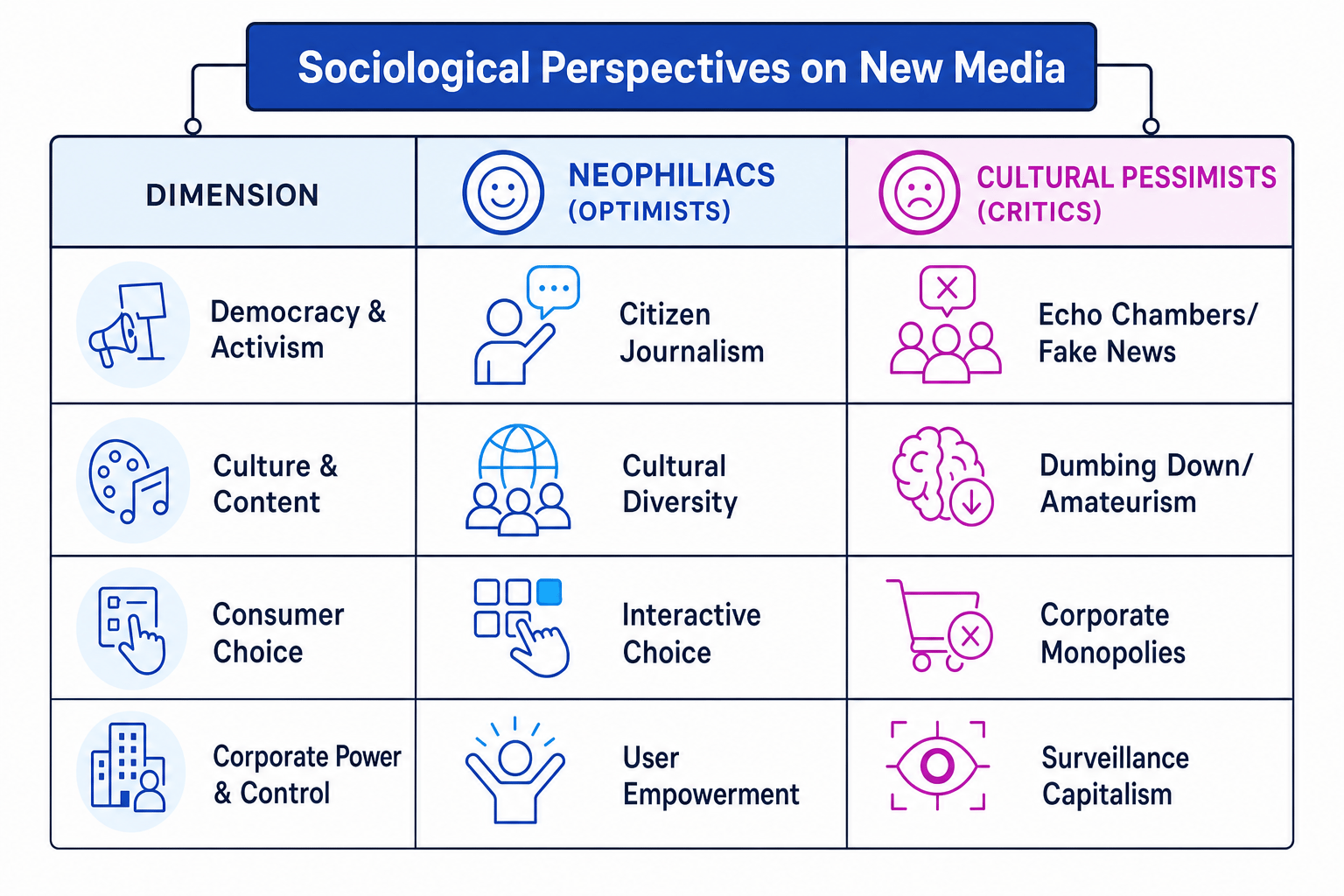
The sociological debate over the significance of the new media is divided into two main camps: Neophiliacs (who see it as a positive force for democracy and freedom) and Cultural Pessimists (who view it as a tool for corporate control, surveillance, and superficiality).
The Neophiliac (Optimist) Perspective
Neophiliacs argue that the new media has fundamentally improved society. They point to several key benefits:
- Increased Consumer Choice: There are now millions of websites, streaming services, and niche platforms. Audiences are no longer restricted to what a few TV executives decide to broadcast.
- E-Commerce and Convenience: Online shopping, banking, and services have empowered consumers, allowing easy price comparison and customisation.
- Revitalising Democracy (Citizen Journalism): Ordinary citizens can bypass traditional corporate media gatekeepers. Anyone with a smartphone can film police brutality, report from war zones, or start a political movement (e.g., Black Lives Matter, climate strikes).
- The Global Village: Marshall McLuhan’s concept of the "global village" has been realised. People can communicate instantaneously across the globe, foster cross-cultural understanding, and build global communities based on shared interests rather than geographic proximity.
The Cultural Pessimist (Critical) Perspective
Cultural pessimists argue that the neophiliac view is naive, corporate-friendly, and ignores the darker structural realities of digital capitalism.
- The Domination of Media Conglomerates: Rather than democratising the media, power has concentrated into the hands of a tiny group of tech giants (e.g., Meta, Alphabet/Google, Apple, Microsoft, Amazon). These companies act as massive corporate gatekeepers.
- Surveillance Capitalism: Sociologist Shoshana Zuboff (2019) argues that our personal data is continuously harvested, analyzed, and packaged to predict and modify our behaviour for corporate profit. We are not the customers of social media; we are the product.
- The "Cult of the Amateur" and Dumbing Down: Andrew Keen (2007) argues that the rise of user-generated content has eroded the quality of culture. Professional journalism, expert knowledge, and high-quality artistic achievements are replaced by superficial, unedited blogs, fake news, and low-quality viral videos.
- Echo Chambers and Filter Bubbles: Algorithms are designed to keep us engaged by showing us content that confirms our existing biases. This creates "echo chambers" that radicalise political opinions and deeply polarise society, undermining democratic debate.
- Mental Health and Isolation: Sherry Turkle (2011), in her book Alone Together, argues that while we are more digitally connected than ever, we are physically and emotionally isolated. We use technology to avoid deep, authentic face-to-face relationships, leading to anxiety and shallow interactions.
<commonmistake title="The "Either/Or" Trap">
Do not write your essay as if one perspective is completely right and the other is completely wrong. The strongest sociological answers evaluate how both perspectives describe different elements of the same reality. For instance, the internet can be a tool for democratic liberation (Neophiliac) while simultaneously acting as a tool for state and corporate surveillance (Cultural Pessimist).
4. Applied Analytical Practice
To succeed in your A-Level exam, you must show the examiners that you can apply these abstract theoretical perspectives to contemporary real-world developments.
Evaluating the social impact of algorithmic content feeds
Apply the Neophiliac and Cultural Pessimist perspectives to analyze the rise of highly personalized algorithmic feeds (e.g., TikTok's "For You" page).
- Identify the core mechanism of the technology: Algorithmic curation uses machine learning to track a user's watch time, likes, and shares, automatically serving them content tailored precisely to their individual psychological profile.
- Apply the Neophiliac perspective: An optimist would argue this is a peak example of consumer control and interactivity. The user is freed from traditional scheduling; the media adaptively serves their specific niche tastes, fostering creative communities (e.g., "BookTok" or communities for rare neurodivergent experiences) that help individuals find validation and construct their identities.
- Apply the Cultural Pessimist perspective: A critic would argue this represents algorithmic control and surveillance capitalism. The platform treats the user's attention span as a commodity. By feeding them increasingly extreme versions of their interests to maximize screen time, it creates filter bubbles that isolate them from diverse opinions, while harvesting their emotional profile data to sell to advertisers.
- Synthesize the two for a high-level evaluation: While the technology offers unprecedented personalization (AO1/AO2), it shifts power from the individual to corporate algorithms (AO3). The user feels they have infinite agency, but this agency is curated and contained within a closed system designed to exploit human psychology for corporate profit.
Outdated Examples
Avoid using examples from the early 2000s (like Myspace or MSN Messenger) as if they are modern trends. Keep your examples fresh! Talk about TikTok, the rise of generative AI (like ChatGPT), Elon Musk’s takeover of X, or streaming platforms like Netflix and Spotify. This shows the examiner that you are a contemporary sociologist.
In the exam
- Unpack the question carefully: If the essay question asks you to "Evaluate the view that the new media has democratised society," you must structure your answer around the Neophiliac vs. Cultural Pessimist debate, using democracy as your core focus.
- Weave in structural inequalities: Don't just talk about technology in a vacuum. Always link the debate back to stratification (how age, class, and gender limit who can participate in this "democratisation").
- Use precise sociological terms: Elevate your writing by replacing everyday words with terms like prosumerism, surveillance capitalism, digital underclass, media convergence, and cultural imperialism. </2. Provide contemporary, UK-focused evidence: Mention developments like citizen journalism during political protests, the ONS statistics on digital exclusion, or the role of social media in elections to support your points.
Check yourself
- Can you explain the difference between technological convergence and cultural convergence using real-world examples?
- Why does Helsper argue that the digital divide is about more than just "having a computer"?
- How does Shoshana Zuboff’s concept of "surveillance capitalism" challenge the Neophiliac view that the internet is a free utility for users?
