What you'll learn
- Why sociologists treat development as multidimensional, not just economic growth.
- How employment, education, health, demographic change and gender can all indicate development.
- How to apply theories such as modernisation, dependency, world-systems, feminist theory and Sen’s capability approach.
- How to build AO3 evaluation by questioning indicators, power inequalities and Western assumptions.
Development is more than GDP
In Global Development, development means more than a country becoming richer. It usually refers to improvements in people’s living standards, choices, rights, health, security and ability to participate in society.
Development
Development is a process of social, economic, political and cultural change that improves people’s life chances and freedoms.
By contrast, economic growth means an increase in the value of goods and services produced by an economy, often measured through GDP or GNI. Growth can help development, but it does not guarantee it. A country may have a high GDP because of oil exports while still having poor health care, low literacy, gender inequality or extreme poverty.
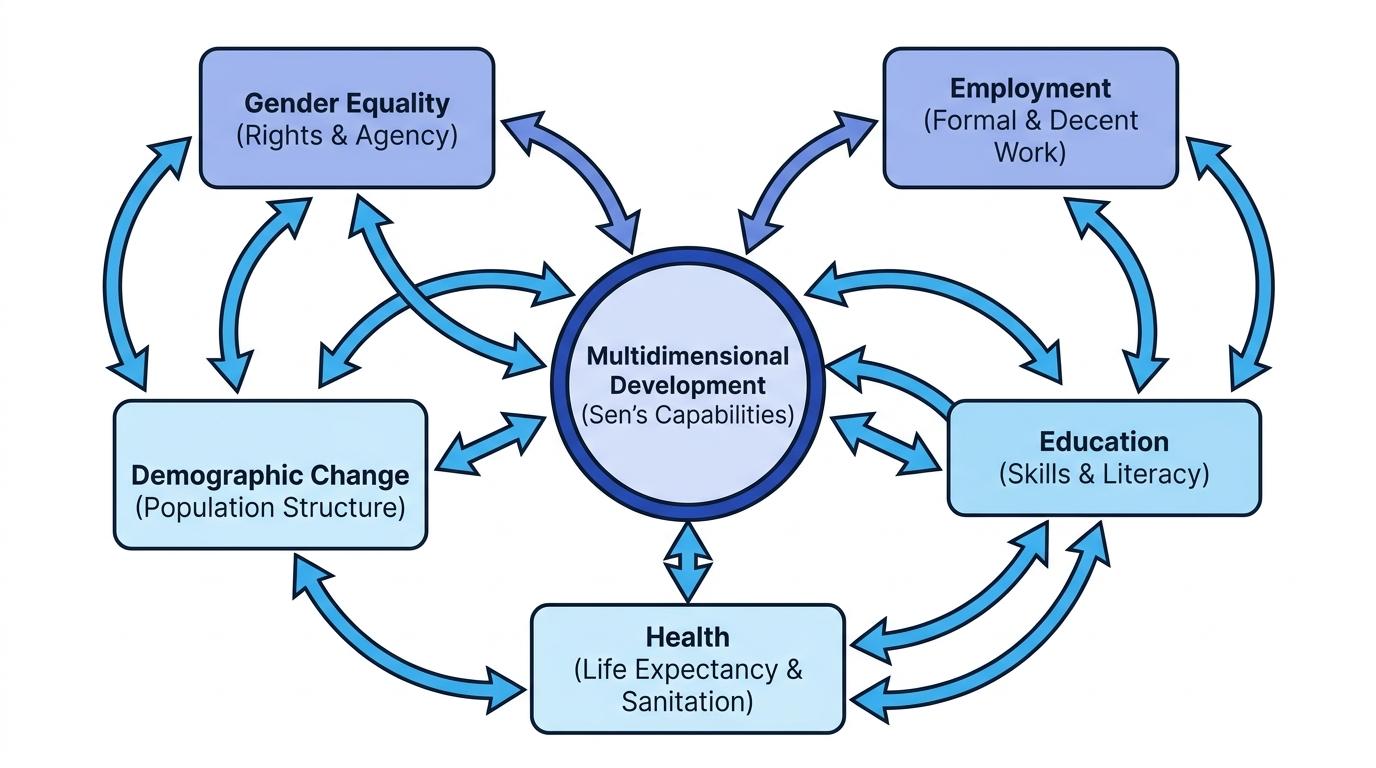
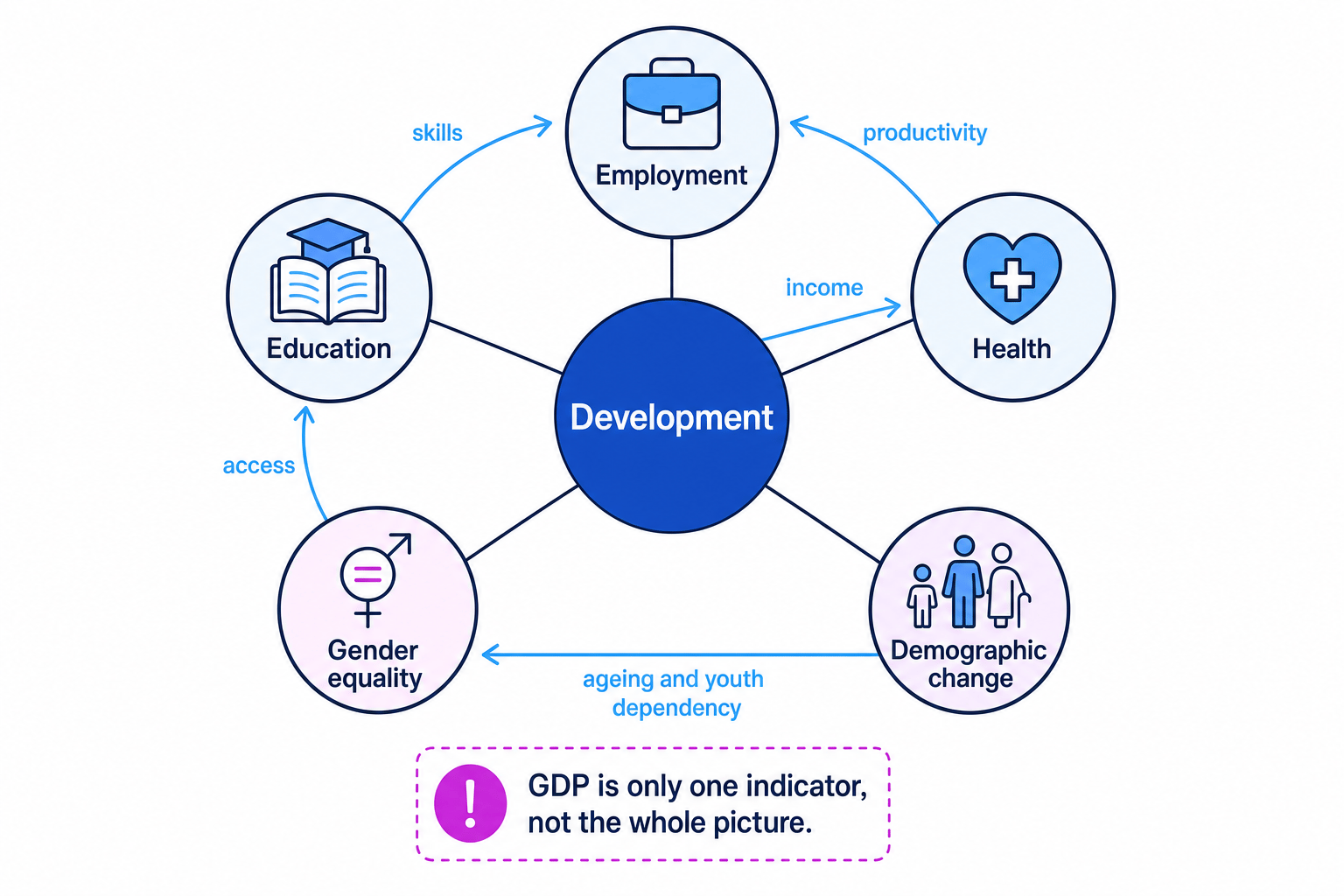
This is why sociologists look at aspects of development: employment, education, health, demographic change and gender. These aspects affect each other in feedback loops.
The big idea
Development is best understood as a pattern of changes in people’s lives, not as a single number on a league table.
A useful theorist here is Amartya Sen, who argues that development should be about expanding people’s capabilities: their real opportunities to live the kind of life they value. This links directly to AQA’s core themes: development changes culture, identity and socialisation, but it is also shaped by power, stratification and inequality.
Comparing two development profiles
Imagine Country A has high national income from mineral exports but low life expectancy and low girls’ secondary school attendance. Country B has lower national income but high literacy, low infant mortality and strong gender equality.
- Start by separating economic growth from wider development: Country A may be richer on paper, but its wealth is not necessarily improving ordinary people’s lives.
- Compare several indicators: education, health and gender equality suggest Country B may be more developed in Sen’s sense of real human capabilities.
- Apply AO3: Country A may show how wealth can be concentrated among elites or foreign companies, supporting dependency and world-systems arguments about unequal power.
- Reach a balanced judgement: income matters, but it is not valid on its own as a measure of development.
Reducing development to GDP
Do not write as if “more GDP” automatically means “more development”. Always ask: who benefits, how is wealth distributed, and what happens to health, education, gender and work?
Employment as an aspect of development
Employment matters because paid work can provide income, independence, status and social identity. In development sociology, you should consider both the quantity and quality of jobs.
Formal and informal employment
Formal employment is regulated work with contracts, wages and legal protections. Informal employment is work outside full state regulation, such as street vending, casual labour or unpaid family work.
Modernisation theorists, such as Rostow, see development as involving a shift from agriculture to industry and then services. More factories, offices and professional jobs are seen as signs of progress. Education supplies skills, employment raises income, and higher income can improve health and living standards.
However, dependency theorists such as Frank, and world-systems theorists such as Wallerstein, are more critical. They argue that global capitalism may create jobs in poorer countries, but often in low-paid, insecure roles linked to the needs of richer core economies. Export processing zones, garment factories and electronics assembly can bring employment while also reproducing exploitation.
Employment is also gendered. Women may enter paid work but still face low wages, harassment, informal contracts and unpaid domestic labour. This shows the theme of social differentiation and power: class, gender and global location shape who gains from economic change.
Explaining job growth without full development
A transnational corporation opens a factory in a low-income country. Thousands of jobs are created, but most workers are young women on low wages with little union protection.
- Identify the development gain: employment can increase household income and may give women more independence.
- Question job quality: if wages are low, hours are long and contracts insecure, the work may not count as “decent work”.
- Apply theory: modernisation theory would stress industrialisation and skills; dependency theory would stress exploitation by global capitalism.
- Evaluate: employment is a real aspect of development, but it is stronger evidence when work is secure, fairly paid and protected by labour rights.
Education as an aspect of development
Education is a key aspect of development because it increases literacy, skills, political awareness and future employment opportunities. It is also a major agency of socialisation, meaning the process through which people learn norms, values, roles and identities.
Human capital
Human capital means the skills, knowledge and abilities people have that can increase productivity and economic opportunities.
Modernisation theorists see education as crucial because it spreads achievement, literacy, scientific thinking and national identity. This can support industrialisation and democratic participation.
Sociologists also look at education as a site of inequality. Bourdieu’s idea of cultural capital reminds us that education systems often reward the language, confidence and tastes of more privileged groups. In global development, this matters because schooling may be unequal by class, gender, region, ethnicity and language. Children in rural areas, conflict zones or poor households may be officially “enrolled” but not learning effectively.
Education is strongly linked to gender. Girls’ education is associated with later marriage, lower fertility, better child health and increased political participation. This is why international development programmes, including UK aid projects, often focus on girls’ schooling and teacher training.
AO2 application
You can apply education to examples such as SDG 4 on quality education, PISA comparisons, UK-funded girls’ education programmes, or debates about “brain drain” when skilled workers migrate to richer countries.
AO3: education statistics can be misleading. A high enrolment rate does not prove high-quality education. Some children attend overcrowded schools, lack textbooks, or are taught in a language they do not speak at home. From an interpretivist view, official indicators may miss pupils’ lived experiences.
Health as an aspect of development
Health is both an outcome of development and a condition for further development. Healthy people are more likely to attend school, work, care for others and participate in society.
Key health indicators
Life expectancy is the average number of years people are expected to live. Infant mortality is the number of babies dying before age one. Morbidity refers to illness or disease within a population.
Health development often involves better sanitation, clean water, vaccination, nutrition, housing and access to medical care. It also reflects power inequalities. Poor groups, women, disabled people, ethnic minorities and rural communities may have worse access to services.
A useful concept is the epidemiological transition: as societies develop, the main causes of death tend to shift from infectious diseases and malnutrition towards chronic diseases such as heart disease, cancer and diabetes.
AO2 examples include global vaccine inequality during Covid-19, the NHS as a high-income-country health system, and the contrast between countries with high GDP but unequal health outcomes. Countries such as Cuba or the Indian state of Kerala are often used to show that strong health and education outcomes can be achieved without being among the richest societies.
AO3: health indicators may be more valid than GDP because they show real human outcomes. But they can still hide inequality. A national life expectancy average may conceal major class, gender, ethnic or regional gaps.
Demographic change as an aspect of development
Demographic change means changes in the size and structure of a population. It includes birth rates, death rates, fertility, ageing, migration and urbanisation.
Demography
Demography is the study of populations, including births, deaths, age structure, migration and family patterns.
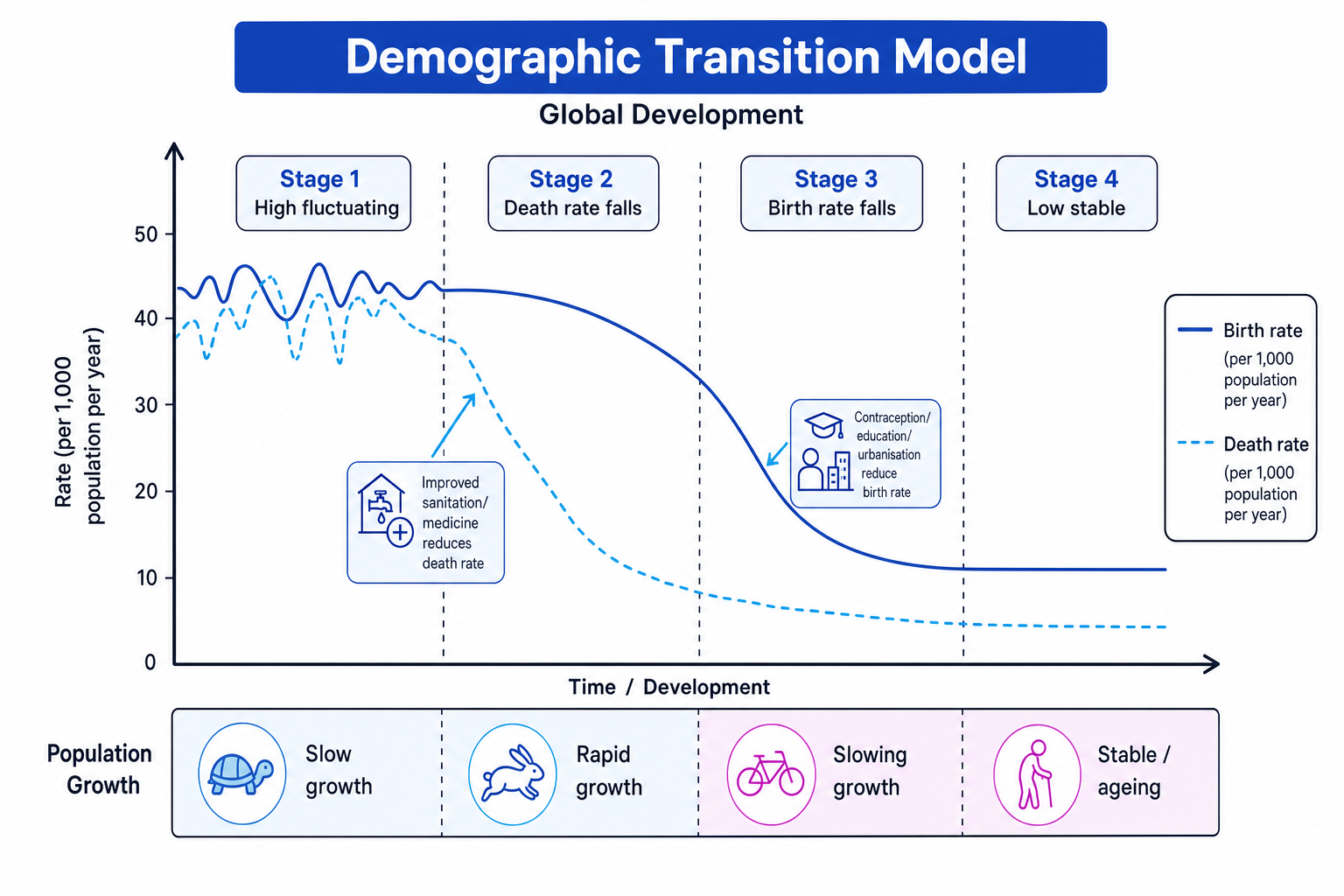
The Demographic Transition Model suggests that countries move from high birth and death rates to low birth and death rates as they develop. Improvements in sanitation, food and medicine usually reduce death rates first. Later, birth rates fall as contraception, education, urbanisation and women’s employment become more common.
Using the demographic transition model
A country has falling death rates because of improved vaccination and clean water, but birth rates remain high. Its population is growing quickly and it has many young dependants.
- Match the pattern to the model: death rates have fallen before birth rates, which suggests Stage 2.
- Explain the cause: medical and sanitation improvements reduce mortality faster than cultural norms around family size change.
- Link to development: a youthful population can create pressure on schools, housing and jobs, but may later become a “demographic dividend” if employment expands.
- Evaluate: the model is useful, but it is based on a Western historical path and may not fit countries affected by war, migration, climate change or global debt.
Malthusian and neo-Malthusian writers argue that rapid population growth can strain food, housing and services. By contrast, Boserup argued that population pressure can encourage innovation. Dependency theorists would add that poverty is not simply caused by “too many people”, but by unequal global access to land, wealth and power.
Demographic change also affects identity and culture. For example, urbanisation can weaken traditional family structures, while ageing populations, such as in the UK and Japan, raise questions about pensions, care work and intergenerational inequality.
Gender as an aspect of development
Gender is central to development because societies are often organised through patriarchy, meaning male dominance in social structures and everyday relationships.
Gender equality
Gender equality means people are not disadvantaged because of gender and have equal access to resources, rights, safety, education, work and political voice.
Feminist sociologists argue that development cannot be judged properly unless women’s lives are considered. Walby defines patriarchy as a system of social structures and practices in which men dominate, oppress and exploit women. In development, this can appear through unequal inheritance rights, restricted access to education, gender-based violence, unpaid care work, low wages and lack of reproductive rights.
Gender also links to culture and socialisation. Norms about masculinity, femininity, marriage and motherhood shape choices, but those “choices” are made within unequal power structures. Intersectionality is important too: women’s experiences differ by class, ethnicity, caste, disability, sexuality, religion and nationality.
AO2 examples include SDG 5 on gender equality, debates about women garment workers in Bangladesh, campaigns against child marriage, and UK comparisons such as the Equality Act 2010 and ongoing gender pay gap reporting.
AO3: gender equality can drive development, but “empowerment” policies are not automatically successful. Microcredit schemes, for example, may help some women start businesses, but they may also increase debt or leave patriarchal household power unchanged.
Avoid cultural stereotyping
When discussing gender in global development, do not imply that “Western” societies are fully equal or that “non-Western” cultures are simply backward. Analyse structures, power and evidence.
Using evidence carefully
Many development indicators come from official statistics produced by governments, the World Bank, UN agencies, WHO, UNESCO or national bodies such as the ONS. These can be useful because they allow comparisons over time and between countries.
However, they raise methodological issues:
- Reliability: statistics may use standard definitions, but poorer states may lack accurate registration systems.
- Validity: an indicator may not measure what it claims. School enrolment is not the same as learning.
- Representativeness: national averages can hide class, gender, ethnic, regional and rural-urban inequalities.
- Theory: positivists may value large-scale statistics; interpretivists may prefer qualitative research into lived experience.
Best essays use linked aspects
Strong answers do not treat employment, education, health, demography and gender as separate checklists. They show how each aspect affects the others through culture, identity, power and stratification.
In the exam
- Define development broadly, then explain why GDP/GNI alone is limited.
- Use at least three aspects in a linked way, such as girls’ education affecting employment, fertility and health.
- Add AO3 by comparing perspectives: modernisation may stress progress; dependency and feminist theories ask who holds power and who benefits.
- Evaluate indicators methodologically: question reliability, validity and hidden inequalities behind national averages.
Check yourself
- Why might a country with high GDP still be considered underdeveloped sociologically?
- How can girls’ education affect health, employment and demographic change?
- What is one strength and one limitation of the Demographic Transition Model?