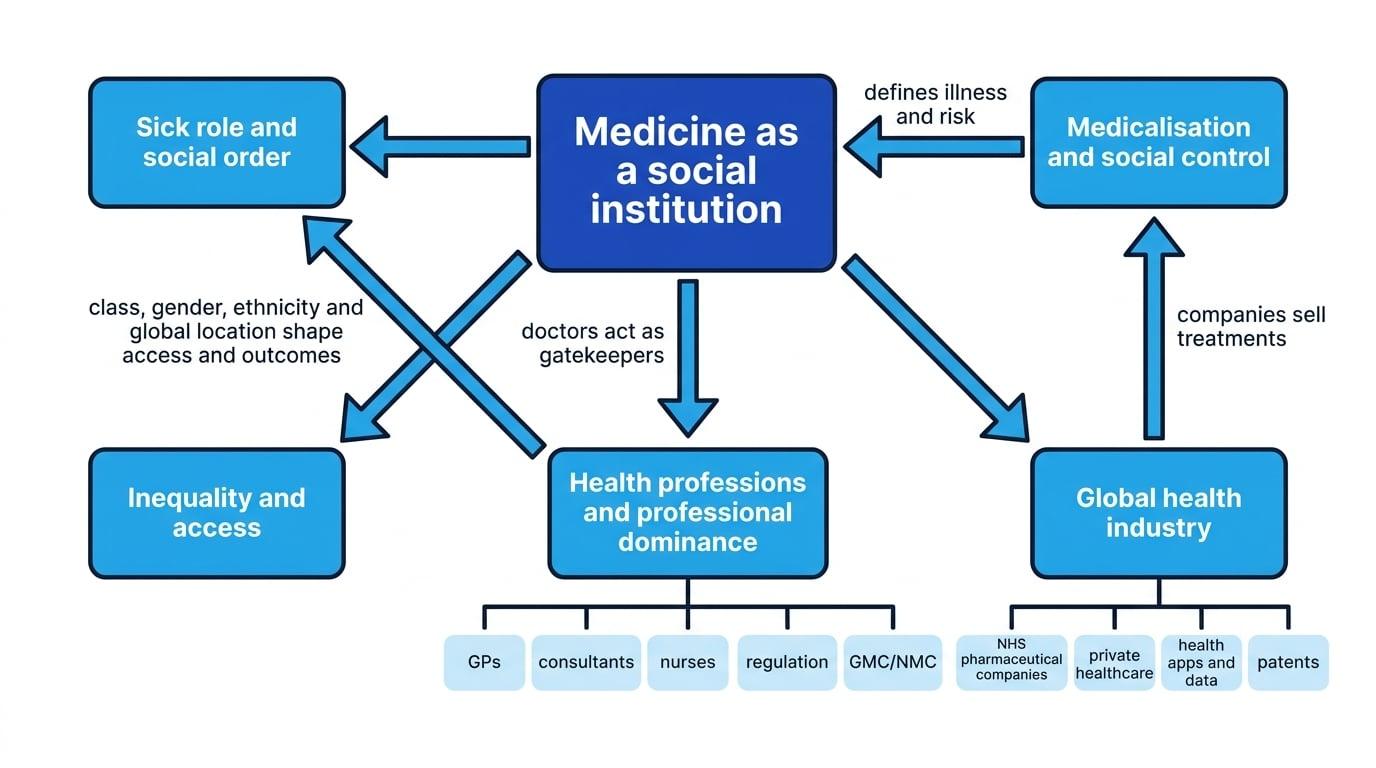
What you'll learn
- How medicine does more than treat disease: it also defines “normality”, illness, risk and responsibility.
- How health professions gain power through expertise, status and regulation.
- How the global health industry links the NHS to pharmaceutical companies, technology firms, patents, private healthcare and global inequalities.
- How to evaluate functionalist, Marxist, feminist, interactionist and postmodern views for essay answers.
The big picture: medicine as a social institution
Medicine is not just a set of treatments. In sociology, you study medicine as a social institution: an organised part of society with rules, roles, specialist knowledge and power. This includes the NHS, hospitals, GPs, nurses, consultants, mental health services, pharmaceutical companies, health apps, private clinics and global supply chains.
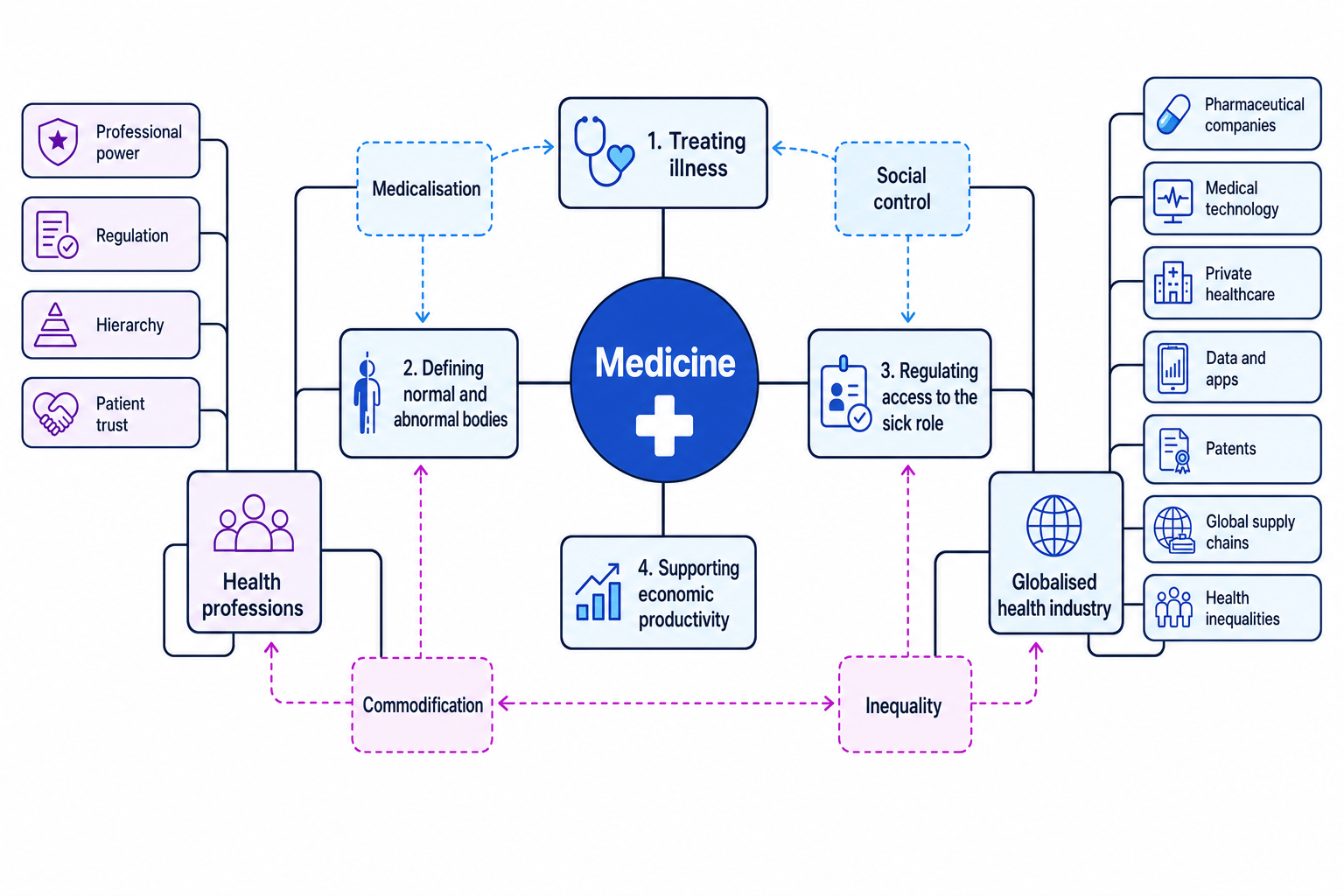
Medicine as a social institution
Medicine is the organised system of knowledge, professions, practices and organisations concerned with defining, preventing and treating illness. Sociologists ask not only “Does the treatment work?” but also “Who defines illness, who benefits, and who has access?”
This matters for the two big AQA themes:
- Socialisation, culture and identity: diagnoses can shape how people see themselves, such as “disabled”, “depressed”, “neurodivergent”, “in recovery” or “chronically ill”.
- Social differentiation, power and stratification: class, gender, ethnicity, age, disability and nationality affect access to healthcare, trust in professionals, treatment outcomes and exposure to medical markets.
The sociological angle
Sociology does not deny biological illness. It asks how illness is interpreted, managed and distributed through social power, culture, institutions and inequality.
Seeing illness as social as well as biological
- Consider long COVID. Biologically, it involves symptoms such as fatigue, breathlessness or cognitive difficulties after infection.
- Now add the social dimension: a person may need GP recognition, workplace adjustments, sick pay, benefits evidence or school support before the illness is treated as “real” by institutions.
- Apply stratification: someone in a secure professional job may be more able to work from home, while someone in insecure service work may lose income or face disbelief.
- Conclude sociologically: the condition is biological, but its consequences are shaped by employment, medical authority, class position and cultural attitudes to invisible illness.
The role of medicine: treatment, order and social control
At the simplest level, medicine treats illness and reduces suffering. Functionalists, who see society as a system of interdependent parts, stress this positive role. Talcott Parsons argued that illness can disrupt society because sick people may be unable to work, study or fulfil family responsibilities.
The sick role
Parsons’ sick role is the set of social rights and duties given to a person officially recognised as ill. They are excused from normal duties, but they are expected to want to get better and seek competent medical help.
Doctors therefore act as gatekeepers: they authorise sick notes, prescriptions, referrals, diagnoses and access to treatment. In the UK, this can be seen when GPs issue fit notes for employers, refer patients to specialists, or decide whether symptoms need urgent investigation.
Functionalists see this as useful because it helps return people to normal social roles. However, it assumes illness is temporary and that patients accept medical authority. This fits flu or a broken bone better than chronic illness, disability, contested conditions or mental health problems.
Applying the sick role to a GP fit note
- Identify the disruption: a worker with severe back pain cannot safely do their warehouse job, so normal work duties are interrupted.
- Apply Parsons: the GP can legitimate the worker’s temporary exemption by issuing a fit note.
- Add the obligation: the worker is expected to follow advice, such as physiotherapy, medication or modified duties.
- Evaluate the fit: if the pain becomes chronic, Parsons’ model becomes weaker because “getting better quickly” may be unrealistic, and the worker may face stigma or employer pressure.
Medicine as social control
Social control means the ways society regulates behaviour and encourages people to conform to norms. Medicine can control behaviour by defining what counts as healthy, risky, abnormal or disordered.
Michel Foucault argued that modern societies increasingly govern people through expert knowledge about bodies. His idea of the medical gaze means doctors are trained to view the body as an object to be examined, classified and monitored. This can be helpful, but it can also reduce a person to symptoms, test results or risk factors.
Ivan Illich was more critical. He argued that modern medicine can create dependency and sometimes harm people through iatrogenesis, meaning illness or harm caused by medical intervention. He also criticised medicalisation.
Medicalisation
Medicalisation is the process by which more areas of ordinary life become defined and treated as medical problems, often requiring professional diagnosis, surveillance or treatment.
Examples often used in sociology include childbirth, menopause, ADHD, addiction, sadness, obesity, ageing, infertility and cosmetic surgery. Be careful: medicalisation is not automatically “bad”. Diagnosis can bring support, treatment and recognition. The sociological question is whether social problems are being individualised as medical problems.
Thinking medicalisation means doctors invented the problem
Medicalisation does not mean the symptoms are fake. It means the explanation and response have become medical, sometimes pushing aside social causes such as poverty, stress, gender expectations, work pressure or trauma.
Health professions: expertise, status and hierarchy
A health profession is an occupation with specialised training, ethical rules, recognised qualifications and a claim to expert authority, such as doctors, nurses, midwives, pharmacists, psychologists, radiographers and physiotherapists.
Professional power
Professional power is the ability of an occupational group to control specialised knowledge, regulate entry into the profession, define standards of practice and influence clients or patients.
Eliot Freidson argued that doctors achieved professional dominance because they controlled diagnosis, treatment decisions and medical knowledge. A Weberian idea linked to this is social closure, where groups protect their status by restricting access through credentials, licensing and professional regulation. In the UK, bodies such as the General Medical Council and Nursing and Midwifery Council regulate professional standards.
This creates trust and protects patients from unqualified practice. But it also creates hierarchy. Historically, medicine has been high-status and male-dominated, while nursing and caring roles have been feminised and lower paid. The NHS also relies heavily on migrant and minority ethnic staff, raising questions about global inequality, recruitment, racism and career progression.
Challenges to professional dominance
Medical authority is not absolute. It has been challenged by:
- Managerialism: targets, audits, budgets and waiting-list pressures shape clinical work.
- Evidence-based medicine: organisations such as NICE assess whether treatments are clinically and cost effective.
- Patient consumerism: patients compare services, use online information and sometimes challenge doctors.
- Digital health: apps, private tests, online pharmacies and telemedicine change how people access expertise.
- Multi-disciplinary care: doctors work alongside nurses, therapists, social workers and mental health specialists.
Evaluation shortcut
For health professions, balance trust and protection against power and inequality. Professional regulation can safeguard patients, but professional dominance can also silence patients or reproduce class, gender and ethnic inequalities.
The globalised health industry
The globalised health industry is the worldwide network of companies, states, charities, professionals and markets involved in producing healthcare goods and services. It includes pharmaceutical corporations, medical technology firms, private hospitals, insurance companies, fertility clinics, cosmetic surgery providers, data platforms and global research organisations.
Commodification
Commodification means turning something into a product or service that can be bought and sold for profit. In health, this includes drugs, private operations, genetic tests, wellness products, fertility treatment, health data and cosmetic procedures.
A Marxist approach argues that capitalism turns health into a market. Writers such as Navarro and Doyal argue that medicine can serve capitalism by keeping workers productive, creating profit opportunities and individualising social causes of illness. For example, workplace stress may be treated with medication or resilience training rather than changes to workload, pay or job security.
Pharmaceutical companies are central here. They fund research, develop drugs and sell medicines globally. This can produce major benefits, such as vaccines, antibiotics, cancer therapies and HIV treatments. But critics argue that patents, pricing and marketing can prioritise profitable conditions and wealthy markets over neglected diseases affecting poorer countries.
AO2 examples you could use include:
- COVID-19 vaccines and debates over patents, global access and “vaccine nationalism”.
- The NHS purchasing drugs and technologies from global companies.
- Weight-loss drugs, antidepressants, HRT and ADHD medication as examples of expanding pharmaceutical markets.
- Private healthcare and diagnostic scans used by those who can afford faster access.
- Fitness trackers and health apps encouraging self-monitoring, but also raising data and privacy issues.
Evaluating a new weight-loss drug market
- Apply medicalisation: body weight is increasingly framed as a medical risk requiring diagnosis, monitoring and treatment.
- Apply commodification: pharmaceutical companies can sell long-term drug treatments, while private clinics may sell faster access.
- Apply stratification: wealthier patients may access treatment privately, while NHS access may depend on eligibility criteria, waiting lists and local provision.
- Evaluate fairly: the drugs may genuinely improve health for some patients, but a sociological answer should also question food poverty, work patterns, stigma, advertising and unequal access to healthy living conditions.
Comparing perspectives
| Perspective | Main view of medicine | Useful evaluation |
|---|---|---|
| Functionalism | Medicine treats illness and helps maintain social order through the sick role. | Too positive; struggles with chronic illness, inequality and patient resistance. |
| Marxism | Medicine can serve capitalism by maintaining workers and creating profit. | Can underplay real medical progress and the ethical motives of health workers. |
| Feminism | Medicine may control women’s bodies through childbirth, contraception, menopause, pain and mental health. | Women have also used medicine for autonomy, safety and campaigning. |
| Interactionism | Focuses on meanings, labels, stigma and doctor-patient interaction. | Strong on lived experience, but may underplay corporate and state power. |
| Postmodernism | Patients are more like consumers using online knowledge, private services and lifestyle medicine. | Consumer choice is unequal; poorer patients often have fewer real choices. |
Researching medicine and the health industry
Evidence can come from official statistics, clinical trials, interviews, ethnographies, patient surveys, prescribing data, NHS workforce data and global health reports. Each has strengths and limits.
Official statistics can show patterns in waiting lists, mortality, prescribing or health inequalities, making them useful for positivist research because they are large-scale and comparable. But they may miss meanings, stigma, misdiagnosis or people who avoid services.
Interpretivist research, such as interviews with patients or observations in clinics, can reveal how people experience diagnosis, trust, pain, shame or professional power. However, access can be difficult because medical settings involve confidentiality, vulnerability and ethical risks.
Do not ignore ethics
Research on health often involves sensitive data, illness, trauma or dependency on professionals. Strong answers mention informed consent, confidentiality, avoiding harm, and the difficulty of researching unequal doctor-patient relationships.
Pulling it together for essays
A strong answer avoids saying medicine is simply “good” or “bad”. Instead, show that medicine has a dual role:
- It can heal, relieve suffering and protect public health.
- It can define normality, regulate behaviour and support social order.
- It can empower patients through diagnosis and treatment.
- It can reproduce inequality through professional power, market access and global capitalism.
In the exam
- Start with a clear AO1 concept, such as the sick role, medicalisation, professional dominance or commodification.
- Apply it to a concrete AO2 example from the UK or global health, such as NHS gatekeeping, NICE, COVID vaccines, private healthcare, health apps or pharmaceutical pricing.
- Add AO3 by weighing benefits against criticisms: treatment versus control, expertise versus hierarchy, innovation versus profit, and choice versus inequality.
Check yourself
- How does Parsons’ sick role help explain the power of doctors, and where does it break down?
- Why might medicalisation be both helpful and harmful?
- How does the globalised health industry connect health to capitalism and inequality?