What you'll learn
- How crime control links to wider social control.
- The main approaches to crime prevention, surveillance and punishment.
- How victims, the criminal justice system and other agencies shape responses to crime.
- How to evaluate policies using UK examples and issues of power, inequality and identity.
1. The starting point: social control
Before you study crime control, you need the broader idea of social control. This means the ways society encourages people to conform to rules and norms.
A norm is an expected way of behaving. Deviance is behaviour that breaks social norms, while crime is behaviour that breaks the criminal law.
Social control can be:
- Informal social control: everyday pressure from family, peers, schools, religion or the media.
- Formal social control: official rules and sanctions used by the state, such as policing, courts and prisons.
Crime control
Crime control means the policies, practices and institutions used to prevent, detect, manage and punish crime.
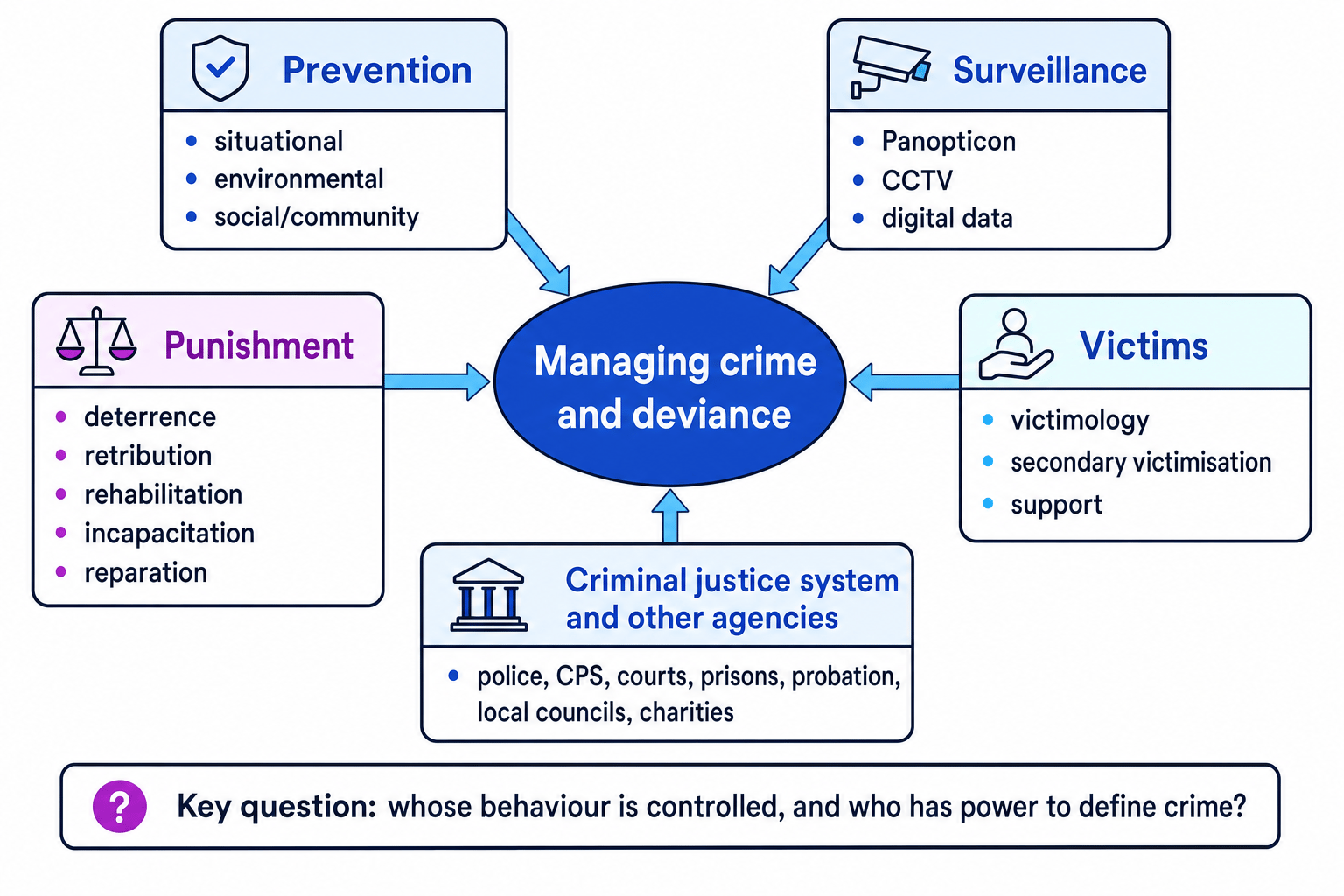
Crime control is never neutral. It always raises sociological questions: whose behaviour is being controlled, who gets labelled as risky, and who has the power to define crime?
The map below shows the main parts of this topic and how they connect.
The big sociological question
Crime control is not just about reducing offending. It is also about power: who is watched, who is punished, who is protected, and whose harm is taken seriously.
2. Crime prevention: stopping crime before it happens
Crime prevention
Crime prevention means attempts to reduce the likelihood of crime occurring, rather than only reacting after an offence has happened.
Sociologists usually divide prevention into three broad types.
Situational crime prevention
Situational crime prevention focuses on reducing opportunities for crime in specific settings.
Clarke argues that many crimes are rational and opportunistic. This links to Felson’s routine activity theory, which says crime is more likely when three things come together:
- A motivated offender.
- A suitable target.
- The absence of a capable guardian, such as CCTV, staff, locks or bystanders.
Examples include better street lighting, CCTV, anti-theft tags, car immobilisers, passwords, door staff and “designing out crime” in housing estates.
AO3 evaluation: situational prevention can reduce some offences, especially property crime, but it may cause displacement, where crime moves to a different place, time, target or method. It also tends to ignore deeper causes such as poverty, exclusion and gendered violence.
Environmental crime prevention
Environmental crime prevention focuses on maintaining public order in physical spaces.
Wilson and Kelling’s broken windows thesis argues that visible disorder, such as vandalism, graffiti and aggressive begging, signals that nobody is in control. This may encourage more serious crime.
This idea influenced zero tolerance policing, where police clamp down on minor disorder to prevent more serious offences. UK examples include Public Space Protection Orders, dispersal powers, anti-social behaviour measures and some forms of intensive town-centre policing.
AO3 evaluation: critics argue this can criminalise poverty and youth culture. For example, homeless people, young working-class men and ethnic minority groups may be treated as “out of place” in public spaces. It may improve the appearance of order without addressing the causes of crime.
Social and community crime prevention
Social crime prevention tries to tackle the social causes of offending. These include poverty, poor housing, school exclusion, unemployment, family stress and lack of legitimate opportunities.
Left realists such as Lea and Young argue that crime is linked to relative deprivation, meaning feeling unfairly disadvantaged compared with others, and marginalisation, meaning lacking political voice or power.
Examples include youth clubs, mentoring, family support, early years programmes, education projects, drug treatment, domestic abuse prevention work and community policing.
AO3 evaluation: social prevention is often more ambitious and humane than purely punitive approaches, but it can be expensive, slow and difficult to measure. It may also become net-widening, where more people are drawn into monitoring and intervention even though they have not committed serious offences.
Classifying a prevention policy
A council installs CCTV in a shopping area, locks alleyways at night, and funds a youth mentoring scheme.
- The CCTV and alley gates are situational crime prevention because they increase the perceived risk of offending and reduce easy opportunities.
- Felson’s routine activity theory helps explain the policy: CCTV acts as a “capable guardian”, making theft or vandalism less attractive.
- The mentoring scheme is social crime prevention because it tries to address longer-term causes, such as exclusion from school, unemployment or lack of support.
- A strong evaluation would compare the approaches: CCTV may displace crime elsewhere, while mentoring may tackle causes but take longer to show results.
Assuming prevention is always progressive
Prevention can help communities, but it can also increase surveillance and control over already disadvantaged groups, especially young people, working-class communities and ethnic minorities.
3. Surveillance: watching, recording and sorting people
Surveillance
Surveillance means monitoring people’s behaviour, movements or data in order to regulate, predict or control them.
Surveillance is central to modern crime control. It includes CCTV, Automatic Number Plate Recognition, body-worn police cameras, electronic tagging, facial recognition trials, online monitoring, biometric data and predictive policing.
Foucault is the key theorist here. In Discipline and Punish, he uses Bentham’s Panopticon, a prison design where inmates can always be watched but never know when they are being watched. Foucault argues that modern power works by encouraging people to monitor themselves.
This is called disciplinary power: power that controls behaviour through surveillance, routines, training and normalisation, rather than only through physical force.
In contemporary society, surveillance can also be actuarial, meaning it sorts people into risk categories. Feeley and Simon call this the new penology: the focus shifts from reforming individual offenders to managing risky populations.
AO2 examples include police use of stop-and-search data, electronic tags for offenders, Prevent referrals in schools and colleges, and algorithmic risk assessments. These do not just detect crime; they shape identities by classifying people as “risky”, “vulnerable” or “suspicious”.
AO3 evaluation: surveillance may deter crime and provide evidence, but it raises issues of civil liberties, privacy and bias. If police data reflects unequal policing, then predictive systems may reproduce those inequalities.
Applying Foucault to electronic tagging
An offender is given a curfew and must wear an electronic tag.
- The tag creates continuous monitoring, so the offender knows their movements can be checked even when no officer is physically present.
- This fits Foucault’s idea of disciplinary power because control works through self-regulation: the offender changes behaviour because they may be watched.
- It also fits actuarial justice because the person is managed as a risk in the community, rather than simply punished inside a prison.
- A critical evaluation would ask whether tagging supports rehabilitation or extends control beyond prison through net-widening.
4. Punishment: why offenders are sanctioned
Punishment
Punishment means the formal penalties imposed on people who are judged to have broken the criminal law.
Punishment has several possible aims:
- Retribution: offenders deserve punishment because they have done wrong.
- Deterrence: punishment discourages future offending.
- Rehabilitation: punishment should reform offenders and help them reintegrate.
- Incapacitation: punishment protects the public by restricting offenders’ freedom.
- Reparation: offenders should repair harm, for example through compensation or restorative justice.
Restorative justice brings offenders, victims and sometimes communities together to discuss harm and responsibility. It can be victim-centred, but it depends on consent, safety and careful facilitation.
Functionalists such as Durkheim argue that punishment reinforces the collective conscience, meaning society’s shared moral beliefs. Public punishment reminds people what the community values.
Marxists argue that punishment protects capitalist interests. They point out that street crime by the poor is often punished more visibly than corporate crime, tax avoidance or environmental harm caused by powerful groups.
Foucault argues that punishment has shifted from public violence against the body to control over the “soul”: routines, classification, surveillance and rehabilitation programmes.
Garland argues that late modern societies have developed a culture of control, combining tougher punishment with risk management and individual responsibility.
Identifying punishment aims in a sentence
A person convicted of burglary receives a short prison sentence, a drug treatment requirement, and an order to compensate the victim.
- The prison sentence shows incapacitation because the offender is temporarily removed from the community.
- It also suggests retribution and deterrence because the sentence expresses blame and may discourage future offending.
- The drug treatment requirement shows rehabilitation because it targets a possible cause of offending.
- The compensation order shows reparation because it focuses on repairing harm to the victim.
Punishment has competing aims
The same sentence can try to punish, deter, rehabilitate, protect the public and repair harm at the same time. These aims may conflict.
5. Victims: who counts and who is heard?
Victimology
Victimology is the sociological study of victims, victimisation and society’s responses to victims.
Positivist victimology looks for measurable patterns in victimisation. For example, the Crime Survey for England and Wales shows that victimisation is not evenly distributed. Risk varies by age, gender, class, ethnicity, area and lifestyle.
However, positivist victimology can slip into victim-blaming if it focuses too heavily on victims’ behaviour. Wolfgang’s idea of victim precipitation, where a victim may be seen as contributing to the event, is especially controversial.
Critical victimology asks how power shapes who is recognised as a victim. Christie’s idea of the ideal victim describes someone seen as weak, innocent and respectable, harmed by a clearly “bad” offender. Victims who do not fit this image may receive less sympathy.
Feminists highlight secondary victimisation, where victims are harmed again by the response of agencies, media or courts. For example, survivors of rape or domestic abuse may face disbelief, intrusive questioning or pressure not to report.
AO2 examples include Victim Personal Statements, the Victims’ Code, Victim Support, specialist domestic abuse services and sexual assault referral centres.
AO3 evaluation: victim-focused policy is important, but official statistics still miss hidden harms, including domestic abuse, coercive control, hate crime, state crime and corporate crime. The “dark figure” of unreported crime remains significant.
6. The criminal justice system and other agencies
Criminal justice system
The criminal justice system is the network of institutions that respond to suspected and proven crime, including police, prosecutors, courts, prisons and probation.
In England and Wales, the main agencies include:
- Police: investigate crime, use discretion, arrest suspects and gather evidence.
- Crown Prosecution Service: decides whether cases meet evidential and public interest tests for prosecution.
- Courts: determine guilt and impose sentences.
- Prisons: punish, incapacitate and sometimes rehabilitate offenders.
- Probation: supervises offenders in the community and after release.
- Youth offending teams: work with children and young people who offend.
- Local councils and community safety partnerships: coordinate local prevention work.
- Charities and voluntary agencies: support victims, offenders and families.
- Private companies: provide security, tagging, prisons, data systems or surveillance technologies.
This shows plural policing, meaning crime control is carried out by many agencies, not just the police.
AO3 evaluation must ask how fairly these agencies operate. The Macpherson Report into the Stephen Lawrence case identified institutional racism in the Metropolitan Police. The Lammy Review later raised concerns about ethnic disproportionality across the criminal justice system.
Class, gender and ethnicity matter throughout the process. For example, stop and search, school exclusion, media stereotypes and court outcomes can all shape who becomes visible as “criminal”.
A strong essay thread
Keep returning to three questions: Does the policy reduce crime? Does it address causes? Does it reproduce inequality?
7. Comparing perspectives
Right realists tend to support target-hardening, deterrence, stronger policing and personal responsibility. Murray’s “underclass” argument links crime to welfare dependency and weak socialisation, though critics say this blames the poor.
Left realists accept that street crime is a real problem, especially for working-class victims, but argue that solutions must tackle inequality, marginalisation and poor police-community relations.
Marxists and feminists push the analysis further by asking which harms are ignored. Corporate crime, state crime, domestic abuse and sexual violence may be less visible than street crime, even though they can cause serious harm.
Interactionists focus on labelling: crime control can create deviant identities. If young people are repeatedly stopped, excluded or labelled as troublemakers, this may strengthen deviant careers rather than prevent them.
In the exam
- Define the policy or concept clearly before evaluating it: prevention, surveillance, punishment, victimology or the criminal justice system.
- Link each point to a theory such as right realism, left realism, functionalism, Marxism, feminism, interactionism or Foucault.
- Use AO2 examples from England and Wales, such as CCTV, stop and search, probation, restorative justice, the Victims’ Code or youth offending teams.
- Evaluate with inequality and evidence: ask who benefits, who is controlled, and whether official statistics fully capture the harm.
Check yourself
- How are situational, environmental and social crime prevention different?
- Why does Foucault see surveillance as a form of power?
- How might victim policies help some people while still ignoring less “ideal” victims?
