How do we decide which social class someone belongs to? Is it about how much money they have, what job they do, or how they speak and spend their leisure time?
In A-Level Sociology, defining and measuring social class is one of the most hotly contested areas of study. It sits at the very heart of the Stratification and Differentiation topic. This guide will walk you through how sociologists moved from simple occupational categories to complex multi-dimensional systems, alongside the major debates surrounding gender and class measurement.
What you'll learn
- The difference between objective and subjective measures of social class.
- How official UK frameworks (like the NS-SEC) measure class using occupational relationships.
- The "gender problem" in traditional class measurements and how feminists challenged it.
- Modern multi-dimensional approaches to class, such as Mike Savage's Great British Class Survey.
1. Defining social class: Objective vs. Subjective
Before sociologists can measure social class, they have to define it. Broadly speaking, there are two ways to do this: objectively and subjectively.
Objective social class
An objective measure of social class relies on empirical, measurable facts independent of an individual's personal feelings. This usually includes quantifiable data such as household income, savings, educational qualifications, or job title.
Subjective social class
A subjective measure of social class refers to an individual's personal identity and self-perception. It is how people feel about their own class position (e.g., whether they identify as working-class or middle-class, regardless of what their actual income might suggest).
While subjective class identity is highly important for understanding culture and voting patterns, official government statistics and macro-sociologists rely primarily on objective measures. This is because objective measures are easier to operationalise, standardise, and compare over time.
2. Measuring class via occupation: From RGSC to NS-SEC
In the UK, the primary objective "proxy" (or stand-in) used to measure social class is occupation (a person's job). Work is chosen because it heavily determines an individual's income, status, and life chances. Over the last century, the official ways of classifying jobs have evolved significantly.
The Registrar General's Social Classification (RGSC)
From 1911 until 2001, the UK government used the RGSC to group populations. This scale split jobs into:
- Professional / Non-manual occupations (often labeled middle-class, such as doctors, teachers, and office clerks).
- Manual occupations (often labeled working-class, such as plumbers, miners, and factory laborers).
Sociologists heavily criticised the RGSC. It was seen as overly simplistic, implied that non-manual work was inherently superior, and ignored the fact that many manual workers (like highly skilled technicians) earned far more than lower-level office clerks.
The National Statistics Socio-economic Classification (NS-SEC)
To address these flaws, the government introduced the NS-SEC in 2001. This is the classification system used in the UK Census today.
The NS-SEC was designed by sociologist John Goldthorpe. Instead of just looking at manual vs. non-manual work, Goldthorpe argued that class is determined by an individual's employment relations. This involves two dimensions:
- Market Situation: The economic rewards of a job, including pay levels, job security, and career promotion prospects.
- Work Situation: The degree of authority, autonomy, and control an individual has over their day-to-day tasks in the workplace.
Based on these two dimensions, the NS-SEC groups the UK population into eight distinct classes, ranging from Class 1 (Higher managerial, administrative and professional occupations) to Class 8 (Never worked and long-term unemployed).
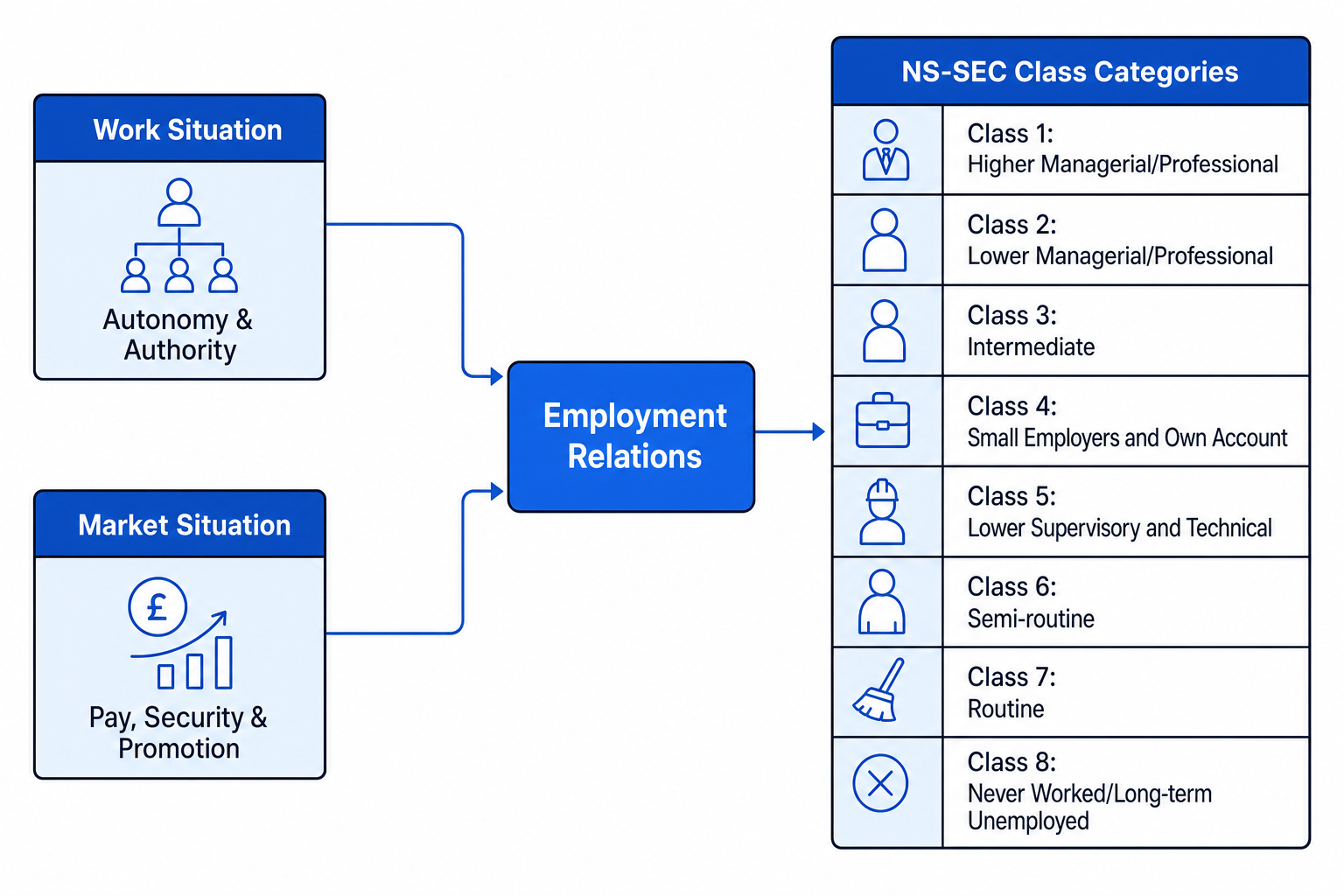
The basis of the NS-SEC
The NS-SEC does not simply rank people by how much money they make. It measures their employment relations—specifically, how much autonomy they have at work (work situation) and their long-term economic security and prospects (market situation).
3. The gender problem in measuring social class
Historically, class measurements suffered from severe gender bias. This debate is often called the "unit of analysis" debate: should the basic unit of social class be the individual or the household?
The Conventional Approach (Goldthorpe)
For decades, sociologists (including Goldthorpe) used the conventional approach. This assumed that the household was the basic unit of stratification, and the class of the entire family was determined by the occupation of the "head of the household" (almost always the male breadwinner).
Goldthorpe defended this by arguing that:
- The family is a shared economic unit.
- Men traditionally had the strongest, most stable attachment to the labor market.
- A wife’s part-time or secondary employment did not significantly alter the family’s overall lifestyle or life chances.
The Feminist Critique
Feminist sociologists like Michelle Stanworth (1984) and Pamela Abbott (1990) fiercely rejected Goldthorpe's defense, arguing that the conventional approach was sexist, outdated, and methodologically invalid.
They raised several key arguments:
- Ignoring the dual-earner reality: In modern society, many households rely on two full-time incomes. A woman’s salary often prevents a family from falling into poverty.
- Class divergence inside the home: A woman might work in a low-paid service job while her husband is a high-earning manager. Classing her as "middle-class" because of her husband hides her personal economic dependence and potential exploitation.
- Vague identities: Women's subjective identities are deeply shaped by their own work, career progression, and financial independence—not just their partner's status.
Confusing gender bias with class bias
Do not write that Goldthorpe "forgot" about women. Goldthorpe was fully aware of women's employment, but he actively argued that the household was the most logically consistent unit of measurement. Your role in the exam is to evaluate his defense against the feminist critiques of Stanworth and Abbott.
Modern Solutions to the Gender Problem
To resolve this debate, sociologists have developed alternative approaches to classifying dual-earner households:
- The Individual Approach: Classifying every adult solely by their own occupation. (Problem: This can make a married couple living in the same house appear to belong to completely different classes, ignoring their shared standard of living).
- The Dominance Approach (Erikson and Goldthorpe): Assigning the household's class based on whichever partner has the higher-status, more dominant occupation, regardless of gender.
Applying different classification approaches to a dual-earner household
Consider a household where Sarah is a highly successful Senior Corporate Solicitor (NS-SEC Class 1) and her partner David is a part-time Administrative Assistant in a local school (NS-SEC Class 3).
-
Apply the conventional approach: Historically, because David is the male partner, his job as an administrative assistant would define the household. The household would be classified as Class 3 (Intermediate), completely ignoring Sarah's high-status, high-earning position. This leads to a massive underestimation of the household's actual wealth and power.
-
Apply the individual approach: Under this model, Sarah is categorized as Class 1 (Elite/Professional) and David is categorized as Class 3 (Intermediate). While this accurately reflects their individual work situations, it fails to capture their shared domestic reality, as David benefits directly from Sarah's high income and assets (such as their housing and shared savings).
-
Apply the dominance approach: Under this modern system, the sociologist compares both roles. Sarah's job as a Senior Corporate Solicitor carries higher autonomy, pay, and status than David's role. Therefore, Sarah's occupation is identified as "dominant," and the entire household is classified as Class 1. This accurately reflects the family's high economic resources while remaining gender-neutral.
4. Beyond occupation: The Great British Class Survey
While occupational scales like the NS-SEC are useful, many contemporary sociologists argue they are too narrow. Does a job title really tell us everything about a person's social class?
To address this, Mike Savage et al. (2013) launched the Great British Class Survey (GBCS). Drawing heavily on the theories of French sociologist Pierre Bourdieu, Savage argued that class is not just about your job, but about your possession of three distinct types of capital:
- Economic Capital: Income, savings, and property value.
- Social Capital: The number and status of the people you know (your social networks).
- Cultural Capital: Your cultural interests, activities, and tastes (e.g., listening to classical music vs. watching reality TV, eating out at expensive restaurants vs. fast food).
Using these three capitals, Savage identified seven distinct social classes in modern Britain:
- Elite: The most privileged group, with high levels of all three capitals.
- Established Middle Class: High economic, social, and cultural capital (the second wealthiest group).
- Technical Middle Class: High economic capital, but low social and cultural capital (often working in science, technology, or engineering; less socially connected).
- New Affluent Workers: Medium levels of economic capital, but high levels of active social and cultural capital (often young, active, and working in sales or services).
- Traditional Working Class: Low on all capitals, but with some home ownership/assets.
- Emergent Service Workers: Low economic capital, but relatively high social and cultural capital (often young people living in urban areas, working in hospitality or customer service).
- Precariat (the precarious proletariat): The most deprived class, with extremely low levels of economic, social, and cultural capital.
Bourdieu's Capitals
When discussing Mike Savage's GBCS, always make the explicit connection to Pierre Bourdieu. Bourdieu argued that cultural capital (such as knowing how to navigate "high culture") is passed down through families and can be converted into economic capital (e.g., performing well in elite job interviews).
5. Summary of methodological problems (AO3)
When evaluating how sociologists define and measure class, keep these core methodological problems in mind:
- The Problem of the Super-Rich: Occupational scales like the NS-SEC fail to capture the ultra-wealthy (the "1%"). These individuals may have no official "occupation" because they live entirely off inherited wealth, investments, and property yields, yet they occupy the very top of the class hierarchy.
- The Growth of the Gig Economy: Traditional occupational categories assume stable, permanent employment. The rise of zero-hours contracts and self-employed gig work (e.g., Deliveroo riders, Uber drivers) makes it difficult to measure "work situation" and "market situation" accurately over time.
- The Subjective-Objective Gap: People often refuse to accept their objective class label. For example, wealthy celebrities or politicians often claim to be "working-class at heart" because of their upbringing, while low-paid office workers may claim to be "middle-class" to avoid social stigma.
In the exam
If you face a question on defining and measuring social class, structure your response around these core strategy tips:
- Lead with theory: Frame the debate using key sociological perspectives. For instance, link Goldthorpe's occupational scales to a Weberian view of "market situation," and link Savage's multi-dimensional approach to Bourdieu's concepts of capital.
- Evaluate the "gender problem" explicitly: Ensure you can outline the debate between Goldthorpe's household/conventional approach and feminist critiques (Stanworth and Abbott). Show how the "dominance approach" attempts to resolve this.
- Use contemporary UK examples (AO2): Illustrate the limitations of occupational scales by referencing the rise of the "gig economy" or the invisible wealth of the ultra-rich who do not rely on standard jobs for their class position.
Check yourself
- Why did John Goldthorpe argue that we must look at a person's "work situation" and "market situation" rather than just their manual or non-manual job title?
- Explain the key difference between the "individual approach" and the "dominance approach" when classifying the social class of a dual-earner couple.
- Name the three types of capital used by Mike Savage and colleagues to construct the seven-class model in the Great British Class Survey.
