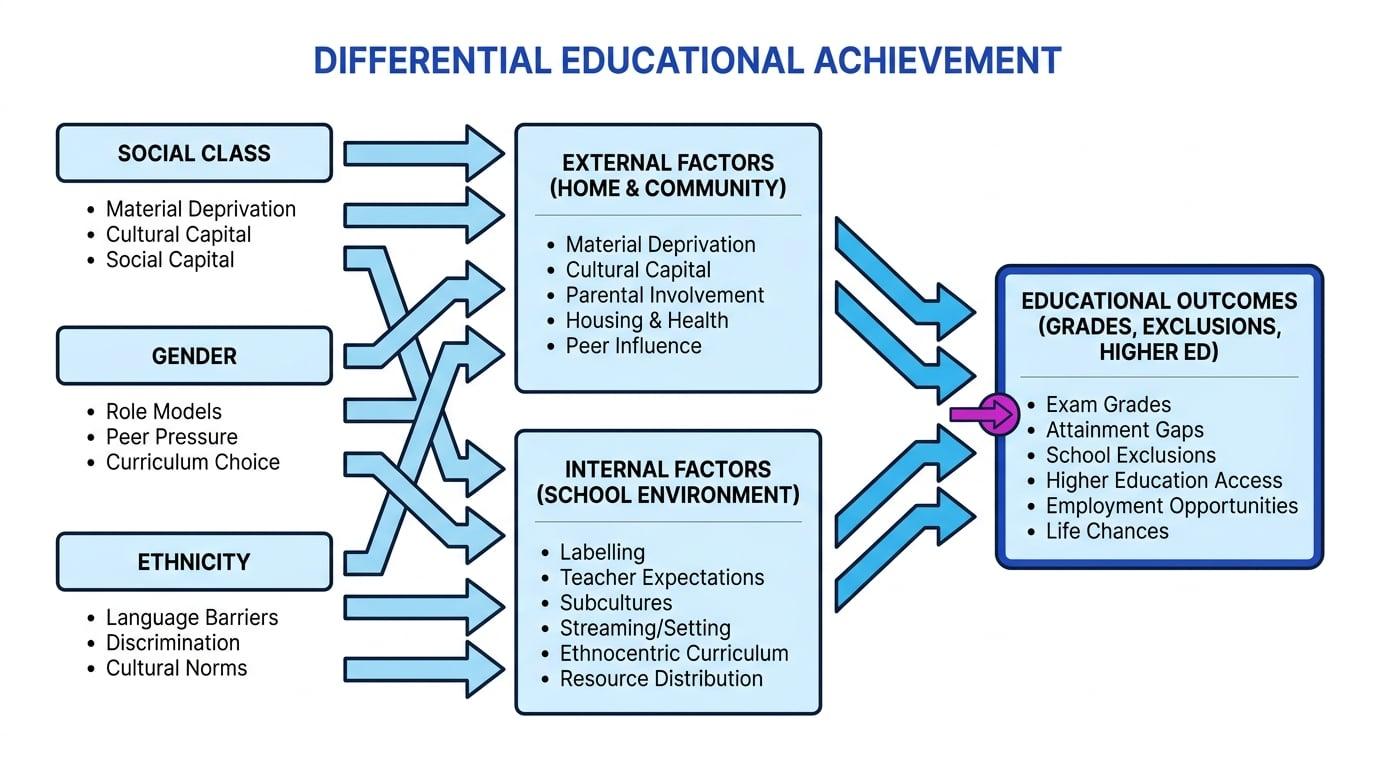
What you'll learn
- How social class, gender and ethnicity are linked to patterns of educational achievement.
- The difference between external factors outside school and internal factors inside school.
- Key sociological explanations: material deprivation, cultural capital, labelling, gender socialisation and institutional racism.
- How to evaluate explanations using intersectionality, contemporary UK examples and research-methods awareness.
The basic idea: what is differential achievement?
Differential educational achievement
Differential educational achievement means differences in educational outcomes between social groups, such as exam results, progress scores, attendance, exclusions, subject choices and progression to university or work.
A social group is a category of people who share a social characteristic. In this topic, the main groups are:
- Social class: a person’s position in the social hierarchy, often linked to occupation, income, wealth and education.
- Gender: the social meanings and expectations attached to being male, female or non-binary. Most official school data still uses “boys” and “girls”.
- Ethnicity: a shared cultural identity, often linked to ancestry, language, religion, nationality or migration history.
The key point is that sociologists are not saying every individual in a group achieves the same outcome. They are looking for patterns and then asking why those patterns exist.
Pattern, not prediction
Educational achievement is socially patterned, but it is not fixed. Sociologists explain how structures such as poverty, racism, patriarchy and school organisation shape opportunities, while still recognising pupil agency.
External and internal explanations
Sociologists often organise explanations into two broad types.
External factors are influences outside school, such as family income, housing, parental education, language, cultural expectations and experiences of racism in wider society.
Internal factors are processes inside school, such as teacher expectations, setting and streaming, the curriculum, school rules, peer groups and assessment methods.
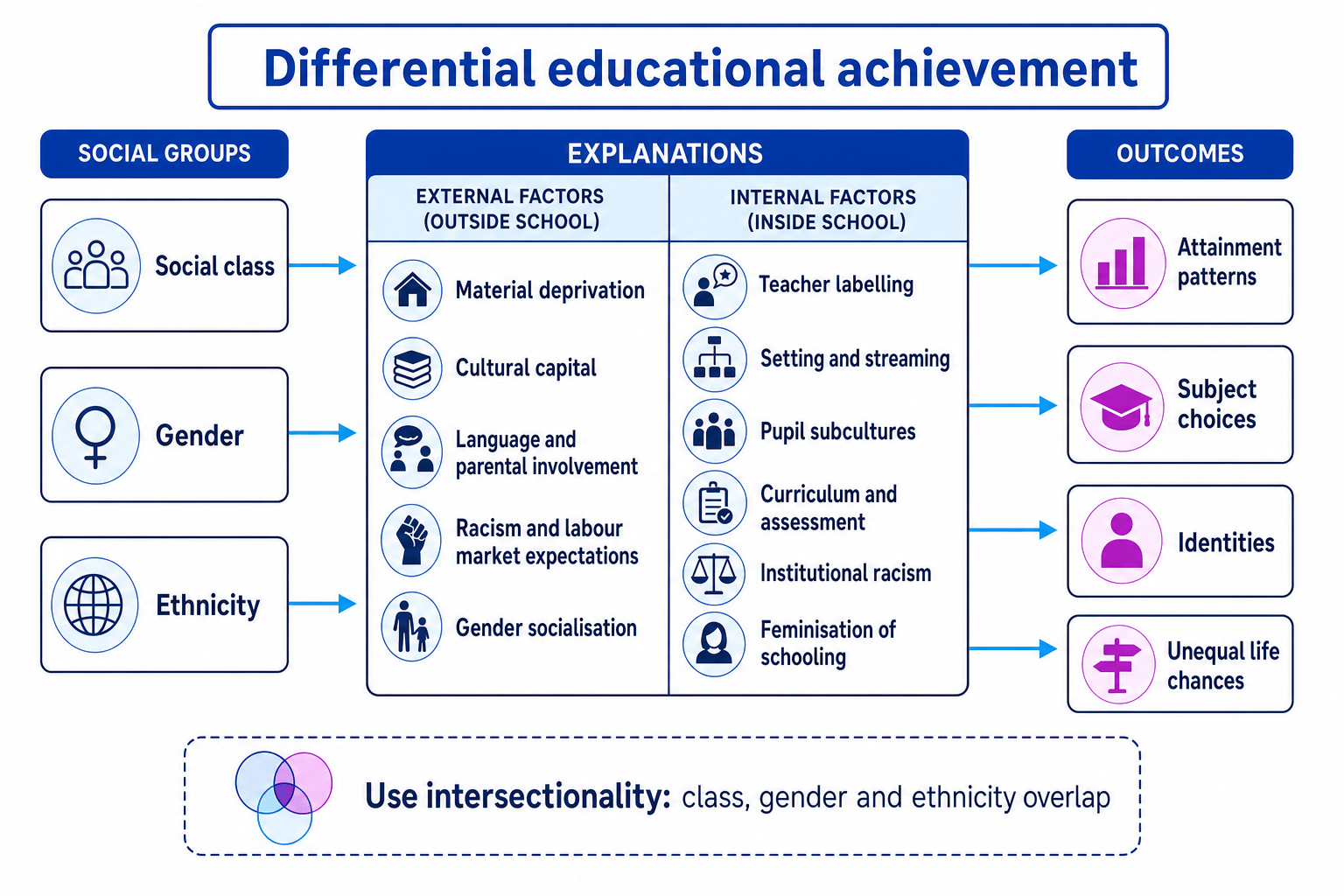
The diagram below shows how class, gender and ethnicity can be connected to both external and internal explanations, leading to different educational outcomes.
Blaming the group
Avoid writing as if working-class pupils, boys or minority ethnic pupils “lack ambition” as a natural trait. Strong answers explain how social conditions and school processes create advantages and disadvantages.
Social class and achievement
In contemporary UK education, pupils from middle-class backgrounds generally achieve higher results than pupils from working-class backgrounds. A common measure is free school meals, often shortened to FSM, which is used as a rough indicator of economic disadvantage. FSM pupils, on average, tend to have lower attainment than non-FSM pupils.
Material deprivation
Material deprivation
Material deprivation means lacking the money and physical resources needed for full participation in education, such as a quiet study space, reliable internet, books, transport, food, heating or private tutoring.
This is a powerful explanation because education costs money even when schooling is officially free. For example, a pupil in overcrowded housing may struggle to revise, and a family affected by the cost-of-living crisis may find school trips, laptops or uniform difficult to afford.
Halsey, Heath and Ridge found strong class inequalities in educational opportunity. More recent debates use policies such as the Pupil Premium, extra funding given to schools for disadvantaged pupils, as evidence that governments recognise material barriers.
Cultural deprivation and cultural capital
Cultural deprivation is the argument that some pupils are disadvantaged because they have not been socialised into the language, attitudes or values rewarded by schools. Douglas linked parental interest to achievement, while Bernstein argued that middle-class pupils are more likely to use an elaborated code, a language style that makes meanings explicit and resembles school language.
However, this can become a deficit view if it implies working-class culture is inferior.
Bourdieu offers a more critical concept: cultural capital, meaning knowledge, tastes, language, qualifications and cultural experiences that have value in institutions such as schools. Middle-class pupils may arrive with cultural capital that matches school expectations, so their confidence, vocabulary and parental knowledge are treated as “ability”.
Bourdieu also uses habitus, meaning deeply learned ways of thinking, behaving and feeling that come from someone’s social background.
Labelling, setting and subcultures
Labelling means attaching a meaning or judgement to a pupil, such as “bright”, “lazy” or “troublemaker”. Becker found that teachers often judged pupils against an ideal student image, which could favour middle-class behaviour.
A self-fulfilling prophecy happens when a label affects how someone is treated, and they eventually act in ways that confirm the label.
Setting means grouping pupils by ability for particular subjects. Streaming means grouping pupils by ability across most or all subjects. Working-class pupils may be more likely to be placed in lower groups, where they receive less demanding work and lower expectations.
Gillborn and Youdell describe educational triage, where schools focus attention on pupils near key grade boundaries to improve league-table results. This can disadvantage pupils seen as unlikely to achieve target grades.
Building a class-based explanation
- Start with the pattern: pupils from disadvantaged backgrounds often have lower average attainment than more advantaged pupils, so class inequality needs explaining sociologically.
- Link an external factor: material deprivation can reduce access to revision space, technology, nutrition and enrichment activities, making schoolwork harder to complete.
- Add an internal factor: teachers may label middle-class pupils as more able, and setting may place working-class pupils in lower groups with restricted exam opportunities.
- Evaluate the explanation: Bourdieu shows that schools reward middle-class cultural capital, but official statistics using FSM are imperfect because they miss some low-income families and hide variation within the working class.
Gender and achievement
Since the late 1980s, girls have generally overtaken boys in many measures of achievement, especially at GCSE. However, gender inequality has not disappeared. Subject choices remain gendered: girls are still under-represented in some areas such as physics, computing and engineering pathways, while boys are often less represented in subjects such as health and social care.
Changing socialisation and ambitions
Gender socialisation means learning the norms, roles and behaviours expected of different genders. Sue Sharpe compared girls’ ambitions in the 1970s and 1990s and found that girls increasingly prioritised careers and independence rather than only marriage and family life.
Wider social changes matter too: feminism, equal opportunities legislation, women’s employment and changing family patterns have made educational success more important to many girls’ identities.
Internal school factors
Some sociologists argue that schools have become more supportive of girls’ achievement through equal opportunities policies, female role models and reduced tolerance of open sexism.
Others discuss the feminisation of schooling, the claim that schools now reward skills stereotypically associated with girls, such as organisation, communication and coursework. This is controversial because it can oversimplify both girls and boys.
Mitsos and Browne suggested that girls may benefit from stronger literacy and organisation, while some boys experience pressure to perform masculinity through anti-school behaviour. Francis and Jackson show that “laddish” or “laddette” identities can make effort appear uncool.
Gender is more than a gap
Do not only write “girls do better than boys”. Also discuss gendered subject choice, peer pressure, teacher expectations and how class and ethnicity shape different masculinities and femininities.
Ethnicity and achievement
Patterns by ethnicity are complex. In recent English data, Chinese and Indian pupils often achieve highly on average. Some groups, including Gypsy/Roma and Traveller of Irish heritage pupils, have very low average attainment. Black Caribbean pupils and White British disadvantaged pupils have often been identified as groups facing particular barriers. Pakistani and Bangladeshi achievement has improved over time but class and local context still matter.
External factors: class, racism and family resources
Minority ethnic groups are not equally placed in the class structure. Some groups are more likely to experience poverty, overcrowded housing or insecure employment, so class and ethnicity overlap.
Racism in wider society can also affect education indirectly. For example, labour-market discrimination may shape expectations, stress and family resources.
Language can matter, but it must be used carefully. Speaking English as an additional language is not automatically a disadvantage; many bilingual pupils achieve highly. Driver and Ballard argued that Asian family cultures can support high achievement, but you should avoid stereotypes because families within any ethnic category vary widely.
Internal factors: labelling and institutional racism
Institutional racism means racism built into the routines, policies and assumptions of an organisation, even when individuals do not openly express racist views.
Wright found that some Asian pupils were stereotyped by teachers and marginalised in classroom interaction. Gillborn and Youdell argued that Black pupils were more likely to be disciplined and seen as threatening, affecting their educational opportunities. Mirza showed that Black girls could succeed despite negative teacher expectations, but their strategies were often not recognised by schools.
An ethnocentric curriculum is a curriculum that treats one culture, usually the dominant culture, as normal or superior. For example, if history, literature and citizenship mainly centre White British experiences, some pupils may feel their identities are excluded.
AO3 evaluation is important here. If the curriculum alone explained achievement, we would struggle to explain why some minority ethnic groups achieve very highly. But this does not mean racism is irrelevant; it means racism interacts with class, gender, school policy and local context.
Intersectionality: putting the groups together
Intersectionality
Intersectionality means that forms of inequality overlap. A pupil is not just “working class” or “female” or “Black”; their class, gender, ethnicity, religion, locality and other identities combine to shape their experience.
This is crucial for top-level answers. For example, “boys underachieve” is too broad. Middle-class Indian boys, White working-class boys, Black Caribbean boys and recently arrived refugee boys may face very different opportunities and expectations.
Similarly, “girls outperform boys” can hide the fact that some girls face racism, poverty, Islamophobia, caring responsibilities or low teacher expectations.
Using evidence carefully
Official statistics are numerical data collected by government bodies, such as Department for Education attainment data. They are useful because they are usually highly representative, meaning they cover a very large or complete population.
They can also be reliable, meaning they are collected in a standardised way. However, their validity, meaning whether they measure what they claim to measure, can be questioned. GCSE results measure exam performance, not the whole of educational experience. Ethnic categories are broad, and FSM is only a rough proxy for poverty.
Correlation is not causation
A correlation is a relationship between two variables. If one group has lower average attainment, that does not prove the group’s culture caused it. You need a sociological mechanism, such as poverty, labelling, racism, subject choice or policy.
Bringing AO1, AO2 and AO3 together
For AO1, name and explain concepts and studies: Bourdieu on cultural capital, Becker on labelling, Gillborn and Youdell on educational triage, Sharpe on girls’ ambitions, and Gillborn on racism.
For AO2, apply them to contemporary examples: FSM gaps, the Pupil Premium, digital exclusion during lockdowns, gendered STEM choices, exclusions, or DfE attainment patterns.
For AO3, compare explanations. Material deprivation may explain class gaps strongly, but not all working-class pupils underachieve. Labelling explains school processes, but pupils can resist labels. Gender explanations must avoid treating all boys or all girls as the same. Ethnicity explanations must avoid cultural stereotypes and consider racism, class and school organisation together.
In the exam
- Begin with a clear pattern of achievement linked to class, gender or ethnicity.
- Use both external and internal factors where possible, rather than relying on only one side.
- Apply named studies to concrete examples, such as FSM, setting, subject choice, exclusions or curriculum content.
- Evaluate by using intersectionality: ask how class, gender and ethnicity overlap.
- Avoid deterministic or deficit language; explain social processes, not supposed natural ability.
Check yourself
- How can material deprivation and cultural capital work together to produce class differences in achievement?
- Why might girls outperform boys overall while subject choices remain strongly gendered?
- How does intersectionality improve an explanation of ethnic differences in educational achievement?