What you'll learn
- What sociologists mean by the role and functions of education.
- How functionalists, Marxists and New Right thinkers explain education’s link to the economy.
- How education may either support social mobility or reproduce the class structure.
- How to turn this topic into AO1, AO2 and AO3 essay paragraphs.
1. Starting point: what is the education system?
In Sociology, you are not just studying “schools”. You are studying a whole set of institutions, rules and processes: nurseries, schools, colleges, universities, exams, qualifications, teachers, Ofsted, the National Curriculum, league tables, apprenticeships and government policy.
Core terms
- The education system is the organised network of institutions and policies that transmit knowledge, skills, values and qualifications.
- A role is what an institution is expected to do.
- A function is the effect an institution has for society or for a particular group.
- Socialisation means learning the norms, values and behaviour expected in society.
- Culture means the shared meanings, practices and values of a group.
- Identity means your sense of who you are, including class, gender, ethnicity, religion and nationality.
- The economy is the system of work, production, wages, profit and consumption.
- A class structure is the hierarchy of social classes, usually linked to wealth, occupation, power and life chances.
A key question runs through the whole topic: does education benefit everyone fairly, or does it mainly serve powerful groups? This is where the two AQA themes matter: socialisation, culture and identity and social differentiation, power and stratification.
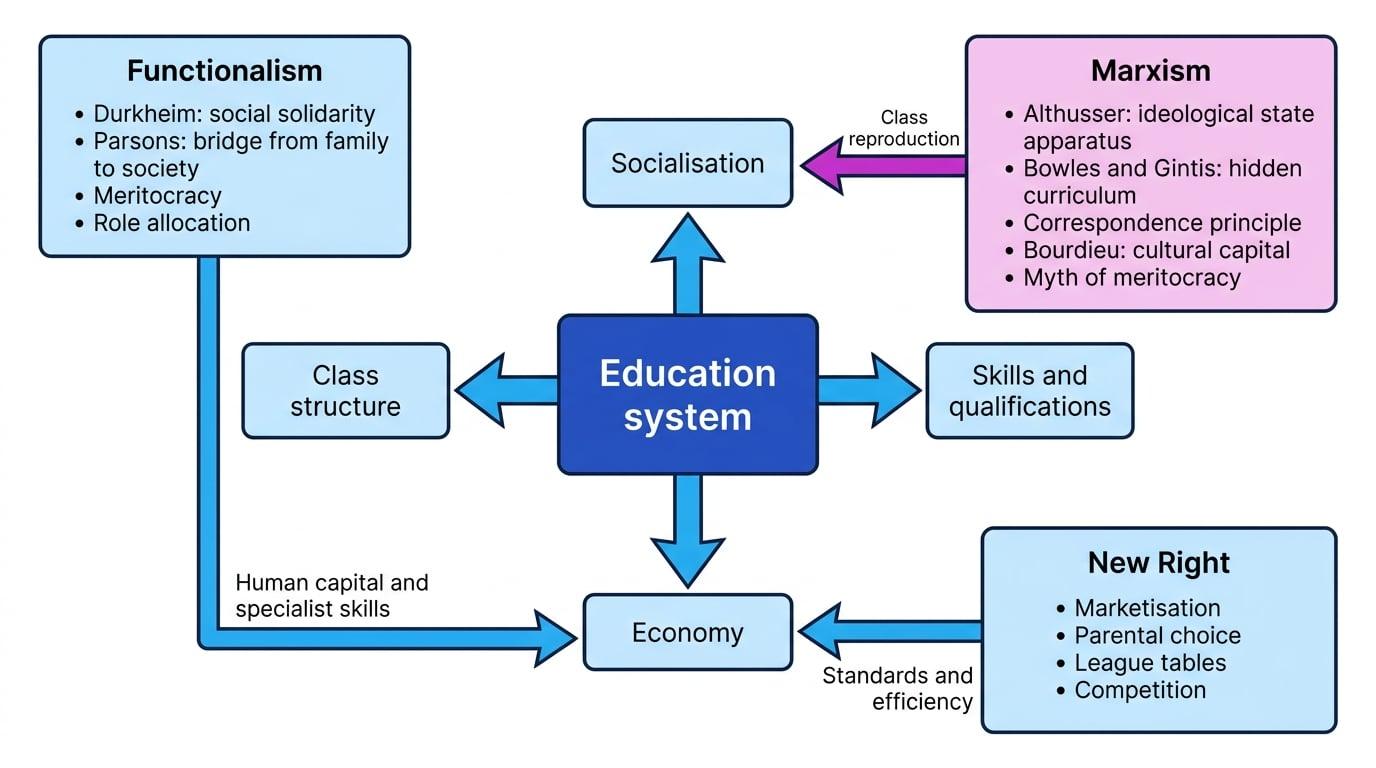
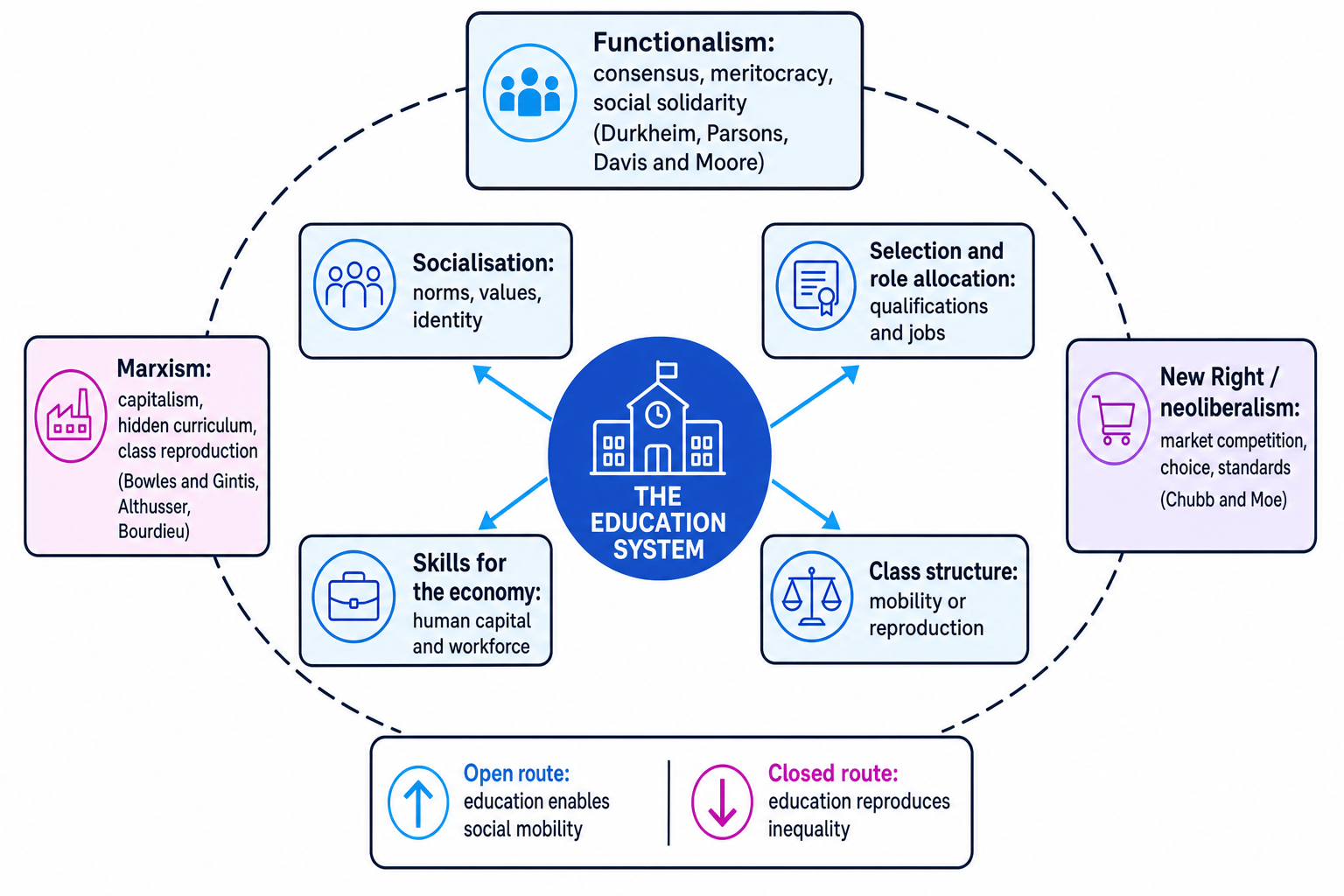
The diagram below maps the main arguments about what education does and who benefits from it.
The central debate
Functionalists see education as creating social order and matching people to jobs. Marxists see it as reproducing class inequality. New Right thinkers see it as an institution that should be made more efficient through competition and parental choice.
2. Functionalism: education helps society work smoothly
Functionalism is a consensus theory, meaning it assumes society is held together by shared values and cooperation. Functionalists ask: what useful jobs does education do for society?
Durkheim: social solidarity and specialist skills
Durkheim argued that education creates social solidarity, meaning a feeling of belonging to a wider society. Schools teach shared values through assemblies, rules, history, citizenship education and everyday routines.
Durkheim also argued that modern societies need specialist skills. In a simple society, many people may do similar work. In a complex industrial society, people need different training for different jobs: doctors, engineers, teachers, electricians, programmers and care workers.
So, for Durkheim, education links directly to the economy by preparing people for a specialised division of labour.
Parsons: education as a bridge
Parsons argued that school is a bridge between the family and wider society. In the family, children are judged by particularistic standards, meaning they are treated as special individuals. In school, they are judged by universalistic standards, meaning the same rules and exams apply to everyone.
This prepares young people for adult society, where jobs are usually allocated through qualifications, interviews and performance.
Meritocracy and role allocation
Meritocracy means a system where people are rewarded according to ability and effort rather than inherited privilege. Role allocation means sorting people into the jobs and social positions they are best suited for.
Davis and Moore argued that education identifies talent and allocates the most able people to the most important jobs. Higher rewards for difficult jobs motivate people to train hard.
Applying functionalism to exams and jobs
- Start with the social need: a modern economy needs workers with different levels of skill, from apprentices to doctors and engineers.
- Link this to education: GCSEs, A-levels, BTECs, T-levels and degrees create a common system for measuring achievement.
- Apply the functionalist idea: qualifications help allocate people to roles, so education appears to support both the economy and social order.
- Add evaluation: this assumes the system is genuinely meritocratic, but class advantages such as tutoring, private schooling and access to high-performing catchment areas may affect results.
Evaluating functionalism
Functionalism is strong because it explains why all modern societies invest heavily in education. It also fits everyday examples: schools do teach punctuality, literacy, numeracy, teamwork and qualifications.
However, it can be too optimistic. It often assumes that the values taught in school are shared by everyone. Marxists would ask: whose values are being taught? Feminists and anti-racist sociologists may also question whether the curriculum has historically privileged male, white and middle-class experiences.
3. Marxism: education reproduces class inequality
Marxism is a conflict theory, meaning it sees society as shaped by inequality and power. Marxists argue that capitalist society is divided between the ruling class, who own and control wealth, and the working class, who sell their labour for wages.
For Marxists, education does not simply create equal opportunity. It helps reproduce capitalism by training obedient workers and making inequality seem fair.
Althusser: education as an ideological state apparatus
Althusser argued that education is an ideological state apparatus. This means it spreads ruling-class ideas through beliefs, values and “common sense”, rather than through direct force.
For example, schools may teach students to accept hierarchy, competition, exams and authority as normal. If students later end up in unequal jobs, they may believe this is because of their own effort or ability, not because of class inequality.
Bowles and Gintis: the correspondence principle
Bowles and Gintis (1976) argued that school mirrors the workplace. This is called the correspondence principle.
Hidden curriculum
The hidden curriculum is everything students learn at school that is not part of the official timetable, such as obedience, punctuality, competition, respect for authority and acceptance of hierarchy.
According to Bowles and Gintis, students learn to follow instructions from teachers just as workers follow instructions from managers. They work for external rewards, such as grades, just as workers work for wages. This prepares them for capitalist employment.
They also criticised the myth of meritocracy: the belief that success is based purely on talent and effort. Marxists argue this myth hides the impact of class background.
Bourdieu: cultural capital
Bourdieu argued that schools reward cultural capital, meaning the knowledge, language, tastes and behaviour valued by the dominant class. Middle-class students may be more familiar with the language of exams, teacher expectations, museums, books, debating and university pathways.
This does not mean middle-class students are naturally “brighter”. It means their home culture may match school culture more closely. Bourdieu called this symbolic violence: the school treats middle-class culture as superior while presenting it as neutral.
Willis: resistance still leads to reproduction
Willis (1977) studied working-class “lads” who rejected school authority and created an anti-school culture. This shows students are not passive. They have agency, meaning the ability to act and make choices.
However, their resistance still led them into manual working-class jobs. So Willis supports Marxism, but adds a more complex picture: class reproduction can happen through resistance, not just obedience.
Explaining class reproduction in school
- Identify the class advantage: a middle-class student may have parents who understand school systems, pay for tutoring and know how to support university applications.
- Apply Bourdieu: these resources become cultural capital because the school recognises them as confidence, ability and ambition.
- Apply Bowles and Gintis: exam success then appears meritocratic, making later labour-market inequality seem deserved.
- Evaluate the claim: this pattern is powerful, but not automatic; some working-class students succeed, and policies such as the Pupil Premium try to reduce class gaps.
Assuming Marxists say schools never teach useful skills
Marxists do not deny that schools teach literacy, numeracy or qualifications. Their point is that education also legitimates inequality and prepares students for unequal positions in capitalism.
4. New Right and neoliberalism: education should be competitive
The New Right is a conservative and neoliberal perspective that supports competition, choice and limited state control. Neoliberalism means applying market principles, such as competition and consumer choice, to public services.
New Right thinkers argue that state schools can become inefficient because they do not face enough competition. Chubb and Moe (1990) argued that parents should have more choice, and schools should compete for pupils.
In the UK, New Right ideas influenced marketisation, meaning making education work more like a market. Examples include:
- league tables
- Ofsted reports
- parental choice
- formula funding, where money follows pupil numbers
- academies and free schools
- competition between schools for reputation and results
The link to the economy is clear: New Right thinkers argue that competition raises standards, and higher standards produce a more skilled and productive workforce.
Evaluating marketisation
Critics argue that marketisation can increase class inequality. Ball, Bowe and Gewirtz found that middle-class parents are often better at using choice because they have more time, confidence, knowledge and transport. Schools may also engage in cream-skimming, selecting easier-to-teach pupils, and silt-shifting, avoiding pupils seen as less likely to boost results.
Evaluating marketisation through class
- Explain the New Right claim: parental choice and competition should force schools to improve.
- Apply a class example: middle-class parents may use league tables, move house for catchment areas or challenge admissions decisions.
- Analyse the outcome: choice may become unequal because not all parents have the same resources to act as effective consumers.
- Reach a judgement: marketisation may raise pressure on schools, but it can also reproduce the class structure by advantaging already privileged families.
5. Education, the economy and class structure
A strong essay needs to keep returning to two relationships.
Relationship to the economy
Functionalists argue education provides human capital, meaning the skills, knowledge and qualifications that make workers productive. This fits policies promoting STEM subjects, apprenticeships, T-levels and employability skills.
Marxists argue education produces workers who accept hierarchy, deadlines and external rewards. From this view, the hidden curriculum is just as important as the official curriculum.
A further concept is credentialism, where society relies increasingly on qualifications as proof of ability. This can help employers sort applicants, but it may also create qualification inflation, where more credentials are needed for jobs that previously required fewer.
Relationship to class structure
Education can support social mobility, meaning movement up or down the class structure. For example, a working-class student may gain high grades, attend university and enter a professional occupation.
But education can also reproduce class inequality. Material factors such as housing, income, devices, private tutoring and quiet study space affect achievement. Cultural factors such as parental knowledge of the system, confidence with teachers and familiarity with academic language also matter.
A simple essay frame
For any point about education, ask: does this help everyone, help the economy, or help powerful groups maintain advantage? That question usually pushes you from AO1 into AO3.
6. Overall comparison
Functionalism is useful for explaining why societies need education: shared values, skills, selection and qualifications. It is especially strong on the link between education and the economy.
Marxism is useful for explaining why class inequalities persist despite formal equality of opportunity. It is especially strong on power, ideology and class reproduction.
The New Right is useful for understanding recent UK education policy, especially marketisation and parental choice. However, critics argue it underestimates how class affects the ability to choose.
The best answers do not simply pick one theory. They compare them. Education can teach useful skills and still reproduce inequality. It can create opportunities for some individuals while maintaining advantages for privileged groups overall.
In the exam
- Start with a clear theoretical claim: functionalist, Marxist or New Right.
- Add AO2 by applying it to a concrete example, such as GCSEs, league tables, apprenticeships, private tutoring, academies or catchment areas.
- Add AO3 by asking whether the function benefits society as a whole or mainly benefits particular classes.
- Use named theorists accurately: Durkheim and Parsons for consensus, Bowles and Gintis or Bourdieu for reproduction, Chubb and Moe for marketisation.
- End paragraphs with a judgement, not just a description.
Check yourself
- How would a functionalist explain the link between education and the economy?
- How do Bowles and Gintis use the hidden curriculum to explain class reproduction?
- Why might marketisation increase inequality even if it claims to increase choice?