When trying to understand why some students succeed and others do not, macro-sociologists (like Marxists and Functionalists) focus on external structural factors such as social class, material deprivation, or capitalism.
However, micro-sociologists (specifically interactionists) argue that we cannot understand educational outcomes without looking inside the "black box" of the school itself. This topic explores the daily interactions, processes, and relationships that happen within the school walls and how they shape student identities and achievement.
What you'll learn
- How teacher expectations and labels can create a self-fulfilling prophecy for students.
- How school organisation, such as setting and streaming, polarises students and shapes pupil subcultures.
- How working-class, gendered, and ethnic identities conflict with school environments.
- The role of the "hidden curriculum" in socialising students for their future roles.
1. Teacher-Pupil Relationships: Labelling Theory
At the heart of the interactionist approach is the idea that our self-concept (how we see ourselves) is constructed through our interactions with others. In a school setting, teachers hold a position of significant power, and their judgements can have a profound impact on students.
Labelling
Labelling is the process of attaching a definition, category, or meaning to an individual. In education, teachers may label a pupil as "troublemaker," "bright," "cooperative," or "low-ability," often based on stereotyped assumptions rather than objective data.
Interactionist sociologist Howard Becker (1971) conducted a famous study based on interviews with 60 Chicago high school teachers. He found that teachers did not evaluate students objectively. Instead, they compared every student to their own cognitive template of the "ideal pupil".
- The Ideal Pupil: Typically middle-class, quiet, polite, clean, and academically eager.
- The Non-Ideal Pupil: Typically working-class, outspoken, poorly behaved, and perceived as lacking motivation.
Subsequent UK research, such as that by Hempel-Jorgensen (2009), confirmed that these templates persist. In a working-class primary school, the "ideal pupil" was defined as quiet and passive because behavior was the teachers' main concern. In a middle-class primary school, the "ideal pupil" was defined in terms of high academic ability and effort.
The Self-Fulfilling Prophecy (SFP)
Once a label is applied, it can trigger a psychological chain reaction that directly influences a student's academic performance.
Self-Fulfilling Prophecy
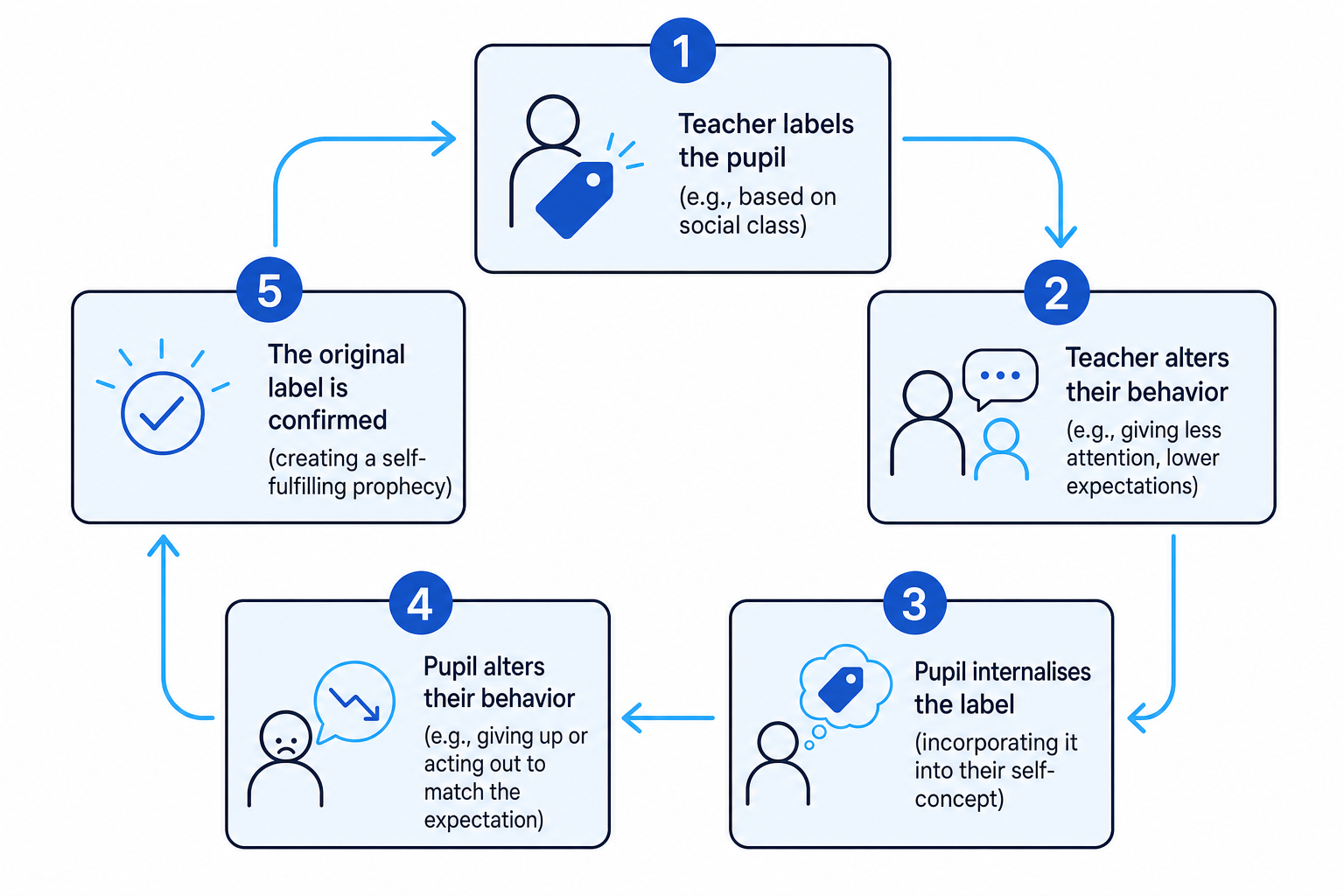
A self-fulfilling prophecy is a prediction or expectation that comes true simply because it has been made. In school, a student internalises a teacher's label, changes their self-belief, and behaves in a way that confirms the original label.
This process typically occurs in four stages:
- The Label is Applied: The teacher labels a pupil (e.g., as "unintelligent") and makes predictions about their future.
- The Treatment Changes: The teacher treats the pupil accordingly (e.g., giving them less attention, placing them at the back of the room, or offering less challenging tasks).
- Internalisation: The pupil internalises the teacher’s expectation. It becomes part of their self-concept (e.g., "I am not smart, so there is no point in trying").
- The Prophecy is Fulfilled: The pupil stops working, fails their exams, and thus "proves" the teacher's original label correct.
Classic Study: Rosenthal and Jacobson (1968)
In Pygmalion in the Classroom, Rosenthal and Jacobson tested the self-fulfilling prophecy in a California primary school.
- They gave students an IQ test but lied to teachers, telling them the test identified a group of students who were about to experience a rapid intellectual "spurt" (the "spurters").
- In reality, these "spurters" were selected completely at random.
- Returning a year later, they found that 47% of the identified "spurters" had made significant, measurable gains in their IQ scores because the teachers had unconsciously given them more warmth, feedback, and encouragement.
The Determinism Fallacy
Many students write as if labelling is deterministic—meaning that if a teacher labels you, you must fail. This is incorrect. Human beings have agency. Some students reject labels and work harder to prove their teachers wrong (such as the Black female pupils in Margaret Fuller’s 1984 study). Always evaluate labelling by showing that it can be resisted.
2. The Organisation of Teaching and Learning
Schools do not just educate; they organise students into groups based on perceived ability. This structural organisation reinforces the labelling that happens in individual classrooms.
Streaming, Setting, and Banding
Schools group students using three main systems:
- Streaming: Pupils are placed in a single ability group (or "stream") for all of their academic subjects based on a general assessment.
- Setting: Pupils are placed in ability groups on a subject-by-subject basis (e.g., top set for Maths, middle set for English).
- Banding: A broader form of streaming where the intake is divided into two or three wide bands of ability.
Because working-class and ethnic minority pupils are more likely to be labelled negatively by teachers, they are disproportionately placed in lower streams and sets.
Once placed there, it is extremely difficult to move up. Douglas found that children placed in lower streams at age 8 suffered a decline in their IQ scores by age 11, whereas those in higher streams showed an improvement.
The Educational Triage
Gillborn and Youdell (2001) show how marketisation and school league tables force schools to categorise students into three groups, a process they call the educational triage:
- Those who will pass anyway: Left to get on with it.
- Those with potential: Targetted for extra help to secure a Grade 5/C (the "A-to-C economy").
- Hopeless cases: Dominated by working-class and Black pupils, who are written off in lower sets and starved of resources.
3. Pupil Subcultures and Identities
When schools group and label students, the students do not react in isolation. They form pupil subcultures to help cope with the school environment.
Pupil Subculture
A pupil subculture is a group of students who share similar values, norms, and behaviors, which often run counter to the dominant, official culture of the school.
Lacey (1970): Differentiation and Polarisation
Colin Lacey explained how pupil subcultures develop through two key school processes:
- Differentiation: The way teachers categorise pupils into different groups based on academic ability or behavior (e.g., through streaming).
- Polarisation: The way students react to differentiation by moving toward one of two opposite poles:
- The Pro-School Subculture: Typically populated by middle-class students in high streams. They gain status through academic success and commit to the school’s values of hard work, respect, and neatness.
- The Anti-School Subculture: Typically populated by working-class students in lower streams. Because the school has denied them academic status, they suffer from status frustration. To regain self-esteem, they invert the school’s values: misbehavior, truanting, and resisting authority become badges of honour and sources of alternative status.
The Mirror Game
Think of an anti-school subculture as looking in a mirror that flips everything. In the school's mirror, getting a detention is a "loss" and finishing your homework is a "win." In the anti-school subculture's mirror, the reflection is reversed: getting a detention is a "win" (status among peers), and doing your homework is a "loss" (being called a "boff" or "geek").
Archer (2010): "Nike" Identities and Class Conflict
Louise Archer and colleagues investigated how working-class identities interact with the school. They utilised the Marxist concept of habitus (the learned, taken-for-granted ways of thinking, speaking, and behaving shared by a particular social class).
- Symbolic Violence: Schools have a middle-class habitus. They devalue working-class culture, language, and preferences, treating working-class tastes as inferior.
- Nike Identities: To generate self-worth and construct a positive identity in an environment that rejects them, working-class youth look to global consumer brands (especially sportswear like Nike).
- The Conflict: Wearing branded sportswear is crucial for working-class peer group acceptance, but it violates the school's middle-class dress code. Teachers view this style as rebellious, "chavvy," and anti-school, leading to further labelling and academic exclusion.
Applying Lacey's differentiation and polarisation to a school scenario
Consider this scenario: A secondary school shifts its year 8 cohort from mixed-ability teaching to a strict, rigid system of six streams based entirely on English and Maths tests.
Let's trace how this organizational shift leads to the formation of anti-school subcultures using Lacey’s framework.
- Identify the process of differentiation: The school's shift to six rigid streams is an act of differentiation. The school is structurally categorising students, placing students like Jack (a working-class student with low reading scores) into "Stream 6." Teachers now view Stream 6 as the "difficult" group and adjust their teaching style to be more disciplinary and less academic.
- Explain the onset of status frustration: Jack, now segregated in Stream 6, experiences a loss of self-worth. The school's official status system rewards academic high-achievers. Because Jack is locked out of this system by being in the bottom stream, he cannot gain status through legitimate, academic means. He experiences status frustration.
- Trace the process of polarisation: To cope with this frustration, Jack and his peers in Stream 6 polarise. They drift away from the school’s values and move towards the "anti-school" pole. They reject the school's goals because those goals are unattainable for them.
- Detail the formation of the subculture: Jack and his friends form a cohesive anti-school subculture. They create their own alternative status system. Within this group, Jack gains status by talking back to the teacher, refusing to wear his blazer, and failing his spelling tests on purpose. What the school labels as "failure," his subcultural peers label as "success."
4. The Hidden Curriculum
While teacher relationships and subcultures represent dynamic personal interactions, schools also socialise students through their structural layout and daily routines. Sociologists refer to this as the hidden curriculum.
Hidden Curriculum
The hidden curriculum refers to the informal, unwritten lessons, values, and attitudes that schools teach students implicitly, as opposed to the academic subjects of the formal curriculum.
| Aspect of School Life | What it Teaches (The Hidden Curriculum) |
|---|---|
| Strict dress codes / uniforms | Conformity, suppression of individuality, and preparing for professional dress standards in the workplace. |
| Hierarchical structures (Headteacher →\to→ Teachers →\to→ Prefects →\to→ Pupils) | Acceptance of authority, obedience, and understanding your place in a social hierarchy. |
| Punctuality, bells, and timetables | Time-discipline and preparing for the rigid schedule of the working day. |
| Exams, grading, and competition | Individualism, meritocratic belief (the idea that those who work hardest succeed), and acceptance of inequality. |
Theoretical Perspectives on the Hidden Curriculum
- Marxists (Bowles and Gintis): Believe the hidden curriculum operates through the correspondence principle. The organization of the school mirrors (corresponds to) the capitalist workplace. It grooms working-class children to be submissive, punctual, and obedient workers who do not question exploitation.
- Functionalists (Parsons): Believe the hidden curriculum is highly beneficial for society. It acts as a bridge between the family (which operates on particularistic standards) and wider society (which operates on universalistic standards). It teaches children how to function in a meritocratic world.
<tip title="Use "Methods in Context" linking">
If you get an exam essay on the hidden curriculum or labelling, link it to Methods in Context (Paper 1).
- If a researcher wanted to study the hidden curriculum, why would they choose unstructured participant observation over questionnaires?
- Answer: Because the hidden curriculum is "hidden" and unconscious; teachers and pupils cannot report it accurately in a survey, but an observer can watch it play out in real time.
In the exam
If you face an essay question on relationships and processes within schools (e.g., "Evaluate the view that factors within schools are the primary cause of differences in educational achievement"), use these strategies:
- Avoid the "Inside vs. Outside" trap: Do not write an essay that is 100% about inside-school factors (labelling, streams) and then a totally separate essay on outside-school factors (material deprivation). Instead, connect them. Show how external class background causes internal labelling (e.g., teachers labelling working-class students because of their accent or uniform, which are external factors).
- Bring in the "Big Three" variables: Ensure your answer touches on how internal processes affect Class (Becker, Lacey, Ball), Gender (how teachers label boys as disruptive; how girls form supportive subcultures), and Ethnicity (Gillborn and Youdell on the educational triage of Black pupils; Wright on the marginalisation of Asian pupils).
- Use evaluation case studies: Balance interactionist accounts (which can make students look like passive victims of labels) with studies showing pupil resistance and agency, such as Fuller's study of high-achieving Black girls who rejected teacher labelling.
Check yourself
- How does Howard Becker's concept of the "ideal pupil" relate to the social class of the student?
- Explain the difference between "differentiation" and "polarisation" in Lacey's theory of subcultures.
- Give two examples of how the hidden curriculum prepares students for a capitalist workplace, according to Marxist sociologists Bowles and Gintis.
