What you'll learn
- How physiological explanations link criminal behaviour to the brain, genes, hormones and neurotransmitters.
- How these differ from non-physiological explanations such as learning, upbringing and cognition.
- The key details of Raine et al. (1997) on brain abnormalities in murderers using PET scans.
- How biological ideas can be applied to preventing criminal behaviour, while staying ethical and realistic.
The big picture: can biology explain crime?
In criminal psychology, a criminal behaviour is behaviour that breaks the law. Psychology does not simply ask “who is bad?” — it asks why some people may be more likely to offend, and why others in similar circumstances do not.
A biological explanation argues that crime may be partly caused by features of the body or nervous system. This does not mean someone is “born criminal” or has no choice. A strong A-Level answer usually says biology may create a predisposition: an increased risk, not a guaranteed outcome.
Physiological explanation
A physiological explanation explains behaviour through bodily processes, such as brain structure, brain activity, neurotransmitters, hormones, genes or nervous-system functioning.
Physiological explanations of criminal behaviour
Brain structure and brain activity
The prefrontal cortex is the front part of the brain involved in planning, decision-making and impulse control. If this area functions less effectively, a person may find it harder to stop themselves acting aggressively or taking risks.
The limbic system is a set of brain areas involved in emotion and motivation. It includes the amygdala, which is linked to fear and aggression, and the hippocampus, which is linked to memory and emotional learning.
The corpus callosum is the band of fibres connecting the two hemispheres of the brain. If communication between hemispheres is weaker, it may affect how emotional information and self-control are integrated.
Neurotransmitters and hormones
A neurotransmitter is a chemical messenger that allows neurons to communicate. Low levels of serotonin have been linked with impulsive aggression because serotonin is involved in mood regulation and inhibition.
A hormone is a chemical messenger carried in the bloodstream. High testosterone is sometimes linked to dominance and aggression, although the relationship is not simple. Hormones interact with context, personality and social learning.
Genes and inherited vulnerability
A gene is a section of DNA that contributes to biological characteristics. Some researchers suggest genetic factors may influence traits linked to offending, such as impulsivity or aggression. However, genes do not act alone: they interact with environments such as childhood experiences, peer groups and stress.
Predisposition, not destiny
Biological factors may make offending more likely, especially violent or impulsive offending, but they do not automatically cause crime. The best answers avoid biological determinism.
Non-physiological explanations
A non-physiological explanation explains crime without focusing mainly on bodily processes.
Examples include:
- Social learning: people may imitate criminal behaviour if they see it rewarded. Bandura et al. (1961) showed that children can imitate aggressive models, which supports the wider idea that aggression can be learned.
- Cognitive explanations: offenders may think differently, for example by justifying harm or underestimating consequences.
- Social explanations: poverty, peer pressure, poor education, family conflict or neighbourhood crime may increase opportunities and motivation for offending.
Separating biological and non-biological factors
A 19-year-old repeatedly gets into violent fights. He has a history of head injury, drinks heavily, and belongs to a peer group where aggression gains status.
- A biological explanation would focus on the head injury and alcohol because both may affect inhibition and impulse control, possibly involving the prefrontal cortex.
- A non-physiological explanation would focus on peer approval, learned aggression and the social rewards he receives for fighting.
- A balanced conclusion would say the violence is best explained by an interaction: biological vulnerability may lower self-control, while the social environment provides triggers and rewards.
Key research: Raine et al. (1997)
Raine et al. (1997) carried out the study “Brain abnormalities in murderers indicated by positron emission tomography.” It is the key research for this biological section of Criminal Psychology.
Aim
The aim was to investigate whether murderers pleading not guilty by reason of insanity showed brain abnormalities compared with a matched control group.
PET scans
Positron emission tomography
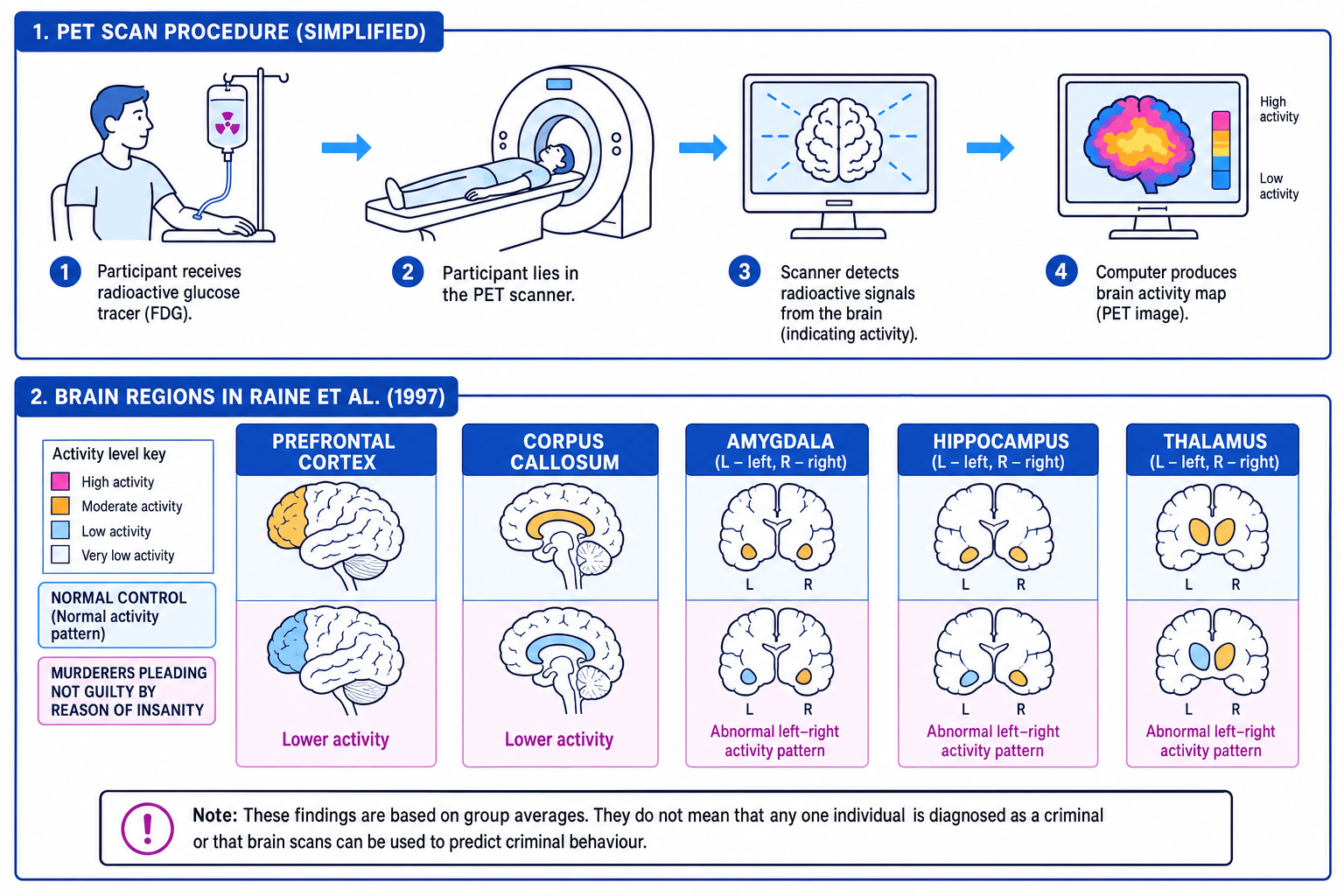
Positron emission tomography (PET) is a brain-imaging technique that uses a radioactive glucose tracer to estimate brain activity. More active brain areas use more glucose, so PET can show relative levels of activity across regions.
The diagram shows the basic PET process and the main brain regions linked to Raine et al.’s findings.
Method
Raine et al. used a quasi-experiment because the researchers did not randomly allocate people to be murderers or non-murderers. The naturally occurring independent variable was whether the participant was a murderer pleading not guilty by reason of insanity or a control participant.
The sample included 41 murderers and 41 controls matched for age and sex. The murderer group was mostly male, and the sample was from the USA, so this matters for generalisability.
Participants were injected with a radioactive glucose tracer and completed a continuous performance task. This task helped standardise what participants were doing while brain activity was being measured. Their brains were then scanned using PET.
The dependent variable was brain activity, measured through glucose metabolism in different brain areas.
Results
Raine et al. found that, compared with controls, the murderer group showed:
- reduced activity in the prefrontal cortex;
- reduced activity in the corpus callosum;
- abnormal activity patterns in the amygdala, hippocampus and thalamus;
- differences in left-right brain activity, especially in areas linked to emotion and aggression.
Conclusions
Raine et al. concluded that some murderers pleading not guilty by reason of insanity show brain abnormalities in areas linked to self-control, emotion and aggression.
This supports a biological explanation of violent crime: impaired brain functioning may make impulsive or aggressive behaviour more likely.
Correlation is not causation
Raine et al. found brain differences between groups, but this does not prove that brain abnormalities caused murder. The differences could be caused by earlier trauma, substance use, mental illness, injury, or other life experiences.
Evaluating Raine et al. (1997)
Strengths
Raine et al. used PET scans, which provide objective biological data rather than relying only on self-report. This supports psychology as a science because the data can be measured and compared.
The study also used a matched control group, which improves validity. Matching participants on age and sex helps reduce alternative explanations for group differences.
The procedure was standardised because participants completed the same task during scanning. This improves reliability because differences in brain activity are less likely to be due to different tasks.
Weaknesses
The study has limited population validity. The sample was murderers pleading not guilty by reason of insanity, not all offenders and not all murderers. It cannot be generalised easily to non-violent crimes such as theft, fraud or drug offences.
It is also reductionist. Explaining murder through brain activity may ignore social and psychological factors such as abuse, poverty, peer influence, moral reasoning and opportunity.
The study is socially sensitive. If brain scans are interpreted too strongly, people with brain differences could be unfairly labelled as dangerous. This raises ethical concerns about stigma, discrimination and responsibility.
Ethics and the BPS Code
Although Raine et al. was conducted in a legal and clinical context, you can still evaluate it using the BPS Code of Human Research Ethics.
Important issues include:
- Respect: participants should understand what scanning involves and give valid consent where possible.
- Responsibility: PET scans involve exposure to radioactive material, so harm must be minimised.
- Integrity: researchers must avoid overstating the findings, especially because the research could affect public attitudes towards offenders.
- Confidentiality: brain and legal information is highly sensitive.
AO3 sentence starter
A strong evaluation sentence might begin: “However, Raine et al. cannot show that brain abnormalities caused murder because…” Then explain the quasi-experimental design and add an alternative explanation.
Application: biological strategies for preventing criminal behaviour
Biological explanations can be useful because they suggest practical prevention strategies. However, these must be used carefully. The aim should be support and risk reduction, not labelling people as “future criminals”.
Nutritional interventions
One biological strategy is improving diet or providing nutritional supplements. The reasoning is that brain functioning depends on nutrients, and poor nutrition may affect mood regulation, concentration and impulse control.
For example, prisons or youth offender institutions could provide balanced meals and supplements such as vitamins, minerals or omega-3, alongside monitoring of behaviour. Some prison nutrition research, such as Gesch et al. (2002), suggests supplements may reduce disciplinary incidents.
This strategy is relatively low-risk and can benefit general health. However, it is unlikely to be enough on its own because offending is also affected by learning, relationships, poverty and opportunities.
Drug treatment
Another biological strategy is medication. For example, selective serotonin reuptake inhibitors are drugs that increase the availability of serotonin in the brain. If low serotonin is linked with impulsive aggression, then increasing serotonin may reduce aggressive outbursts in some people.
This must be clinically assessed and voluntary wherever possible. Medication may have side effects, and it does not teach social skills, empathy or problem-solving.
Brain injury and early support
If brain injury or neurodevelopmental difficulties increase offending risk, prevention could include early assessment, treatment and support. For example, a young person with attention difficulties, impulsivity and a history of head injury might benefit from medical assessment, school support and structured routines.
Designing an ethical prevention plan
A youth offending team works with a 16-year-old who has repeated aggressive incidents, poor sleep, a very limited diet and possible attention difficulties.
- The team should avoid assuming he is biologically “criminal”; instead, they should assess possible risk factors such as sleep, nutrition, neurodevelopmental needs and medical history.
- A biological intervention could include improved nutrition, sleep support and referral for clinical assessment, because these target brain functioning and impulse control.
- The plan should also include non-biological support, such as mentoring, family work and anger management, because biological vulnerability alone does not explain offending.
- The team should evaluate effectiveness by comparing behaviour before and after the intervention, while also checking for wellbeing and consent.
The main debates
Nature versus nurture
Biological explanations emphasise nature, but the strongest view is interactionist. Biology and environment work together.
Free will versus determinism
A purely biological explanation can sound deterministic because it implies brain activity causes crime. A balanced answer says biology may influence behaviour, but people still respond to situations, choices and consequences.
Reductionism versus holism
Raine et al. is reductionist because it focuses on brain areas. A holistic explanation would combine brain functioning with upbringing, cognition, peers, culture and opportunity.
Usefulness
Biological research is useful because it may improve prevention, rehabilitation and treatment. However, it must not be used to predict criminality in individuals from brain scans alone.
In the exam
- For AO1, describe the biological mechanism clearly: brain area, neurotransmitter, hormone or genetic factor, and how it links to offending.
- For Raine et al., include aim, sample, PET method, key results and conclusion; do not just write “criminals have abnormal brains.”
- For AO3, evaluate causality, generalisability, ethics, reductionism and usefulness.
- For AO2, apply cautiously: say biological factors may increase risk in the scenario, not that they prove someone will offend.
Check yourself
- Why does reduced prefrontal cortex activity potentially link to impulsive crime?
- What were two key findings from Raine et al. (1997)?
- Why is it risky to use biological research to predict future criminals?
