What you'll learn
- Why children may be especially influenced by television advertising.
- How adverts can communicate gender stereotypes through voices, language and product presentation.
- What Johnson and Young (2002) found about gendered voices in children’s advertising.
- How to apply strategies such as media literacy, parental mediation and regulation to reduce advertising impact.
Where this topic fits
This is a Component 03 Applied Psychology topic within Child psychology. It is also strongly linked to the social area, because it focuses on how children are influenced by messages from their social environment — in this case, television advertising.
For essays, think in three layers:
- AO1: describe the background, the key research and reduction strategies.
- AO2: apply these ideas to a new advert, child, school campaign or media scenario.
- AO3: evaluate the research and strategies using issues such as validity, ethics, usefulness and cultural bias.
Background: why advertising can affect children
Television advertising
Television advertising means paid promotional content shown on TV to encourage viewers to buy, want, remember or feel positively about a product, brand or lifestyle.
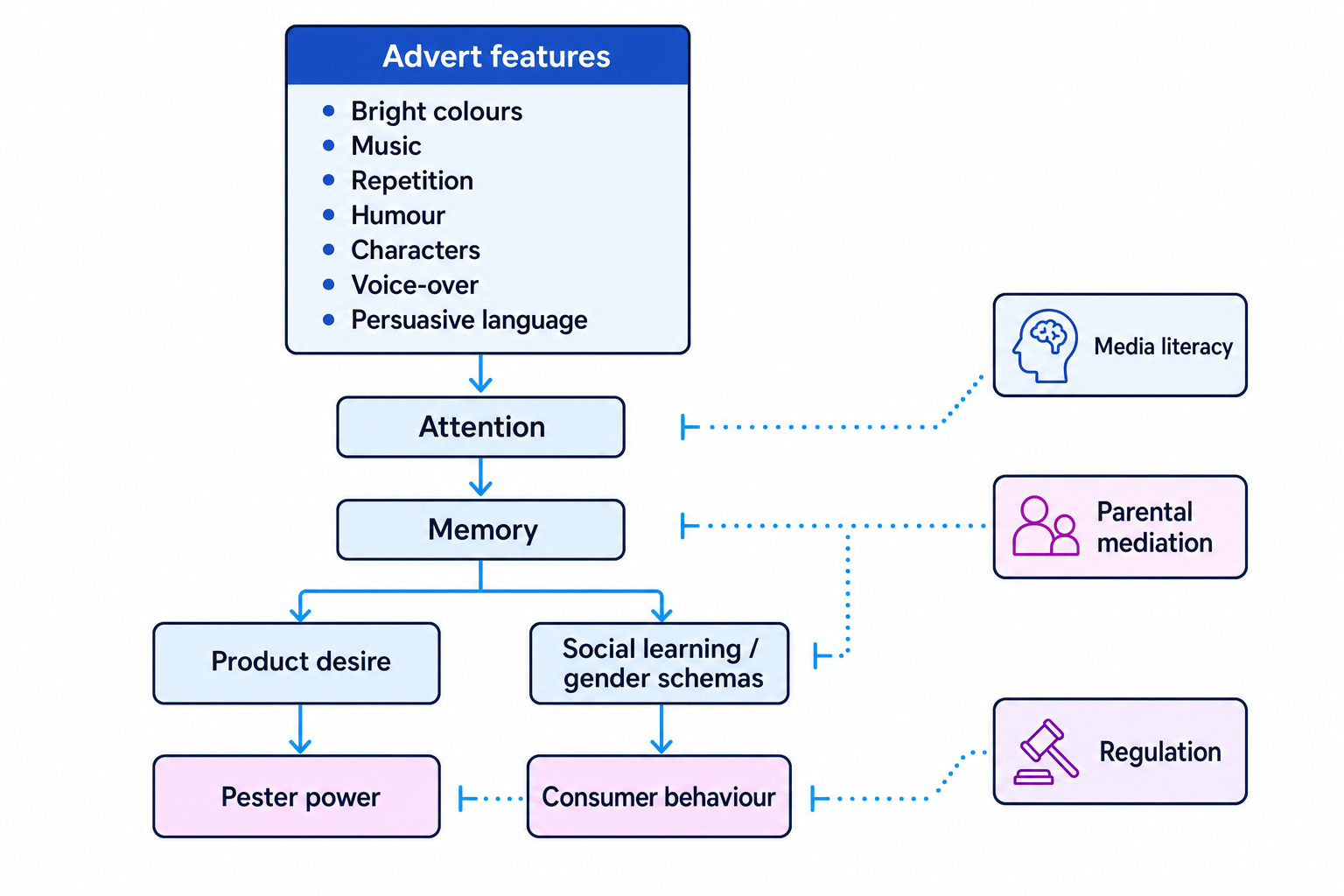
Children are not just “small adults” when they watch adverts. Younger children may find it harder to recognise that adverts are designed to persuade them. They may focus on bright colours, music, humour, characters, repetition and exciting action, rather than critically judging the message.
Persuasive intent
Persuasive intent is the understanding that an advert is deliberately trying to influence your attitudes or behaviour, usually to make you want a product.
A child who understands persuasive intent can think, “This advert is trying to make me want that toy.” A child who does not understand it may treat the advert more like ordinary entertainment or information.
Advertising can influence children in several ways:
- Attention: adverts are short, colourful and repeated.
- Memory: slogans, jingles and characters make products easy to remember.
- Desire: adverts make products seem fun, exciting, popular or necessary.
- Pester power: children may repeatedly ask parents or carers to buy advertised products.
- Social learning: children may copy behaviours or gender roles shown as rewarded or desirable.
Social learning
Social learning is learning by observing other people or models, especially when their behaviour appears rewarded, attractive or successful.
Think of advertising influence as a chain: advert features shape what children notice, remember and imitate.
The main background idea
Children may be vulnerable to advertising because adverts combine persuasive techniques with repeated social messages about what children should want, how they should behave, and what is “normal” for boys and girls.
Stereotyping in children’s advertising
Stereotype
A stereotype is an oversimplified belief about a group of people, such as the idea that boys are naturally adventurous and aggressive while girls are naturally caring and appearance-focused.
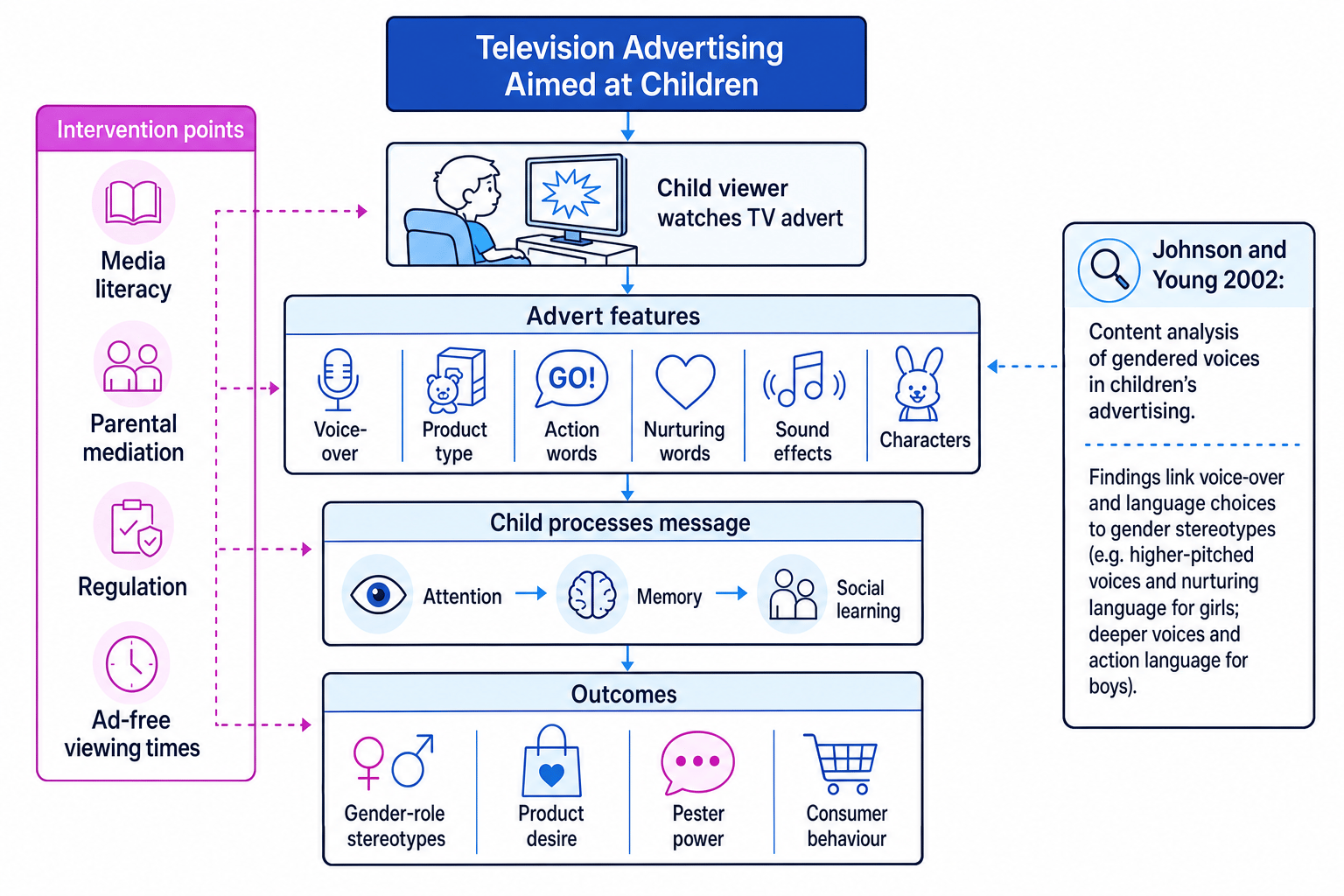
In children’s advertising, stereotyping can appear through:
- the type of product advertised, such as vehicles and action figures for boys, dolls and beauty-related toys for girls;
- the voice-over, meaning the unseen voice narrating the advert;
- the language, such as “battle”, “power” and “attack” compared with “love”, “beautiful” and “care”;
- the pace and sound, such as loud explosions or softer music;
- the characters, such as boys being shown as active and competitive, while girls are shown as nurturing or decorative.
Gender-role stereotype
A gender-role stereotype is a belief about how people should behave because they are male or female, rather than because of their individual personality or choices.
This matters because repeated stereotypes may shape children’s gender schemas.
Gender schema
A gender schema is a mental framework that helps a child organise information about what is seen as appropriate for boys and girls.
If adverts repeatedly show boys as powerful and girls as caring, children may start to treat these roles as natural or expected.
Applying stereotyping to a toy advert
A source describes an advert for a superhero vehicle. The advert uses a deep male voice, fast music, explosions and phrases such as “dominate the battle” and “unleash the power”.
-
Identify the likely target audience by combining several cues, not just one. The superhero vehicle, battle language, explosions and deep male voice suggest the advert is probably coded as aimed mainly at boys.
-
Link the advert features to a stereotype. The words “dominate” and “power” present masculinity as active, aggressive and competitive.
-
Explain the possible effect on children. Through repeated exposure, a child may learn that exciting, powerful play is “for boys”, while other types of play are less appropriate.
-
Add a balanced point. The advert does not prove that every child will become stereotyped; it shows a social message that may contribute to gender schemas alongside family, peers and school.
Assuming adverts directly control children
Do not write as if one advert automatically causes a child to behave in a certain way. A better answer says adverts can contribute to attitudes and desires, especially through repetition and social learning.
Key research: Johnson and Young (2002)
Aim
Johnson and Young (2002), in “Gendered voices in children’s advertising”, investigated how children’s television adverts used voices and language to communicate gendered messages.
Their focus was not simply “are boys and girls shown differently?” but more specifically how voice-overs, sound and wording help construct gender roles.
Method
Content analysis
A content analysis is a research method where researchers systematically code communication material, such as adverts, films or articles, into categories so patterns can be identified.
Johnson and Young used a content analysis of children’s television advertising. They examined adverts aimed at children and coded features such as:
- whether the advert appeared targeted at boys, girls or both;
- the gender and style of the voice-over;
- the kinds of words used;
- the product type;
- the overall message about activity, power, care, beauty or relationships.
This is useful because adverts are naturally occurring media material. The researchers did not need to create artificial adverts in a lab.
Research-method link
Content analysis often produces nominal data, because categories are names rather than scores — for example, male voice-over, female voice-over or mixed voice-over. Researchers can then count frequencies and calculate percentages.
If a psychologist wanted to test whether voice-over gender was associated with target audience, a Chi-square test could be suitable because it tests for an association between two nominal variables.
Research-method link
For this study, use terms such as coding categories, inter-rater reliability, frequencies, percentages and nominal data. These strengthen AO3 evaluation because they show you understand how content analysis works.
Findings
Johnson and Young found that children’s adverts often used voice and language in gendered ways.
Typical patterns included:
- adverts aimed at boys using more forceful, active or competitive language;
- adverts aimed at girls using more nurturing, appearance-related or relationship-based language;
- male voices often being associated with authority, action or excitement;
- female voices being more associated with caring, sweetness or traditionally feminine products.
The key point is that the advert’s soundtrack and narration helped create gendered meanings, not just the images on screen.
Conclusions
Johnson and Young concluded that children’s advertising can reinforce traditional gender roles. Boys may be encouraged to associate masculinity with power, action and control. Girls may be encouraged to associate femininity with beauty, caring and relationships.
This supports the idea that advertising is part of the child’s social environment. It may help shape gender schemas and expectations about suitable behaviour.
Johnson and Young in one sentence
Johnson and Young (2002) showed that children’s adverts use voice, sound and language to communicate gender stereotypes, not just visual images.
Evaluating Johnson and Young (2002)
Strengths
A major strength is ecological validity. The study examined real television adverts rather than artificial materials, so the findings are relevant to the media children may actually encounter.
Another strength is usefulness. The research can inform parents, teachers, regulators and advertisers about subtle stereotyping. It draws attention to voice and language, which are easy to overlook.
Content analysis can also be fairly reliable if coding categories are clear and more than one coder is used. Researchers can check inter-rater reliability, meaning whether different coders classify adverts in the same way.
Weaknesses
A limitation is that content analysis is mainly descriptive. It can show that adverts contain stereotypes, but it cannot prove that those adverts directly change children’s beliefs or behaviour.
There may also be subjectivity in deciding whether an advert is aimed at boys, girls or both. Some products and messages are ambiguous, so coder judgement matters.
The study may be culturally and historically limited. Advertising from one country or time period may not represent advertising in other cultures, later decades or online platforms such as streaming services and social media.
Ethics
Because Johnson and Young analysed adverts rather than testing children directly, there were fewer ethical risks such as distress, deception or lack of consent from child participants.
However, the topic is still socially sensitive because it concerns gender, childhood and media influence. Researchers need to report findings carefully, without implying that all boys or all girls are the same.
Socially sensitive research
Socially sensitive research is research that may have consequences for particular groups in society, especially if findings could be used to label, blame or disadvantage people.
Application: reducing the impact of advertising on children
OCR expects you to know at least one strategy to reduce the impact of advertising aimed at children. Strong answers usually explain the strategy and evaluate whether it is likely to work.
Strategy 1: media literacy education
Media literacy
Media literacy means teaching children to understand, question and evaluate media messages, including how adverts try to persuade them.
A media literacy lesson might teach children to ask:
- Who made this advert?
- What does it want me to feel or do?
- What stereotypes does it show?
- What information is missing?
- Is the product really as exciting as it looks?
This strategy targets children’s understanding of persuasive intent. It is especially useful for older children who can discuss motives, evidence and stereotypes.
AO3 evaluation: media literacy is empowering because it helps children become active, critical viewers. However, it may be less effective for very young children who do not yet have the cognitive skills to analyse persuasion in depth.
Strategy 2: parental mediation
Parental mediation
Parental mediation means parents or carers managing and discussing children’s media use, either by talking about adverts or by limiting exposure.
There are two main forms:
- Active mediation: watching with the child and discussing adverts critically.
- Restrictive mediation: limiting screen time, using ad-free services or avoiding channels with heavy child-targeted advertising.
Active mediation might involve a parent saying, “This advert makes the toy look exciting because it uses music and fast editing, but what do you think it would actually be like?”
AO3 evaluation: parental mediation can be flexible and immediate, but it depends on parents having time, confidence and media knowledge. It may also be harder as children access media on phones, tablets and streaming platforms.
Strategy 3: regulation
Regulation means using rules to control what advertisers can show to children and when they can show it. In the UK, organisations such as the Advertising Standards Authority and rules linked to broadcast advertising can restrict misleading or harmful adverts.
Regulation may involve:
- limiting adverts during children’s programming;
- banning adverts that exploit children’s inexperience;
- restricting harmful stereotypes;
- limiting advertising for products linked to health concerns;
- requiring adverts to be clearly recognisable as adverts.
AO3 evaluation: regulation is useful because it does not rely only on individual children or parents. However, it can be difficult to enforce across online platforms, influencers and international media.
Choosing a reduction strategy
A school reports that Year 5 pupils are repeating gendered slogans from toy adverts and saying some toys are “only for boys” or “only for girls”.
-
Identify the main problem. The issue is not just product desire; it is gender stereotyping and peer reinforcement of gender schemas.
-
Choose the best first strategy. Media literacy is appropriate because the school can teach pupils how adverts use voice, language and product cues to create stereotypes.
-
Apply the strategy to the scenario. Pupils could compare two toy adverts, identify the voice-over, list action or nurturing words, and discuss whether the message is fair or limiting.
-
Add a supporting strategy. Parental mediation could reinforce the lesson at home by encouraging families to talk about adverts rather than simply banning them.
-
Evaluate briefly. This is likely to help children think critically, but it may not remove all influence because adverts are repeated across TV, online video and peer conversations.
Linking to debates
This topic links well to several wider debates.
Individual versus situational explanations
Advertising is a situational influence because it comes from the child’s environment. However, children are not passive. Age, personality, family discussion and previous beliefs affect how they respond.
Nature versus nurture
The topic mainly supports nurture, because it focuses on learned gender roles and consumer desires. It suggests children’s preferences may be shaped by repeated social messages, not simply biology.
Usefulness
The research is highly useful because it can guide media literacy teaching, parental advice and advertising regulation.
Reductionism
A weakness would be to reduce children’s gender development only to adverts. A more balanced answer recognises that advertising is one influence among many, including family, peers, school, culture and wider media.
In the exam
-
For AO1, clearly describe the background, Johnson and Young (2002), and at least one reduction strategy such as media literacy, parental mediation or regulation.
-
For AO2, apply the ideas to the exact scenario: identify the advert features, the likely stereotype, the child’s possible response, and the most suitable intervention.
-
For AO3, evaluate with specific issues: ecological validity, content analysis reliability, lack of direct cause-and-effect evidence, cultural/historical bias, ethics and usefulness.
Check yourself
- How can a voice-over communicate gender stereotypes even when the images are not discussed?
- Why does Johnson and Young’s content analysis show patterns in adverts but not prove direct effects on children?
- Which reduction strategy would you choose for very young children, and why?