What you'll learn
- What counts as biological forensic evidence, and why fingerprint evidence involves human judgement.
- How motivation and contextual information can bias evidence collection and processing.
- What Hall and Player (2008) found about emotional context in fingerprint analysis.
- How to apply bias-reduction strategies to novel forensic scenarios.
1. The basic idea: forensic biological evidence
Forensic evidence
Forensic evidence is information collected from a crime scene, victim, suspect or object that may help investigate a crime or be used in court.
In this sub-topic, the focus is biological evidence: evidence linked to the body, such as blood, saliva, semen, skin cells, hair, DNA and fingerprints. Fingerprints are especially important for OCR because the key research is Hall and Player (2008) on fingerprint analysis.
Strictly, fingerprint comparison is also a type of pattern evidence because examiners compare ridge patterns. However, fingerprints come from the body’s friction-ridge skin and often include sweat, oils and skin-cell traces, so they fit the biological evidence theme in this applied topic.
Collection and processing
Collection means finding, recording, preserving and packaging evidence. Processing means analysing and interpreting it, often in a laboratory or by a specialist examiner.
A key issue is that evidence does not “speak for itself”. People decide where to search, what to collect, what to compare, and how to interpret ambiguous results. That is where bias can enter.
2. Fingerprints: the evidence OCR wants you to understand
A latent fingerprint is a print left at a scene that may not be visible until it is treated with powder, chemicals or light. A known print is a print taken from an identified person, such as a suspect, for comparison.
Fingerprint examiners usually look at ridge characteristics, such as ridge endings, bifurcations and the overall flow of ridges. Their decision may be:
- Identification: the examiner concludes the unknown mark and known print came from the same source.
- Exclusion: the examiner concludes they came from different sources.
- Inconclusive: there is not enough reliable detail to decide.
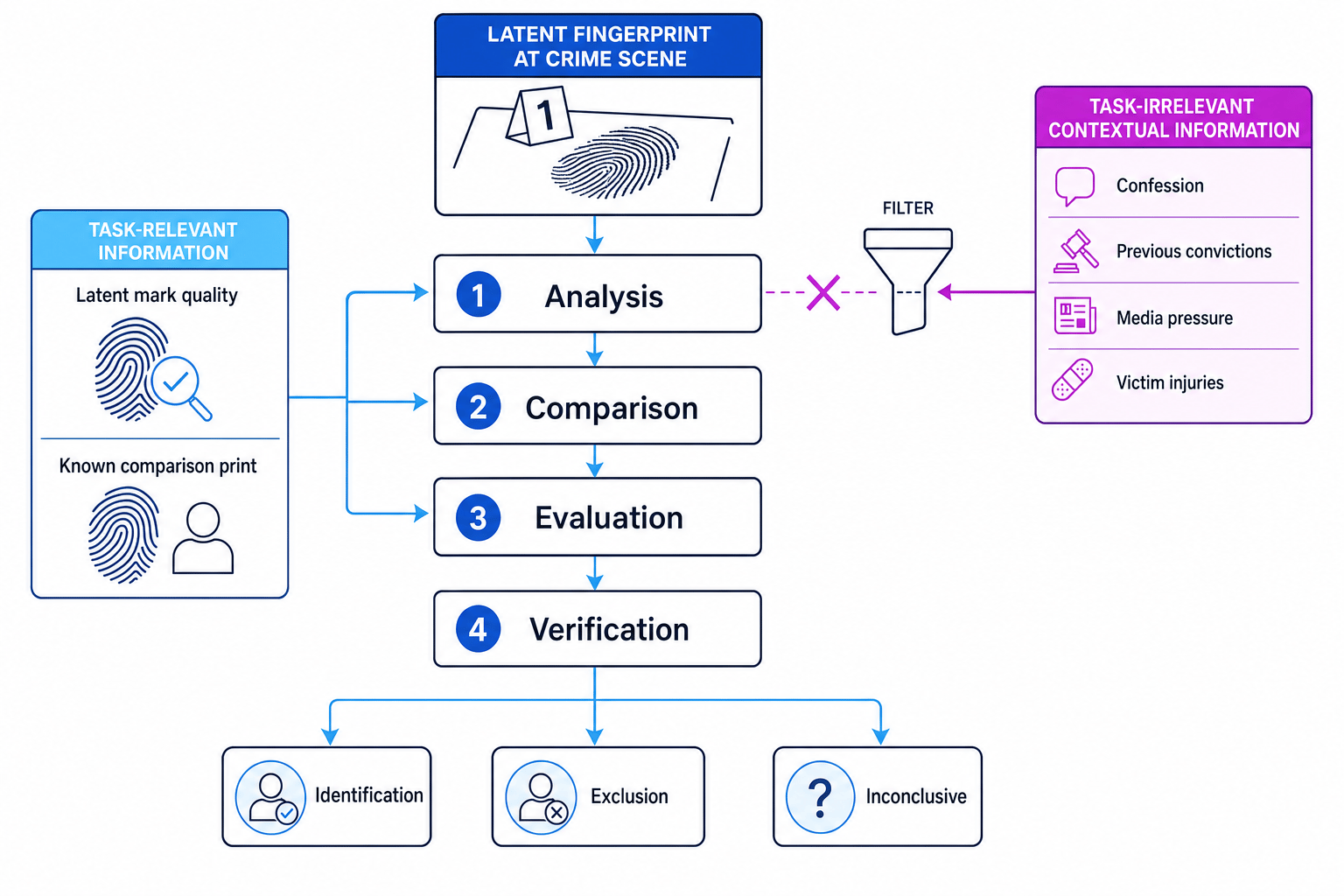
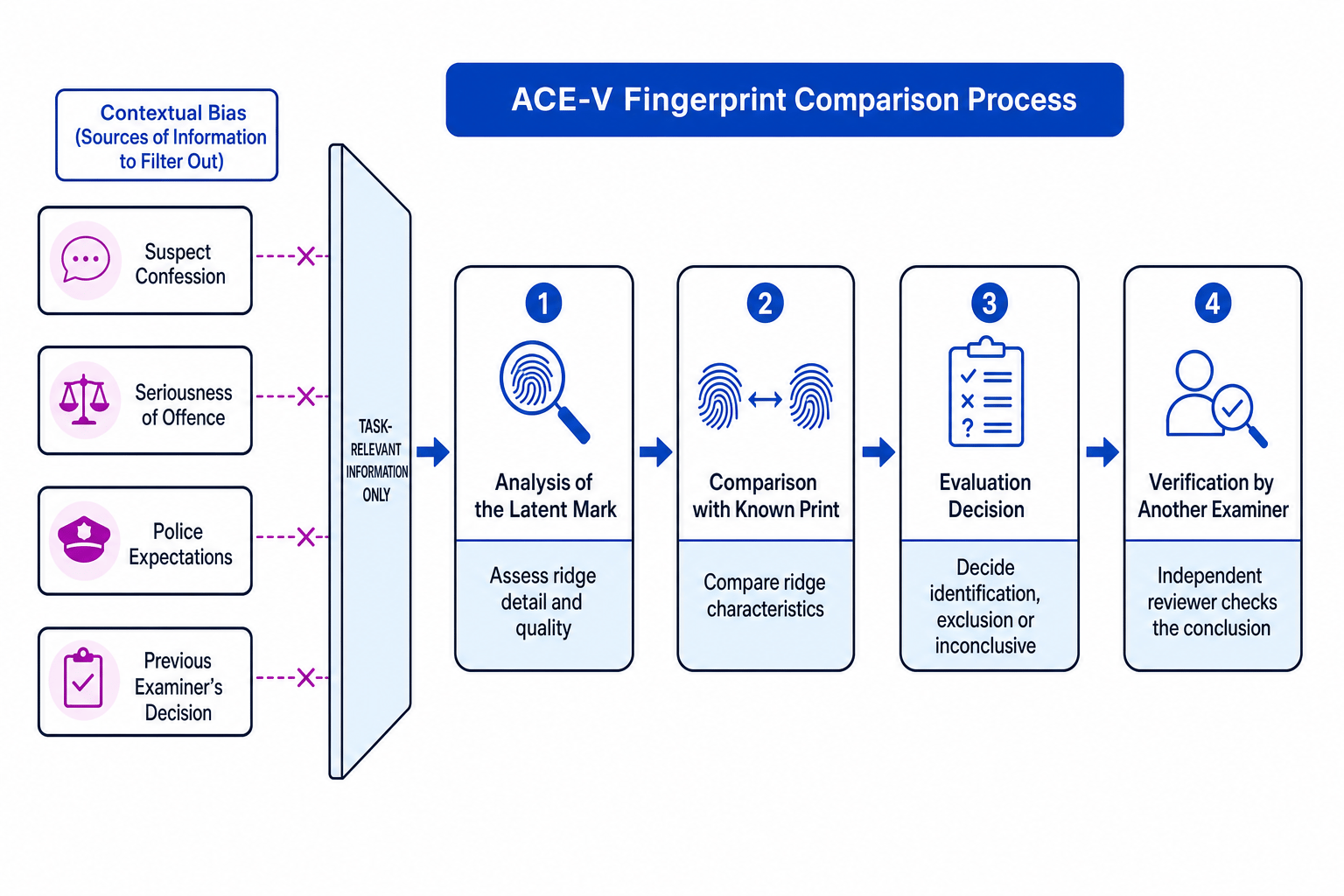
A common framework is ACE-V: Analysis, Comparison, Evaluation and Verification.
Human judgement matters
Fingerprint evidence can be powerful, but it is not a completely automatic “machine answer”. Examiners make judgements about print quality, similarity and sufficiency, especially when marks are partial or smudged.
Writing as if fingerprints are infallible
Avoid saying “fingerprints prove guilt”. A fingerprint may suggest contact with a surface, but the examiner still has to interpret the mark, and the wider case must explain when and why the contact happened.
3. Bias in collection and processing
Bias
Bias is a systematic distortion in thinking or decision-making. It is not the same as random error; it pushes judgements in a particular direction.
Bias in forensic work can be unconscious. It does not mean the examiner is corrupt. Instead, normal cognitive processes may be influenced by expectations, emotions or pressure.
Contextual bias
Contextual bias happens when information outside the evidence itself affects interpretation. For example, if an examiner is told “the suspect has confessed”, they may be more likely to see an ambiguous print as a match.
Task-relevant information might include the quality of the print, the surface it came from, and the comparison print. Task-irrelevant information might include the suspect’s previous convictions, the victim’s injuries, media pressure or what another examiner concluded.
Confirmation bias
Confirmation bias is the tendency to notice, seek or interpret information in a way that supports an existing belief. In criminal investigations, this might mean police focus on evidence that supports their preferred suspect and overlook evidence pointing elsewhere.
Motivational bias
Motivational bias occurs when a desired outcome affects judgement. In forensic contexts, motivating factors could include:
- wanting justice for the victim;
- pressure to solve a serious case quickly;
- loyalty to the investigation team;
- fear of letting a dangerous offender go free;
- pressure from senior officers, lawyers or public attention.
Spotting contextual bias in a case file
A fingerprint examiner is asked to compare a partial print from a burglary scene with a suspect’s print. The detective says, “We are sure he did it — he has burgled before and his girlfriend says he needed money.”
-
Separate the information into task-relevant and task-irrelevant categories. The print quality and comparison print are task-relevant; previous burglary and relationship information are not needed to compare ridge detail.
-
Identify the likely bias. The detective’s comment could create confirmation bias, because the examiner may expect the suspect’s print to match.
-
Explain the possible effect on the decision. If the mark is ambiguous, the examiner may be pushed towards an identification rather than an inconclusive decision.
-
Apply a control. The examiner should receive only the latent mark and comparison print, with case details filtered out until after their initial decision is recorded.
4. Key research: Hall and Player (2008)
The named study is Hall and Player (2008), “Will the introduction of an emotional context affect fingerprint analysis and decision-making?”
Aim
Hall and Player aimed to investigate whether giving fingerprint experts emotionally loaded case information would affect their fingerprint analysis and decisions.
This links directly to the background issue: if emotional context influences experts, then forensic evidence may be less objective than courts assume.
Method and sample
This was an experiment using professional fingerprint examiners. The participants were experienced experts rather than students, which is important because the study was testing real forensic decision-making.
Participants were given fingerprint comparison materials and asked to make decisions as they would in professional practice. Some participants received an emotional context about the case, while others received a more neutral context or less emotionally loaded information.
The main dependent variable was the examiner’s fingerprint decision, such as whether they judged the mark to match, not match, or be inconclusive. The researchers were interested in whether the emotional context shifted these decisions.
Results
Hall and Player found that the emotional context did not produce a strong or statistically significant change in fingerprint decisions. In other words, trained fingerprint experts were generally not swayed simply by being given emotionally disturbing case information.
In research language, a non-significant result means the difference between conditions was not large enough to confidently reject chance as an explanation, often written as p>0.05p > 0.05p>0.05 if the 5% significance level is being used.
Conclusion
The study suggests that experienced fingerprint examiners may be fairly resistant to emotional contextual bias, at least under the conditions Hall and Player tested. However, this does not prove that forensic decision-making is always bias-free.
Hall and Player’s main conclusion
Emotional context alone did not appear to substantially affect the fingerprint decisions of trained experts, but wider contextual and motivational biases can still be a risk in real investigations.
5. Evaluating Hall and Player (AO3)
Strengths
A major strength is ecological validity. The study used professional fingerprint examiners, so the sample was much closer to real forensic practice than a student sample would be.
The study is also useful. If examiners are generally resistant to emotional context, this supports confidence in expert training. If some risks remain, the study still helps forensic services design better safeguards.
The experiment had some control because participants were exposed to specific materials and context conditions. This makes it easier to examine the possible effect of emotional information.
Weaknesses
One limitation is that an experimental task may not fully reproduce the pressure of a real murder, rape or terrorism investigation. In real cases, examiners may face repeated contact with detectives, media attention, court deadlines and organisational pressure.
Another issue is demand characteristics, where participants guess the aim of the study and change their behaviour. Professional examiners may want to appear objective, so they might consciously resist emotional information more than they would in everyday work.
There may also be sampling bias. If the participants came from particular forensic services or training backgrounds, the findings may not generalise to all examiners, all countries, or other forms of biological evidence such as DNA interpretation.
Ethics
Ethically, the study involved professional adults, but researchers still needed to follow BPS principles such as informed consent, the right to withdraw, confidentiality and debriefing. Confidentiality is especially important because results might affect perceptions of professional competence.
There is also a socially sensitive angle. Research suggesting forensic experts can be biased may reduce public trust in the justice system. However, it can also improve justice by identifying ways to reduce wrongful convictions.
6. Application: reducing bias in forensic evidence work
The main strategy you should be ready to apply is context management, especially linear sequential unmasking.
Linear sequential unmasking
Linear sequential unmasking is a bias-reduction procedure where the examiner receives information in a controlled order: first the evidence itself, then only the extra information that is genuinely needed for the next stage of analysis.
For fingerprint evidence, the examiner should first analyse the latent mark on its own and record its features. Only then should they compare it with the suspect’s known print. Irrelevant information, such as a confession or the seriousness of the offence, should be withheld.
A second useful strategy is blind verification. This means another examiner checks the decision without being told the first examiner’s conclusion. If they already know the first decision, a bias cascade can occur, where one person’s judgement influences the next person’s judgement.
Designing a bias-resistant fingerprint procedure
A police force wants to reduce bias when processing fingerprints from a serious assault.
-
Start with blind analysis. The examiner first studies the latent print without knowing the suspect’s name, previous convictions, confession status or victim injuries.
-
Record the initial judgement. The examiner writes down the ridge features and whether the mark is good enough for comparison before seeing any suspect print.
-
Reveal information sequentially. The suspect’s known print is then provided for comparison, but emotional case details remain hidden because they are not needed for ridge analysis.
-
Use blind verification. A second examiner independently checks the mark and known print without being told the first examiner’s conclusion.
-
Document the reasoning. Both examiners record why they reached identification, exclusion or inconclusive, making the process more transparent in court.
Applying this to scenarios
When a scenario includes phrases like “the detective told the examiner…”, “the suspect had confessed…”, or “everyone expected a match…”, you should immediately think: contextual bias, confirmation bias, and the need for blind or sequential procedures.
7. Writing strong AO1, AO2 and AO3 answers
For AO1, describe the concepts clearly: biological evidence, fingerprint processing, bias, contextual information, Hall and Player’s aim, method, results and conclusion.
For AO2, apply the ideas to the exact source or scenario. Do not just say “there is bias”; explain what information is biasing, who is affected, and how it could change evidence collection or processing.
For AO3, evaluate both sides. Hall and Player supports the idea that trained experts may resist emotional context, but real cases may involve stronger pressures, more ambiguous evidence and more opportunities for bias.
In the exam
-
Use Hall and Player (2008) by name and link it directly to emotional context and fingerprint decision-making.
-
For application questions, separate task-relevant evidence from task-irrelevant context before explaining the likely bias.
-
For evaluation, avoid extremes: forensic evidence is not useless, but it is also not perfectly objective. Discuss training, ecological validity, demand characteristics, ethics and usefulness.
Check yourself
- What is the difference between contextual bias and confirmation bias in forensic evidence processing?
- Why does Hall and Player (2008) not prove that all fingerprint analysis is completely bias-free?
- How would blind verification reduce the risk of a bias cascade?