What you'll learn
- What the usefulness debate means in A-Level Psychology.
- How research can be useful in practical, theoretical and methodological ways.
- How to evaluate usefulness using studies such as Milgram (1963), Loftus and Palmer (1974), Bandura et al. (1961) and Sperry (1968).
- How usefulness links to ethics, validity, reliability, sampling bias and statistics.
The basic idea
In Psychology, asking whether research is “useful” means asking whether it has value. That value might be very obvious, such as improving police interviews, or more indirect, such as helping psychologists build a better theory of memory.
Usefulness of research
Usefulness of research is the extent to which psychological research makes a valuable contribution to knowledge, real-world practice, policy, treatment, education or future research, while taking account of its limitations and costs.
Usefulness is not a simple “yes/no” judgement. A study can be useful in one way but limited in another. For example, Milgram (1963) is useful for understanding obedience to authority, but it raises serious ethical concerns about deception and psychological distress.
The big takeaway
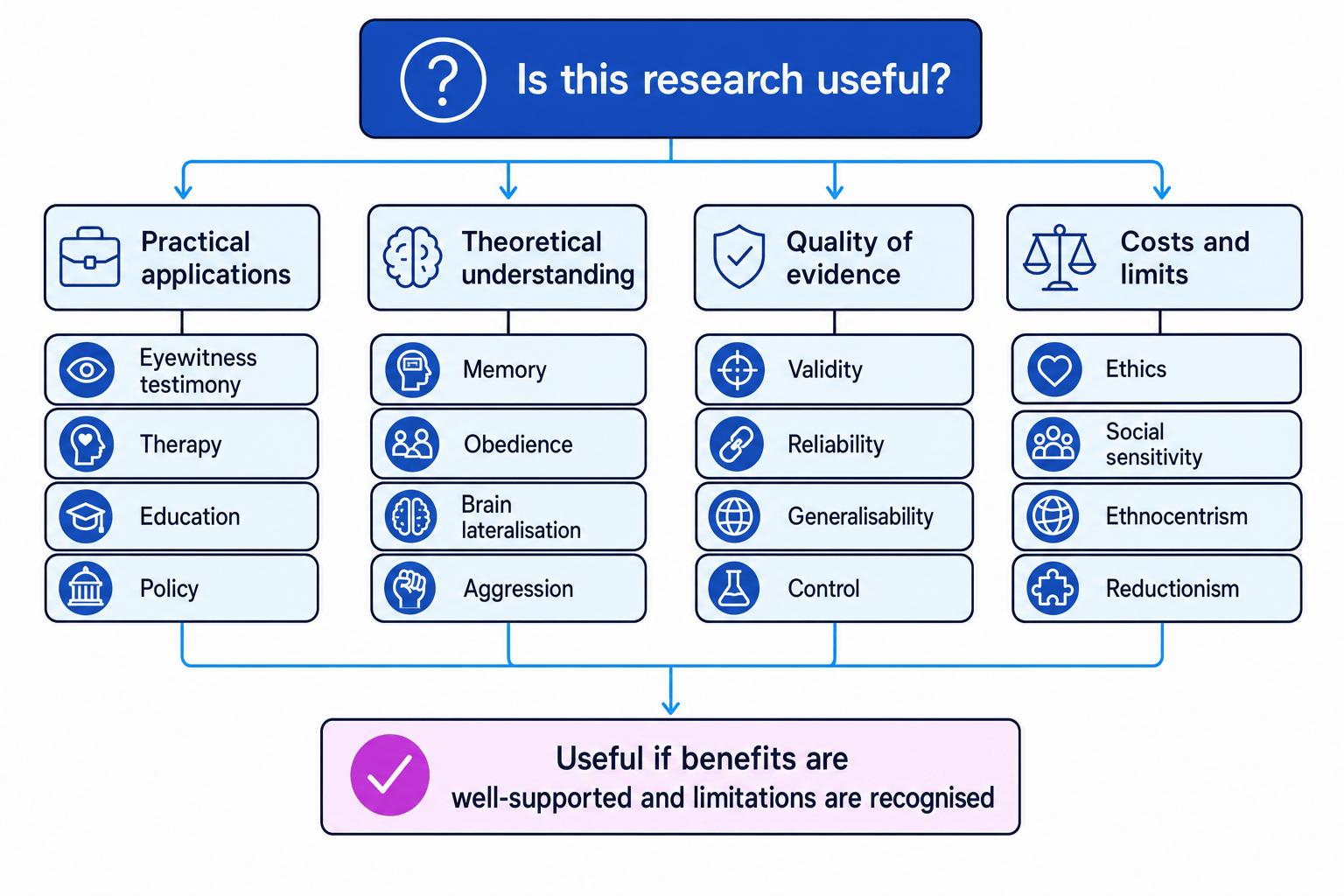
A study does not have to be perfect to be useful. In essays, the strongest answer weighs the benefits of the research against its methodological, ethical and social limitations.
Different ways research can be useful
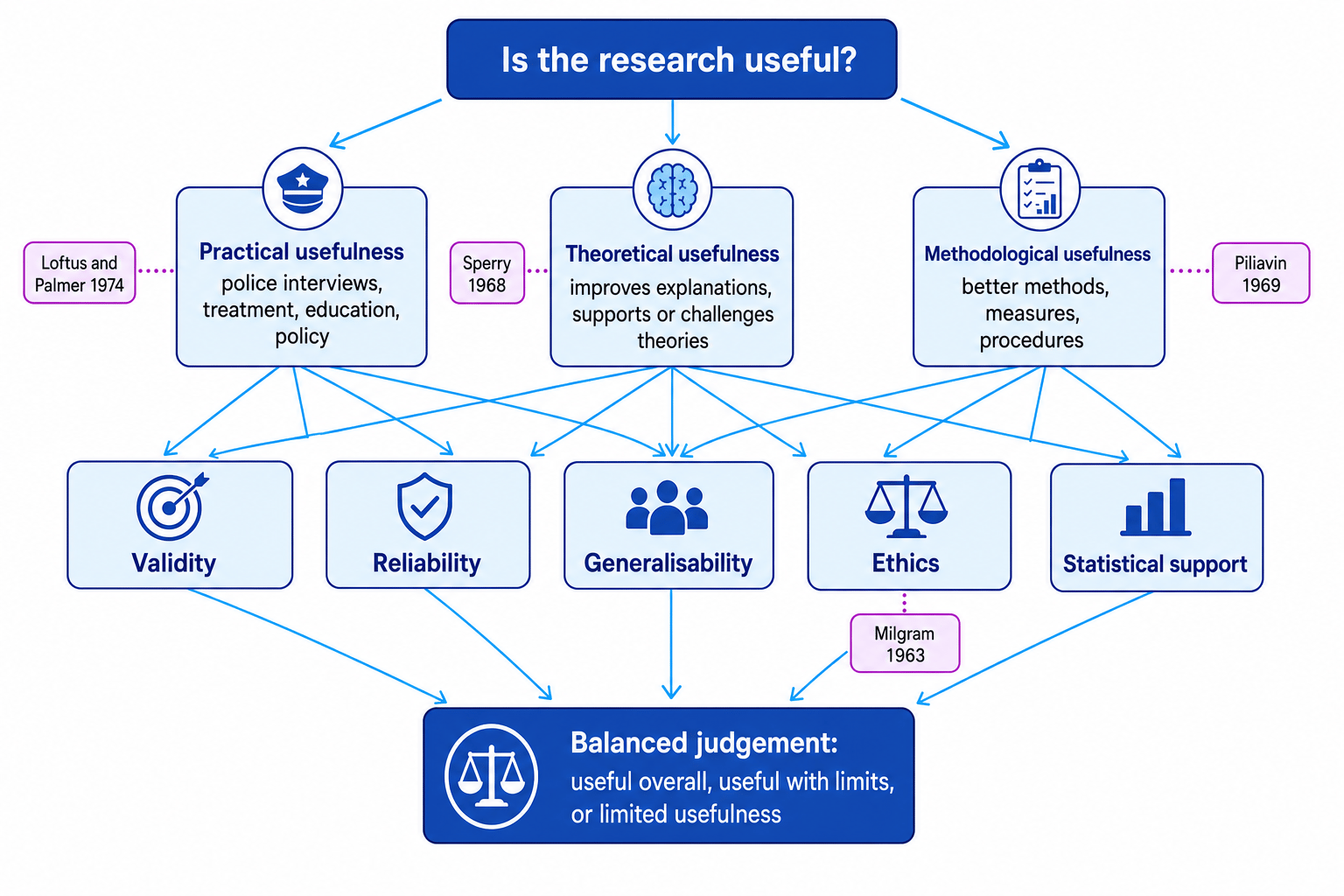
Practical usefulness
Practical usefulness means research can be applied to real-life problems.
For example, Loftus and Palmer (1974) showed that leading questions can affect eyewitness memory. This is useful because it can inform how police officers question witnesses and how courts treat eyewitness evidence.
Bandura et al. (1961) showed that children can imitate aggressive behaviour from an adult role model. This can be applied to parenting, education and debates about media violence, although the study used an artificial Bobo doll setting.
Piliavin et al. (1969) studied helping behaviour on a New York subway. Its field setting gives it ecological validity, meaning it took place in a realistic environment, so it may help explain bystander behaviour in public emergencies.
Ecological validity
Ecological validity is the extent to which research findings can be applied to real-life settings and everyday behaviour.
Judging practical usefulness in Loftus and Palmer
-
Identify the real-world issue: eyewitnesses are often questioned by police, and their memory can influence court decisions.
-
Apply the finding: Loftus and Palmer found that wording such as “smashed” rather than “hit” affected speed estimates, so interviewers should avoid leading questions.
-
Weigh the limitation: the study used film clips in a laboratory, so it may not fully represent the stress and consequences of witnessing a real accident.
-
Reach a balanced judgement: the study is useful for improving interview practice, but it should not be treated as proof that all eyewitness testimony is unreliable.
Theoretical usefulness
Research can also be useful because it improves psychological understanding, even if it does not immediately solve a practical problem.
Theory
A theory is an organised explanation of behaviour or mental processes, usually based on evidence and used to generate further research.
For example, Sperry (1968) studied split-brain patients and showed that the left and right hemispheres can have different functions. This was highly useful for theories of brain lateralisation, even though the sample was small and unusual.
Maguire et al. (2000) found structural differences in the hippocampi of London taxi drivers. This supports ideas about brain plasticity, meaning the brain can change in response to experience. This is useful for understanding learning, navigation and rehabilitation after brain injury.
Methodological usefulness
Sometimes a study is useful because it develops a method, measure or procedure that later researchers can use.
For example, controlled laboratory research like Loftus and Palmer (1974) allows cause-and-effect conclusions because extraneous variables are controlled. Field studies like Piliavin et al. (1969) are useful because they capture more natural behaviour.
Validity and reliability
Validity means a study measures what it claims to measure. Reliability means a study or measure is consistent and could produce similar results if repeated.
A study with poor validity or reliability is less useful because psychologists cannot confidently apply its conclusions.
When research may have limited usefulness
Artificial settings
A study may be less useful if its task is too unlike real life. For example, in Bandura et al. (1961) children watched an adult model and then interacted with a Bobo doll. This shows imitation, but hitting an inflatable doll is not the same as serious real-world aggression.
Sampling bias
Sampling bias occurs when the participants are not representative of the target population. For instance, Milgram (1963) used only male American volunteers, so the findings may not generalise to women, other cultures or non-volunteers.
Generalisability
Generalisability is the extent to which findings from a sample can be applied to wider groups, settings or times.
Ethical and social costs
Usefulness must be judged alongside ethics. The British Psychological Society Code of Ethics and Conduct is based on principles including respect, competence, responsibility and integrity.
Milgram’s obedience study is useful because it helps explain destructive obedience, but participants were deceived, pressured to continue and many showed visible distress. In contrast, Bocchiaro et al. (2012) studied disobedience and whistleblowing in a more contemporary context, but still involved deception, so ethical cost remains relevant.
Socially sensitive research
Socially sensitive research is research that may have consequences for individuals or groups in society, such as stigma, discrimination or changes in policy.
Saying useful means ethical
Do not argue that a study is ethical just because it produced useful findings. In evaluation, usefulness can be part of a cost-benefit argument, but it does not automatically cancel out harm, deception or lack of valid consent.
Research-methods link: evidence makes usefulness stronger
A study is more useful when its evidence is well analysed. This means you should be able to comment on data type, descriptive statistics, graphs and inferential statistics.
Levels of measurement
- Nominal data are categories with no order, such as “helped” or “did not help”.
- Ordinal data are ranked or rated, but the gaps may not be equal, such as a 1–10 anxiety rating.
- Interval data use equal units, such as many standardised test scores.
Descriptive statistics and graphs
- Mode, median and mean describe central tendency.
- Range, variance and standard deviation describe spread.
- Ratios, percentages and fractions describe proportions, such as 12 out of 20 or 60%.
- A bar chart suits categories or separate conditions.
- A histogram suits continuous interval data.
- A line graph suits change over time or ordered conditions.
- A pie chart shows proportions of a whole.
- A scatter diagram shows relationships between two variables.
Inferential statistics
Inferential statistics help psychologists decide whether findings are likely to be due to chance. A significance level such as p<0.05p < 0.05p<0.05 means there is less than a 5% probability that the result occurred by chance, assuming the null hypothesis is true.
Researchers use statistical tables of critical values to decide whether their calculated test value is significant. They must also consider:
- Type I error: falsely accepting a significant effect when there is not one.
- Type II error: failing to find a significant effect when there is one.
Parametric tests are usually chosen when the data are interval, roughly normally distributed and meet assumptions such as similar variance. If those assumptions are not met, psychologists often use non-parametric tests:
- Mann-Whitney U: difference test, independent groups, ordinal or non-parametric interval data.
- Wilcoxon Signed Ranks: difference test, repeated measures or matched pairs, ordinal or non-parametric interval data.
- Chi-square: association or difference test using nominal frequency data.
- Binomial Sign test: related design with nominal data showing direction of change.
- Spearman’s Rho: correlation test for ordinal data or non-parametric interval data.
You may also see symbols such as =, <, <<, >>, >, ∞ and ~ in statistical notation. The key point for this debate is: statistical significance can support usefulness, but it does not prove that an effect is practically important.
Choosing a graph and statistical test
-
Identify the aim: a researcher wants to know whether a stress-management session changes students’ stress ratings before and after the session, so this is a test of difference.
-
Identify the design: the same students are measured twice, so it is a repeated measures design.
-
Identify the data level: stress ratings from 1 to 10 are usually treated as ordinal unless equal intervals are clearly justified.
-
Choose the display and summary: a line graph could show individual before-after change, while the median and range would summarise ordinal scores.
-
Choose the inferential test: the best test is Wilcoxon Signed Ranks because the design is repeated measures and the data are ordinal.
Linking usefulness to other debates
Ethics
Usefulness and ethics often pull in different directions. Milgram’s research is highly useful for understanding obedience, but ethically controversial. A balanced essay should ask whether benefits justify risks under BPS principles.
Validity and reliability
Research is more useful when it is valid and reliable. For example, a highly controlled lab study may be internally valid, meaning it can show cause and effect, but less ecologically valid if the task is artificial.
Ethnocentrism and sampling bias
A study is less useful if it assumes one culture represents all people. Research based only on Western samples may not apply globally.
Reductionism and holism
A reductionist study explains behaviour using one narrow factor, such as brain structure or authority pressure. This can be useful because it gives clear explanations, but it may ignore the full complexity of behaviour. A holistic approach considers multiple influences, which may be more realistic but harder to test.
Individual and situational explanations
Useful applications depend on whether behaviour is explained by individual factors or situational factors. For example, Milgram suggests obedience can be shaped by the situation, so changing authority structures may be more useful than blaming individuals.
Writing about usefulness in essays
For AO1, define usefulness and describe the relevant study accurately. For AO2, apply the debate to the specific source, scenario or named study in the question. For AO3, evaluate whether the research is useful overall, considering applications, evidence quality, ethics and generalisability.
A strong evaluation sentence
Try using: “This research is useful because…, however its usefulness is limited by…, therefore it is most useful when applied to… rather than…”
In the exam
-
Name the kind of usefulness you are discussing: practical, theoretical or methodological.
-
Anchor your point in a named study and year, such as Milgram (1963), Loftus and Palmer (1974), Bandura et al. (1961), Sperry (1968) or Bocchiaro et al. (2012).
-
Balance usefulness against limitations, especially ethics, validity, reliability, sampling bias and ethnocentrism.
Check yourself
- Can you explain why Loftus and Palmer (1974) is useful but still limited?
- How might ethical concerns reduce the usefulness of Milgram (1963)?
- Which is stronger in an essay: saying “this study is useful” or explaining exactly who could use it and why?