What you'll learn
- What the ethical considerations debate is and why it matters in Psychology.
- How the BPS Code of Ethics guides research decisions.
- How studies such as Milgram (1963) and Bocchiaro et al. (2012) illustrate different ethical positions.
- How to write AO1, AO2 and AO3 points about ethics in essays.
The starting point: what is a “debate”?
A debate in A-Level Psychology is an issue where psychologists can reasonably take different positions. Ethical considerations are not just a checklist of rules — they are a debate about how to balance the rights of participants with the value of gaining knowledge.
Ethical considerations
Ethical considerations are the moral issues psychologists must think about when planning, carrying out, reporting and applying research, especially where people could be harmed, misled, exposed, labelled or treated unfairly.
In simple terms, ethics asks: Should this research be done, and if so, how can it be done responsibly?
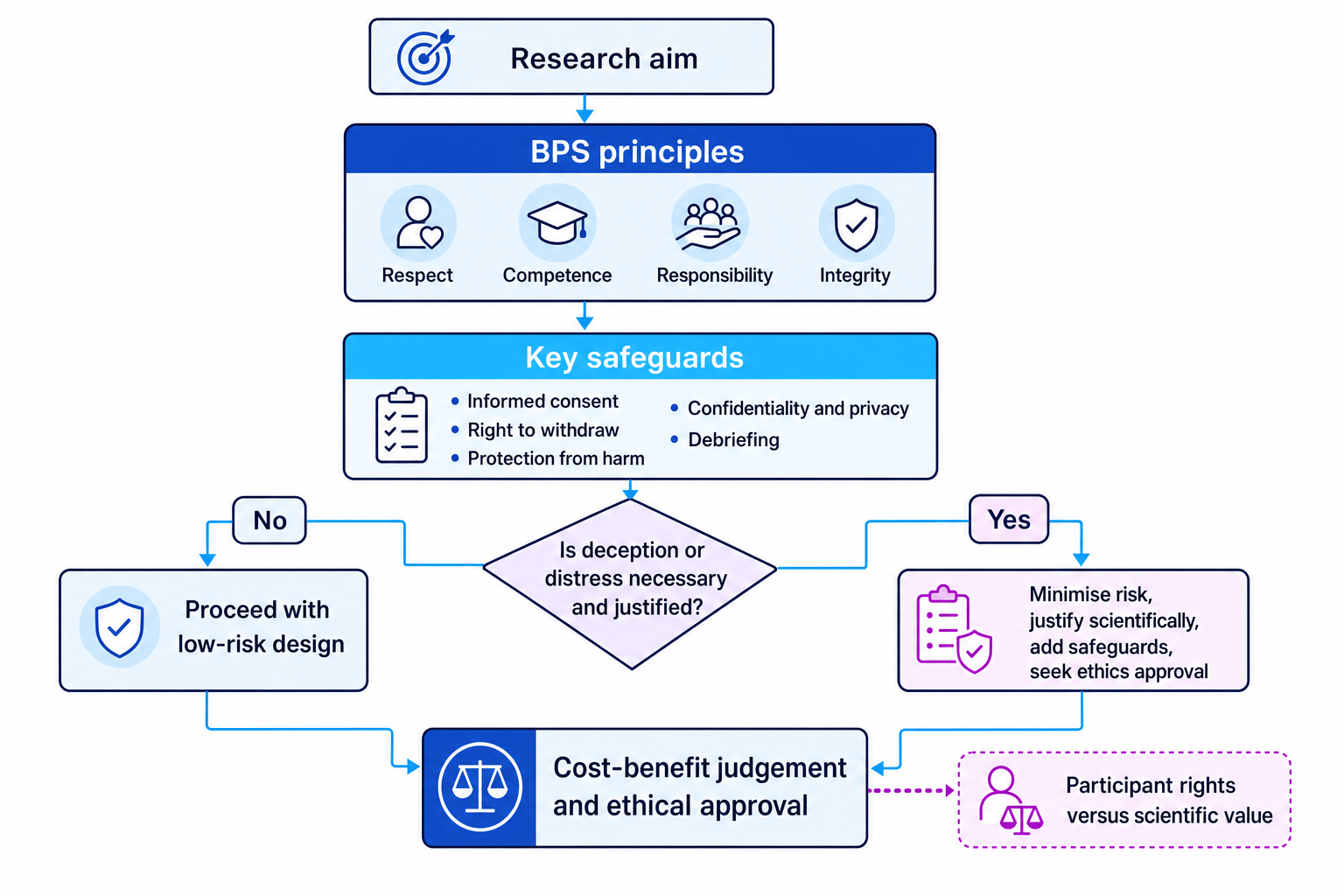
Use this as your mental map: ethical decisions move from a research aim, through key safeguards, to a cost-benefit judgement.
The BPS Code: the core principles
In the UK, psychologists are guided by the British Psychological Society (BPS) Code of Ethics and Conduct. For OCR, you should know the ideas rather than memorise every clause.
The four BPS principles
The BPS Code is built around respect, competence, responsibility and integrity. These principles help researchers protect participants while still allowing useful psychological research.
Respect
Respect means treating participants as people with rights, not just as data sources. This includes informed consent, privacy, confidentiality and the right to withdraw.
Competence
Competence means psychologists should have the training and skill to conduct research safely and appropriately. For example, a study involving distress or vulnerable participants should not be run by someone untrained.
Responsibility
Responsibility means researchers must consider the effects of their work on participants, researchers, institutions and wider society.
Integrity
Integrity means being honest and accurate. Researchers should not fabricate results, hide important risks, or mislead readers about what their data show.
Key ethical concepts
Informed consent
Informed consent means participants agree to take part after being told enough information to make a meaningful choice. This includes what they will do, possible risks, their right to withdraw and how their data will be used.
Sometimes fully informed consent is difficult. For example, if participants know the exact aim of a study on obedience, they may change their behaviour. Researchers may then use presumptive consent, where people from a similar population are asked whether they think the procedure would be acceptable.
Deception
Deception means deliberately misleading participants or withholding important information. It is not automatically banned, but it must be justified.
Milgram (1963) used major deception: participants believed they were giving electric shocks to a real learner, when the learner was a confederate and the shocks were fake.
Right to withdraw
The right to withdraw means participants can leave a study at any point and can usually ask for their data to be removed. This must be genuinely possible, not just written on a consent form.
In Milgram (1963), the verbal prods such as “You have no other choice, you must go on” arguably undermined this right.
Protection from harm
Protection from harm means participants should not experience more physical or psychological risk than they would in everyday life. Harm can include stress, embarrassment, guilt, fear, loss of self-esteem or social consequences.
Confidentiality and privacy
Confidentiality means personal data should not be shared in a way that identifies participants. Privacy means people should not be observed or recorded in situations where they reasonably expect to be left alone.
Debriefing
A debrief happens after the study. Researchers explain the true aims, reveal deception, check wellbeing and remind participants of their rights.
Saying debriefing fixes everything
A debrief can reduce ethical problems, but it does not erase them. If a participant has experienced serious distress, humiliation or lasting harm, saying “we explained it afterwards” is not enough.
The main positions in the debate
Position 1: Participant rights come first
This is a rights-based position. It argues that some procedures are unacceptable even if the findings are useful. From this view, participants should never be seriously deceived, pressured or harmed.
A psychologist taking this position might criticise Milgram (1963), because participants were deceived, visibly distressed and pressured to continue.
Position 2: Cost-benefit judgements are necessary
A cost-benefit analysis weighs the possible costs to participants against the scientific or social value of the research.
From this view, some deception or distress may be acceptable if:
- the research has important value
- there is no better alternative method
- risks are minimised
- participants are properly debriefed
- an ethics committee has approved the procedure
Milgram’s defenders argue that his study revealed important evidence about obedience to authority after the Holocaust. Critics argue that usefulness does not justify the level of distress.
Position 3: Regulated compromise
Modern psychology usually takes a regulated compromise position. It does not ban all risk or deception, but it requires researchers to justify and reduce them.
Bocchiaro et al. (2012), the contemporary obedience study, illustrates this better than Milgram. Participants were deceived about a sensory deprivation study and given the chance to whistle-blow, but the procedure was approved by an ethics committee, debriefed carefully, and designed to avoid Milgram-level distress.
Judging whether deception is acceptable
A researcher wants to study whether students will challenge an unfair instruction from a teacher. Participants are told the study is about classroom communication, not obedience.
-
Identify the ethical cost: the main issue is deception because participants do not know the true aim. There may also be mild stress if they realise they obeyed an unfair instruction.
-
Consider the scientific reason: if participants were told the study was about obedience, demand characteristics would likely increase; they might deliberately resist to look moral.
-
Check whether harm is proportionate: the deception may be acceptable if the unfair instruction is mild, no one is humiliated, and participants are not pressured to continue.
-
Add safeguards: the researcher should gain prior consent to take part in psychological research, allow withdrawal, anonymise data, debrief fully, and offer support if participants feel uncomfortable.
-
Reach a balanced judgement: the study could be ethical if approved and carefully managed, but it would become unethical if participants were strongly pressured, shamed, or denied withdrawal.
Research that illustrates ethical issues
Milgram (1963): obedience and authority
Milgram’s study is the classic example of ethical controversy. Forty male participants believed they were giving increasingly severe electric shocks to a learner in a Yale laboratory. The learner was actually a confederate.
Ethical problems included:
- deception, because participants believed the shocks were real
- psychological harm, because many showed signs of extreme tension
- right to withdraw, because the prods made withdrawal difficult
- informed consent, because participants did not know the true nature of the study
However, Milgram did debrief participants and argued the findings were socially valuable.
Bocchiaro et al. (2012): whistle-blowing and modern ethics
Bocchiaro et al. studied obedience and disobedience in a more ethically regulated way. Participants were asked to write a statement supporting a supposedly unethical sensory deprivation study, but they could also anonymously report the researcher.
This still involved deception, but it had stronger safeguards than Milgram. It shows how modern research can investigate difficult social behaviour while reducing participant risk.
Bandura et al. (1961): children and aggression
Bandura’s Bobo doll study raises ethical concerns because children observed aggressive adult models and then had their aggression measured. The issue is not just immediate distress, but whether the study encouraged aggressive behaviour.
This is especially important because children are a vulnerable group, meaning they may need extra protection and may not fully understand consent.
Loftus and Palmer (1974): memory and leading questions
Loftus and Palmer used film clips of car accidents and misleading questions. The ethical risk was relatively mild compared with Milgram, but there was still deception, especially in the broken glass condition. The study is often judged more ethically acceptable because the likely harm was low and the findings were useful for eyewitness testimony.
Applications of ethical positions
Ethical considerations affect real research design. Psychologists may use:
- consent forms and participant information sheets
- debrief scripts
- anonymised participant numbers instead of names
- ethics committees or review boards
- risk assessments
- safeguarding procedures for children or clinical groups
- data protection procedures
Ethics also applies to how findings are reported. Under integrity, researchers should choose appropriate statistics and graphs rather than exaggerating results.
For OCR research methods, this links to:
- levels of measurement: nominal, ordinal and interval data
- descriptive statistics: mode, median, mean, range, variance, standard deviation, ratios, percentages and fractions
- graphs: bar charts, histograms, line graphs, pie charts and scatter diagrams
- non-parametric tests: Mann-Whitney U for two independent groups, Wilcoxon Signed Ranks for related conditions, Chi-square for nominal frequencies, Binomial Sign test for related directional changes, and Spearman’s Rho for correlations
- parametric test criteria: interval-level data, roughly normal distribution, similar variance across conditions and no serious outliers
- significance: researchers use probability, significance levels such as 5%, and statistical tables of critical values to judge whether results are likely due to chance
- errors: a Type I error is a false positive; a Type II error is a false negative
You may see symbols such as =, <, <<, >>, >, ∞ and ~ in research reporting. Ethically, the key point is that symbols and statistics must be used honestly, not to make weak evidence look stronger than it is.
Ethics and statistics link
If a researcher reports p<.05p < .05p<.05, they are saying the result is statistically significant at the 5% level. Integrity means they should not describe a non-significant result as “proved” just because it looks interesting.
Similarities and differences with other debates
Ethics and usefulness
Ethics is closely linked to usefulness. A study may be ethically questionable but highly useful, such as Milgram (1963). However, usefulness alone does not make research ethical.
Ethics and socially sensitive research
Socially sensitive research is research that may affect particular groups or society, for example by influencing policy, stereotypes or public attitudes. Ethics focuses mainly on how participants are treated during research; socially sensitive research also considers wider consequences after publication.
Ethics and psychology as a science
Scientific control can create ethical tension. Laboratory studies may use deception to reduce demand characteristics, but deception can reduce informed consent. Ethical rules may limit what can be studied, but they also improve public trust in psychology.
Ethics and ethnocentrism
Ethical principles such as individual consent may reflect Western values about autonomy. In some cultures, community or family consent may also matter. This does not mean “anything goes”; it means psychologists should apply ethical principles sensitively across cultures.
Evaluating the ethical considerations debate
A major strength of ethical regulation is that it protects participants and improves trust in psychology. Without ethical standards, people may refuse to take part or may see psychology as manipulative.
Another strength is that ethics encourages better research design. If researchers must justify deception or harm, they are pushed to create safer, clearer and more responsible procedures.
However, ethical decisions can be subjective. One ethics committee may approve a study that another would reject. Cost-benefit judgements depend on how much value researchers think the findings have.
A further limitation is that strict ethics can reduce ecological validity. If participants are fully informed about every aim, they may behave unnaturally. This is why deception is sometimes defended, especially in social psychology.
The balanced conclusion
The strongest answer is rarely “ethics always stops research” or “important findings justify anything”. The best position is balanced: psychological research should be useful, but participant rights and wider social responsibility must be actively protected.
In the exam
-
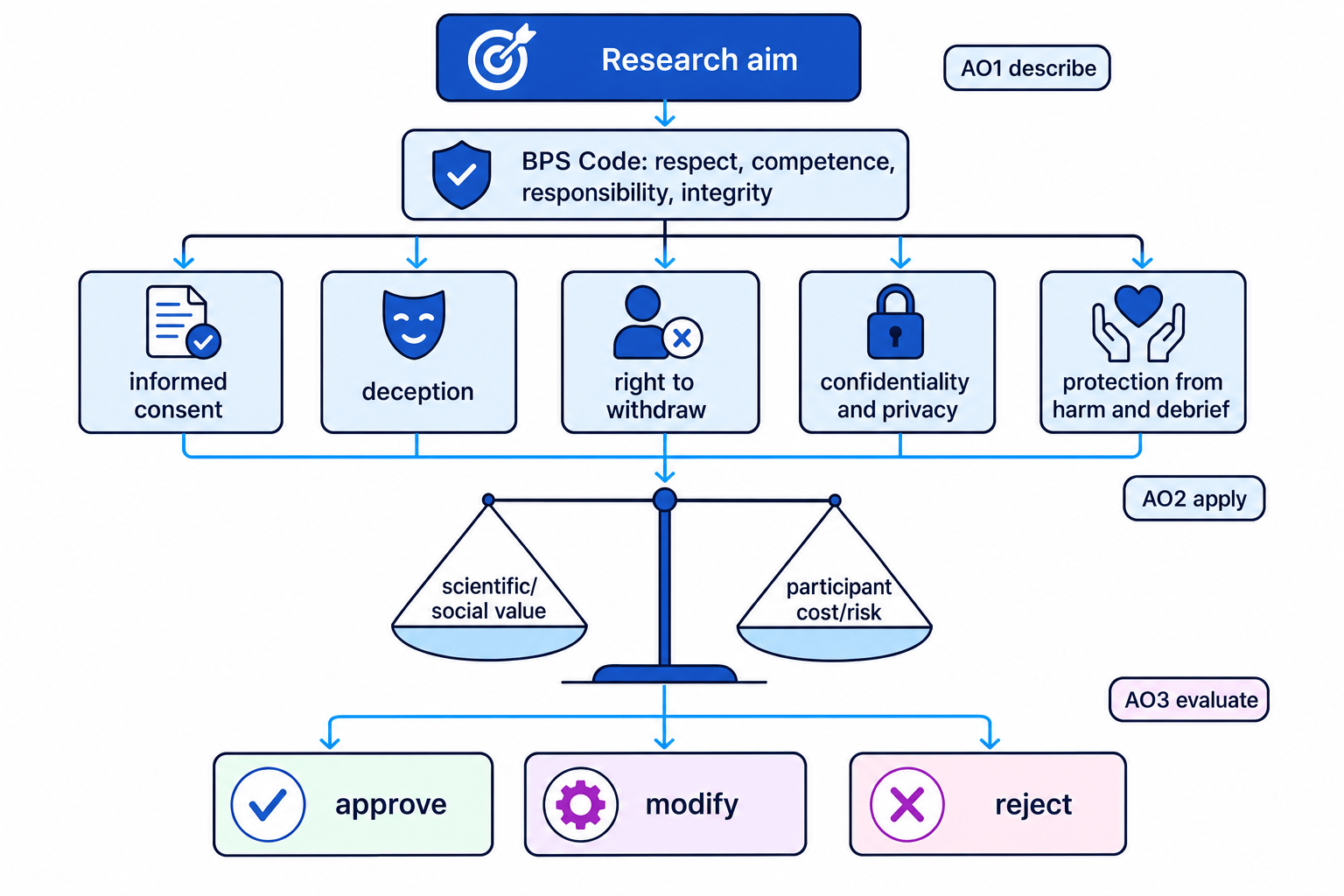
For AO1, define the debate clearly using terms such as informed consent, deception, right to withdraw, protection from harm, confidentiality, debriefing and cost-benefit analysis.
-
For AO2, apply ethics directly to the named study or scenario: say exactly who may be harmed, what information is hidden, whether withdrawal is possible, and what safeguards are present.
-
For AO3, make a balanced judgement: weigh scientific or social value against participant cost, and compare studies such as Milgram (1963) and Bocchiaro et al. (2012).
Check yourself
- Why is deception not automatically unethical in psychological research?
- How does Bocchiaro et al. (2012) show more modern ethical practice than Milgram (1963)?
- What is the difference between ethical considerations and socially sensitive research?