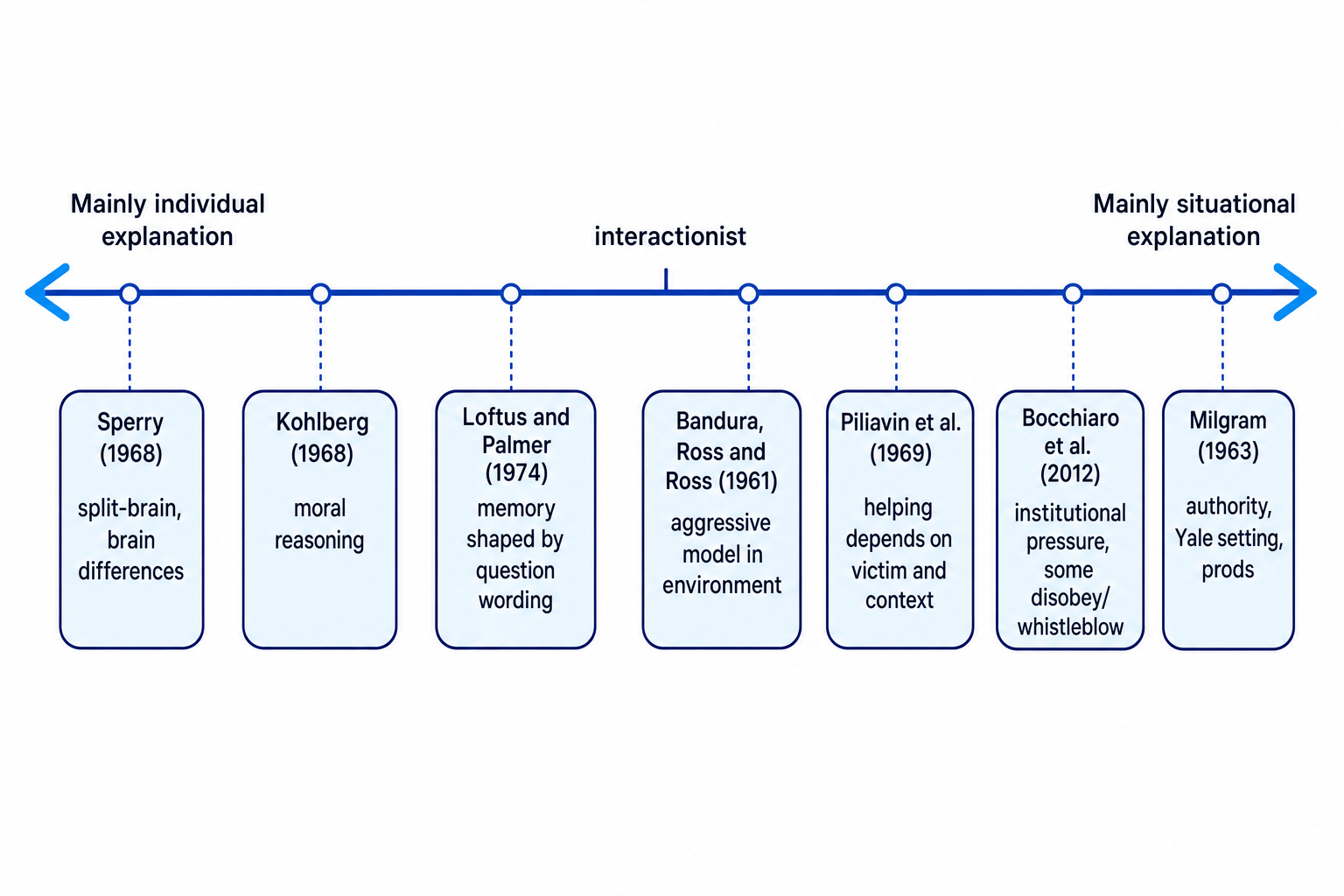
What you'll learn
- What individual and situational explanations mean in psychology.
- How to place research on a continuum from “inside the person” to “outside the person”.
- How to use OCR core studies, such as Milgram (1963) and Bandura (1961), to illustrate the debate.
- How to evaluate the debate for AO3 and apply it to novel scenarios for AO2.
The basic idea
Psychologists often ask: why did this person behave like that? The individual/situational debate is about where we locate the main cause of behaviour.
Some explanations focus on the person: their personality, biology, thoughts, emotions, moral reasoning or past experiences. Other explanations focus on the situation: the social setting, authority figures, culture, roles, instructions, rewards, pressures or physical environment.
Individual explanation
An individual explanation explains behaviour mainly through factors inside the person, such as personality, genes, brain structure, cognition, mental disorder, moral development or personal attitudes.
Situational explanation
A situational explanation explains behaviour mainly through factors outside the person, such as social pressure, authority, culture, group norms, role expectations, physical setting or the way a task is presented.
Think of this debate as a continuum, not two separate boxes. Many good psychological explanations are interactionist, meaning they combine personal factors and environmental pressures.
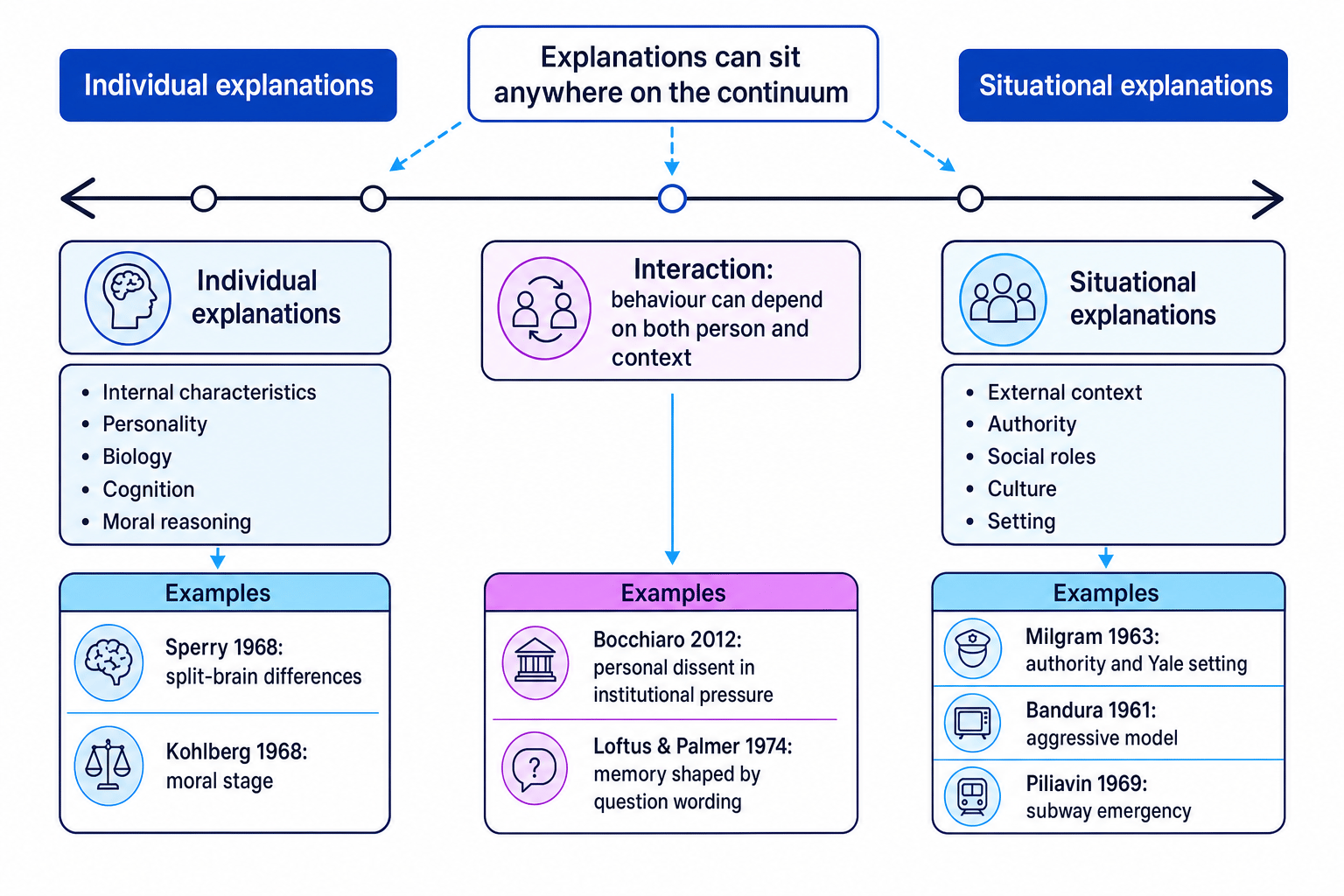
The headline point
The strongest answers usually avoid saying behaviour is “only individual” or “only situational”. Instead, explain which side is more convincing in that study or scenario, and why.
Individual explanations
Individual explanations are sometimes called dispositional explanations. A disposition is a relatively stable personal characteristic, such as confidence, empathy, aggression or anxiety.
In OCR Psychology, individual explanations can appear in several forms:
Biological individual explanations
These explain behaviour through the body or brain. For example, Sperry (1968) studied people who had undergone split-brain surgery. Their behaviour in visual-field tasks was explained through internal biological differences, especially the separation of the brain’s hemispheres.
This is individual because the explanation focuses on the participant’s neurological condition, not mainly on social pressure.
Cognitive individual explanations
These explain behaviour through mental processes such as memory, attention, perception or decision-making. For example, some explanations of eyewitness testimony focus on how an individual reconstructs memory.
However, Loftus and Palmer (1974) also shows that memory can be shaped by the situation: the wording of a question, such as “smashed”, changed speed estimates and later reports of broken glass.
Developmental or moral individual explanations
Kohlberg (1968) explained moral behaviour through stages of moral reasoning. This is largely individual because it focuses on the person’s level of moral development.
However, Kohlberg has been criticised for cultural bias and gender bias, reminding you that “individual” explanations may still be affected by wider social values.
Treating individual as only biological
“Individual” does not just mean genes or brain structure. It can also mean cognition, personality, attitudes, moral reasoning, mental health or personal experience.
Situational explanations
Situational explanations focus on the power of context. They ask what features of the environment made the behaviour more or less likely.
Social pressure and authority
Milgram (1963) is one of the clearest examples. Participants were instructed by an experimenter at Yale University to give increasingly severe electric shocks to a learner. Although the shocks were fake, participants believed they were real. Milgram found that 65% went to the maximum 450 volts.
A situational explanation would focus on:
- the authority of the experimenter;
- the prestige of Yale University;
- the gradual increase in shock levels;
- the participant’s assigned role as “teacher”;
- verbal prods such as “the experiment requires that you continue”.
Milgram’s variations also support situational explanations. Obedience changed when the setting, proximity of the learner, or presence of authority changed.
Social learning and role models
Bandura, Ross and Ross (1961) showed that children who observed an aggressive adult model were more likely to imitate aggressive acts towards a Bobo doll. This supports a situational explanation because the model in the child’s environment affected behaviour.
That said, Bandura also found differences linked to the sex of the child and model, so an interactionist answer is possible.
Emergency settings
Piliavin et al. (1969) studied helping behaviour on a New York subway. Whether people helped depended partly on the situation, such as the victim’s appearance and the public nature of the emergency. The “cane” victim received more help than the “drunk” victim.
This suggests helping is not just about being a “helpful person”; it is also shaped by cost, risk, social norms and the immediate context.
Applying the debate to a scenario
A student refuses to challenge a teacher who is treating another student unfairly. How could you apply the individual/situational debate?
-
Decide what the individual factors might be: the student may be anxious, low in confidence, conflict-avoidant, or unsure of their own moral judgement.
-
Decide what the situational factors might be: the teacher has authority, the classroom is public, peers are watching, and the student may fear punishment or embarrassment.
-
Weigh the two sides: if many students in the same classroom also stay silent, the situational explanation becomes stronger because the shared context seems powerful.
-
Add an interactionist point: a confident student might speak up in the same situation, so personal characteristics can affect how strongly the situation influences behaviour.
The interactionist position
An interactionist explanation argues that behaviour results from the interaction between individual characteristics and situational pressures.
This is often the most realistic position. For example, in Bocchiaro, Zimbardo and Van Lange (2012), participants were asked to write a statement supporting a proposed sensory deprivation study, even though it sounded unethical. Most obeyed the researcher, some disobeyed, and a smaller number whistleblew.
The institutional setting created pressure, which supports a situational explanation. But not everyone behaved the same way, so individual differences may still matter. Interestingly, personality measures did not strongly predict who would whistleblow, which suggests situations can be surprisingly powerful.
A good essay phrase
Use wording like: “This study mainly supports a situational explanation, but it does not completely rule out individual differences.” That gives you balance without sitting on the fence.
Ethics and the debate
This debate has an important ethical angle. The BPS Code of Human Research Ethics includes principles such as respect, competence, responsibility and integrity.
Situational research often involves creating pressure, deception or discomfort. For example:
- Milgram (1963) involved deception, psychological distress and questions about the right to withdraw.
- Bandura (1961) exposed children to aggressive models, raising protection-from-harm issues.
- Bocchiaro et al. (2012) involved deception about the sensory deprivation study, although participants were debriefed.
Individual explanations also raise ethical issues. If behaviour is explained as due to personality, brain structure or moral weakness, this may lead to labelling, stigma or victim-blaming.
Ethical balance
A study can be ethically questionable but still theoretically useful. In AO3, do not simply say “unethical, therefore worthless”; explain whether the knowledge gained justified the costs and whether safeguards were used.
Strengths and weaknesses of individual explanations
Strengths
Individual explanations are useful because they explain why people behave differently in the same situation. For example, not all participants in Milgram obeyed to 450 volts, and not all participants in Bocchiaro et al. obeyed.
They can also lead to personalised applications, such as therapy, anger management, social-skills training or support for people with specific cognitive difficulties.
Weaknesses
They can become reductionist, meaning they oversimplify behaviour by reducing it to one internal cause. They may ignore poverty, culture, authority, discrimination or social roles.
They can also encourage blame. For example, saying someone failed to help because they are “uncaring” ignores situational barriers such as fear, ambiguity or diffusion of responsibility.
Strengths and weaknesses of situational explanations
Strengths
Situational explanations are useful because they often lead to practical social change. If behaviour changes when the environment changes, then we can design better environments.
Applications include:
- changing police interview wording to reduce misleading questions, based on Loftus and Palmer (1974);
- training authority figures to reduce blind obedience, linked to Milgram (1963);
- using positive role models in classrooms, linked to Bandura (1961);
- making whistleblowing systems anonymous and safe, linked to Bocchiaro et al. (2012).
Weaknesses
Situational explanations can underplay personal responsibility. If we explain harmful behaviour only through authority or pressure, we may seem to excuse it.
They can also be deterministic. Determinism is the view that behaviour is controlled by forces beyond a person’s free choice. Situational determinism says behaviour is controlled by external pressures.
Building an AO3 evaluation point
How could you evaluate Milgram using the individual/situational debate?
-
Start with the situational evidence: 65% of participants obeyed to 450 volts in the original Yale setting, suggesting ordinary people can obey under strong authority pressure.
-
Add supporting detail from variations: obedience changed when situational variables changed, such as the setting or the closeness of the learner, which strengthens the situational explanation.
-
Challenge the explanation: 35% did not go to 450 volts, so individual differences such as moral courage, empathy or resistance to authority may still be relevant.
-
Reach a balanced judgement: Milgram is best used as strong evidence for situational influence, but not as proof that individual factors are irrelevant.
Links to other debates
Nature/nurture
The individual/situational debate overlaps with nature/nurture, but they are not identical.
- Nature means behaviour is influenced by inherited or biological factors.
- Nurture means behaviour is influenced by experience and environment.
Individual explanations are often linked to nature, such as brain structure in Sperry. Situational explanations are often linked to nurture, such as modelling in Bandura. But there are exceptions: a learned personality trait is individual but may come from nurture.
Free will/determinism
Both sides can be deterministic. An individual explanation might say behaviour is determined by biology or personality. A situational explanation might say behaviour is determined by authority, roles or social pressure.
An interactionist view leaves more room for free will because it allows people to respond differently to the same context.
Reductionism/holism
A single individual or situational explanation can be reductionist if it oversimplifies behaviour. A holistic explanation considers multiple levels at once, such as biology, cognition, social context and culture.
Ethnocentrism
Ethnocentrism means judging behaviour from the viewpoint of one culture. Western cultures often emphasise individual responsibility, while collectivist cultures may place more emphasis on social context and group norms. This means the debate itself can be culturally biased.
Best overall judgement
For most OCR essays, the safest conclusion is that individual and situational explanations are both useful, but behaviour is usually best understood through their interaction.
In the exam
-
Define both sides clearly before evaluating: individual means factors inside the person; situational means factors outside the person.
-
Use named studies precisely: for example, Milgram (1963) for authority and situation, Bandura (1961) for modelling, Sperry (1968) for biological individual differences.
-
For AO3, avoid one-sided conclusions. Weigh up which explanation is stronger, then add a balanced interactionist judgement.
Check yourself
- Why is Milgram (1963) usually used as evidence for situational explanations?
- How could Bandura (1961) be used to support both situational and interactionist explanations?
- How is the individual/situational debate similar to, but different from, nature/nurture?