What you'll learn
- How the medical model explains mental illness as a biological disorder.
- The three background explanations: biochemical, genetic and brain abnormality.
- What Gottesman et al. (2010) found about offspring with two psychiatrically ill parents.
- How biological treatments can be applied to one disorder: schizophrenia.
Starting point: what is the medical model?
A model is a way of explaining something. In psychology, a model helps you decide what counts as a cause, what evidence matters, and what treatment should look like.
The medical model treats mental illness in a similar way to physical illness: a person shows symptoms, receives a diagnosis, and is offered treatment aimed at the underlying problem. In this topic, the “underlying problem” is assumed to be biological.
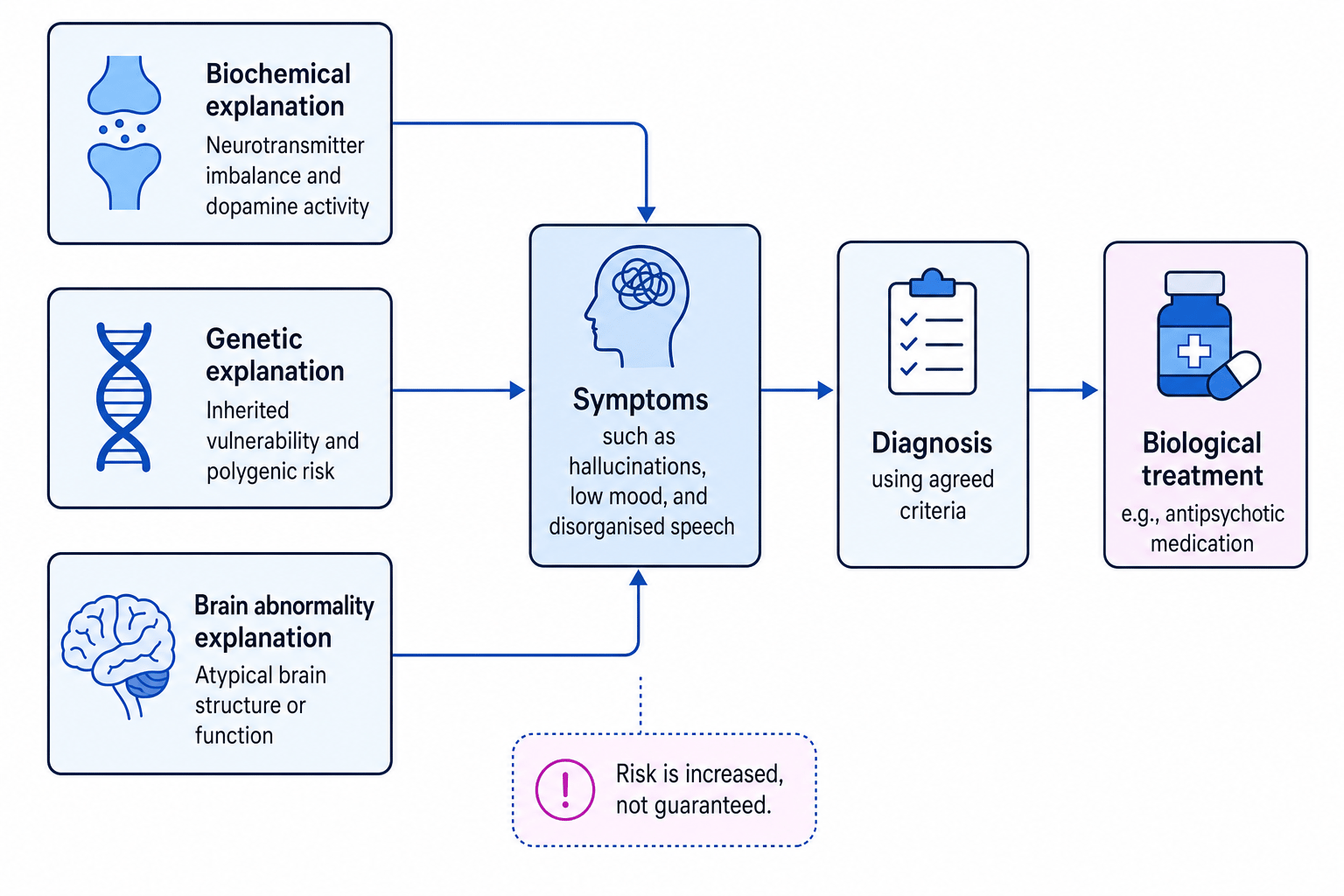
A symptom is an observable or reported sign of a disorder, such as low mood, hallucinations or disorganised speech. A diagnosis is a classification label given when a pattern of symptoms fits agreed criteria.
The medical model
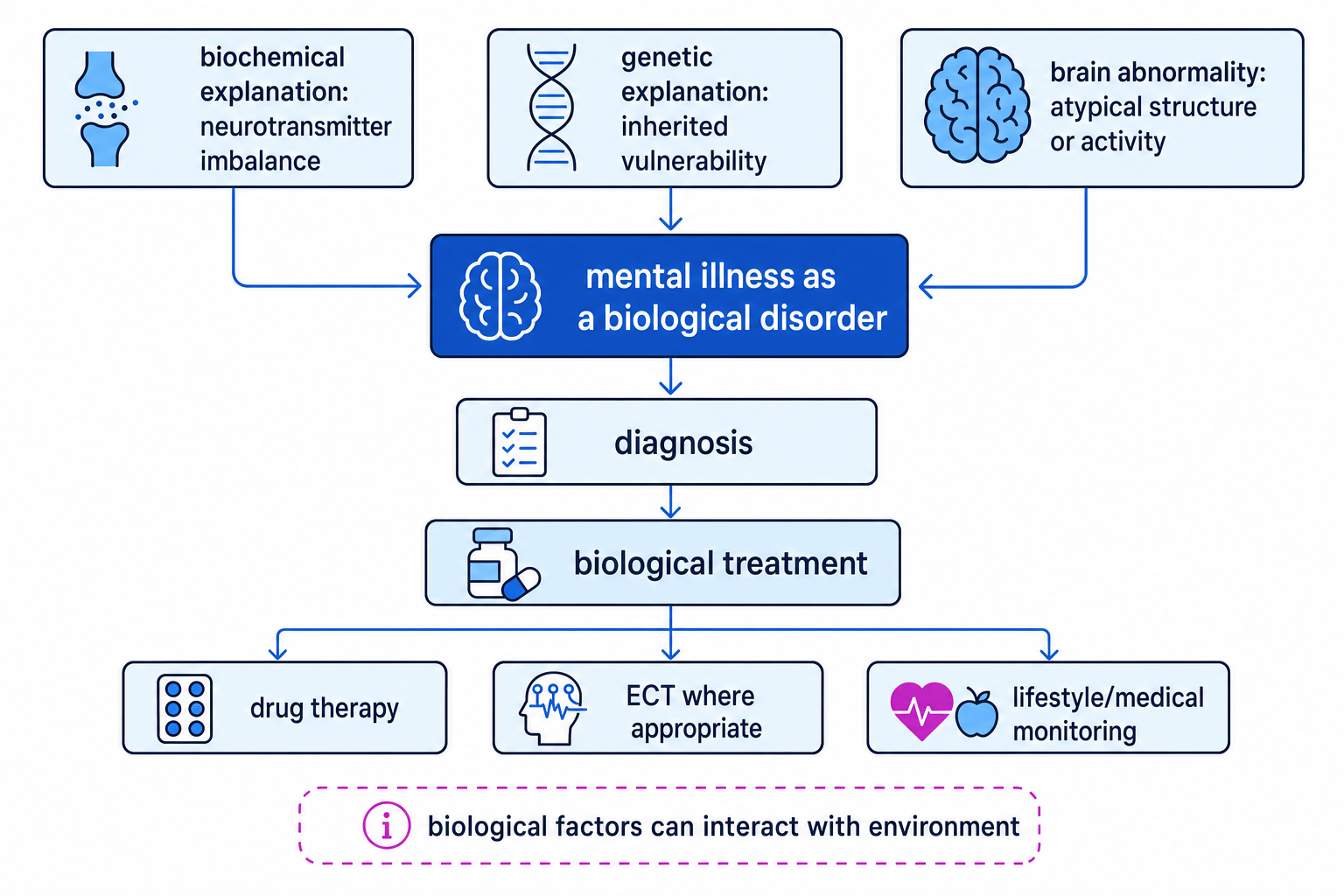
The medical model is the view that mental illnesses are disorders with biological causes, such as neurotransmitter imbalance, inherited genetic vulnerability or abnormal brain structure/function, and should therefore be treated using medical or biological interventions.
The diagram summarises the logic of the model: biological causes are used to explain symptoms, which then guide diagnosis and treatment.
Big picture
The medical model is not saying “people are their illness”. It is saying that mental disorders can be understood partly through the body and brain, so biological evidence and biological treatments matter.
Background explanation 1: the biochemical explanation
Biochemical means involving chemicals in the body. In the brain, the key chemicals are often neurotransmitters: chemical messengers that pass signals between nerve cells at a synapse, which is the tiny gap between neurons.
In schizophrenia, a common biochemical explanation is the dopamine hypothesis. Dopamine is a neurotransmitter involved in reward, motivation and some aspects of perception. The dopamine hypothesis suggests that unusual dopamine activity may contribute to symptoms such as hallucinations and delusions.
For example, too much dopamine activity in some brain pathways has been linked with positive symptoms of schizophrenia. Positive symptoms are additions to ordinary experience, such as hearing voices or holding delusional beliefs. Lower activity in other pathways may be linked with negative symptoms, which are reductions in normal functioning, such as reduced motivation or flattened emotional expression.
This explanation supports the medical model because it suggests that changing brain chemistry, for example through medication, may reduce symptoms.
Background explanation 2: the genetic explanation
A gene is a section of DNA that contributes to a characteristic. A genetic explanation argues that mental illness may be partly caused by inherited biological vulnerability.
This does not usually mean “one gene causes one disorder”. Most serious mental disorders are thought to be polygenic, meaning many genes each make a small contribution. The person may inherit a vulnerability, not a guaranteed outcome.
A useful term here is diathesis-stress. A diathesis is a vulnerability or predisposition. Stress refers to environmental pressures or life events that may trigger the disorder. So a person may inherit risk, but whether the disorder develops can depend on their experiences too.
Genes do not mean destiny
Do not write as if having a parent with schizophrenia means a child will definitely develop schizophrenia. Genetic evidence usually shows increased risk, not certainty.
Background explanation 3: brain abnormality
A brain abnormality is an atypical structure or pattern of activity in the brain. This can include differences in the size of brain areas, the connections between areas, or how active a region is during tasks.
In schizophrenia, researchers have investigated abnormalities such as enlarged ventricles, reduced grey matter in some areas, and differences in the frontal and temporal lobes. The frontal lobe is involved in planning and decision-making. The temporal lobe is involved in hearing, language and memory, so it is relevant when explaining auditory hallucinations.
Brain abnormality explanations support the medical model because they frame mental illness as linked to physical brain systems. However, you should be cautious: a brain difference might be a cause, a consequence, or simply associated with the disorder.
Applying the three explanations to a scenario
A patient has hallucinations, a family history of schizophrenia, and a brain scan showing unusual activity in temporal-lobe areas.
- Link the hallucinations to the biochemical explanation by arguing that unusual dopamine activity may affect perception and contribute to hearing voices.
- Link the family history to the genetic explanation by arguing that inherited vulnerability could increase the patient’s risk of developing schizophrenia.
- Link the scan result to brain abnormality by explaining that atypical temporal-lobe activity is relevant because this region is involved in hearing and language.
- Add balance by stating that these explanations are not mutually exclusive: genes, neurotransmitters, brain systems and environment may interact.
Key research: Gottesman et al. (2010)
Aim and background
Gottesman et al. (2010) investigated the risk of severe mental disorders in offspring whose parents had serious psychiatric illnesses, especially schizophrenia and bipolar disorder.
This is key research for the medical model because it tests whether mental illness appears to run in families in a way that supports genetic vulnerability.
Method
This was a population-based register study. A register study uses official records rather than directly testing participants in a lab.
The researchers used Danish national records, including psychiatric registers, to identify parents diagnosed with schizophrenia or bipolar disorder and then examine diagnoses in their children. Denmark was useful because national registers allow researchers to link family relationships and psychiatric diagnoses across a very large population.
The study compared different groups of offspring, including:
- offspring with two parents diagnosed with schizophrenia
- offspring with one parent diagnosed with schizophrenia
- offspring with two parents diagnosed with bipolar disorder
- offspring with one parent diagnosed with bipolar disorder
- comparison groups from the wider population
Results
The clearest pattern was that risk increased when parents had a psychiatric diagnosis, especially when both parents were affected.
Important findings included:
- Offspring with two parents with schizophrenia had a much higher risk of schizophrenia than the general population.
- Offspring with one parent with schizophrenia also had increased risk, but lower than those with two affected parents.
- A similar pattern was found for bipolar disorder.
- Risk was not 100%, even when both parents were affected.
A commonly reported figure is that the risk of schizophrenia was about 27% for offspring with two parents with schizophrenia, compared with around 1% in the general population. For bipolar disorder, offspring with two parents with bipolar disorder also showed a much higher risk than the general population.
Conclusions
Gottesman et al. concluded that serious mental disorders show strong familial patterns. This supports the genetic explanation because the risk is higher when biological parents have psychiatric diagnoses.
However, the findings also show that genes are not the whole story. Many offspring of two psychiatrically ill parents did not develop the same disorder, which leaves room for environmental influence, resilience and protective factors.
Using Gottesman et al. as evidence
Suppose an essay asks whether schizophrenia can be explained genetically.
- Choose the relevant comparison: Gottesman et al. found that offspring with two parents with schizophrenia had a far higher risk of schizophrenia than people in the general population.
- Interpret the pattern: higher risk in offspring of affected parents supports the idea that inherited factors contribute to schizophrenia.
- Avoid overclaiming: because the study was not an experiment, it cannot prove that genes alone caused the disorder.
- Add nuance: because risk was far below 100%, the evidence fits a diathesis-stress view better than a simple “gene causes illness” view.
Evaluating Gottesman et al. (2010)
Strengths
A major strength is the huge sample size. National register data reduces the problem of small, unrepresentative samples. This makes the findings more reliable and gives the study strong statistical power.
Another strength is that the data came from real psychiatric diagnoses rather than artificial lab tasks. This increases usefulness because the study is directly relevant to mental health services and risk prediction.
The study also fits the scientific aims of psychology: it used systematic records, comparisons between groups, and objective diagnostic data rather than relying only on opinion.
Weaknesses
A key weakness is that the study is correlational. A correlation is a relationship between variables, but it does not prove that one variable causes the other. Children share environments with their parents as well as genes, so family patterns may reflect both nature and nurture.
Another issue is diagnostic validity, meaning whether a diagnosis truly measures the disorder it claims to measure. Psychiatric diagnoses can change over time, and different clinicians may interpret symptoms differently.
There is also a risk of ethnocentrism, which means assuming findings from one culture apply everywhere. Danish register data is very strong, but Denmark’s healthcare system, social support and diagnostic practices may differ from those in other countries.
Ethically, register studies can be less distressing than direct experiments, but they raise issues of privacy and consent. Under the BPS Code of Human Research Ethics, researchers should protect confidentiality, minimise harm and handle sensitive data responsibly.
Socially sensitive research
Genetic research into mental illness can help with early support, but it can also increase stigma if people wrongly assume children of psychiatrically ill parents are “bound” to become ill.
Application: biological treatment of schizophrenia
For the application part of this topic, you need to know how the medical model can be used to treat one specific disorder. A strong choice is schizophrenia.
Schizophrenia is a severe mental disorder involving symptoms such as hallucinations, delusions, disorganised thinking, reduced motivation and social withdrawal.
A biological treatment is a treatment that directly targets the body or brain. For schizophrenia, the main biological treatment is antipsychotic medication.
Antipsychotic medication
Antipsychotics are drugs used to reduce psychotic symptoms such as hallucinations and delusions.
Older typical antipsychotics, such as chlorpromazine and haloperidol, mainly work by blocking dopamine receptors, especially D2 receptors. This reduces dopamine activity and can reduce positive symptoms.
Newer atypical antipsychotics, such as clozapine, risperidone and olanzapine, affect dopamine and often serotonin systems too. Serotonin is another neurotransmitter involved in mood, sleep and cognition. Atypical antipsychotics may help some people who do not respond well to typical drugs.
Clozapine can be effective for treatment-resistant schizophrenia, but it requires medical monitoring because it can have serious side effects, including effects on white blood cells.
Applying antipsychotic treatment
A patient with schizophrenia reports hearing threatening voices and believes neighbours are controlling their thoughts.
- Identify the treatment target: the voices and delusional beliefs are positive symptoms, so reducing psychotic symptoms is the immediate aim.
- Apply the biochemical explanation: if excessive dopamine activity contributes to these symptoms, an antipsychotic that blocks dopamine receptors may reduce them.
- Consider monitoring: the clinician should assess symptom change and side effects, because medication may need adjustment.
- Evaluate holistically: medication may reduce symptoms, but psychological therapy, family support and social care may still be needed for long-term recovery.
Evaluating biological treatment
A strength of antipsychotic medication is usefulness. For many patients, it reduces distressing symptoms and can make everyday functioning more manageable. It can also reduce relapse risk when taken consistently.
A second strength is that drug treatment fits the scientific side of the medical model. Medication can be tested in controlled trials, doses can be compared, and symptom changes can be measured.
However, biological treatment can be reductionist. Reductionism means explaining a complex behaviour or experience using only one level of explanation. Schizophrenia involves biology, but also trauma, family relationships, social stress, poverty and culture.
Side effects are another major limitation. Antipsychotics can cause sedation, movement problems, weight gain and other physical health issues. If side effects are unpleasant, patients may stop taking medication, which affects effectiveness.
There is also an ethics issue around consent and autonomy. Patients should be given clear information, treated with dignity, and involved in decisions wherever possible.
AO3 balance
A strong evaluation does not simply say “drugs work” or “drugs have side effects”. Link the point back to the medical model: medication supports a biological explanation, but side effects and incomplete recovery show that biology may not be the full explanation.
Bringing it together for essays
For AO1, describe the medical model clearly: mental illness is explained using biological causes, including biochemical imbalance, genetic vulnerability and brain abnormality.
For AO2, apply those ideas to a person, symptom pattern or scenario. For example, family history can be linked to genetic risk, while hallucinations can be linked to dopamine activity.
For AO3, evaluate the explanation and evidence. Gottesman et al. supports genetic influence, but it is correlational and socially sensitive. Biological treatments are useful, but they can be reductionist and have side effects.
In the exam
- Structure answers around explanation → evidence → evaluation: describe the biological cause, support it with Gottesman et al. or treatment evidence, then evaluate.
- Avoid deterministic wording: write “increases risk” or “may contribute to symptoms” rather than “causes the disorder”.
- Use debates for AO3: nature/nurture, reductionism/holism, usefulness, ethics, validity, reliability and socially sensitive research all fit this topic well.
Check yourself
- How are biochemical, genetic and brain-abnormality explanations different from each other?
- What did Gottesman et al. (2010) show about risk in offspring with two psychiatrically ill parents?
- Why might antipsychotic medication support the medical model but also be criticised as reductionist?