What you'll learn
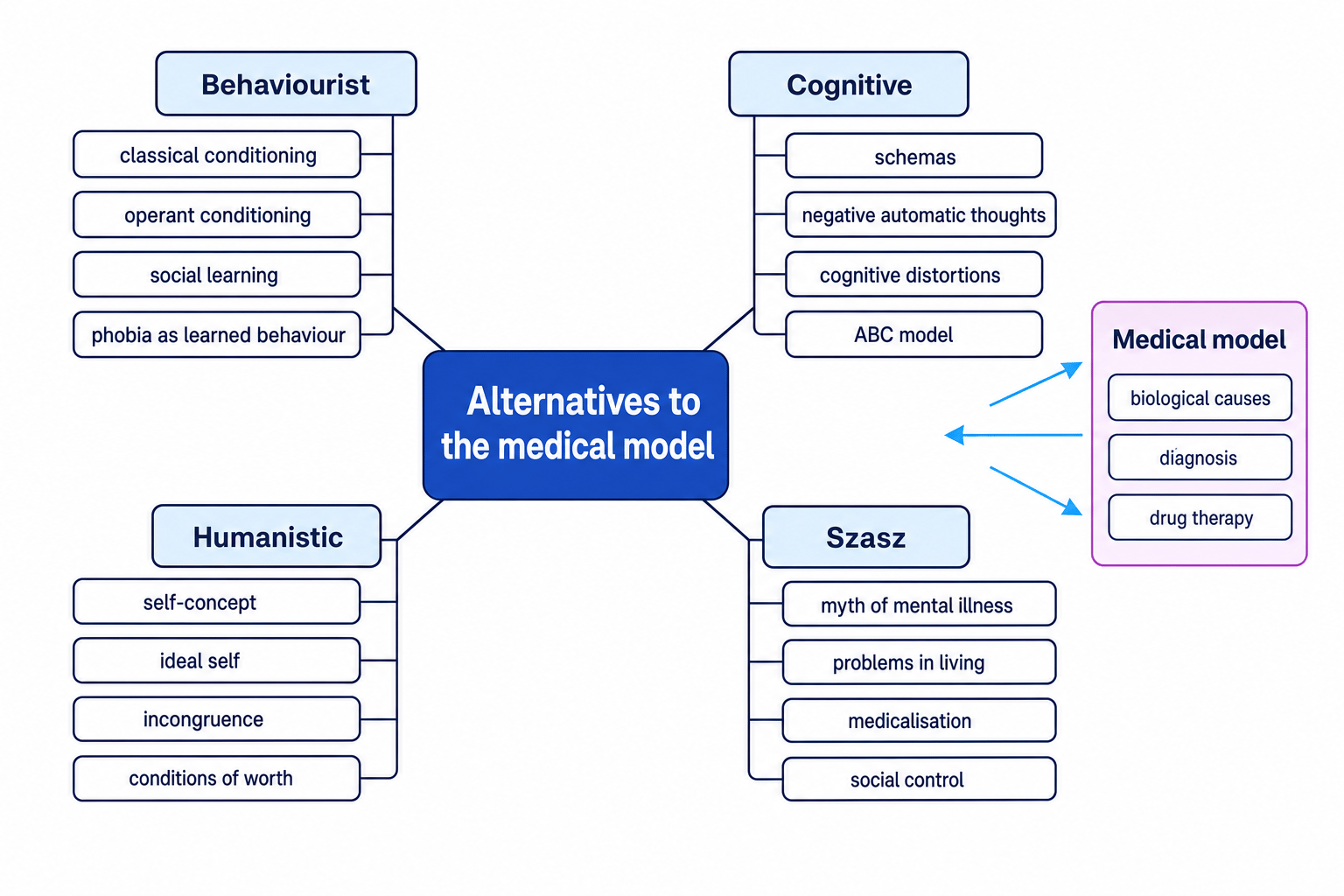
- How the behaviourist, cognitive and humanistic explanations understand mental illness.
- Why Szasz (2011) challenged the idea that mental illness is literally a disease.
- How a non-biological treatment can be applied to a specific disorder.
- How to build AO1, AO2 and AO3 points for essay-style answers.
Starting point: the medical model
Before you learn the alternatives, you need the baseline they are reacting against.
Medical model
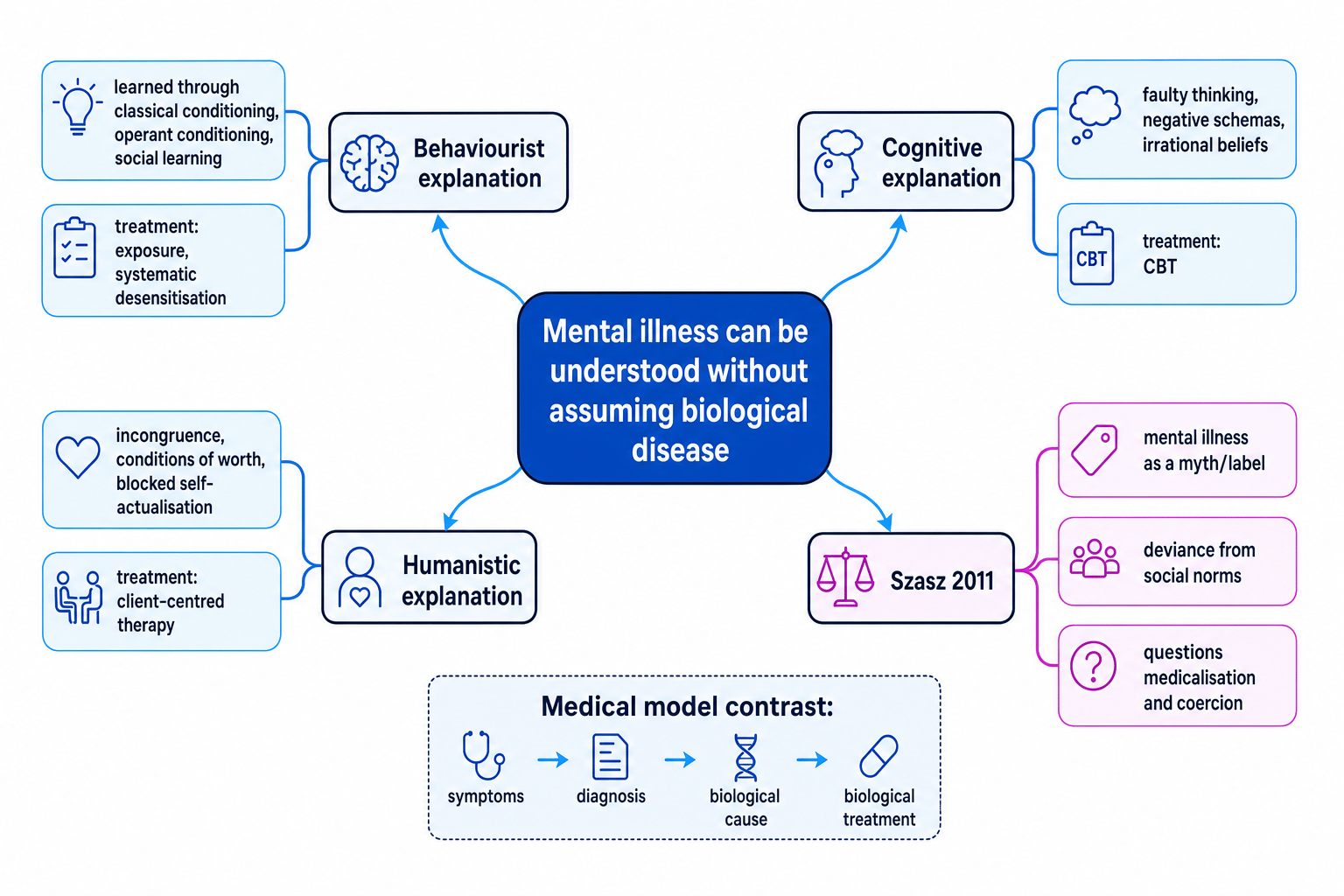
The medical model views mental disorders as illnesses with symptoms, diagnoses, underlying biological causes, and treatments aimed at correcting biological dysfunction, such as medication or electroconvulsive therapy.
In the medical model, a person’s depression, schizophrenia or phobia may be explained through genes, neurotransmitters, hormones, brain structures or other biological mechanisms. This can be useful because it treats mental illness as real and potentially treatable.
However, alternatives argue that mental distress can also be understood through learning, thinking patterns, relationships, personal meaning and social labelling.
Main shift
Alternatives to the medical model do not always deny biology. The key shift is that they explain mental illness without assuming it is primarily a physical disease inside the body.
Behaviourist explanation of mental illness
The behaviourist approach explains behaviour through learning from the environment. It focuses on observable behaviour rather than hidden thoughts or biological causes.
There are three learning processes you should know:
- Classical conditioning: learning by association. A neutral stimulus becomes linked with fear or distress.
- Operant conditioning: learning through consequences, such as rewards or relief.
- Social learning: learning by observing and imitating others.
For mental illness, behaviourists argue that symptoms can be learned maladaptive behaviours. “Maladaptive” means harmful or unhelpful in everyday life.
A classic example is a specific phobia, which is an intense and persistent fear of a particular object or situation, such as dogs, spiders or flying.
Explaining a dog phobia using behaviourism
-
A child is bitten by a dog. The bite naturally produces fear, so the dog becomes associated with fear through classical conditioning.
-
The child later feels anxious around similar dogs. The fear has generalised, meaning it has spread from one dog to other dogs.
-
The child avoids parks where dogs might be present. Avoidance reduces anxiety, so it is strengthened through negative reinforcement.
-
If the child sees a parent panic around dogs, this may further strengthen the phobia through social learning.
Evaluating the behaviourist explanation
A strength is that it is quite scientific because it focuses on observable behaviour and testable learning processes. It also leads directly to useful treatments, such as systematic desensitisation for phobias.
A limitation is that it can be reductionist, meaning it may oversimplify mental illness by reducing it to learning. It may ignore thoughts, biology, trauma, culture and personal meaning.
Negative reinforcement
Negative reinforcement is not punishment. It means a behaviour is strengthened because it removes something unpleasant, such as anxiety.
Cognitive explanation of mental illness
The cognitive approach explains mental illness through internal mental processes, such as thoughts, beliefs, expectations and interpretations.
A schema is a mental framework that helps you interpret information. For example, someone with a negative self-schema may interpret ordinary setbacks as proof that they are worthless.
Cognitive explanations often focus on:
- Faulty thinking: biased or inaccurate interpretations.
- Negative automatic thoughts: quick, habitual negative thoughts.
- Irrational beliefs: extreme or unrealistic assumptions.
- Cognitive distortions: errors such as catastrophising, overgeneralising or all-or-nothing thinking.
For example, depression may be linked to a negative view of the self, the world and the future. Anxiety may be linked to overestimating danger and underestimating coping ability.
Using the ABC model to explain distress
-
The activating event is that a friend does not reply to a message.
-
The person’s belief is, “They hate me; I always ruin friendships.” This belief involves catastrophising and overgeneralising.
-
The consequence is anxiety, low mood and avoidance of social contact.
-
A cognitive treatment would challenge the belief by considering alternative explanations, such as “They may be busy.”
Evaluating the cognitive explanation
A strength is that it explains why two people can experience the same event but react differently. It also supports cognitive behavioural therapy, which has strong practical usefulness.
A limitation is the issue of cause and effect. Negative thoughts may cause distress, but distress may also cause negative thoughts. It can also be too individualistic if it ignores social causes such as poverty, discrimination or family stress.
Humanistic explanation of mental illness
The humanistic approach focuses on free will, personal growth, subjective experience and the human need for meaning.
A key humanistic psychologist, Carl Rogers, argued that people have a natural drive towards self-actualisation, which means fulfilling their potential. Mental distress can happen when this growth is blocked.
Important terms:
- Self-concept: how you see yourself.
- Ideal self: the person you would like to be.
- Incongruence: a mismatch between your self-concept and ideal self.
- Conditions of worth: expectations you feel you must meet to be accepted or loved.
From this view, mental illness is not simply a set of symptoms. It may reflect a person feeling unable to be authentic, accepted or valued.
Explaining low mood using humanistic ideas
-
A student believes, “I am only worthwhile if I get top grades,” because praise at home has always depended on achievement.
-
This creates conditions of worth, so the student hides stress and feels unable to admit failure.
-
Their real self feels anxious and exhausted, while their ideal self is “perfect and successful”. This gap creates incongruence.
-
A humanistic therapist would aim to provide acceptance and empathy so the student can develop a healthier self-concept.
Evaluating the humanistic explanation
A strength is that it is holistic, meaning it considers the whole person rather than just symptoms. It can feel respectful and empowering because it does not reduce the individual to a diagnosis.
A limitation is that it is harder to test scientifically. Ideas such as self-actualisation and incongruence are more subjective than observable behaviours or measurable symptoms.
Key research: Szasz (2011)
The named key research is Szasz (2011), “The myth of mental illness: 50 years later.” This is not a laboratory experiment with participants. It is a theoretical and critical argument about psychiatry.
AO1: What Szasz argued
Szasz argued that “mental illness” is a myth in the sense that it is not an illness in the same way as a physical disease. He did not mean that people are pretending or that suffering is unreal.
His main argument was that diseases are problems of the body. If a person has a clear brain disease, such as a tumour or neurological damage, then that is a medical condition. But if a person has unusual thoughts, distressing emotions or socially unacceptable behaviour, Szasz argued this should not automatically be labelled as an illness.
He described many mental health problems as problems in living. This means difficulties with relationships, choices, values, social expectations and personal conflict.
He also criticised medicalisation, which means turning human problems into medical diagnoses. Szasz was especially concerned that psychiatric labels could justify coercion, such as involuntary treatment or hospitalisation.
What Szasz did not say
Do not write that Szasz thought mental distress was fake. His argument was that calling distress an “illness” can be misleading and can give psychiatry too much social power.
AO2: Applying Szasz to a scenario
If a person is diagnosed with depression after bereavement, Szasz might argue that the diagnosis risks turning an understandable human response into a medical disorder. He would focus on the person’s meanings, relationships and choices rather than assuming a disease process.
However, you should apply him carefully. If there is strong evidence of brain pathology, Szasz would treat that as a medical or neurological issue, not simply a social label.
AO3: Evaluating Szasz
A strength is that Szasz challenges reductionism and reminds us that diagnosis can reflect social norms. What counts as “abnormal” may vary across cultures and historical periods, so his work is useful for debates about ethnocentrism and social control.
Another strength is ethical. His argument supports autonomy, informed consent and caution around coercive treatment.
A limitation is that he may underplay the severity of mental disorders. Many people experience intense distress, risk and impairment, and a diagnosis can help them access support. Biological evidence in areas such as schizophrenia and depression also challenges a purely social explanation.
His work is also socially sensitive research, meaning it has real-world consequences. If misunderstood, it could increase stigma by making mental illness sound less “real”.
Application: systematic desensitisation for specific phobia
For the application, one clear non-biological treatment is systematic desensitisation for specific phobia.
Systematic desensitisation
Systematic desensitisation is a behavioural therapy that treats phobias by gradually exposing the person to the feared stimulus while they remain relaxed.
It is based on counterconditioning, where a new response is learned to replace the old fear response. The person learns to associate the feared object with calmness rather than anxiety.
The therapy usually involves:
- Building an anxiety hierarchy, from least frightening to most frightening.
- Teaching relaxation techniques, such as breathing or muscle relaxation.
- Gradually working up the hierarchy while maintaining relaxation.
- Repeating exposure until anxiety reduces.
Designing systematic desensitisation for spider phobia
-
The therapist and client create an anxiety hierarchy: looking at a cartoon spider, looking at a photo, watching a video, seeing a spider in a jar, standing near a spider, then holding a container with a spider inside.
-
The client learns relaxation techniques so that fear and calmness cannot easily occur at the same time. This is called reciprocal inhibition.
-
The client starts with the least frightening stage and only moves up when anxiety has reduced.
-
Over time, the spider becomes associated with calmness rather than panic, weakening the learned phobic response.
Evaluating this treatment
A strength is that it is ethical compared with more intense exposure therapies because the process is gradual and collaborative. It also avoids biological side effects because no medication is required.
Another strength is usefulness. It directly targets the learned association that may maintain the phobia, so it fits well with the behaviourist explanation.
A limitation is that it may work best for specific phobias rather than complex disorders such as schizophrenia or severe depression. It also requires motivation, time and willingness to face feared stimuli.
BPS ethical principles still matter: the therapist should gain informed consent, protect the client from excessive distress, allow withdrawal, and work within their competence.
In the exam
-
For AO1, define the model or explanation clearly before giving details: behaviourist = learning, cognitive = thinking, humanistic = personal growth, Szasz = challenge to medicalisation.
-
For AO2, apply the explanation to the specific scenario. Use the person’s behaviour, thoughts or experiences rather than writing a generic paragraph.
-
For AO3, balance usefulness with limitations: scientific support, ethics, reductionism, determinism, social sensitivity and whether the explanation leads to effective treatment.
Check yourself
- How would a behaviourist explain the maintenance of a phobia through negative reinforcement?
- Why did Szasz describe mental illness as a “myth”, and what did he not mean by this?
- How does systematic desensitisation use counterconditioning to treat a specific phobia?