What you'll learn
- How explanations of mental illness have changed over time.
- How psychologists try to define “abnormality”.
- How diagnostic systems categorise mental disorders.
- What Rosenhan (1973) showed about psychiatric diagnosis and labelling.
Why historical context matters
Mental health has not always been understood in the same way. The same behaviour might be seen as spiritual possession in one period, “madness” requiring confinement in another, or symptoms of a treatable disorder today.
Mental illness and abnormality
A mental illness is a pattern of thoughts, emotions or behaviours that causes distress, impairs everyday functioning, or increases risk of harm. Abnormality means a departure from what is considered typical, healthy or expected — but this depends heavily on culture, time period and context.
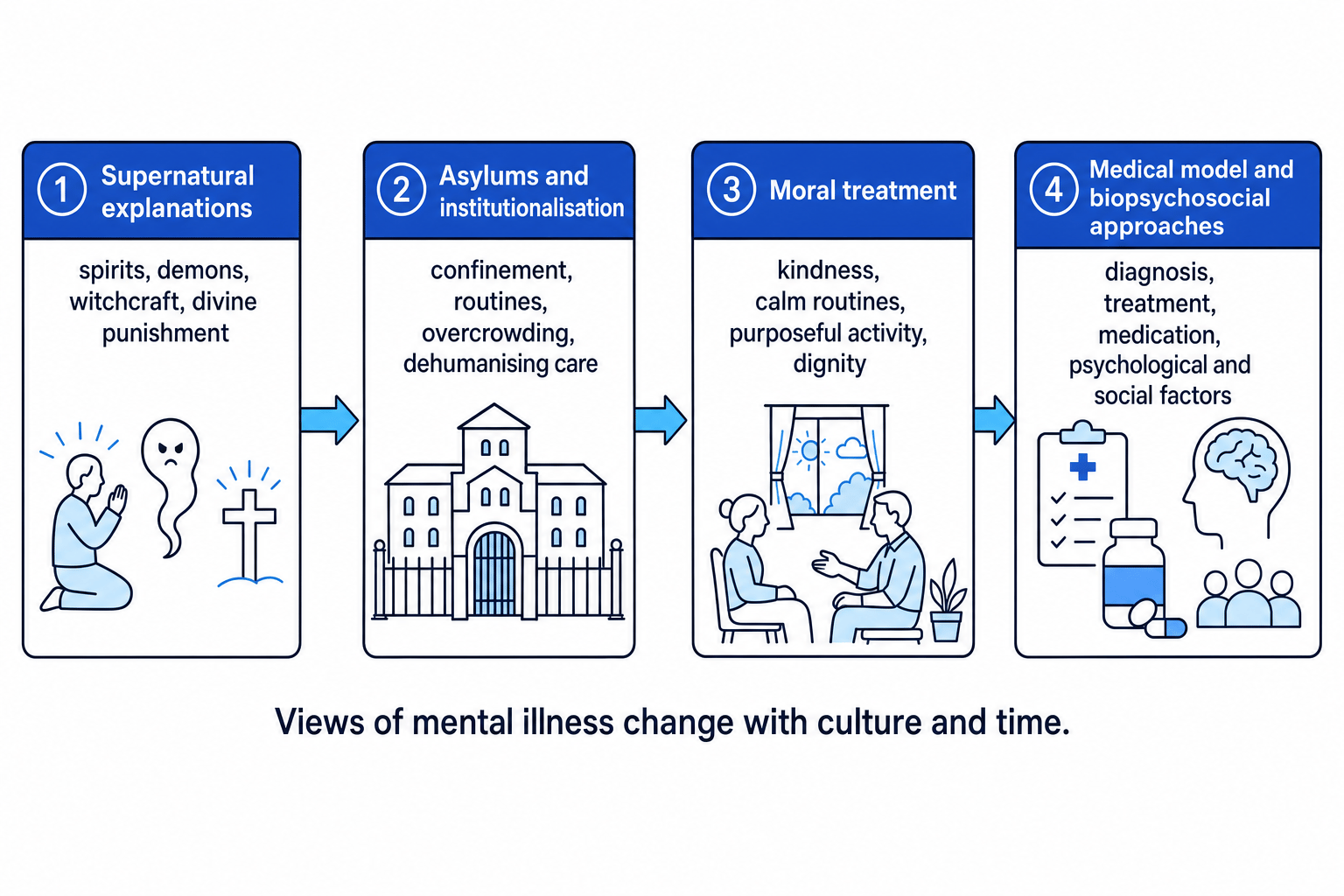
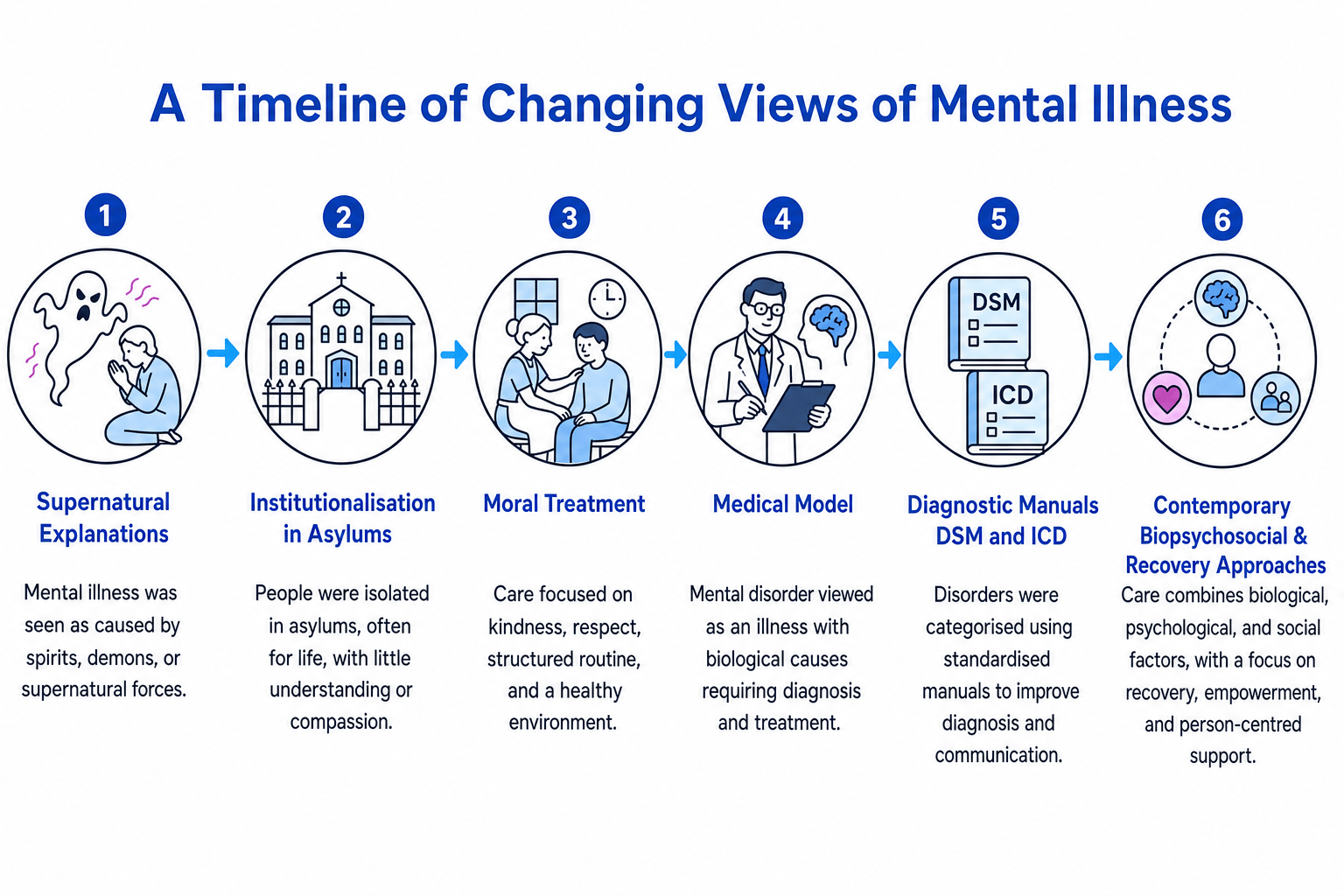
A helpful way to remember this topic is as a movement from supernatural explanations, to institutional care, to the medical model, and then towards modern biopsychosocial approaches.
The big historical point
Views of mental illness are shaped by the society they come from. This means diagnosis can be useful, but it can also reflect cultural assumptions and create powerful labels.
Historical views of mental illness
Supernatural explanations
In many early societies, unusual behaviour was explained through supernatural explanations: forces beyond the natural world, such as spirits, demons, witchcraft or divine punishment. Treatment could involve prayer, exorcism or punishment rather than medical care.
This matters because it shows that explanations of mental illness often reflect the dominant beliefs of the time.
Asylums and institutionalisation
An asylum was an institution where people with mental illness were housed, often away from the community. Institutionalisation means placing people into large organisations where their daily lives are controlled by routines, rules and staff.
Some asylums aimed to protect people, but many became overcrowded and dehumanising. Patients could be treated as “mad” rather than as individuals with needs and rights.
Moral treatment
Moral treatment was a more humane approach associated with kindness, calm routines, purposeful activity and respect. The word “moral” here does not mean judging someone as good or bad; it means treating the person as capable of dignity and self-control.
This was an important step towards seeing patients as people who could recover or improve.
The medical model
The medical model views mental disorders as illnesses with symptoms, causes and treatments. This encouraged diagnosis, hospital treatment, medication and professional psychiatry.
Its strength is usefulness: it can reduce blame and guide treatment. Its weakness is reductionism: complex distress may be reduced too narrowly to biological symptoms.
Defining abnormality
Psychologists use several definitions of abnormality. None is perfect, so strong AO3 evaluation often comes from comparing them.
Deviation from social norms
A social norm is an expected rule for behaviour in a particular society or group. Someone may be seen as abnormal if they behave in a way that strongly breaks these expectations.
Strength: it considers the social world people live in.
Weakness: norms vary across cultures and time, so this definition can be culturally biased.
Statistical infrequency
Statistical infrequency means a behaviour or characteristic is rare. For example, a very unusual score on a measure of mood or anxiety might be considered abnormal.
Strength: it seems objective.
Weakness: rare does not automatically mean undesirable or disordered.
Rare does not always mean abnormal
Do not write as if “unusual” and “mentally ill” mean the same thing. Very high intelligence is statistically rare, but it is not usually a mental disorder.
Failure to function adequately
Failure to function adequately means a person is struggling to manage everyday life, such as maintaining hygiene, relationships, work, school or safety.
Strength: it focuses on real-life impairment.
Weakness: judging “adequate” functioning can be subjective, and some people cope privately despite severe distress.
Deviation from ideal mental health
Deviation from ideal mental health defines abnormality by comparing someone with positive signs of wellbeing, such as autonomy, accurate perception of reality, self-esteem and the ability to cope with stress. Marie Jahoda is often linked with this approach.
Strength: it focuses on positive wellbeing, not just illness.
Weakness: very few people meet every ideal all the time.
Applying definitions of abnormality
A student stops seeing friends, misses school for several weeks, sleeps very little and says life feels pointless after a major family conflict.
- Social norms: Some sadness after conflict is understandable, but withdrawing from normal activities for several weeks goes beyond what many people would expect in that context.
- Failure to function adequately: Missing school, losing sleep and avoiding relationships suggest everyday functioning is impaired, so this definition strongly supports concern.
- Deviation from ideal mental health: Low coping, reduced relationships and hopeless thoughts suggest poor psychological wellbeing.
- Balanced judgement: The behaviour should not be labelled “abnormal” just because it is unpleasant; the strongest evidence is the duration, distress and impairment.
Categorising mental disorders
Diagnosis and classification
A diagnosis is the identification of a disorder based on symptoms and criteria. Classification is the system used to organise disorders into categories, such as anxiety disorders or psychotic disorders.
Modern diagnosis often uses manuals such as the DSM — the Diagnostic and Statistical Manual of Mental Disorders — and the ICD — the International Classification of Diseases. These manuals describe symptom patterns, duration, impairment and exclusion criteria.
A symptom is a reported or observed sign of a disorder. A syndrome is a cluster of symptoms that tend to occur together. Comorbidity means having more than one disorder at the same time.
Two key ideas are:
- Reliability: clinicians reach the same diagnosis consistently.
- Validity: the diagnosis accurately identifies a real condition and helps predict symptoms, causes or treatment response.
Reliability versus validity
A diagnosis can be reliable but not valid. If two clinicians consistently give the same label, that is reliability; if the label truly explains the person’s difficulties, that is validity.
Categorisation is useful because it gives professionals a shared language and can guide treatment. However, it can also create stigma, ignore individual differences and encourage “labelling”, where the diagnosis changes how others interpret the person.
Key research: Rosenhan (1973)
Rosenhan’s study, On being sane in insane places, is central to this topic because it challenged whether psychiatric hospitals could reliably tell the “sane” from the “insane”.
Background and aim
Rosenhan was interested in diagnostic validity and labelling. Labelling means attaching a category to a person, which may then shape how their behaviour is interpreted.
The key question was: if people without mental illness entered psychiatric hospitals, would staff recognise them as sane?
Method and procedure
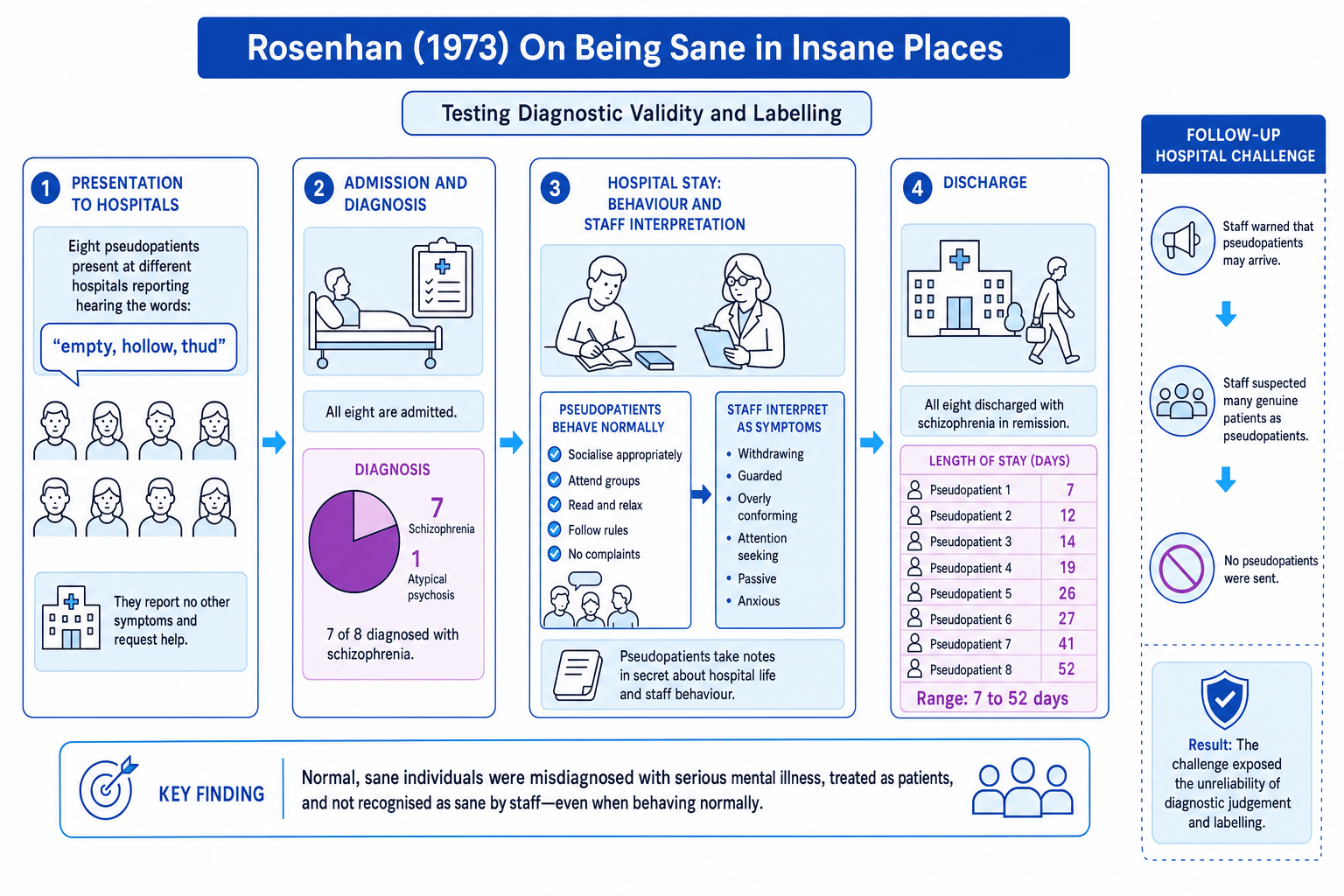
Rosenhan used pseudopatients, meaning people pretending to be patients for research purposes. Eight pseudopatients went to psychiatric hospitals in the USA and reported hearing voices saying “empty”, “hollow” and “thud”. Apart from this, they gave truthful personal histories and behaved normally after admission.
The diagram summarises the main procedure and findings.
Results
All pseudopatients were admitted. Most were diagnosed with schizophrenia, and one was diagnosed with manic-depressive psychosis. Once inside, they behaved normally, but ordinary behaviours — such as writing notes — were sometimes interpreted as symptoms.
They stayed in hospital for between 7 and 52 days and were discharged with a diagnosis such as “schizophrenia in remission”.
In a follow-up, one hospital was warned that pseudopatients might try to gain admission. Staff suspected many genuine patients of being pseudopatients, even though Rosenhan sent none.
Conclusions
Rosenhan concluded that psychiatric diagnosis could be unreliable and that labels powerfully shape perception. Once someone was labelled as mentally ill, staff tended to interpret behaviour through that label.
Rosenhan's challenge
Rosenhan did not simply show that staff were careless. He showed how a diagnostic label can create a context where normal behaviour is reinterpreted as evidence of abnormality.
Evaluation
Validity: The study had strong ecological validity because it took place in real hospitals. However, the pseudopatients were not real patients seeking genuine treatment, so the situation was artificial in one important way.
Reliability: Rosenhan raised serious concerns about inter-rater reliability in diagnosis. The same “symptom” led to hospital admission, but later normal behaviour did not lead staff to revise the diagnosis quickly.
Ethics: Using the BPS Code today, the study raises issues of deception, lack of informed consent from hospital staff and possible disruption to real patients. However, hospitals were not named, and the research had major social value because it exposed potential harm in psychiatric labelling.
Historical limitation: Rosenhan studied hospitals in the early 1970s, before later diagnostic manuals became more operationalised. Modern DSM and ICD systems have clearer criteria, so you should avoid claiming the study proves all diagnosis is useless today.
Do not overclaim Rosenhan
A strong answer says Rosenhan questioned the reliability and validity of diagnosis in that historical context. A weak answer says he “proved mental illness is not real” — he did not.
Application: disorder categories
For OCR, you need to apply broad characteristics of an affective disorder, a psychotic disorder and an anxiety disorder.
| Disorder type | Core feature | Example characteristics |
|---|---|---|
| Affective disorder | Disturbance of mood or emotion | Persistent low mood, loss of pleasure, mania, changes in sleep, appetite or energy |
| Psychotic disorder | Loss of contact with reality | Hallucinations, delusions, disorganised thinking, reduced emotional expression |
| Anxiety disorder | Excessive fear, anxiety or avoidance | Panic, phobias, constant worry, physical arousal, avoidance of feared situations |
An affective disorder involves mood. Depression and bipolar disorder are common examples.
A psychotic disorder involves disrupted reality testing. Schizophrenia is the classic example linked to Rosenhan. A hallucination is a perception without an external stimulus; a delusion is a fixed false belief.
An anxiety disorder involves excessive fear or worry that interferes with everyday life.
Choosing a broad disorder category
Ben says his neighbours are sending secret messages through the television. He hears a voice commenting on his actions and has stopped going to college because he believes people are watching him.
- Identify the core disturbance: The main issue is not just low mood or worry; Ben is experiencing unusual beliefs and perceptions.
- Match symptoms to categories: Secret messages and being watched suggest delusions, while hearing a commenting voice suggests hallucinations.
- Compare alternatives: Anxiety may be present because Ben avoids college, but the strongest evidence is loss of contact with reality.
- Apply the category carefully: This is most consistent with a psychotic disorder, but a full diagnosis would require professional assessment and more information.
Bringing it together for essays
For AO1, describe the historical shift, definitions of abnormality, classification systems and Rosenhan’s procedure/results.
For AO2, apply these ideas to scenarios: decide whether behaviour shows impairment, whether a diagnosis might be affected by labelling, or which disorder category best fits a description.
For AO3, evaluate using validity, reliability, ethics, cultural bias, usefulness, reductionism and the danger of stigma.
In the exam
- Start with the concept: define abnormality, diagnosis or labelling before using it.
- Use Rosenhan precisely: include pseudopatients, voice symptoms, admission, normal behaviour, discharge and the follow-up hospital challenge.
- Evaluate with balance: diagnosis can help treatment and communication, but it can also be unreliable, culturally biased or stigmatising.
Check yourself
- Why might “deviation from social norms” be a culturally biased definition of abnormality?
- What did Rosenhan’s pseudopatients do after being admitted to hospital?
- How would you distinguish an affective disorder from a psychotic disorder in a short scenario?