What you'll learn
- How to spot the psychological content hidden inside a novel source.
- How to make evidence-based suggestions using OCR core studies.
- How to evaluate your own suggestions for strengths, weaknesses and ethics.
- How to write Section C answers using AO1, AO2 and AO3 together.
The big idea: using psychology in the real world
In Component 02, Section C, you are given a novel source. This might be a newspaper article, blog post, diary entry, email exchange, school report or similar written source. Your job is not just to remember studies — it is to use psychology to make sense of a real-life situation.
Practical application
A practical application is a way psychological knowledge can be used to understand, improve or manage a real-world situation.
The exam is testing whether you can move from research evidence to a useful suggestion. For example, if a source describes children copying aggressive behaviour online, you might use Bandura, Ross and Ross (1961) to suggest reducing exposure to rewarded aggressive models and increasing prosocial role models.
This is the basic route your thinking should follow: identify the issue, choose evidence, suggest an action, then judge how good your action is.
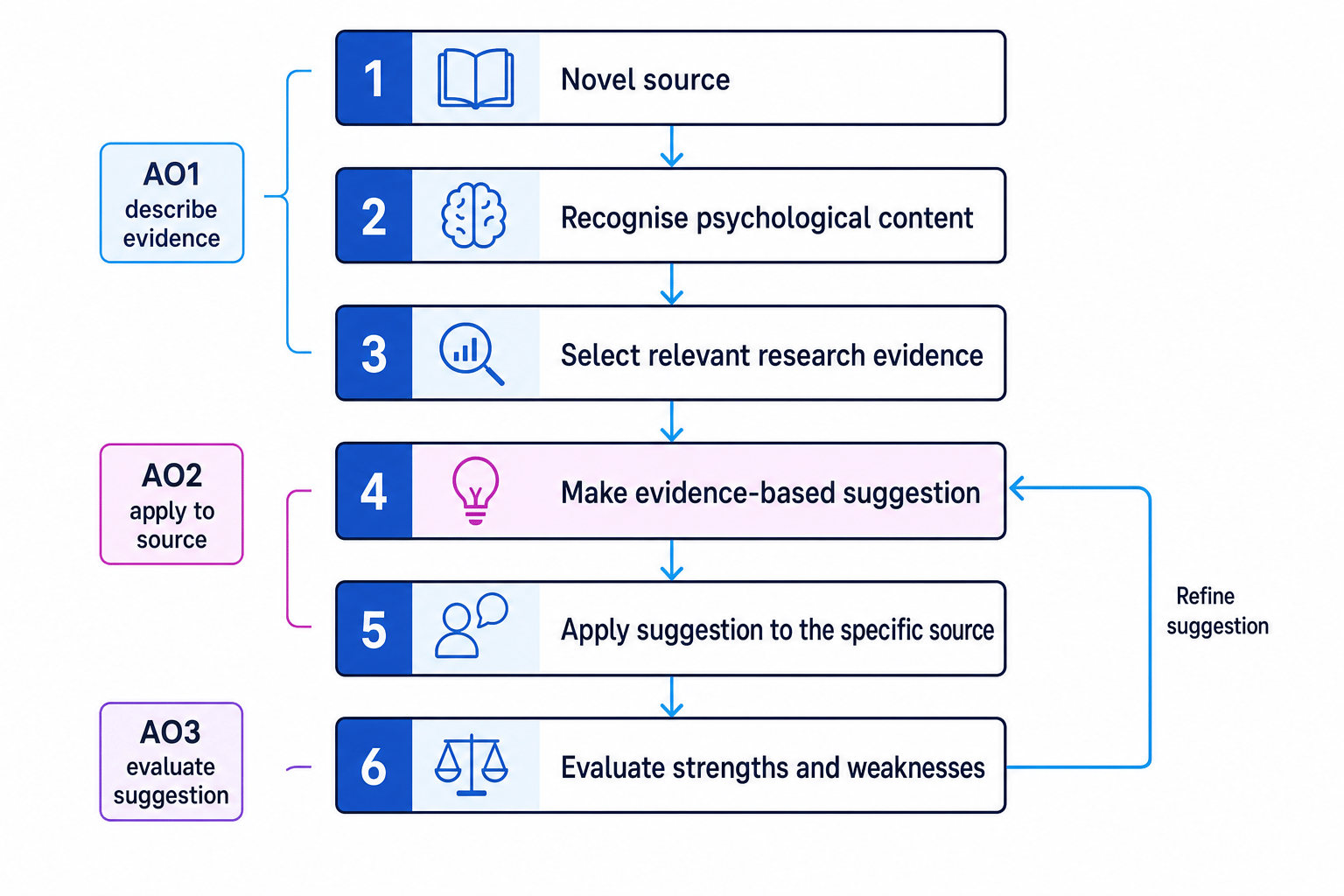
The three exam moves
A strong practical applications answer usually does three things: recognises psychology in the source, makes an evidence-based suggestion, and evaluates the strengths and weaknesses of that suggestion.
AO1, AO2 and AO3 in this section
AO1: describe the psychology
AO1 means showing accurate knowledge and understanding. In this section, that usually means naming and briefly describing relevant research, concepts or debates.
Examples of AO1:
- Milgram (1963) found high levels of obedience to an authority figure in a controlled laboratory setting.
- Loftus and Palmer (1974) showed that leading questions can affect eyewitness memory.
- Bandura, Ross and Ross (1961) found that children can imitate aggressive behaviour shown by adult models.
AO2: apply it to the source
AO2 means using psychology to explain the specific source. You must refer to details from the source, not write a generic paragraph.
If the source says a teacher repeatedly uses harsh punishments and pupils copy this behaviour, AO2 would connect that to social learning from Bandura et al. (1961).
AO3: evaluate your suggestion
AO3 means judging strengths and weaknesses. In this section, the key is to evaluate your suggestion, not just the original study.
You might consider:
- Is the suggestion realistic?
- Is it ethical?
- Does the evidence come from a similar situation?
- Could there be alternative explanations?
- Would it work for everyone?
Only retelling the study
Do not spend the whole answer describing a core study. You need enough AO1 to support your point, but the marks come from applying it to the source and judging your own suggestion.
Step 1: recognise the psychological content
The source will not usually say, “This is about obedience” or “This is about eyewitness memory.” You have to translate everyday language into psychology.
Look for:
- Authority, orders, pressure, resistance → Milgram (1963), Bocchiaro et al. (2012).
- Eyewitnesses, questioning, memory errors, context → Loftus and Palmer (1974), Grant et al. (1998).
- Children copying behaviour, role models, aggression → Bandura et al. (1961), Lee et al. (1997).
- Brain functioning, self-control, biological explanations → Sperry (1968), Casey et al. (2011).
- Phobias, autism, individual differences → Freud (1909), Baron-Cohen et al. (1997).
Psychological content
Psychological content means the behaviour, thought processes, emotions, social influences or individual differences in the source that can be explained using psychology.
Core study anchors you can use
In OCR H567, practical application questions can draw on your knowledge of the Component 02 core studies.
Useful anchors include:
- Social psychology: Milgram (1963) on obedience; Bocchiaro et al. (2012) on disobedience and whistleblowing.
- Cognitive psychology: Loftus and Palmer (1974) on reconstructive memory; Grant et al. (1998) on context-dependent memory.
- Developmental psychology: Bandura et al. (1961) on imitation of aggression; Lee et al. (1997) on cultural differences in evaluations of lying and truth-telling.
- Biological psychology: Sperry (1968) on split-brain research; Casey et al. (2011) on delay of gratification and brain activity.
- Individual differences: Freud (1909) on Little Hans and phobia; Baron-Cohen et al. (1997) on theory of mind and the Eyes Task.
Spotting the psychology in a source
A school blog says that younger pupils copied a popular older pupil who mocked new students. Teachers noticed the behaviour increased after other pupils laughed.
- Identify the behaviour that needs explaining: pupils are copying aggressive or antisocial behaviour.
- Link this to relevant evidence: Bandura et al. (1961) found children imitated aggressive behaviour shown by adult models, especially when the model’s behaviour appeared successful or attention-grabbing.
- Apply it to the source: the older pupil acts as a model, and laughter from others may act as social reinforcement, making imitation more likely.
- Choose a possible direction for application: the school could reduce attention given to mocking behaviour and promote respected prosocial role models.
Step 2: make an evidence-based suggestion
A suggestion should be more than “raise awareness” or “give support.” It needs to be specific and linked to evidence.
Evidence-based suggestion
An evidence-based suggestion is a practical action justified by psychological research or theory.
A good suggestion has three parts:
- Action: what should be done.
- Evidence: which study or concept supports it.
- Source link: why it fits this particular situation.
For example, if a source describes police officers asking witnesses, “How fast was the car going when it smashed into the wall?”, a strong suggestion would be to train interviewers to use neutral wording. This is supported by Loftus and Palmer (1974), where the verb used in a question affected speed estimates and reports of broken glass.
Make the suggestion concrete
Use verbs such as train, change, reduce, increase, provide, separate, record, monitor or model. These force you to say what someone should actually do.
Common suggestion patterns
You can adapt these to the source:
- Obedience and authority: create safe reporting systems, encourage dissenting role models, reduce unnecessary status cues. Link to Milgram (1963) and Bocchiaro et al. (2012).
- Eyewitness memory: avoid leading questions, record interviews early, reinstate context. Link to Loftus and Palmer (1974) and Grant et al. (1998).
- Aggression and role models: reduce rewarded aggressive models, use prosocial peer leaders. Link to Bandura et al. (1961).
- Cultural or developmental issues: avoid assuming all children interpret behaviour the same way. Link to Lee et al. (1997).
- Autism and communication: avoid over-relying on subtle facial cues; use clear language and supportive communication. Link to Baron-Cohen et al. (1997).
- Self-control: use delay strategies and environmental supports rather than blaming the individual. Link to Casey et al. (2011).
Designing a source-specific suggestion
A local news article says several witnesses to a robbery gave different descriptions after discussing the event together and being questioned by a journalist using dramatic wording.
- Select the psychological issue: the source is about eyewitness memory being influenced after the event.
- Choose evidence: Loftus and Palmer (1974) showed that leading questions can alter memory reports, so witness questioning should avoid suggestive wording.
- Turn evidence into an action: police should interview witnesses separately as soon as possible, using neutral questions such as “What did you see?” rather than dramatic or leading phrases.
- Apply it directly: because the article says witnesses discussed the robbery together, separation reduces contamination between accounts.
- Predict a realistic benefit: the accounts may become more reliable because they are less likely to be shaped by post-event information.
Vague suggestions
“People should be educated” is usually too vague. Say who should be educated, what they should learn, and how this follows from the evidence.
Step 3: consider strengths and weaknesses
You must evaluate the suggestion you made. This is where many students lose marks because they evaluate the study instead.
Evaluation
Evaluation means making a reasoned judgement about the value, limits or consequences of an explanation, study or suggestion.
Useful evaluation angles include:
Evidence quality
Ask whether the supporting evidence is strong.
For example, Loftus and Palmer (1974) was controlled and easy to replicate, which supports reliability. However, watching film clips is not the same as witnessing a real crash, so ecological validity may be limited.
Ecological validity
Ecological validity is the extent to which research reflects real-life settings, tasks and behaviour.
Population and culture
A suggestion may not work equally well for every group.
Ethnocentrism
Ethnocentrism means judging behaviour mainly from the viewpoint of one culture, which can make conclusions less valid for other cultures.
For example, Lee et al. (1997) is useful because it directly compares children from different cultural backgrounds, reminding you that practical advice in schools or families should be culturally sensitive.
Ethics
Psychological suggestions must consider the BPS Code of Ethics, especially respect, competence, responsibility and integrity.
In practice, ask:
- Could the suggestion cause harm or distress?
- Are people’s privacy and confidentiality protected?
- Is there informed consent where needed?
- Are vulnerable groups protected from stigma?
- Is deception avoided or justified?
Ethics still matter in applications
A suggestion can be effective but still unacceptable. For example, secretly manipulating pupils with false authority figures might reduce bullying, but it would raise serious concerns about deception, consent and psychological harm.
Usefulness and feasibility
A suggestion can be supported by research but still hard to use. It may be expensive, time-consuming, require specialist staff, or depend on cooperation from people in the source.
Evaluating a memory suggestion
Suggestion: police should interview witnesses separately using neutral questions.
- Judge a strength: this is supported by Loftus and Palmer (1974), which showed that wording can influence recall, so neutral questions directly target a known source of memory distortion.
- Judge a limitation: Loftus and Palmer used film clips rather than real crimes, so the emotional intensity of a robbery may reduce how far the finding generalises.
- Add an ethical point: separate interviews protect the investigation without deceiving witnesses or causing obvious harm, so the suggestion is relatively ethical.
- Reach a balanced conclusion: the suggestion is useful and low-risk, but it should be combined with other safeguards because eyewitness memory can still be affected by stress, attention and individual differences.
Writing a strong Section C paragraph
A useful structure is:
- Point: state the suggestion.
- Evidence: name the study and finding.
- Application: connect it to a detail in the source.
- Evaluation: give one strength or weakness of your suggestion.
For example:
“Police should avoid leading questions when interviewing the witnesses. This is supported by Loftus and Palmer (1974), who found that changing the verb in a question affected speed estimates and reports of broken glass. In the source, the journalist used dramatic wording, so neutral police questioning could reduce further distortion. A strength is that this is practical and ethical; however, the original study used film clips, so it may not fully represent the stress of witnessing a real robbery.”
Application is not name-dropping
You do not get strong AO2 just by mentioning a study. You need to show exactly how the study helps explain or improve the situation in the source.
Debates you can use in evaluation
Practical applications often connect naturally to wider debates:
- Individual versus situational explanations: is behaviour due to personality, or the situation? Milgram (1963) strongly suggests situational pressure matters.
- Nature versus nurture: is behaviour influenced more by biology or experience? Bandura et al. (1961) supports learning from the environment.
- Reductionism versus holism: does the suggestion oversimplify behaviour by focusing on one factor?
- Psychology as a science: is the evidence controlled, reliable and objective?
- Usefulness: does the research lead to real-world improvements?
- Social sensitivity: could applying the research stigmatise groups, such as autistic people or children from particular cultures?
In the exam
- Start by identifying the psychological issue in the source before choosing a study.
- Make one or two specific suggestions, each supported by named evidence such as Milgram (1963), Loftus and Palmer (1974) or Bandura et al. (1961).
- Evaluate your own suggestion using evidence quality, ethics, feasibility and whether it fits the people and setting in the source.
Check yourself
- Can you turn a detail from a source into a psychological concept, such as obedience, memory distortion or social learning?
- Can you make a suggestion that names both an action and supporting evidence?
- Can you give one strength and one weakness of your own suggestion, rather than only evaluating the original study?
