What you'll learn
- What psychologists mean by territory, personal space and workspace personalisation.
- How these ideas affect behaviour and well-being in the workplace.
- The key research: Wells (2000) on office personal displays.
- How to apply the research to practical office design and evaluate it for AO3.
Background: why space matters at work
Environmental psychology
Environmental psychology is the study of how physical settings influence people’s thoughts, feelings and behaviour.
Workplaces are not just “rooms where work happens”. They shape social behaviour: who feels comfortable, who feels watched, who feels in control, and who feels they belong.
In this topic, the key idea is that employees often need some control over space. When people can mark, adapt and manage their workspace, they may feel more secure and valued. When they cannot, they may experience stress, crowding or loss of identity.
Territory: “this space is mine, ours, or public”
Territory
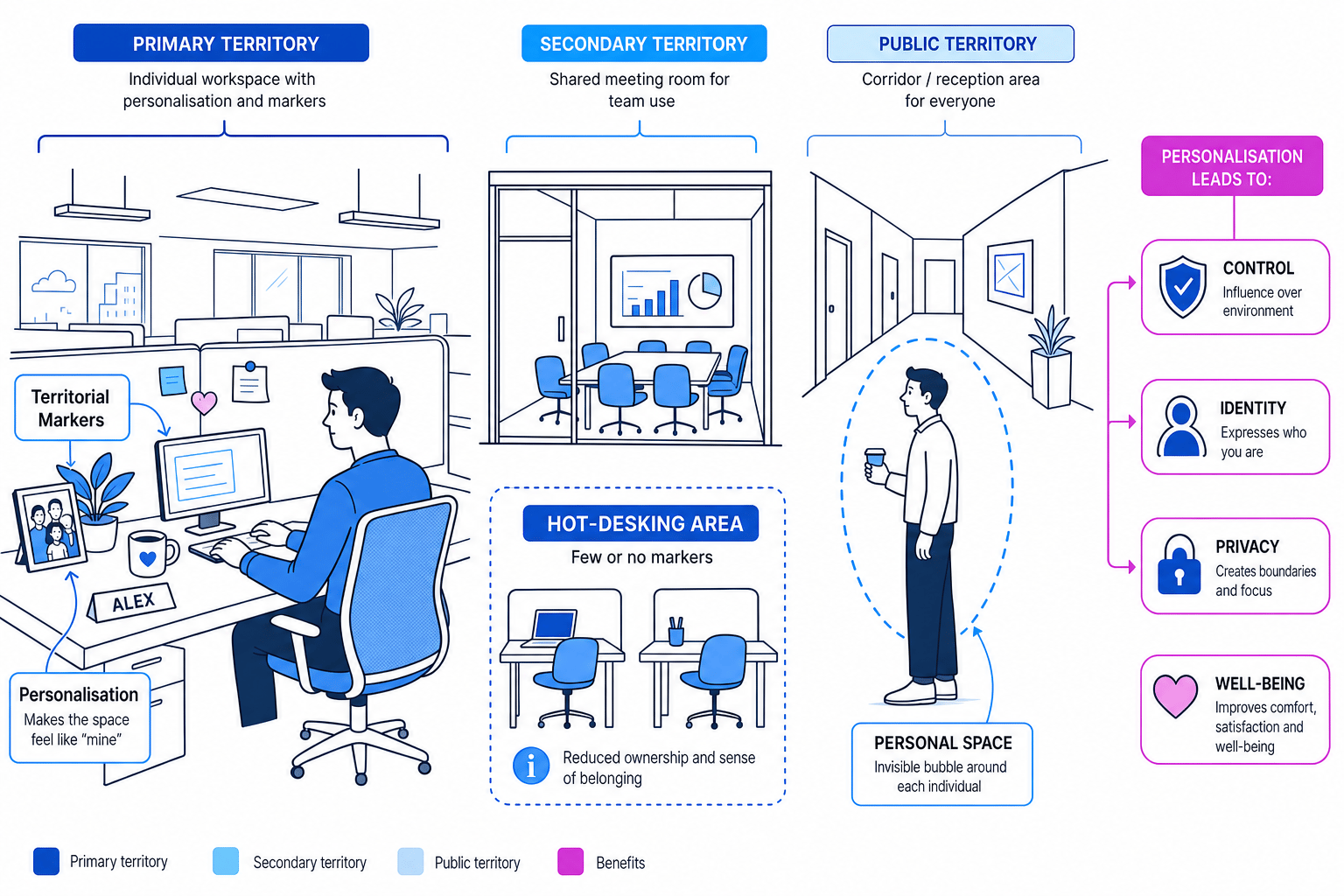
A territory is a physical area that a person or group sees as belonging to them, or as being under their control.
Territory is social because it communicates boundaries. A desk with family photos, a nameplate and a favourite mug tells other people: “this is my workspace”. These objects are called territorial markers because they signal ownership or control.
Psychologists often divide territory into three types:
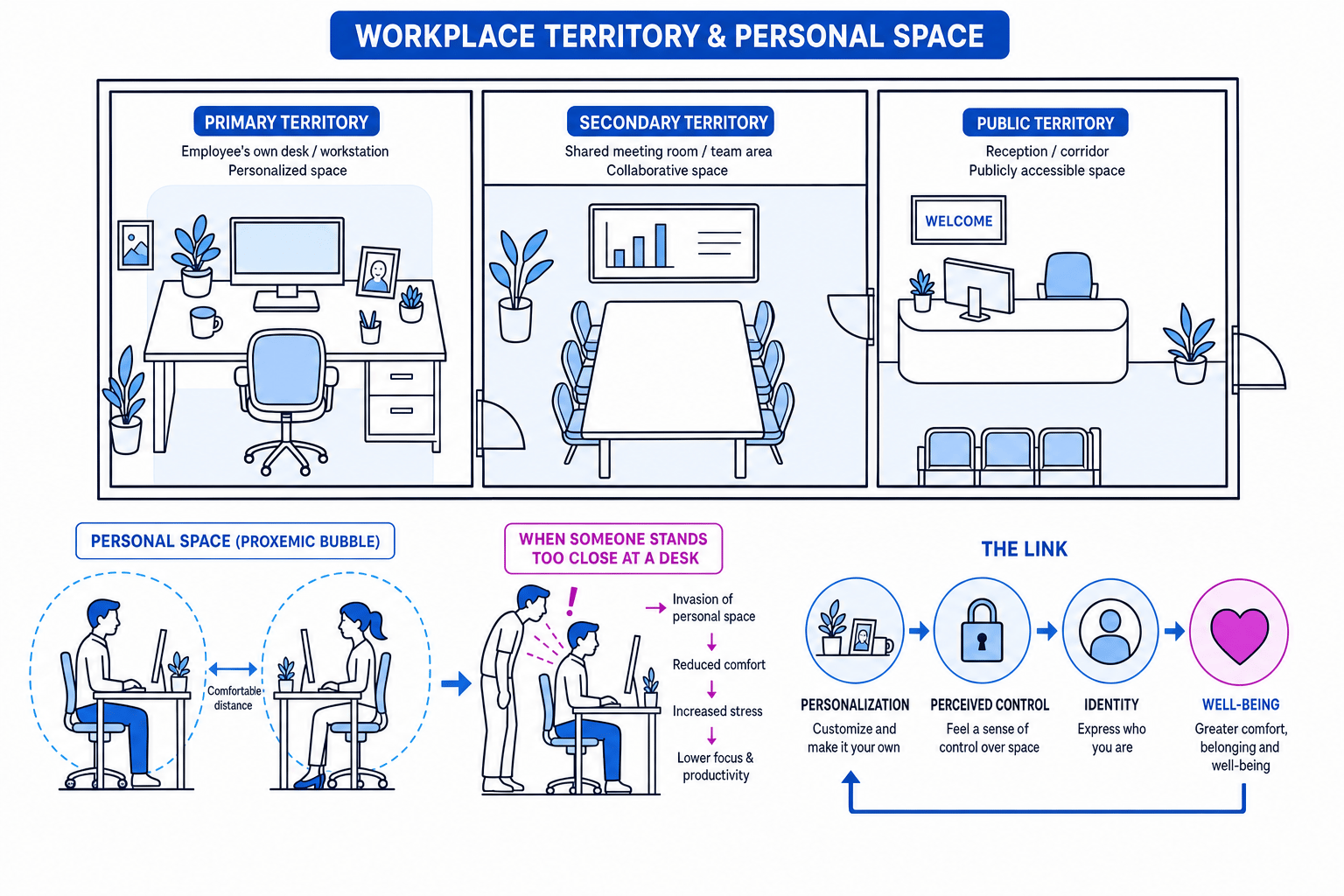
- Primary territory: a space strongly associated with one person or group, such as your own desk or private office.
- Secondary territory: a shared space used by a known group, such as a team meeting room.
- Public territory: a space anyone can use, such as a reception area or corridor.
The same workplace can contain all three types of territory, and problems often occur when boundaries are unclear or ignored.
Territory is about control
In workplace psychology, territory is not only about physical space; it is about control, identity and social boundaries.
Identifying territorial problems in an office
A company introduces hot-desking. Employees can no longer keep photos, plants or files on a regular desk. Some say they feel “like visitors” at work.
- Classify the space: the old desk was a primary territory because it was personally associated with one employee; hot-desks are closer to temporary or shared territory.
- Identify the psychological loss: employees have less opportunity to use territorial markers, so they may feel less ownership and identity.
- Apply the likely outcome: reduced control over the workspace may lower comfort, belonging and satisfaction with the physical work environment.
Personal space: the invisible boundary around you
Personal space
Personal space is the invisible, flexible area around a person that they prefer others not to enter without permission.
Personal space is different from territory. Territory is usually linked to a place; personal space moves around with the person.
For example, if a colleague stands very close behind you while reading your screen, they may be invading your personal space even if they are not taking your desk. This can feel uncomfortable because it reduces privacy and control.
Personal space varies depending on:
- relationship: friends can usually stand closer than strangers;
- context: a busy lift feels different from a quiet office;
- culture: preferred distances vary between societies;
- status and power: a manager standing over an employee may feel more threatening;
- individual differences: some people prefer more distance than others.
Do not mix up territory and personal space
A desk with personal photos is about territory. Someone standing too close to you is about personal space. In essays, keep the two concepts separate before linking them.
Crowding, privacy and control
Crowding
Crowding is the subjective feeling that there is too little space or too much unwanted social contact.
Crowding is not just the number of people in a room. Two people may experience the same office differently depending on noise, privacy, desk layout, control and relationships.
A key related idea is privacy regulation: people try to control how much contact they have with others. Territory and personal space help with this. For instance, a door, screen, nameplate or clear desk boundary can reduce unwanted interruptions.
The workplace link
Office design affects well-being partly because it affects how much privacy, control and identity employees feel they have.
Workspace personalisation
Workspace personalisation
Workspace personalisation means adapting a work area with personal or meaningful objects, such as photographs, plants, artwork, certificates, mugs or souvenirs.
Personalisation can look like “clutter” to an organisation, but it may be psychologically meaningful to the employee. It can:
- mark territory;
- express identity;
- increase perceived control;
- create emotional comfort;
- support belonging to the organisation or team.
This is why a “clean desk” policy may look efficient but still have negative effects if it removes all opportunities for ownership.
Useful AO2 chain
For application questions, use this chain: office design → control/privacy/territory → employee feelings → behaviour or well-being.
Key research: Wells (2000)
The named study for this topic is Wells (2000), “Office clutter or meaningful personal displays: The role of office personalization in employee and organisational well-being.”
Aim
Wells wanted to investigate whether personalising office space is just clutter, or whether it has a positive role in employee and organisational well-being.
Method
Wells used a field-based correlational survey. This means the study took place in real workplace settings and looked for relationships between variables rather than manipulating them in a controlled experiment.
The sample was made up of office employees in the USA. Participants completed questionnaires about issues such as:
- how much they personalised their workspace;
- satisfaction with the physical work environment;
- job satisfaction;
- well-being;
- features of the workspace and organisation.
Results
The main pattern was that workspace personalisation was linked with more positive experiences of the work environment. Employees who had meaningful personal displays tended to report greater satisfaction with their physical workspace.
Wells’ findings suggest that personal displays should not automatically be dismissed as mess. They may help employees feel that their workspace is “theirs”, which can support comfort, identity and well-being.
Conclusions
Wells concluded that office personalisation can play a useful role in employee and organisational well-being. Organisations should therefore think carefully before removing all opportunities for personal displays.
Interpreting Wells’ findings cautiously
A manager reads about Wells (2000) and says, “Personal photos cause employees to be happier at work.”
- Identify the design: Wells used a correlational method, so variables were measured rather than controlled experimentally.
- Consider alternative explanations: happier employees may be more likely to personalise, or a supportive organisation may encourage both personalisation and well-being.
- Give a cautious conclusion: Wells supports a link between personalisation and well-being, but it does not prove that personal displays alone cause happiness.
Evaluation of Wells (2000)
Strengths
A major strength is ecological validity. Because Wells studied real office workers, the findings are relevant to actual workplaces rather than artificial laboratory settings.
The study is also useful. It gives organisations practical guidance: allowing some personalisation may improve employees’ experience of the workplace.
It also fits well with wider environmental psychology because it links the physical setting to psychological outcomes such as control, identity and satisfaction.
Weaknesses
A key limitation is that the study is correlational. It can show relationships between personalisation and well-being, but it cannot prove cause and effect.
The study also relied heavily on self-report data. Participants may have answered in socially desirable ways, or they may not have accurately judged their own well-being and satisfaction.
There may be sampling bias and ethnocentrism. Wells studied office employees in the USA, so findings may not apply equally to all cultures, workplaces or job roles. Some organisations value personal expression; others emphasise uniformity or shared space.
There are also possible individual differences. Some employees love personal displays, while others prefer a minimalist workspace. A good office design should allow choice rather than forcing one style on everyone.
Ethics
Wells’ research is relatively low risk, but ethical issues still matter. Under the BPS Code of Human Research Ethics, researchers should ensure informed consent, confidentiality, anonymity and the right to withdraw.
This is especially important in workplace research because employees may worry that negative comments about their office or job could reach managers.
Overclaiming the application
Do not write “Wells proves personalisation causes well-being.” A stronger AO3 answer says Wells provides useful correlational evidence, but causal claims should be cautious.
Application: office design strategies
A good application answer should turn the research into a practical strategy.
Strategy: personalisable home bases
One evidence-based office design strategy is to give employees a personalised home base. This could be a regular desk, workstation, locker, noticeboard or team zone where people can display meaningful items and store personal materials.
This strategy is especially important in open-plan offices and hot-desking systems. If a company must use flexible seating, it can still protect territory by offering:
- personal lockers or storage;
- small display areas;
- team “neighbourhoods”;
- desk booking systems that reduce uncertainty;
- quiet rooms for privacy;
- screens or layout choices to reduce personal space invasion.
The aim is not to let offices become chaotic. The aim is to balance organisational needs with employees’ need for control, identity and privacy.
Designing a workplace strategy
A call centre reports stress, low morale and complaints that employees feel “packed in” and “replaceable”.
- Diagnose the issue: the complaints suggest loss of personal space, low territorial control and weak workplace identity.
- Choose a strategy: introduce personalisable home bases or team zones, plus storage, screens and quiet areas for private work.
- Link to research: based on Wells (2000), meaningful personalisation may improve satisfaction with the physical environment, which may support well-being.
- Add evaluation: the organisation should gather feedback after the change because the best design may vary by task, culture and individual preference.
Writing strong AO1, AO2 and AO3
For AO1, describe the concepts clearly: territory, personal space, personalisation, control and well-being.
For AO2, apply these ideas directly to the source or scenario. If the question describes hot-desking, open-plan work or complaints about interruptions, use the exact evidence in the scenario.
For AO3, evaluate the research and application. Consider validity, ethics, sampling bias, usefulness, individual differences and whether the evidence is correlational.
In the exam
- Start by defining the key term in the question, such as territory, personal space or personalisation.
- For Wells (2000), remember the core point: personal displays can be meaningful because they support control, identity and well-being.
- In application answers, build a clear chain from office feature → psychological process → likely outcome.
- In evaluation, avoid causal overclaiming and mention that Wells’ evidence is useful but correlational.
- Include an ethics point if discussing workplace research: confidentiality is crucial because employees may fear employer judgement.
Check yourself
- How is territory different from personal space?
- Why might a clean-desk policy reduce employee well-being?
- What is one strength and one weakness of Wells (2000) as evidence for office design?