What you'll learn
- The difference between arousal, anxiety, cognitive anxiety and somatic anxiety.
- How arousal can improve or damage sports performance.
- What Fazey and Hardy (1988) argued in their catastrophe model.
- How athletes can measure and manage anxiety using biological techniques such as biofeedback, breathing control and progressive muscular relaxation.
The starting point: arousal and anxiety
In sport, performance is not just about physical skill. The same athlete can perform brilliantly in training but struggle under pressure in competition. Sport psychologists therefore study how the body’s activation level and the athlete’s interpretation of pressure affect performance.
Arousal and anxiety
- Arousal is the general level of physiological and psychological activation, ranging from very low activation, such as tiredness, to very high activation, such as intense excitement.
- Anxiety is a negative emotional state linked to worry, nervousness and perceived threat.
- Cognitive anxiety is the mental part of anxiety, such as worry, doubt and fear of failure.
- Somatic anxiety is the bodily part of anxiety, such as increased heart rate, sweating, muscle tension and rapid breathing.
Arousal is not automatically bad. A sprinter may need high activation to explode out of the blocks, while an archer may need lower activation to keep fine motor control. Anxiety becomes a problem when the athlete sees the situation as threatening and feels unable to cope.
State anxiety is anxiety felt in a particular moment, such as before a penalty shoot-out. Trait anxiety is a general tendency to become anxious across many situations.
Arousal is not the same as anxiety
Arousal is activation; anxiety is usually activation plus worry or perceived threat. Two athletes can have the same heart rate but interpret it differently: one as “I’m ready”, the other as “I’m panicking”.
The biological response to pressure
When an athlete feels pressure, the sympathetic branch of the autonomic nervous system prepares the body for action. This can increase heart rate, breathing rate, sweating and muscle tension. Adrenaline may help energy and alertness, but too much tension can disrupt timing, decision-making and coordination.
This is why sport psychologists often try to help performers find their optimal arousal level: the amount of activation that produces their best performance.
Optimising arousal: the inverted-U hypothesis
The inverted-U hypothesis suggests that performance improves as arousal rises, up to an optimum point. After that point, further arousal harms performance. The relationship looks like an upside-down U shape.
At low arousal, the athlete may be flat, distracted or unmotivated. At moderate arousal, attention and energy are usually better. At very high arousal, the athlete may rush, become tense, narrow their attention too much or make poor decisions.
The optimum point is not the same for every sport or every athlete. Simple, gross-motor tasks, such as weightlifting or sprint starts, may tolerate higher arousal. Fine, complex or accuracy-based tasks, such as putting in golf or taking a free throw, often need lower arousal.
Matching arousal to a sporting task
A basketball player is taking a free throw in the final seconds of a match.
- Identify the task demands: a free throw requires fine motor control, accuracy and a consistent routine, so excessive muscle tension is likely to harm performance.
- Match the likely optimum: the player probably needs moderate-to-low arousal rather than maximum intensity.
- Apply the idea: if the player is shaking, rushing their routine and breathing rapidly, the coach should help reduce arousal before the shot, for example through slow breathing and a familiar pre-shot routine.
Fazey and Hardy (1988): catastrophe theory
Fazey and Hardy (1988), in The inverted-U hypothesis: A catastrophe for sport psychology, criticised the inverted-U hypothesis for being too simple. Their key argument was that performance does not always decline smoothly when arousal becomes too high. Sometimes athletes experience a sudden dramatic collapse, often called “choking”.
Their work is best understood as a theoretical paper rather than a laboratory experiment with a sample and procedure. They used catastrophe theory, a mathematical way of modelling sudden changes, to explain sport performance under pressure.
The model focuses on the interaction between physiological arousal and cognitive anxiety. When cognitive anxiety is low, performance may follow something like the inverted-U pattern. However, when cognitive anxiety is high and physiological arousal keeps increasing, performance can suddenly drop very sharply. Recovery may require the athlete to reduce arousal a lot, not just slightly. This delayed recovery pattern is known as hysteresis.
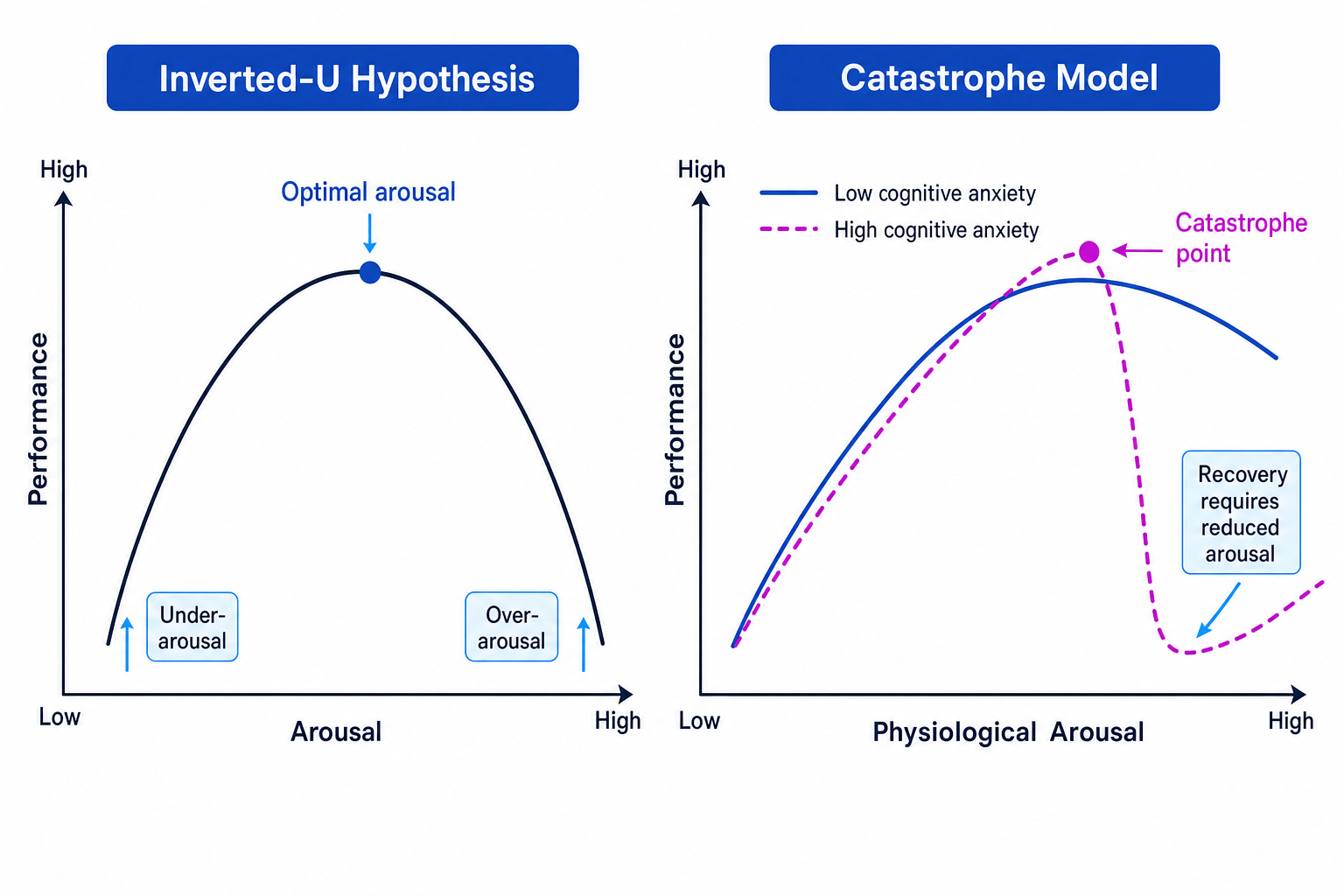
The catastrophe model
High physiological arousal is most dangerous when it combines with high cognitive anxiety. The problem is not simply “too much arousal”; it is arousal plus worry.
Explaining a sudden collapse in performance
A tennis player is serving well, but at match point they start thinking, “If I miss this, I’ll lose.” Their heart rate rises and they double fault twice.
- Classify the anxiety: the thought “If I miss this, I’ll lose” shows high cognitive anxiety because the player is worrying about failure.
- Classify the arousal: the rising heart rate and physical tension suggest high physiological arousal.
- Apply Fazey and Hardy’s model: because both cognitive anxiety and physiological arousal are high, performance may not decline gradually; it may suddenly collapse.
- Choose a recovery strategy: the player may need to reduce arousal substantially through breathing, relaxation and a reset routine before performance returns.
Evaluating Fazey and Hardy
A strength of the catastrophe model is that it explains sudden choking better than the inverted-U hypothesis. Many athletes do not gradually get worse under pressure; they seem to fall apart quickly once anxiety passes a certain point.
It is also useful because it separates cognitive anxiety from physiological arousal. This helps coaches choose better interventions. If the problem is mainly bodily tension, biological relaxation may help. If the problem is mainly worry, cognitive techniques such as self-talk or attentional control may also be needed.
However, the model is more complex and harder to test than the inverted-U hypothesis. Researchers must measure anxiety and performance at precise moments, and sport performance is affected by many other variables, such as skill level, fatigue, opposition quality and coaching.
The model may also be reductionist because it focuses heavily on arousal and anxiety. Real sporting performance can involve team dynamics, confidence, motivation, tactics and social pressure.
Saying high arousal is always bad
High arousal can help some performers in some tasks. In catastrophe theory, the biggest risk comes when high physiological arousal combines with high cognitive anxiety.
Measuring anxiety in sport
To manage anxiety, coaches and sport psychologists first need to measure it. No single measure is perfect, so a combination is often best.
Self-report questionnaires ask athletes to rate their own feelings. For example, the Competitive State Anxiety Inventory-2, often shortened to CSAI-2, measures cognitive anxiety, somatic anxiety and self-confidence. The Sport Competition Anxiety Test, often shortened to SCAT, is linked more to competitive trait anxiety.
Physiological measures look at bodily signs of arousal. These may include heart rate, breathing rate, skin conductance, muscle tension or cortisol. These can be useful because they are less dependent on what the athlete says.
Behavioural observation can also help. A coach might record signs such as pacing, rigid movements, rushed routines, avoidance of eye contact or uncharacteristic errors.
Choosing measures for a pre-match assessment
A sport psychologist is working with a gymnast who says she “feels panicky” before beam routines.
- Choose a self-report measure: a state anxiety questionnaire would help separate cognitive anxiety, such as worry, from somatic anxiety, such as tension.
- Add a physiological measure: heart rate or muscle tension data could show whether her body is becoming highly activated before the routine.
- Compare the sources: if self-report worry and physiological arousal both rise before beam routines, this supports the idea that anxiety is affecting performance.
- Use the findings for intervention: if muscle tension is especially high, biological techniques such as progressive muscular relaxation or biofeedback may be appropriate.
Ethics of measuring anxiety
Using anxiety measures with athletes should follow the BPS Code: gain informed consent, protect confidentiality, allow withdrawal, avoid unnecessary distress and explain clearly how the data will be used.
Managing arousal and anxiety: biological techniques
Biological techniques mainly target the bodily symptoms of anxiety. They aim to help the athlete control heart rate, breathing, sweating or muscle tension.
Biofeedback
Biofeedback is a technique where the athlete is connected to equipment that gives real-time information about physiological activity, such as heart rate, skin conductance or muscle tension. The athlete then practises controlling these responses.
A typical biofeedback programme might involve:
- Taking a baseline measure of physiological arousal.
- Showing the athlete live feedback, such as heart rate on a screen.
- Practising breathing, relaxation or imagery while watching the feedback.
- Reinforcing the strategies that reduce arousal.
- Gradually applying the skill to sport-specific situations.
Biofeedback is useful because it makes invisible bodily changes visible. An athlete can learn what tension feels like and what successful relaxation feels like. However, equipment can be expensive, and improvement in a quiet training room may not fully transfer to a noisy competition environment.
Progressive muscular relaxation
Progressive muscular relaxation, often shortened to PMR, involves tensing and relaxing muscle groups in sequence. This helps the athlete notice the difference between tension and relaxation. It can reduce somatic anxiety before performance.
For example, a performer may tense their shoulders for a few seconds, release the tension, then move through the arms, hands, legs and face. With practice, the routine can become shorter and more practical for use before competition.
Breathing control
Breathing control usually involves slow, controlled breathing, often from the diaphragm. This can reduce over-arousal by slowing the breathing pattern and helping the athlete feel more in control. It is especially useful because it can be used quickly during competition, such as before a serve, shot or routine.
Selecting a technique for an over-aroused performer
A hockey player reports tight muscles, rapid breathing and shaky hands before penalty strokes.
- Identify the main symptoms: the symptoms are mainly somatic anxiety, because they are bodily signs of arousal.
- Match the technique to the symptoms: PMR could reduce muscle tension, while breathing control could slow rapid breathing.
- Add biofeedback if available: heart-rate or muscle-tension feedback could help the player learn which strategy works best.
- Apply to the sport situation: the player should practise the technique in training first, then use a shortened version before penalty strokes in matches.
Combine biological and cognitive control
If an athlete is both physically tense and mentally worrying, biological techniques may not be enough on their own. They may need relaxation plus cognitive strategies such as positive self-talk, attentional focus or imagery.
AO1, AO2 and AO3 focus
For AO1, you need accurate description: define arousal and anxiety, outline the inverted-U hypothesis, describe Fazey and Hardy’s catastrophe model, and explain at least one anxiety-management technique.
For AO2, apply the ideas to sporting examples. Look at the athlete’s symptoms, the task demands and whether the anxiety is cognitive, somatic or both.
For AO3, evaluate usefulness and limitations. The catastrophe model is useful because it explains sudden performance drops, but it is harder to test and may oversimplify complex sporting performance. Biological techniques are practical, but they may not solve cognitive worry unless combined with psychological strategies.
In the exam
- Separate arousal, cognitive anxiety and somatic anxiety clearly; do not treat them as the same thing.
- When applying Fazey and Hardy, explain the interaction: high cognitive anxiety plus high physiological arousal can cause a sudden performance drop.
- For evaluation, link points to sport: usefulness for coaches, difficulty of measurement, individual differences, ecological validity and ethical handling of anxiety data.
Check yourself
- How does the catastrophe model improve on the inverted-U hypothesis?
- Why might a physiological measure of anxiety be useful but not fully valid on its own?
- Which biological technique would you choose for an athlete with muscle tension before competition, and why?
