What you'll learn
- What the built environment and urban renewal mean in environmental psychology.
- How physical settings can affect stress, recovery, social interaction and wellbeing.
- The key research: Ulrich (1984) View through a window may influence recovery from surgery.
- How to apply this topic to real design improvements in hospitals and communities.
Starting point: environmental psychology
Environmental psychology is the study of how people interact with their physical surroundings. In this topic, you are not just asking, “Do people like nice buildings?” You are asking a more psychological question:
How can places shape behaviour, emotion, stress, health and social wellbeing?
This is part of the social side of environmental psychology because buildings and neighbourhoods influence how people relate to others: whether they feel crowded, safe, supported, isolated or in control.
Built environment
The built environment is the human-made physical setting around us, including housing, hospitals, schools, roads, lighting, noise control, transport links, public spaces and access to green areas.
Wellbeing
Wellbeing means a person’s overall psychological and physical functioning, including mood, stress levels, sense of safety, social connection, recovery from illness and quality of life.
How the built environment affects wellbeing
The built environment can affect us through several routes.
1. Stress and overload
Some environments act as stressors, meaning they place demands on people that may feel unpleasant or difficult to cope with. Examples include noise, crowding, lack of privacy, poor lighting, confusing layouts and pollution.
Crowding is the subjective feeling that there are too many people or too little space. This is different from density, which is the objective number of people in a space.
Crowding is not the same as density
Density is a measurable feature of the environment. Crowding is a psychological experience. Two places can have the same density, but one may feel more crowded if people have less privacy, less control or fewer escape routes.
2. Restoration and nature
Some environments are restorative, meaning they help people recover from stress or mental fatigue. Natural views, trees, water, daylight and quiet outdoor spaces may reduce arousal and provide a “positive distraction”.
This is important for health settings such as hospitals, because patients may already be stressed, anxious and physically vulnerable.
3. Social support and control
Design can also encourage or block social wellbeing. For example, a housing estate with safe communal gardens may encourage neighbour contact. A badly designed estate with dark stairwells and no shared spaces may increase fear and isolation.
A key idea here is perceived control: the feeling that you can manage your surroundings. Even small design features, such as clear signs in a hospital or access to a quiet room, can reduce stress because people feel less helpless.
| Environmental feature | Psychological pathway | Possible wellbeing effect |
|---|---|---|
| Trees, daylight, views of nature | Restoration and positive distraction | Lower stress, improved mood |
| Noise, crowding, poor privacy | Stress and overload | Anxiety, irritability, poorer sleep |
| Clear signs and simple layouts | Perceived control | Less confusion and frustration |
| Safe shared spaces | Social support | Reduced isolation, stronger community |
Linking a design feature to wellbeing
A local council reports that residents in a high-rise block feel anxious and isolated. The building has dark corridors, little green space and no safe shared area.
- Identify the relevant built-environment features: dark corridors may reduce perceived safety, while lack of green space removes a possible restorative setting.
- Link these features to psychological processes: residents may experience stress, low perceived control and fewer chances for positive social interaction.
- Predict likely wellbeing effects: anxiety and isolation may increase, while neighbour support and community identity may decrease.
- Suggest a design improvement based on the mechanism: adding secure lighting, visible entrances and a shared garden could improve safety, restoration and social contact.
Urban renewal
Urban renewal
Urban renewal, also called regeneration, is the redevelopment or improvement of urban areas, often through better housing, transport, green space, public facilities, lighting and community resources.
Urban renewal can improve wellbeing if it removes environmental stressors and gives people better access to healthy spaces. For example, replacing derelict land with a park may encourage exercise, social interaction and relaxation.
However, it can also have negative social effects. If regeneration leads to higher rents and local people are pushed out, this is called gentrification. In that case, the physical environment may improve, but community wellbeing may suffer because social networks are disrupted.
Built environments are not neutral
Places do not simply “contain” behaviour. They can make some behaviours easier, such as socialising or relaxing, and other behaviours harder, such as sleeping, recovering or feeling safe.
Key research: Ulrich (1984)
The key study for this topic is Ulrich (1984), “View through a window may influence recovery from surgery.”
Ulrich investigated whether a natural view from a hospital window could influence recovery after surgery. This is a classic study because it links a simple design feature — what patients can see from bed — to measurable health outcomes.
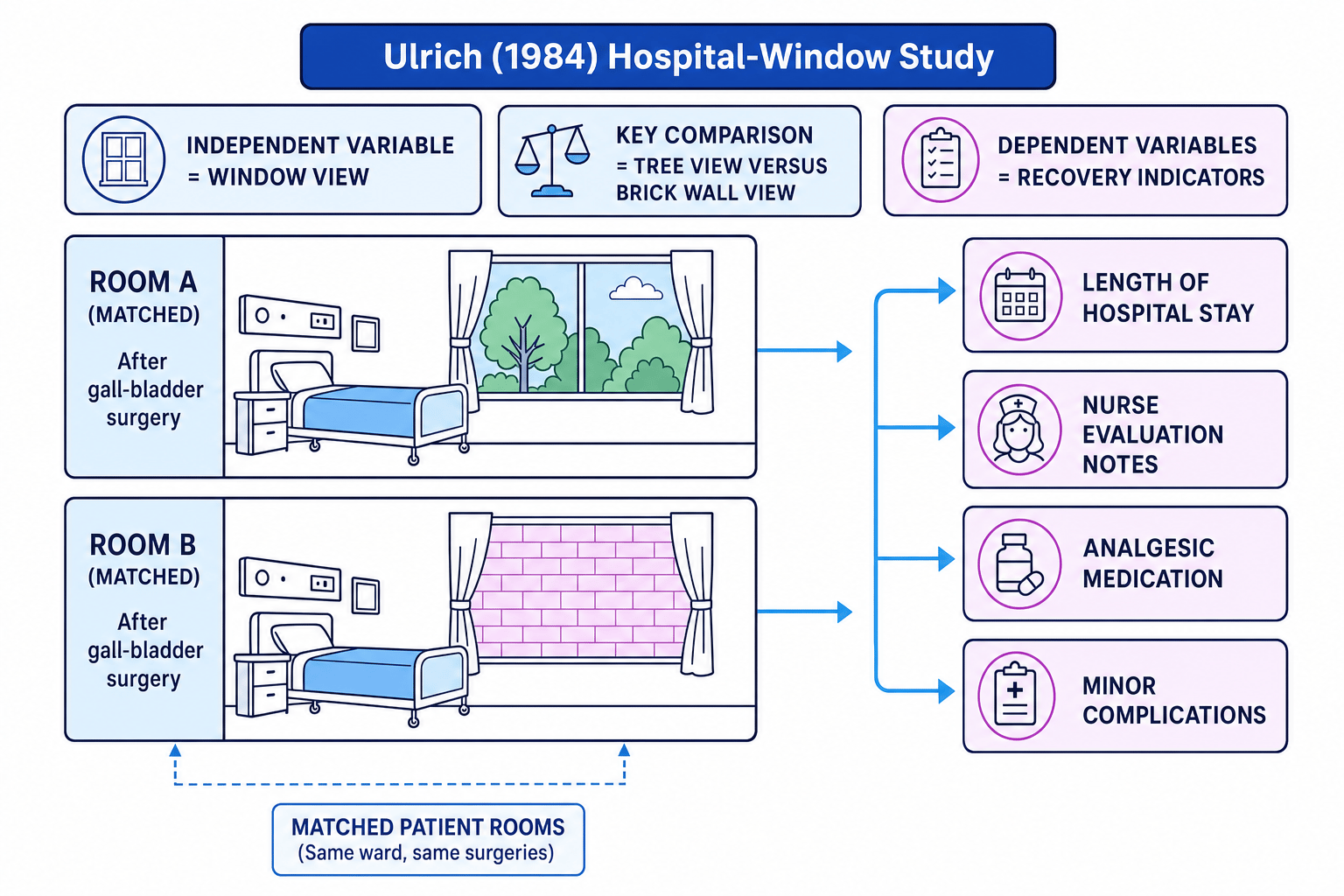
The diagram below shows the logic of Ulrich’s comparison: similar surgical patients were compared according to whether their window view was of trees or a brick wall.
Aim
Ulrich aimed to test whether patients recovering from gall-bladder surgery would recover differently depending on whether their hospital room window looked out onto trees or a brick wall.
Method
This was a quasi-experiment. A quasi-experiment is a study where the independent variable is naturally occurring rather than randomly allocated by the researcher.
The independent variable was the type of window view: trees or brick wall. The dependent variables were indicators of recovery, including length of hospital stay, nurses’ notes, pain medication and minor complications.
Ulrich used hospital records from patients in a Pennsylvania hospital. The sample included 46 patients recovering from the same type of surgery. Patients were matched as closely as possible on important factors such as sex, age, smoking status and weight.
This was a matched-pairs design, meaning participants in one condition were paired with similar participants in the other condition to reduce participant differences.
Materials and measures
Ulrich used existing medical records. Recovery was operationalised, meaning turned into measurable indicators, through:
- number of days spent in hospital after surgery
- nurses’ positive or negative evaluation notes
- number and strength of analgesics, which are pain-relieving medicines
- minor post-surgical complications
Results
Patients with a tree view tended to recover better than patients with a brick-wall view. They had:
- a slightly shorter hospital stay
- fewer negative comments in nurses’ notes
- less need for strong painkillers
- somewhat fewer minor complications
The overall pattern suggested that a natural view may support recovery.
Conclusion
Ulrich concluded that views of nature may have beneficial effects on health and recovery. A likely explanation is that natural scenes reduce stress and provide a positive distraction from pain, anxiety and the hospital environment.
Use cautious wording
Do not write that “trees cure illness.” A stronger exam answer says that natural views may influence recovery by reducing stress and supporting wellbeing, while other medical and social factors also matter.
Evaluating Ulrich (1984)
Strengths
Ulrich’s study has strong ecological validity, meaning it took place in a real-life setting rather than an artificial laboratory. The patients were actual hospital patients recovering from real surgery, so the findings are useful for hospital design.
The study also used practical, measurable outcomes such as hospital stay and medication use. This makes the research more scientific than simply asking patients whether they liked the view.
The matched-pairs design is another strength because it reduced some participant variables. Matching patients on factors such as age and smoking status makes it less likely that differences in recovery were due only to obvious health differences.
Weaknesses
A key limitation is internal validity, meaning whether the study can confidently show that the independent variable caused the change in the dependent variable. Because patients were not randomly assigned to rooms, there may have been confounding variables, which are uncontrolled factors that also affect the results.
For example, the tree-view rooms may have differed in noise, light, temperature, staff attention or location on the ward. Any of these could have influenced recovery.
The sample was also small and taken from one hospital in the USA. This limits generalisability, meaning the extent to which findings apply to other people, places and times.
Some measures were more objective than others. Length of stay and medication records are fairly concrete, but nurses’ notes may involve judgement and could be affected by staff expectations or recording habits.
Ethics
Using hospital records raises ethical issues around privacy and confidentiality. Under the BPS Code of Human Research Ethics, researchers should respect participants’ dignity, protect confidential data and avoid harm.
Ulrich’s study was low risk because it used existing records and did not deliberately deny treatment. However, if conducted today, researchers would need careful ethical approval, anonymisation of records and strong justification for using patient data.
Application: designing for health and wellbeing
The application part of this topic asks you to use research evidence to improve real environments.
One clear example is evidence-informed hospital design. Hospitals could include:
- patient rooms with views of trees, gardens or sky
- healing gardens that patients, visitors and staff can access
- natural light and reduced noise
- clear signs to reduce confusion
- spaces for both privacy and social support
- nature images where real outdoor views are not possible
This does not mean every building must be surrounded by woodland. The key is to apply the psychological mechanism: reduce stress, increase perceived control and support restoration.
Designing a restorative hospital ward
A hospital wants to improve patient wellbeing on a surgical ward with few windows, high noise levels and anxious patients.
- Select the main psychological problem: the ward may increase stress because patients lack control, experience noise and have little positive distraction.
- Choose design features that target the problem: add access to a courtyard garden, use nature images in windowless areas, reduce night-time noise and create clearer wayfinding signs.
- Link each feature to a predicted outcome: garden access and nature views may support restoration, noise reduction may improve sleep, and better signs may increase perceived control.
- Plan how to evaluate the change: compare patient anxiety ratings, medication use, complaints and length of stay before and after the redesign, while checking that staffing and patient severity have not changed.
Urban renewal can also be applied beyond hospitals. For example, a city might improve wellbeing by creating parks, safe walking routes, community gardens and well-lit public spaces. These changes could increase exercise, reduce fear of crime and strengthen social contact.
But AO3 evaluation is essential: renewal should involve local residents. If changes are imposed from above, they may reduce community identity or displace the people they were meant to help.
AO1, AO2 and AO3 focus
For AO1, describe the background, Ulrich’s study and the application clearly. Include key terms such as built environment, urban renewal, wellbeing, quasi-experiment and matched-pairs design.
For AO2, apply the theory to a new source. If a scenario mentions a noisy hospital, crowded housing or lack of green space, link the feature to stress, restoration, control or social support.
For AO3, evaluate. Useful points include ecological validity, real-world usefulness, sample limitations, possible confounding variables, ethics and whether findings generalise across cultures and settings.
In the exam
- For AO1, tell the story of Ulrich (1984): aim, sample, tree-view versus wall-view comparison, recovery measures, results and conclusion.
- For AO2, connect scenario details to mechanisms such as stress reduction, restoration, perceived control and social support.
- For AO3, balance usefulness and ecological validity against causality problems, sample limits, confounds and ethical issues with patient records.
Check yourself
- How did Ulrich (1984) operationalise recovery from surgery?
- Why does the study have good ecological validity but weaker internal validity?
- How could urban renewal improve wellbeing, and why might it sometimes harm a community?

