What you'll learn
- How environmental stressors can trigger biological stress responses.
- Why chronic noise exposure may be linked to stress and hypertension.
- The main story of Black and Black’s 2007 aircraft-noise study.
- How to apply evidence to strategies for managing environmental stress.
1. Background: what is an environmental stressor?
An environmental stressor is something in the physical environment that places a demand on the body and mind. Examples include aircraft noise, crowding, traffic, poor air quality, extreme heat, and poor housing conditions.
The biological approach is interested in what happens inside the body when the environment repeatedly activates stress systems.
Environmental stressor
An environmental stressor is a physical feature of the surroundings that is experienced as demanding, threatening, unpleasant, or difficult to control, and which can trigger a stress response.
Noise is a particularly important environmental stressor because it can be:
- Unpredictable — you do not know exactly when the next aircraft will pass.
- Uncontrollable — residents usually cannot stop the noise.
- Chronic — exposure may happen repeatedly over months or years.
- Intrusive — it can disrupt sleep, conversation, concentration, and relaxation.
2. The biological stress response
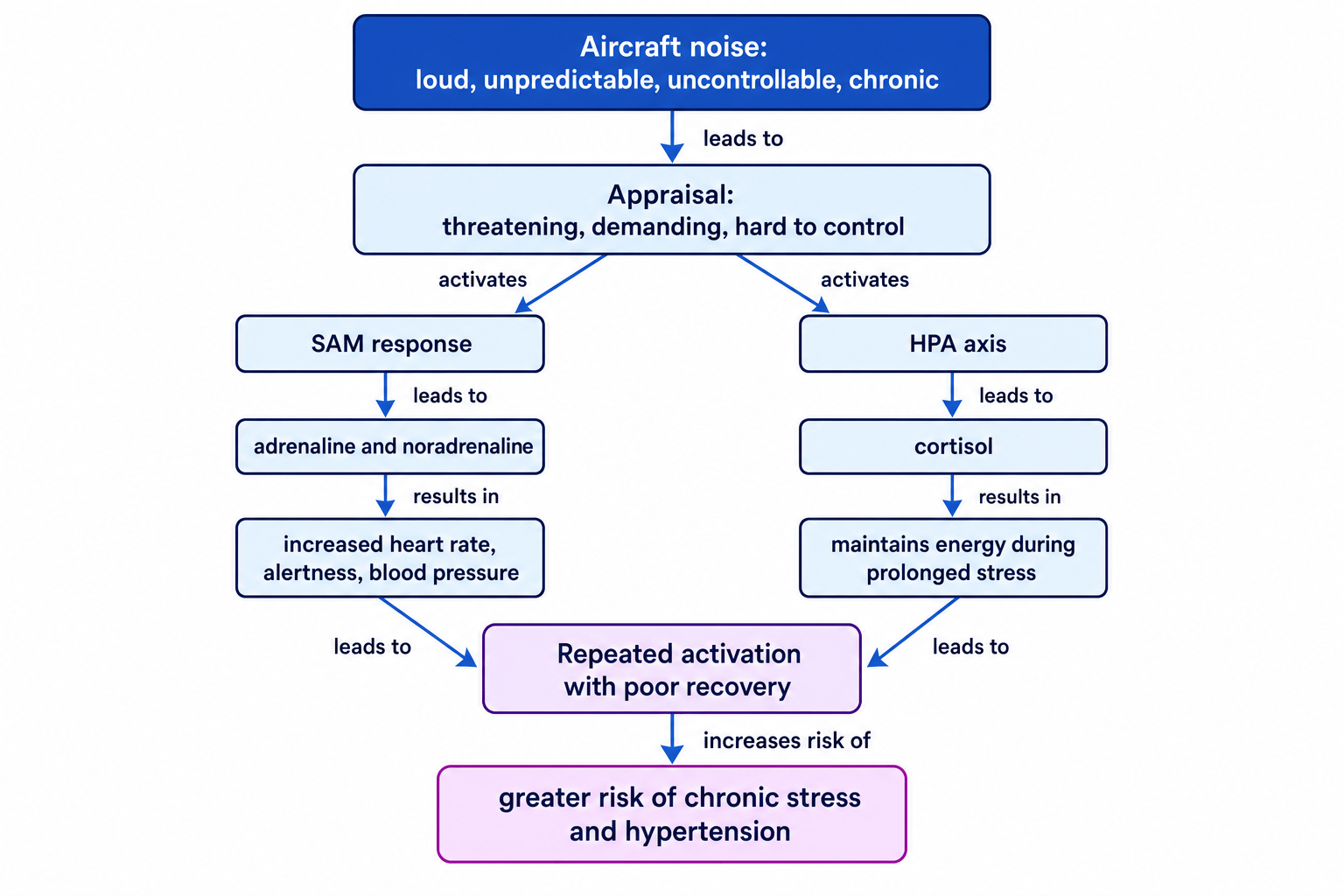
When you experience a stressor, your brain does not just “notice” it. It also appraises it, meaning it evaluates whether the situation is threatening, demanding, or manageable.
If the stressor is appraised as stressful, the body may activate two main systems.
The SAM response
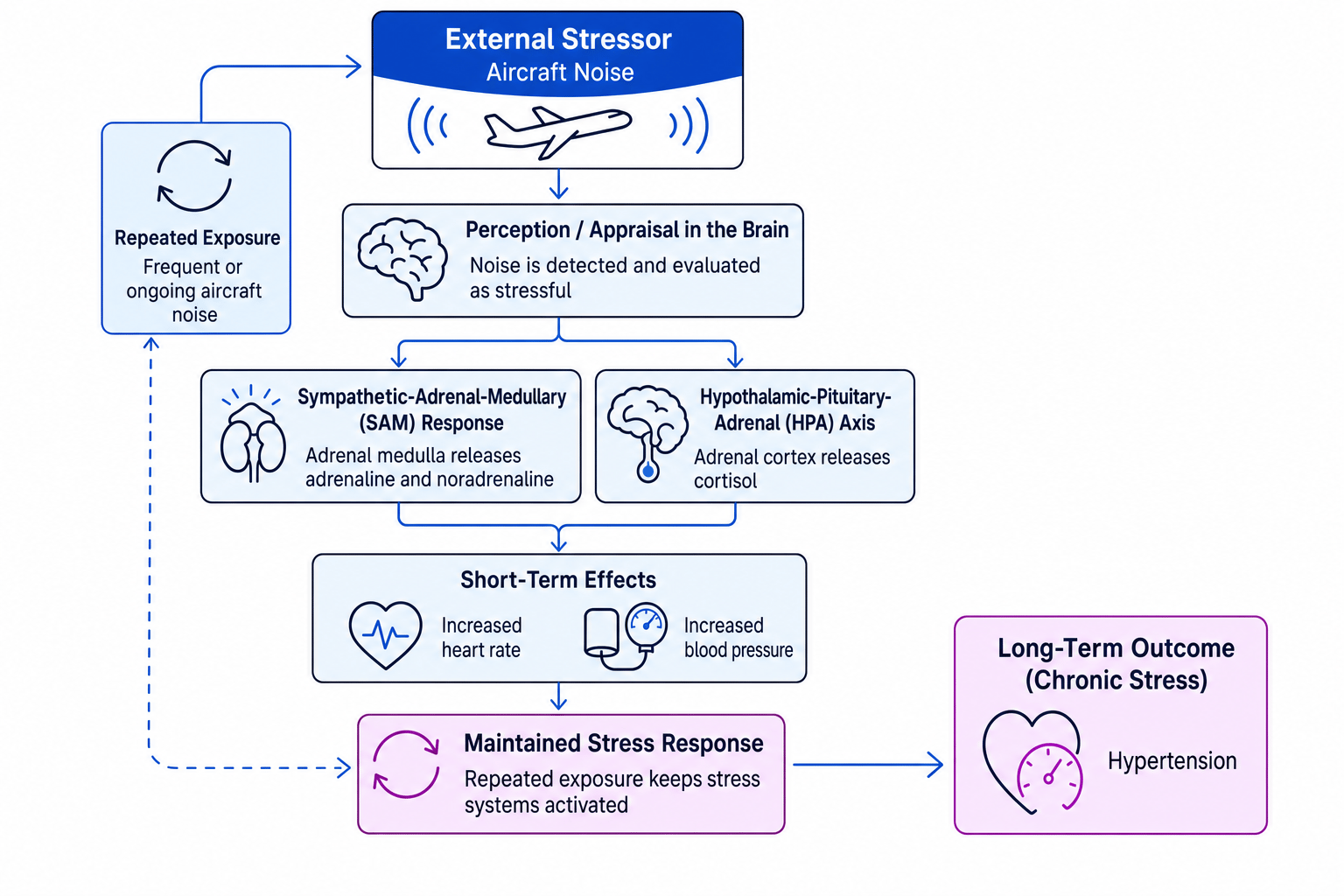
The sympathetic-adrenal-medullary response, often shortened to SAM response, is the body’s fast “fight-or-flight” pathway. It involves the sympathetic nervous system stimulating the adrenal medulla, which releases adrenaline and noradrenaline.
These hormones prepare the body for action by increasing heart rate, alertness, and blood pressure.
The HPA axis
The hypothalamic-pituitary-adrenal axis, usually shortened to HPA axis, is a slower stress pathway. It leads to the release of cortisol, a hormone involved in maintaining energy and responding to longer-lasting demands.
In short bursts, these systems are adaptive. The problem comes when they are activated again and again.
Chronic stress is the issue
Environmental stressors become most biologically harmful when they are repeated and difficult to control. Repeated activation of stress systems can place strain on the cardiovascular system.
Hypertension
Hypertension
Hypertension means persistently high blood pressure. In psychology, it matters because chronic stress may contribute to long-term cardiovascular strain.
Aircraft noise does not directly “cause” hypertension in a simple one-step way. A more realistic explanation is that repeated noise exposure may increase stress arousal, disturb sleep, and reduce recovery time. Over time, this may increase the risk of high blood pressure in some residents.
3. Key research: Black and Black (2007)
Black and Black (2007) investigated the relationship between aircraft noise exposure, residents’ stress, and hypertension. This is the named key research for this topic, so you need to know the basic story and be able to evaluate it.
Aim
The study aimed to examine whether people living with higher levels of aircraft noise were more likely to report stress and hypertension.
This matters because airport expansion and flight-path planning are public health issues, not just transport issues.
Method and design
This was a field study using naturally occurring environmental exposure. It was also largely correlational, because the researchers examined whether aircraft noise exposure was associated with health outcomes.
A correlational design looks for a relationship between variables, but it does not manipulate the independent variable in the same controlled way as a laboratory experiment.
Sample
The participants were residents living in areas affected by aircraft noise, linked to the context of airport noise exposure. The research focused on real residents rather than artificially creating noise exposure in a lab.
This is important because the participants were experiencing the stressor in everyday life.
Materials and measures
The study used measures of aircraft noise exposure and resident health information. Key variables included:
- Level of aircraft noise exposure.
- Self-reported stress.
- Self-reported hypertension or high blood pressure.
- Possible background factors that could also affect health.
Procedure
Residents’ aircraft noise exposure was compared with measures of stress and hypertension. The researchers then looked for patterns: were residents in noisier areas more likely to report stress-related health outcomes?
Results
The main finding was that higher aircraft noise exposure was associated with higher levels of stress and hypertension among residents.
The results suggested a dose-response relationship: as exposure to the environmental stressor increased, negative health outcomes were more likely.
Dose-response relationship
A dose-response relationship is a pattern where greater exposure to a factor is linked with a greater effect. In this topic, the “dose” is aircraft noise exposure and the “response” is stress or hypertension.
Conclusions
Black and Black concluded that aircraft noise can be understood as an environmental stressor with potential biological health effects. The research supports the idea that long-term exposure to noise may contribute to stress and cardiovascular problems.
Black and Black takeaway
The study supports the biological view that chronic aircraft noise is linked to stress and hypertension, especially when exposure is repeated and difficult for residents to control.
4. Applying the study to a scenario
AO2 application usually means taking the research and using it to explain a new situation. For example, you might be given a source about a family living under a new flight path.
Explaining stress in residents near an airport
-
Identify the environmental stressor as aircraft noise, especially if it is frequent, loud, unpredictable, or occurs at night.
-
Link the stressor to biological arousal: repeated noise may activate the SAM response and HPA axis, increasing adrenaline, noradrenaline, cortisol, heart rate, and blood pressure.
-
Explain the long-term risk: if residents do not get enough recovery time, chronic activation may contribute to hypertension or stress-related symptoms.
-
Apply Black and Black: their 2007 research found an association between aircraft noise exposure and residents’ stress and hypertension, so the scenario fits the pattern found in the key study.
5. Evaluating Black and Black (2007)
Strengths
A major strength is ecological validity. The study examined real residents exposed to real aircraft noise, so the findings are highly relevant to everyday life.
The study is also useful. It can inform airport planning, public health policy, insulation schemes, flight curfews, and decisions about where housing should be built.
Another strength is that it focuses on a measurable health outcome: hypertension. This makes the study more biologically grounded than simply asking whether noise is “annoying”.
Weaknesses
The biggest weakness is that the research is correlational. Even if aircraft noise and hypertension are related, this does not prove that noise directly caused the hypertension.
Correlation is not causation
Do not write that Black and Black “proved” aircraft noise causes hypertension. A safer answer is that aircraft noise exposure was associated with stress and hypertension.
There may also be confounding variables, which are other factors that could affect the results. For example, residents near airports may differ in income, housing quality, occupation, smoking, road-traffic exposure, sleep patterns, or access to healthcare.
Self-report is another issue. If residents reported their own stress or blood pressure status, their answers may have been affected by memory, awareness of health problems, or concern about aircraft noise.
Ethics
The study is less ethically problematic than deliberately exposing people to harmful noise, because the researchers did not create the aircraft noise themselves. However, health data are sensitive, so researchers should follow BPS principles such as informed consent, confidentiality, protection from harm, and the right to withdraw where possible.
Debates
This topic links strongly to the situational explanation debate. Stress is not treated simply as a personal weakness; it is partly explained by features of the environment.
It also links to usefulness, because findings can improve policy and health protection. However, it may be socially sensitive if areas near airports are already linked with inequality, lower housing costs, or political conflict over airport expansion.
Easy AO3 structure
For evaluation, use the chain: point → evidence from the study → impact on credibility or usefulness. For example: “Because the study used real residents, it has high ecological validity, making it useful for airport planning.”
6. Application: managing environmental stress
A good way to organise strategies is to ask where the intervention works: the source, the path, or the person.
Source-focused strategies
These try to reduce the stressor itself. For aircraft noise, this could include:
- Quieter aircraft engines.
- Limits on night flights.
- Changing flight paths.
- Runway rotation to spread exposure.
- Airport operating restrictions during sensitive times.
These are powerful because they reduce exposure before the biological stress response is triggered.
Path-focused strategies
These try to block or reduce the stressor before it reaches the person. For noise, this could include:
- Double glazing.
- Sound insulation.
- Noise barriers.
- Better building design.
- Land-use planning so homes, schools, or hospitals are not placed in the noisiest zones.
Person-focused strategies
These help the individual cope with the stressor. Examples include relaxation training, stress-management programmes, sleep-hygiene advice, and giving residents clear information about noise schedules.
Person-focused strategies can help, but they do not remove the environmental cause.
Choosing a noise-management strategy
-
If the goal is to reduce biological arousal for many residents, prioritise a source-focused strategy such as limiting night flights, because this reduces exposure for everyone affected.
-
If aircraft noise cannot be removed, add a path-focused strategy such as insulation, because it reduces the sound reaching residents inside their homes.
-
If some exposure remains, use a person-focused strategy such as relaxation training, because it may reduce perceived stress and help recovery after exposure.
-
Evaluate the strategy by considering effectiveness, cost, fairness, and whether it targets the cause of the stressor or only helps people cope with it.
Blaming the individual
Avoid suggesting that residents should simply “learn to cope”. Environmental psychology often argues that stress is partly produced by the environment, so changing the environment may be more ethical and effective.
7. How to write this as an essay answer
For AO1, describe the biological stress pathway and the key study. Use terms such as environmental stressor, SAM response, HPA axis, cortisol, hypertension, and dose-response relationship.
For AO2, apply the ideas to the source. If the source mentions sleep disruption, lack of control, repeated exposure, or health complaints, link these directly to chronic stress.
For AO3, evaluate the evidence. The strongest points are ecological validity, usefulness, correlation-not-causation, confounding variables, self-report, ethics, and social sensitivity.
In the exam
-
For AO1, tell the story clearly: aircraft noise is the stressor, biological systems are activated, and chronic activation may be linked to hypertension.
-
For AO2, keep returning to the scenario: mention the specific stressor, the people affected, and how the biological response would apply to them.
-
For AO3, avoid absolute claims. Write “linked with” or “associated with” unless the design genuinely proves cause and effect.
Check yourself
- Why might aircraft noise be more stressful when it is unpredictable and uncontrollable?
- What is the difference between the SAM response and the HPA axis?
- Why is Black and Black’s study useful but limited for proving cause and effect?