What you'll learn
- How biological rhythms control patterns such as sleep, alertness and body temperature.
- Why jet lag and shift work can disrupt behaviour and wellbeing.
- The key research: Czeisler et al. (1982) on improving rotating shift schedules.
- How to apply circadian principles to reduce disruption in real-life scenarios.
1. What are biological rhythms?
Biological rhythm
A biological rhythm is a regular, repeating biological pattern, such as the sleep-wake cycle, body temperature changes, hormone release, or stages of sleep.
Your body is not equally ready to do everything at all times. Across a day, you tend to have predictable changes in alertness, sleepiness, digestion, temperature and mood. These patterns are controlled by internal clocks and adjusted by cues from the environment.
The most important rhythm for this topic is the circadian rhythm, which lasts about 24 hours.
The three main rhythm types
| Rhythm type | Cycle length | Example |
|---|---|---|
| Circadian | About 24 hours | Sleep-wake cycle; body temperature |
| Ultradian | Less than 24 hours | REM/NREM sleep cycle, roughly every 90 minutes |
| Infradian | More than 24 hours | Menstrual cycle; seasonal patterns |
Classifying a biological rhythm
- A researcher measures a pattern that repeats several times during one night of sleep.
- Because the cycle is shorter than 24 hours, it cannot be circadian or infradian.
- The rhythm is ultradian, because it occurs more than once within a day.
2. The body clock: pacemakers and zeitgebers
Endogenous pacemaker and exogenous zeitgeber
An endogenous pacemaker is an internal biological clock that controls rhythms. An exogenous zeitgeber is an external cue, such as light, that helps synchronise the body clock with the outside world.
The key endogenous pacemaker is the suprachiasmatic nucleus, often shortened to SCN. This is a small area in the hypothalamus, a brain region involved in regulating basic bodily functions.
Light enters the eye and sends information to the SCN. The SCN then influences the pineal gland, which releases melatonin, a hormone associated with sleepiness. Melatonin is usually released more in darkness and less in bright light.
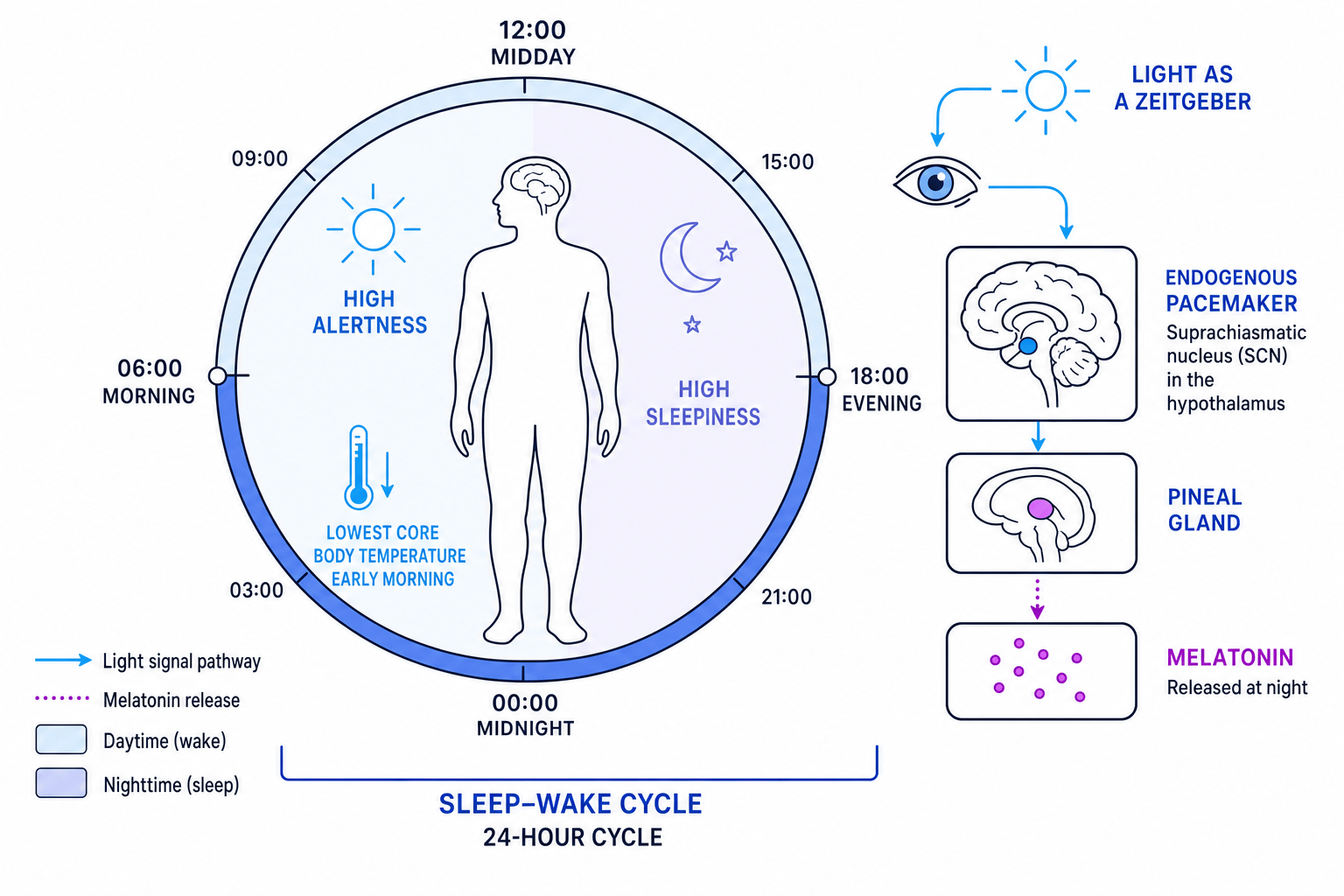
The central idea
Biological rhythms come from an interaction between internal clocks and external cues. Disruption happens when these stop matching each other.
Entrainment, phase advance and phase delay
Entrainment means resetting or synchronising a biological rhythm to environmental cues. For example, morning light helps keep your sleep-wake cycle aligned with daytime and night-time.
A phase shift is a movement in the timing of a rhythm.
- A phase advance means shifting the body clock earlier, such as needing to sleep earlier and wake earlier.
- A phase delay means shifting the body clock later, such as needing to sleep later and wake later.
Humans usually find phase delays easier than phase advances because the natural human circadian cycle tends to run slightly longer than 24 hours if external cues are removed.
Working out the direction of a phase shift
- A worker changes from a day shift to an evening shift, so they need to stay awake and active later than usual.
- Staying awake later means the sleep-wake rhythm is being shifted later.
- This is a phase delay, which is usually easier for the body clock than a phase advance.
Thinking rhythms are only about sleep
Sleep is the easiest rhythm to notice, but circadian disruption can also affect attention, reaction time, digestion, mood, hormone release and body temperature.
3. Disruption: jet lag and shift work
Circadian disruption
Circadian disruption happens when the internal body clock is out of sync with external demands, such as local time, work hours or light exposure.
Jet lag
Jet lag occurs after rapid travel across time zones. Your body clock may still be set to “home time” while the environment demands “destination time”.
Common effects include:
- sleep disturbance
- daytime tiredness
- poor concentration
- irritability
- digestive problems
- reduced performance
Eastward travel is often harder than westward travel. Travelling east usually requires a phase advance, meaning you must sleep and wake earlier than your body expects. Travelling west usually requires a phase delay, which tends to be easier.
Shift work
Shift work means working outside typical daytime hours, especially evening, night or rotating shifts. It is common in hospitals, factories, transport, emergency services and hospitality.
Night workers may need to be alert when their body is biologically prepared for sleep. They may also need to sleep during the day when light, noise and social responsibilities make sleep harder.
Why behaviour changes
When rhythms are disrupted, behaviour suffers because the person is trying to perform at a time when their body is not biologically prepared for that activity.
4. Key research: Czeisler et al. (1982)
The key study for this topic is Czeisler et al. (1982): Rotating shift work schedules that disrupt sleep are improved by applying circadian principles.
Aim
Czeisler et al. aimed to see whether applying knowledge of circadian rhythms could improve rotating shift schedules and reduce disruption for real shift workers.
Method
This was a field intervention in a real workplace, often described as a quasi-experiment because workers were not randomly allocated in the highly controlled way you would expect in a laboratory experiment.
The sample involved male industrial shift workers in the USA who were already working rotating shifts. The researchers compared an older rota with a redesigned rota based on circadian principles.
The key change was the direction and speed of rotation. A counterclockwise rota, such as night to evening to day, requires repeated phase advances. A clockwise rota, such as day to evening to night, produces phase delays, which are usually easier.
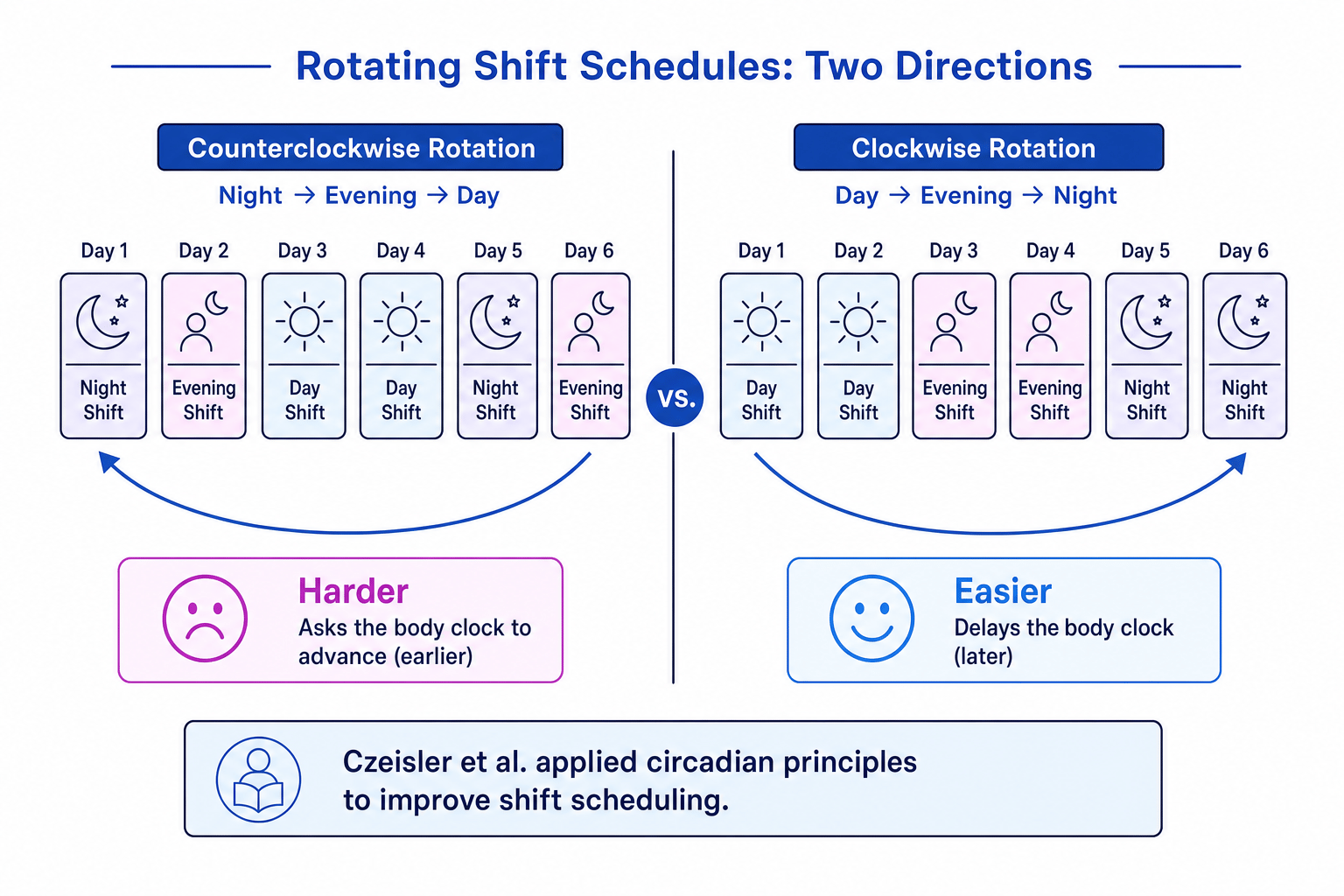
Procedure and measures
Workers’ sleep, adjustment and satisfaction were assessed before and after the rota change. Evidence came from workplace measures and self-report measures, such as reports of sleep, fatigue and preference.
The redesigned schedule applied circadian principles by making rotation more compatible with the body clock. In simple terms: move shifts later rather than earlier, and give the rhythm more time to adjust.
Results
The new schedule was associated with better adjustment. Workers generally reported improved sleep and reduced tiredness compared with the more disruptive rotation. The schedule was also more acceptable to workers.
Conclusions
Czeisler et al. concluded that shift work disruption can be reduced when schedules are designed around circadian biology. This supports the usefulness of biological psychology because it shows how knowledge of internal clocks can solve a real-world problem.
Improving a rotating rota
- A hospital rota changes nurses from night shifts to evening shifts to day shifts. This moves sleep and work times earlier.
- Moving earlier is a phase advance, which is usually difficult for the circadian system.
- A better rota would rotate day to evening to night, because this produces a phase delay.
- The improvement should be explained biologically: it works because the human body clock delays more easily than it advances.
Reversing the rotation rule
Do not just write “rotate shifts” as a strategy. The direction matters: day → evening → night is usually better than night → evening → day.
5. Evaluating Czeisler et al. (AO3)
Strengths
A major strength is ecological validity. The research was carried out with real workers in a real workplace, so the findings are more useful than a purely artificial sleep lab study.
It is also highly useful. The study gives practical guidance for employers, hospitals and transport organisations. Better shift design can reduce tiredness, errors and possible accidents.
The study supports the biological area because it shows behaviour can be affected by physiological processes such as circadian rhythms, melatonin and the SCN.
Weaknesses
A limitation is that the research was not a tightly controlled laboratory experiment. Other workplace changes may have affected sleep or satisfaction, so cause and effect is not perfect.
The sample may also limit generalisability. If the workers were mostly male industrial workers from one workplace and culture, the findings may not apply equally to all occupations, women, older workers or people with different home responsibilities.
Self-report data can be affected by social desirability or demand characteristics. Workers might report liking a new rota because they know management or researchers are interested in it.
Ethics
The BPS Code of Human Research Ethics is relevant because workplace research can involve power imbalances. Workers should give informed consent where possible, have privacy and confidentiality protected, and not be pressured by employers to participate. Researchers also have a responsibility to reduce harm, especially because fatigue can affect health and safety.
6. Application: reducing jet lag and shift-work effects
Strategy 1: timed light exposure
Light is the strongest zeitgeber for the sleep-wake cycle. You can use light to shift the body clock.
For a phase advance, such as adjusting to an earlier schedule, bright light in the morning and reduced light in the evening can help. For a phase delay, bright light later in the day or evening can help.
Strategy 2: better shift scheduling
For shift work, employers can reduce disruption by:
- using clockwise rotation: day to evening to night
- avoiding very quick backward rotations
- allowing rest days after night shifts
- keeping night shift blocks predictable
- reducing bright morning light after a night shift if the worker needs to sleep soon
- encouraging a dark, quiet sleep environment during daytime sleep
Strategy 3: melatonin and sleep routines
Melatonin may help some people sleep at the new local bedtime, especially for jet lag. However, timing matters, and it may not be suitable for everyone. Good sleep routines also matter: consistent sleep times, limiting caffeine before sleep, and reducing noise and light can support entrainment.
Applying it to a scenario
When you are given a source, identify the mismatch first: body clock time versus required behaviour. Then suggest a strategy that directly fixes that mismatch.
Choosing a jet-lag strategy
- A student flies east and must wake up earlier than their body expects. This requires a phase advance.
- A suitable strategy is morning light exposure at the destination, because light can act as a zeitgeber and shift the sleep-wake cycle earlier.
- They should reduce bright evening light because evening light may delay the body clock, making it harder to sleep early.
7. AO1, AO2 and AO3: how to write about this topic
For AO1, describe the biological mechanisms clearly: circadian rhythms, SCN, light as a zeitgeber, melatonin, and phase shifts.
For AO2, apply the ideas to the situation. If a source describes a pilot, nurse, factory worker or traveller, explain exactly how their rhythm is disrupted and which strategy would help.
For AO3, evaluate using evidence and debates. Useful points include ecological validity, usefulness, control, sampling bias, ethics, reductionism and the nature-nurture debate. Biological rhythms are strongly biological, but environmental cues such as light and work schedules also shape behaviour.
In the exam
- Define the rhythm or disruption first, then link it to behaviour such as alertness, sleep, mood or performance.
- For Czeisler et al. (1982), focus on the logic: clockwise rotation creates phase delays, which are easier than phase advances.
- In evaluation, balance usefulness and ecological validity against weaker control, sampling bias and ethical issues in workplace research.
Check yourself
- What is the difference between an endogenous pacemaker and an exogenous zeitgeber?
- Why is day → evening → night usually easier than night → evening → day?
- How could timed light exposure help someone reduce jet lag?
