What you'll learn
- Why imprisonment is used as punishment and as a possible route to reform.
- How prisons can affect behaviour through social roles, power, and deindividuation.
- The key research: Haney, Banks and Zimbardo (1973), the simulated prison study.
- How a strategy such as restorative justice can be used to reduce reoffending.
1. Background: why imprison people?
Imprisonment is one response to criminal behaviour. It removes an offender from ordinary society and places them in a highly structured institution with rules, routines, authority figures, and limited freedom.
Imprisonment
Imprisonment is a custodial sentence where an offender is held in prison and loses freedom of movement, privacy, and many everyday choices.
Imprisonment can be justified in two broad ways: punishment and reform.
Punishment
Punishment means giving an unpleasant consequence after an offence. In criminal justice, punishment may aim to:
- Retribute: make the offender “pay” for the harm caused.
- Deter: discourage the offender, or others, from future crime.
- Incapacitate: protect the public by physically preventing further offending.
Reform
Reform, also called rehabilitation, aims to change the offender so they are less likely to offend again. This might involve education, therapy, drug treatment, skills training, or help with housing and employment.
Punishment versus reform
Punishment focuses on making crime costly; reform focuses on changing the person or their circumstances so law-abiding behaviour becomes more likely.
Classifying aims of a sentence
A judge gives an offender a prison sentence, requires them to attend drug treatment, and sets supervision after release.
- The prison sentence itself removes liberty, so it can be seen as punishment through retribution and incapacitation.
- The drug treatment targets a factor linked to future offending, so it is mainly reform.
- Supervision after release monitors behaviour and can support change, so it combines deterrence with rehabilitation.
2. Social effects of imprisonment
The word social matters here. This topic is not just about individual personality. It asks how behaviour can be shaped by the prison environment, group norms, authority, and role expectations.
Social roles and role adoption
Social role
A social role is a set of behaviours expected from someone in a particular position, such as “prisoner”, “guard”, “teacher”, or “student”.
Role adoption happens when a person begins to behave in ways that fit the role they have been given. In prison, guards may be expected to control and discipline; prisoners may be expected to obey, resist, or identify with inmate culture.
Deindividuation
Deindividuation
Deindividuation is a psychological state where people feel less personally identifiable and less personally responsible for their behaviour.
In prison, uniforms, numbers, routines, and group identities can reduce individuality. This may make people more likely to follow group norms, especially if those norms involve aggression, obedience, or humiliation.
Institutionalisation and prisonisation
Institutionalisation is when a person becomes dependent on institutional routines and finds it difficult to cope independently outside prison.
Prisonisation is when prisoners adopt the norms, values, and behaviours of prison culture. This might include mistrusting authority, using aggression for status, or learning criminal techniques from others.
Do not treat prison as one uniform experience
Not every prisoner becomes institutionalised, and not every prison produces the same effects. Effects depend on the prison regime, staff behaviour, sentence length, support systems, individual differences, and wider social factors.
3. Key research: Haney, Banks and Zimbardo (1973)
Haney, Banks and Zimbardo’s study is often called the Stanford Prison Experiment. Its formal focus was the behaviour of prisoners and guards in a simulated prison.
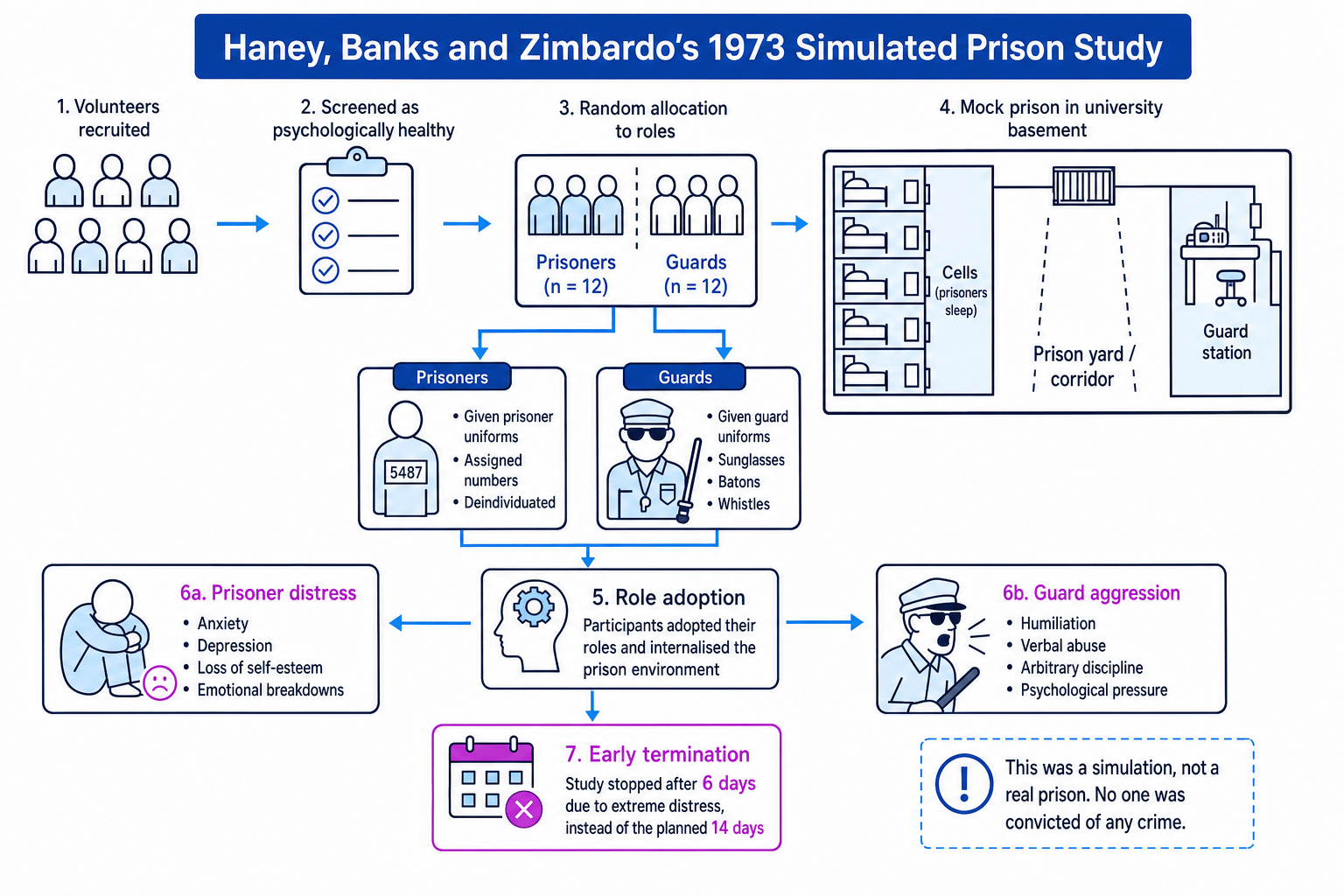
The study is easiest to remember as a sequence: screened volunteers, random allocation, role cues, role adoption, distress and aggression, early termination.
Aim
The researchers wanted to investigate whether prison behaviour is mainly caused by individual personalities or by the situation of being placed into powerful social roles.
This links strongly to the individual/situational debate. If ordinary, psychologically healthy participants behave harshly or submissively because of role pressures, this supports a situational explanation.
Method
The study was a controlled prison simulation in the basement of Stanford University.
The sample was made up of male student volunteers who were screened to remove people with obvious psychological or behavioural problems. Participants were then randomly assigned to be either guards or prisoners.
The mock prison included cells, a corridor or “yard”, and observation equipment. Prisoners wore smocks and identification numbers. Guards wore uniforms, carried whistles and batons, and wore reflective sunglasses. These materials were designed to make the roles feel real and to reduce individual identity.
Procedure
Prisoners were unexpectedly arrested by local police, searched, booked, and taken to the simulated prison. They were given numbers instead of names and had to follow prison routines.
Guards worked shifts and were told to maintain order, although physical violence was not allowed. The study was planned to last two weeks but was stopped after six days because the prisoners showed serious distress and some guards became increasingly abusive.
Results
Many prisoners became anxious, depressed, passive, or emotionally distressed. Some had to be released early.
Many guards became controlling and authoritarian. Some used humiliation, arbitrary rules, sleep disruption, and psychological pressure. Importantly, this behaviour emerged even though participants had been screened and randomly allocated.
Conclusions
Haney et al. concluded that the prison situation can powerfully shape behaviour. Social roles, deindividuation, unequal power, and institutional routines can encourage cruelty in guards and helplessness in prisoners.
AO1 structure for Haney et al.
For a clear description, write the study in this order: aim → sample → setting/materials → procedure → results → conclusion. This stops your answer becoming a vague story about “Zimbardo’s prison”.
Applying Haney to a prison-wing scenario
A new prison wing gives officers mirrored visors, refers to prisoners by numbers, and gives prisoners little control over daily routines.
- The mirrored visors and numbers reduce individuality, so you can apply deindividuation to both staff and prisoners.
- The staff role includes authority and control, so Haney et al. would predict stronger role adoption among officers.
- The prisoners have low autonomy, so the situation may increase passivity, distress, resentment, or resistance.
- A balanced answer should add that these outcomes are not inevitable because staff training, leadership, oversight, and individual differences can reduce harmful role behaviour.
4. Evaluating Haney et al. (AO3)
Strength: control and random allocation
The researchers screened participants and used random allocation. This makes it harder to argue that all the behaviour was caused by pre-existing “bad” personalities. The study therefore gives useful evidence for situational explanations of prison behaviour.
Strength: usefulness
The study is useful because it highlights risks in real prisons: unchecked power, dehumanising routines, poor oversight, and lack of accountability. It supports reforms such as staff training, monitoring, prisoner rights, and more rehabilitative regimes.
Weakness: serious ethical issues
Using the BPS Code of Ethics and Conduct as a benchmark, the study raises concerns about protection from harm, valid consent, and the right to withdraw. Participants experienced distress, and the situation became more intense than they could reasonably have expected.
The right to withdraw was also psychologically unclear. Prisoners acted as if they were trapped in a real institution, even though it was a study.
Weakness: validity and demand characteristics
A major criticism is that participants may have acted according to stereotypes of how prisoners and guards “should” behave. This is called demand characteristics, where participants pick up cues about the expected behaviour and respond accordingly.
Zimbardo also acted as prison superintendent, which may have influenced events. This reduces objectivity and makes the study less valid as a neutral investigation.
Weakness: generalisability
The sample was small, male, student-based, and from the USA. Real prisons include different ages, genders, cultures, offences, sentence lengths, and staff structures. This limits population validity, meaning the findings may not generalise to all prisoners and guards.
Avoid the evil guard shortcut
Do not write that Haney et al. proved guards are naturally cruel. The study suggests that certain social situations can encourage cruelty, but behaviour still varies between individuals and contexts.
5. Application: reducing reoffending
Reoffending
Reoffending, or recidivism, means committing another offence after already being punished or processed by the criminal justice system.
A strategy for reducing reoffending should target factors that make crime more likely. These are sometimes called criminogenic needs, such as antisocial attitudes, substance misuse, poor problem-solving, unemployment, or negative peer groups.
Strategy: restorative justice
Restorative justice
Restorative justice is a structured process where an offender communicates with the victim or community to understand the harm caused and agree how to repair it.
This may involve a face-to-face conference, letters, mediation, apology, compensation, or community repair work. It should be voluntary and carefully risk-assessed.
Restorative justice links to the social approach because it focuses on relationships, responsibility, reintegration, and community norms. Instead of simply labelling the offender as “criminal”, it encourages them to take responsibility and rebuild a pro-social identity.
How it may reduce reoffending
Restorative justice can reduce reoffending by:
- Increasing empathy for the victim.
- Making the consequences of the offence personally meaningful.
- Encouraging responsibility rather than denial.
- Reintegrating the offender into the community.
- Creating a practical agreement to repair harm.
Evaluation of restorative justice
A strength is that it can be useful for both victims and offenders. Victims may feel heard, and offenders may understand the impact of their behaviour more clearly than they would through punishment alone.
However, it is not suitable for every case. Victims must not be pressured into taking part, and offenders need to accept responsibility. There is also a risk of re-traumatising victims if the process is poorly managed.
Choosing a reoffending-reduction strategy
An offender has committed burglary, shows little empathy for the victim, and says “it was just a house, no one got hurt”.
- The key criminogenic need is poor understanding of harm, so a strategy targeting empathy and responsibility is appropriate.
- Restorative justice could involve a carefully facilitated meeting or letter exchange with the victim, if the victim freely agrees.
- The mechanism is that the offender hears the personal impact of the crime, making the harm harder to minimise.
- The limitation is that the strategy should not be used if the offender denies responsibility or if the victim may be harmed by participation.
In the exam
- For AO1, define key terms clearly: imprisonment, punishment, reform, social role, deindividuation, and reoffending.
- For Haney et al. (1973), tell the study as a sequence: screened sample, random roles, prison simulation, role adoption, harmful effects, early stopping.
- For AO3, balance usefulness and control against ethics, demand characteristics, researcher bias, and limited generalisability.
Check yourself
- How can imprisonment act as both punishment and reform?
- What features of Haney et al.’s simulated prison encouraged role adoption?
- Why might restorative justice reduce reoffending, and when might it be unsuitable?
