What you'll learn
- What the Social area of psychology assumes about human behaviour.
- How classic and contemporary research, especially Milgram (1963) and Bocchiaro et al. (2012), illustrates social influence.
- Strengths, weaknesses and applications of the Social area.
- How the Social area is similar to and different from the other OCR areas.
What is the Social area?
The Social area studies how behaviour, thoughts and emotions are affected by other people and by the social situation. This includes the influence of real people, imagined people, groups, authority figures, culture, roles and social norms.
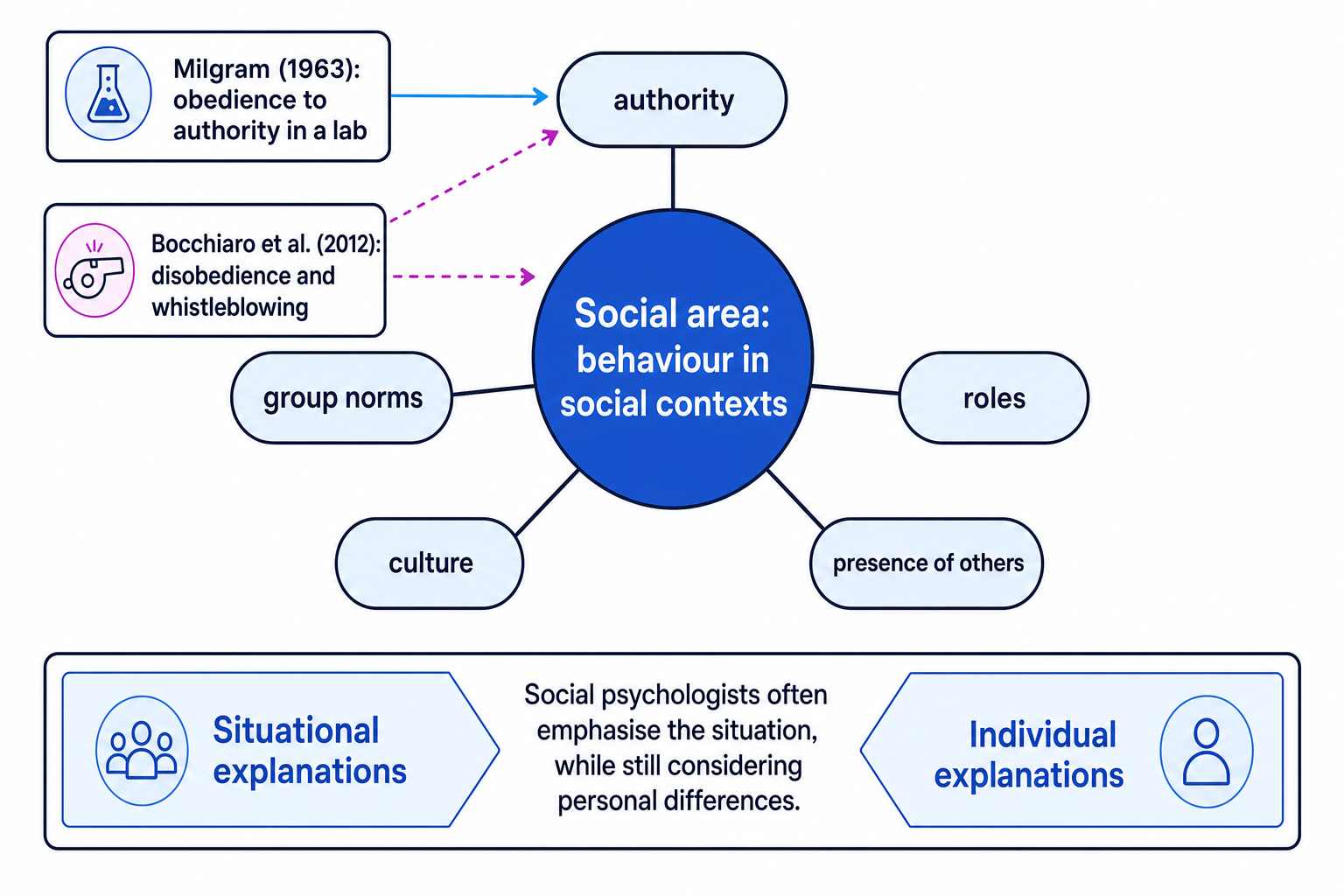
Social area
The Social area is the branch of psychology that investigates how individuals behave in relation to other people, groups, social roles, cultural expectations and social situations.
A key idea is that behaviour is not only caused by what is “inside” a person, such as personality or biology. It can also be shaped powerfully by the situation around them.
The core assumption
Social psychologists often explain behaviour using situational explanations: the idea that behaviour is strongly influenced by the social context rather than just by individual personality.
Key concepts in the Social area
Social influence
Social influence means the effect that other people have on a person’s behaviour, attitudes or beliefs. This influence can be direct, such as an authority figure giving an instruction, or indirect, such as feeling pressure to fit in with a group.
Social influence can lead to several behaviours, including:
- Obedience: following orders from someone perceived to have authority.
- Conformity: changing behaviour or beliefs to fit in with a group.
- Disobedience: refusing to follow an order.
- Whistleblowing: reporting wrongdoing, usually by an organisation or authority.
Obedience
Obedience is a form of social influence where a person follows a direct order from an authority figure.
Whistleblowing
Whistleblowing is when a person reports unethical, illegal or harmful behaviour, often within an organisation or authority system.
Situational explanations
A situational explanation focuses on external factors that affect behaviour. For example, a person may obey because the authority figure appears legitimate, the setting seems official, or the person feels responsibility has been shifted onto someone else.
This contrasts with an individual explanation, which focuses on internal characteristics such as personality, intelligence, attitudes or mental processes.
Situational explanation
A situational explanation explains behaviour in terms of external social factors, such as authority, group pressure, roles, setting or culture.
Applying the Social area to a scenario
A student is told by a senior prefect to exclude another student from a group chat. The student feels uncomfortable but does it anyway.
- Identify the social influence: the senior prefect is acting as an authority figure, so the behaviour can be explained through obedience.
- Apply the situational factor: the student may feel the prefect has legitimate power within the school setting, making the instruction seem harder to challenge.
- Avoid an overly individual explanation: instead of saying “the student is cruel”, a Social-area answer would focus on the pressure created by hierarchy, school roles and fear of disapproval.
- Link to research: this resembles the logic of Milgram (1963), where ordinary participants obeyed an authority figure in a formal setting.
Research illustrating the Social area
For OCR H567, the Social area is strongly illustrated by the theme of responses to people in authority. The two core studies are:
- Milgram (1963) — a classic study of obedience.
- Bocchiaro et al. (2012) — a contemporary study of disobedience and whistleblowing.
You do not need to retell every detail of both studies in an “area” essay, but you should be able to use them accurately as evidence.
Milgram (1963): obedience to authority
Milgram investigated whether ordinary people would obey an authority figure even when this meant apparently harming another person.
Background
Milgram was influenced by events such as the Holocaust and wanted to understand how people could commit harmful acts under orders. The study challenged the idea that destructive obedience is only caused by abnormal or cruel personalities.
Method
Milgram used a laboratory experiment at Yale University. The participants were male volunteers from the New Haven area. They believed they were taking part in a study about memory and learning.
Participants were assigned the role of “teacher”. A confederate, called the “learner”, was strapped into a chair in another room. The participant was instructed by an experimenter in a lab coat to give increasingly severe electric shocks whenever the learner made a mistake. The shocks were fake, but the participant believed they were real.
Results
A striking finding was that 65% of participants continued to the maximum 450 volts. Many showed signs of distress, such as trembling, sweating or nervous laughter, but still obeyed.
Conclusions
Milgram concluded that ordinary people may obey destructive orders when placed in a powerful social situation. Factors such as the prestigious Yale setting, the authority of the experimenter and the gradual increase in shock levels helped produce obedience.
Milgram’s Social-area message
Milgram’s study suggests that social context can make ordinary people behave in ways they may personally find distressing or morally wrong.
Ethics in Milgram
Milgram’s study raises major ethical issues. Participants were deceived about the true purpose of the study and believed they might be harming another person. Some experienced psychological distress. There were also questions about whether the right to withdraw was fully protected, because the experimenter used verbal prompts such as “You have no other choice, you must go on.”
Using the BPS Code of Human Research Ethics, you could evaluate Milgram in terms of respect, responsibility, integrity and scientific value. The study had important value, but protection from harm and valid consent were serious concerns.
Do not just say Milgram was unethical
For AO3, name the specific issue: deception, distress, right to withdraw, informed consent or protection from harm. Then explain why it matters.
Bocchiaro et al. (2012): disobedience and whistleblowing
Bocchiaro et al. investigated whether people would obey, disobey or blow the whistle when asked to support an unethical study.
Background
This contemporary study built on obedience research but focused more directly on moral resistance. Instead of measuring whether people would harm someone, it tested whether participants would refuse an unethical request or report it.
Method
The study was conducted in the Netherlands with university students. Participants were asked to write a statement encouraging other students to take part in a sensory deprivation study. They were told the study could have harmful effects, but they were still encouraged to help recruit people.
Participants could:
- Obey by writing the supportive statement.
- Disobey by refusing.
- Whistleblow by reporting the unethical request to a research ethics committee.
Results
Most participants predicted that they would disobey or whistleblow. However, in the actual situation, obedience was much higher than predicted, and whistleblowing was relatively rare.
Conclusions
Bocchiaro et al. concluded that people are often poor at predicting how they will behave in a social situation. The study supports the Social area because it shows that authority and context can shape behaviour even when people believe they would resist.
Bocchiaro’s Social-area message
People may think they will challenge unethical authority, but the real social situation can make disobedience and whistleblowing harder than expected.
Ethics in Bocchiaro et al.
Bocchiaro et al. also used deception because participants did not know the true purpose of the study. However, the ethical risk was generally lower than in Milgram because participants were not led to believe they had physically harmed someone. The study was reviewed by an ethics committee, and participants were debriefed.
Strengths of the Social area
It explains powerful real-world behaviour
The Social area helps explain important behaviours such as obedience, conformity, prejudice, discrimination, helping, crowd behaviour and whistleblowing. This makes it highly useful.
For example, Milgram’s findings can help explain why people may follow harmful orders in military, workplace or institutional settings. Bocchiaro et al. can help organisations understand why whistleblowing is difficult even when people privately disagree with wrongdoing.
It often uses scientific methods
Social psychologists often use experiments to test cause and effect. Milgram’s laboratory setting allowed him to control variables such as the authority figure, shock generator and standardised verbal prompts. This makes the study easier to replicate and supports reliability.
Reliability
Reliability means consistency. A study is reliable if it can be repeated and produces similar findings.
It has practical applications
The Social area can be applied to:
- improving whistleblowing procedures in organisations;
- training people to resist destructive obedience;
- designing anti-bullying and anti-discrimination campaigns;
- improving teamwork and leadership;
- understanding crowd behaviour and public responses to authority.
Using Social psychology in a workplace
A hospital wants staff to report unsafe practice by senior doctors, but junior staff rarely speak up.
- Identify the social barrier: junior staff may see senior doctors as legitimate authority figures, making disobedience difficult.
- Apply Bocchiaro et al.: people may privately believe they would report wrongdoing, but real authority pressure can reduce whistleblowing.
- Suggest an application: the hospital could create anonymous reporting systems and clear policies stating that whistleblowers are protected.
- Link to usefulness: this shows how Social psychology can reduce harm by changing the situation, not just blaming individuals.
Weaknesses of the Social area
It may underestimate individual differences
A weakness is that social explanations can sometimes underplay personality, moral beliefs or previous experiences. In Milgram, not everyone obeyed to 450 volts. This suggests individual differences still matter.
Individual differences
Individual differences are the ways people vary from each other, such as personality, intelligence, mental health, attitudes or moral reasoning.
It can be reductionist
The Social area can be reductionist if it explains complex behaviour mainly through one social factor, such as authority or group pressure. Real behaviour may involve several influences at once: social context, biology, cognition, culture and personal history.
Reductionism
Reductionism means explaining complex behaviour by breaking it down into simpler parts, sometimes oversimplifying it.
Ethical issues are common
Social psychology often studies sensitive behaviours such as obedience, prejudice or wrongdoing. To create realistic situations, researchers may use deception or create pressure. This can raise ethical issues, especially around informed consent and psychological harm.
Cultural bias can be a problem
Many social studies use samples from Western, educated societies. For example, Milgram used American male volunteers, and Bocchiaro et al. used students in the Netherlands. This can make it difficult to generalise findings to all cultures.
Ethnocentrism
Ethnocentrism is judging or explaining behaviour mainly from the viewpoint of one culture, often assuming that culture is normal or universal.
AO3 balance
A strong evaluation does not say “the Social area is good” or “the Social area is bad”. It weighs up usefulness and scientific control against ethics, cultural bias and possible oversimplification.
Similarities and differences with other areas
Social and Cognitive
The Cognitive area studies internal mental processes such as memory, attention and decision-making. The Social area studies how other people and situations influence behaviour.
They overlap because social behaviour often involves thinking. For example, a person obeying an authority figure may cognitively judge the situation, interpret responsibility and decide whether to continue.
Social and Biological
The Biological area explains behaviour through genes, brain structures, hormones, neurotransmitters and evolution. The Social area focuses more on the environment and social context.
They can work together. A stressful authority situation may create biological arousal, while the social setting shapes how the person behaves.
Social and Developmental
The Developmental area studies how behaviour changes over time, especially across childhood and the lifespan. The Social area can link to development because people learn social norms, roles and expectations as they grow up.
Social and Individual Differences
The Individual Differences area focuses on how people vary from one another. The Social area often looks for patterns in how most people respond to social situations.
The contrast is useful in essays: Social explanations emphasise the situation, while Individual Differences explanations emphasise the person.
Do not treat areas as completely separate
In real life, behaviour usually has multiple causes. OCR essays often reward you for recognising overlaps between areas, as long as your main point stays focused on the question.
The Social area in essay answers
For an area question, think in terms of AO1, AO2 and AO3.
AO1: describe
You need to describe the defining assumptions of the Social area. Use terms such as social influence, authority, obedience, disobedience, whistleblowing, roles and situational explanation.
AO2: apply
You may be asked to apply the Social area to an unfamiliar scenario. Focus on how the person’s behaviour is shaped by authority, group pressure, social norms or setting.
AO3: evaluate
You should evaluate using issues such as:
- usefulness;
- ethics;
- validity;
- reliability;
- sampling bias;
- ethnocentrism;
- reductionism;
- individual versus situational explanations.
Validity
Validity means whether a study measures what it claims to measure, or whether an explanation accurately reflects real behaviour.
In the exam
- Start with the main Social-area assumption: behaviour is influenced by other people and the social situation.
- Use named evidence accurately: Milgram (1963) for obedience and Bocchiaro et al. (2012) for disobedience and whistleblowing.
- For AO3, make a clear judgement: explain how a strength or weakness affects the value of the Social area, rather than simply naming it.
Check yourself
- How would you explain obedience using a situational explanation?
- What does Bocchiaro et al. (2012) show about people’s predictions of their own behaviour?
- Give one strength and one weakness of the Social area.

