What you'll learn
- What the cognitive area is and the principles that define it.
- How cognitive psychologists study hidden mental processes scientifically.
- How OCR core studies such as Loftus & Palmer (1974) and Grant et al. (1998) illustrate the area.
- How to evaluate the cognitive area for AO1, AO2 and AO3 essay answers.
Starting point: what is an “area” in psychology?
An area is a broad way of explaining behaviour. Each area has its own assumptions about what causes behaviour and how psychologists should study it.
For OCR H567, the cognitive area is one of the main areas in Component 02. It is especially useful when explaining memory, perception, attention, thinking, language and decision-making.
Cognitive area
The cognitive area explains behaviour by studying internal mental processes — private processes inside the mind, such as memory, perception and thinking — and how these processes influence observable behaviour.
The big idea: the mind processes information
Cognitive psychologists often see humans as active information processors. This means you do not simply react to the world automatically. Instead, you take in information, interpret it, store it, retrieve it and use it to guide behaviour.
Internal mental processes
Internal mental processes are mental activities that cannot be directly seen, such as remembering, paying attention, recognising, interpreting, problem-solving and making decisions.
Because these processes are hidden, cognitive psychologists use inference. An inference is a reasoned conclusion about something unseen, based on observable evidence.
For example, if a participant recalls more words in one condition than another, the researcher cannot directly see memory working. Instead, they infer something about memory from the participant’s performance.
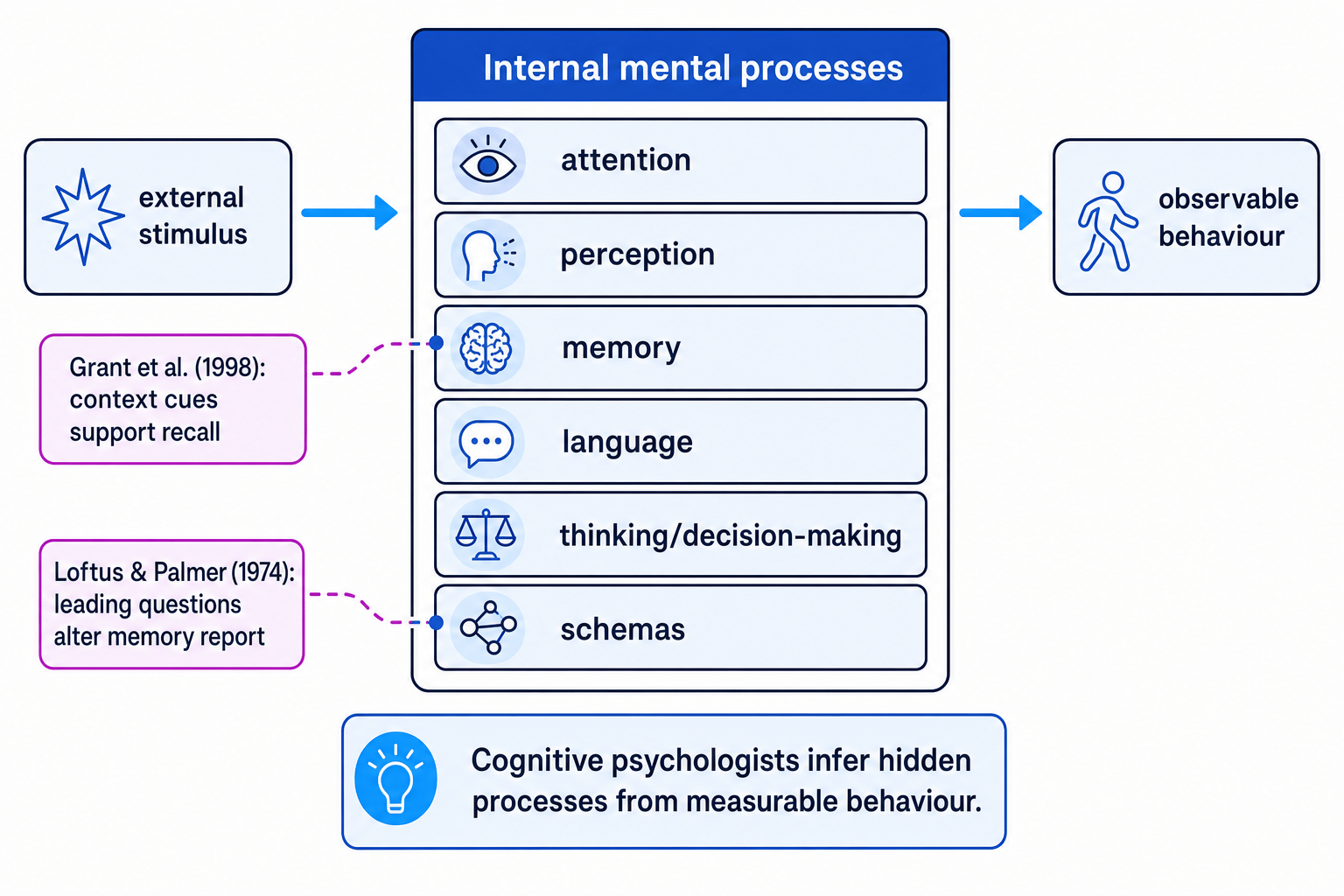
The cognitive logic
Cognitive psychologists measure behaviour carefully, then infer what this suggests about hidden mental processes.
Treating thoughts as directly observed
Do not write as if researchers can directly see a memory, schema or decision process. In cognitive psychology, these are usually inferred from behaviour, such as recall scores, reaction times or answers to questions.
Core concepts in the cognitive area
Information processing
Information processing is the idea that the mind handles information in stages, a little like a system that receives input, processes it and produces output.
For example:
- Input: seeing a car accident.
- Processing: paying attention, interpreting speed, storing details.
- Output: answering a police officer’s question about what happened.
The computer analogy
Cognitive psychologists sometimes compare the mind to a computer: information is input, processed, stored and output. This analogy is useful, but limited, because humans also have emotion, motivation and social influences.
Schemas
A schema is a mental framework built from previous experience. Schemas help you interpret new information quickly.
For instance, you probably have a schema for a “classroom”: desks, teacher, students, board and learning. If you walk into a room with those features, you identify it quickly.
Schema
A schema is a mental framework of expectations based on past experience, used to organise and interpret information.
Schemas can make thinking efficient, but they can also distort memory. If you expect a car crash to involve broken glass, you may later “remember” glass even when there was none.
Reconstructive memory
Reconstructive memory means memory is not an exact recording. Instead, it is rebuilt during recall using stored information, schemas and cues from the situation.
This is a key idea behind Loftus & Palmer (1974).
Reconstructive memory
Reconstructive memory is the idea that recall is an active rebuilding process, influenced by original information, later information and existing schemas.
Explaining an eyewitness error
A witness sees a minor car accident. Later, they are asked, “How fast were the cars going when they smashed into each other?” They estimate a high speed and later report seeing broken glass, although there was none.
-
Identify the observable behaviour: the witness gives a higher speed estimate and reports glass that was not present.
-
Infer the mental process: the word “smashed” may activate a crash schema, so the witness reconstructs the event as more severe.
-
Link to evidence: Loftus & Palmer found that stronger verbs such as “smashed” led to higher speed estimates and more false reports of broken glass.
-
Form the cognitive explanation: the witness’s report is influenced by memory reconstruction, not just by the original event.
Context-dependent memory
Context-dependent memory is the idea that recall can improve when the context at retrieval matches the context at learning.
A context is the surrounding environment, such as noise level, location, smell or background conditions.
Context-dependent memory
Context-dependent memory occurs when remembering is better because the environment at recall matches the environment present when the information was learned.
This is illustrated by Grant et al. (1998), who studied whether background noise affected memory for meaningful material.
Research that illustrates the cognitive area
Loftus & Palmer (1974): leading questions and eyewitness memory
Loftus & Palmer investigated whether the wording of a question could affect eyewitness memory. This is a classic cognitive study because it focuses on memory, schemas and reconstruction.
They used a laboratory experiment, which is a study in a controlled setting where the researcher manipulates an independent variable and measures a dependent variable. The independent variable is what the researcher changes. The dependent variable is what the researcher measures.
In one experiment, participants watched film clips of car accidents. They were then asked how fast the cars were going when they “smashed”, “collided”, “bumped”, “hit” or “contacted” each other.
The stronger the verb, the higher the estimated speed. For example, “smashed” produced a higher mean speed estimate than “contacted”.
In a second experiment, participants who heard “smashed” were more likely to report seeing broken glass a week later, even though there was no broken glass in the film.
Loftus & Palmer’s conclusion
Leading questions can alter eyewitness reports because memory is reconstructive and can be influenced by post-event information.
Ethical issues in Loftus & Palmer
The BPS Code of Human Research Ethics gives guidance on issues such as consent, deception, the right to withdraw, confidentiality and protection from harm.
Loftus & Palmer involved mild deception because participants were not fully aware that the wording of the question was the focus. However, the study was relatively low risk compared with real eyewitness situations, and participants could be debriefed afterwards.
Evaluation of Loftus & Palmer
A strength is that the laboratory setting gave high control. The researchers could standardise the film clips and questions, making the study easier to replicate. Reliability means consistency, so this control supports reliability.
A weakness is lower ecological validity, which means the extent to which findings apply to real-life settings. Watching a film clip is not the same as witnessing a real crash, where emotion, danger and surprise may affect memory.
The sample was also limited, as student participants may not represent all eyewitnesses. This raises sampling bias, where the sample is not fully representative of the wider population.
Grant et al. (1998): context and recall
Grant et al. studied context-dependent memory using meaningful learning material.
Participants read an article in either silent or noisy conditions. Later, they completed memory tests either in the same context or a different context. This created matched conditions, such as silent learning with silent testing, and mismatched conditions, such as silent learning with noisy testing.
The general finding was that recall was better when the learning and testing contexts matched. This supports the cognitive idea that environmental cues can help retrieval.
Applying context-dependent memory to revision
You revise psychology in a quiet library, but your mock exam takes place in a quiet classroom.
-
Compare the learning and recall contexts: both are quiet, so there is a contextual match in background noise.
-
Apply the cognitive principle: similar contexts may provide retrieval cues, helping you access the information learned earlier.
-
Make a careful prediction: your recall may be better than if you revised with loud music and then sat the exam in silence, although other factors such as attention and quality of revision still matter.
Ethical issues in Grant et al.
The ethical risk was low, but researchers still needed informed consent, protection from excessive discomfort due to noise, the right to withdraw and debriefing.
Evaluation of Grant et al.
A strength is that it has useful applications to education. It suggests students should consider how learning and testing conditions may affect recall.
A weakness is that the situation was still artificial. Real revision involves motivation, stress, sleep, repeated practice and individual differences, not just background noise.
Strengths of the cognitive area
It is scientific
The cognitive area often uses controlled experiments, standardised procedures and measurable data. This supports psychology as a science because hypotheses can be tested.
A hypothesis is a testable prediction about what will happen in a study.
It has useful applications
Cognitive research has practical value. Eyewitness research has influenced police interviewing and legal procedures. Memory research can help improve revision strategies, classroom learning and exam preparation.
One application is the cognitive interview, a police interviewing technique designed to improve eyewitness recall by using memory principles, such as reinstating the context and reporting everything.
It explains complex human behaviour
The cognitive area goes beyond simple stimulus-response explanations. It recognises that people interpret situations, use expectations and actively construct meaning.
Weaknesses of the cognitive area
Mental processes are indirect
The main difficulty is that thoughts and memories cannot usually be observed directly. Researchers infer them from behaviour, so explanations may be less certain than they first appear.
It can be reductionist
Reductionism means explaining complex behaviour by breaking it down into smaller parts. Cognitive psychology may reduce rich experiences, such as eyewitness trauma or learning, to memory scores or response times.
This can be useful for control, but it may miss emotion, motivation, culture and social context.
Some studies lack realism
Many cognitive studies use laboratory tasks, such as watching film clips or learning articles under controlled noise conditions. This improves control but may reduce ecological validity.
Saying lab studies are simply bad
A lab study is not automatically weak. The better point is a trade-off: laboratory control can improve reliability and help show cause and effect, but it may reduce ecological validity.
Similarities and differences with other areas
Cognitive and biological
The biological area explains behaviour through the brain, nervous system, hormones, genes and evolution. The cognitive area explains behaviour through mental processes such as memory and attention.
They are similar because both often use scientific methods and controlled research. They can also overlap in cognitive neuroscience, which studies the brain mechanisms behind mental processes.
Cognitive and social
The social area explains behaviour through other people, groups, authority, culture and social situations. The cognitive area focuses more on what happens inside the individual’s mind.
They can work together. For example, an eyewitness’s memory may be affected by social pressure from a police officer as well as cognitive reconstruction.
Cognitive and developmental
The developmental area studies how behaviour changes across the lifespan. Cognitive processes such as memory, language and reasoning can develop with age, so these areas often overlap.
Cognitive and individual differences
The individual differences area focuses on how people vary, for example in personality, disorder or ability. Cognitive studies often look for general processes, but they may underplay individual variation in memory ability, anxiety or attention.
Using the cognitive area in essays
For AO1, which means accurate description, define the area and describe its assumptions clearly.
For AO2, which means application, connect cognitive ideas to a new situation. If a scenario involves memory, attention, decision-making, perception or interpretation, the cognitive area may be relevant.
For AO3, which means evaluation, discuss strengths and weaknesses such as scientific control, usefulness, ecological validity, ethics, sampling bias, reductionism and whether conclusions are based on inference.
Essay sentence starter
A strong AO3 sentence often sounds like: “This supports the cognitive area because…” or “However, this limits the cognitive area because…”
In the exam
-
Start by defining the cognitive area as the study of internal mental processes and behaviour, not just “the study of the brain”.
-
Use named evidence: Loftus & Palmer (1974) for reconstructive memory and Grant et al. (1998) for context-dependent memory.
-
For evaluation, balance control and usefulness against ecological validity, sampling bias, ethics and the problem of inferring hidden processes.
Check yourself
- How is the cognitive area different from the biological area?
- Why does Loftus & Palmer (1974) support the idea of reconstructive memory?
- What is one strength and one weakness of using laboratory experiments in cognitive psychology?
