What you'll learn
- How Hancock et al. (2011) studied the language used by psychopathic and non-psychopathic murderers.
- The full “story” of the study: background, method, results and conclusions.
- How to evaluate the study for validity, reliability, ethics and sampling.
- How to compare Hancock et al. with the paired classic study, Gould (1982), in the theme Measuring differences.
Why this study matters
Hancock et al. (2011) sits in the Individual differences area of psychology. This area studies how people vary from one another in traits, abilities, behaviours and experiences.
The key theme is Measuring differences: psychologists try to measure something internal, such as intelligence or psychopathy, using observable evidence.
Psychopathy
Psychopathy is a personality profile involving traits such as shallow emotion, lack of remorse, lack of empathy, manipulation, impulsivity and antisocial behaviour. It is not the same as “being criminal”, and not all people with psychopathic traits commit violent crimes.
Hancock et al. focused on whether psychopathic offenders use language differently when describing their crimes. The logic is simple but powerful: if emotion and motivation differ between individuals, those differences might appear in their word choices.
The measuring-differences link
Hancock et al. measured an internal individual difference — psychopathy — by combining a standardised checklist with computerised analysis of real speech.
Background: why study language?
Psychologists had already suggested that psychopaths may experience and process emotion differently from non-psychopaths. For example, they may show emotional detachment, reduced guilt and a more instrumental way of thinking about harm to others.
Instrumental behaviour means behaviour used as a means to an end. In crime, an instrumental homicide would be committed to achieve a goal, such as money, status or escape, rather than mainly from sudden emotion.
Language is useful because it can reveal patterns that are hard to notice casually. A person might not directly say “I felt detached”, but their speech may contain more distancing language, fewer emotional references, or more causal explanations.
Aim of the study
Hancock et al. aimed to investigate whether psychopathic murderers used different language patterns from non-psychopathic murderers when describing their homicide offences.
More specifically, they looked for differences in:
- causal words, such as “because” or “since”
- references to basic needs, such as food, money or sex
- references to social needs, such as family or religion
- tense, such as past tense versus present tense
- speech disfluencies, such as “um” or “uh”
Method: how the study was carried out
Design
This was a quasi-experiment using an independent groups design.
Quasi-experiment
A quasi-experiment compares naturally occurring groups. The researcher does not randomly allocate participants to conditions because the key difference already exists, such as being classified as psychopathic or non-psychopathic.
The naturally occurring grouping variable was psychopathy level. The researchers compared language from offenders classified as psychopathic with language from offenders classified as non-psychopathic.
The study also used content analysis, which means systematically coding communication — in this case, spoken narratives — into measurable categories.
Sample
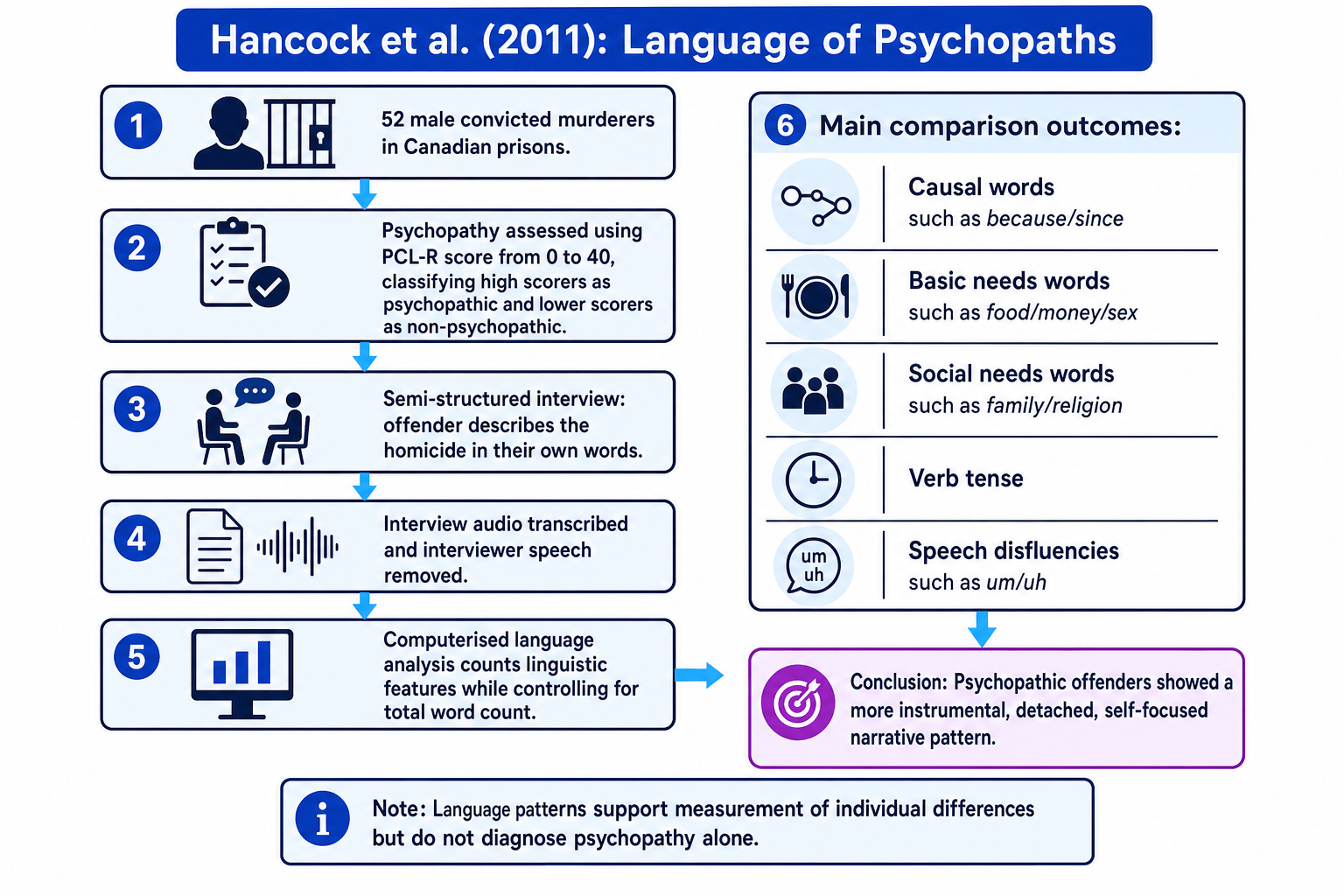
The sample consisted of 52 male convicted murderers from Canadian prisons. They were divided into:
- 14 psychopathic offenders
- 38 non-psychopathic offenders
Psychopathy was assessed using the Psychopathy Checklist-Revised, usually shortened to PCL-R.
PCL-R
The Psychopathy Checklist-Revised (PCL-R) is a standardised assessment tool used by trained raters to score psychopathic traits. It gives a score from 0 to 40 based on interview evidence and file information.
Materials and apparatus
The main materials were:
- the PCL-R
- semi-structured interview questions about the homicide
- audio-recording equipment
- written transcripts of the interviews
- computerised language-analysis software
A semi-structured interview uses prepared questions but allows follow-up questions, so participants can give detailed answers in their own words.
Procedure
Participants were interviewed about their homicide offence. Their speech was recorded, transcribed and then analysed using computerised language tools.
The researchers focused on the offenders’ own words, not the interviewer’s speech. They counted language features and compared the two groups.
Here is the overall structure of the study:
The language features
Causal words
Psychopathic offenders used more words showing cause and effect, such as “because”, “since” and “so that”.
These are sometimes called subordinating conjunctions, because they connect one idea to another by showing a relationship between clauses.
For example:
- “I did it because I needed the money.”
- “I went there so that I could get what I wanted.”
This suggests a more rational, goal-focused or instrumental narrative style.
Basic needs and social needs
Psychopathic offenders made more references to basic needs, such as food, drink, money and sex.
Non-psychopathic offenders made relatively more references to social needs, such as family, relationships, religion or spirituality.
This supports the idea that psychopathic offenders may frame events more around self-focused, material or physical goals.
Tense and emotional distance
Psychopathic offenders used more past-tense language and less present-tense language.
This matters because past-tense language can create psychological distance. Saying “that happened” may sound more detached than speaking as if the event is still emotionally alive.
Disfluencies
Psychopathic offenders also used more speech disfluencies, such as “um” and “uh”.
A disfluency is a break or hesitation in speech. This could suggest increased cognitive effort, perhaps because the speaker is managing their account carefully. However, this interpretation must be cautious.
Turning language into diagnosis
Do not write that Hancock et al. proved you can diagnose psychopathy from a few words. The study found group-level patterns, not a simple test that identifies every individual psychopath.
Interpreting a speech pattern
Imagine an offender says: “I went there because I needed cash. Um, then it happened. I was thinking about getting food after.”
-
Identify the measurable language categories: “because” is a causal word, “cash” and “food” are basic-needs references, “um” is a disfluency, and “it happened” uses past-tense distancing.
-
Link the categories to Hancock et al.’s findings: these features resemble patterns found more often in the psychopathic group than the non-psychopathic group.
-
Make a cautious conclusion: the speech pattern may suggest instrumental and detached narration, but it cannot diagnose psychopathy without a full assessment such as the PCL-R.
Results
The main findings were that, compared with non-psychopathic murderers, psychopathic murderers:
- used more causal language
- referred more to basic needs
- referred less to social needs
- used more past-tense language
- showed more speech disfluencies
These findings suggest that the psychopathic offenders tended to describe their crimes in a more detached, self-focused and instrumental way.
Conclusions
Hancock et al. concluded that psychopathy is reflected in subtle language patterns. The study supports the view that psychopathic offenders may process serious offences differently, showing less emotional involvement and more focus on personal goals.
The study also shows how psychologists can measure individual differences using objective language data, not just questionnaires or observation.
AO1 memory hook
For Hancock et al., remember: PCL-R → murder interviews → transcripts → computer analysis → causal/basic-needs/detached language.
Evaluation: strengths and weaknesses
Reliability
A major strength is that the study used the PCL-R, a standardised tool, and computerised language analysis. This improves reliability, meaning the consistency of measurement.
Because the transcripts could be re-analysed using the same categories, the method is more replicable than relying only on a researcher’s impression of whether someone “sounds psychopathic”.
However, reliability is not perfect. Transcription decisions, interview quality and PCL-R scoring still involve human judgement.
Validity
The study has strong ecological validity in one sense because it used real convicted murderers discussing real offences. This is much more realistic than asking students to imagine a crime.
However, there are validity issues. Participants were describing past events, so their accounts may have been affected by memory distortion, self-presentation or desire to minimise responsibility.
Also, language may be influenced by education, intelligence, prison culture, anxiety, social class or interview style. So it is not certain that every language difference was caused by psychopathy itself.
Sampling bias
The sample was small and highly specific: 52 male murderers in Canadian prisons.
This limits generalisability. The findings may not apply to:
- female offenders
- non-violent psychopaths
- offenders in other cultures
- people with psychopathic traits who have never been imprisoned
The psychopathic group was especially small, with only 14 participants, so one or two unusual individuals could have affected the group pattern.
Ethics
The study involved prisoners, who can be seen as a vulnerable group because they may feel pressure to cooperate with authority figures. Ethical safeguards would therefore need to include informed consent, confidentiality, the right to withdraw and careful debriefing.
The research is also socially sensitive. Findings about psychopathy and murder could increase stigma if reported carelessly. However, the study may also be useful for forensic assessment and understanding risk.
Balanced ethics point
The study can be justified because it may improve forensic understanding, but researchers must avoid implying that language patterns make someone dangerous or “evil”.
Usefulness
Hancock et al. is useful because it suggests that language analysis could support forensic psychology. It may help researchers understand emotional processing, motive and risk in offenders.
But it should only be one source of evidence. In real life, decisions about sentencing, parole or treatment should not be based on word patterns alone.
Link to the Individual differences area
This study is a clear example of the Individual differences area because it investigates how people differ in personality traits and how those differences affect behaviour and communication.
It also raises a big question for the area: can complex human qualities, such as psychopathy, be measured accurately?
Hancock et al. suggests they can be measured partly, using structured tools and objective analysis. But it also shows that measurement is never neutral: the categories chosen by psychologists shape what they find.
Comparison with Gould (1982)
The paired classic study for this theme is Gould (1982), “A Nation of Morons”. Gould criticised early intelligence testing, especially the use of Army IQ tests in the USA, arguing that they were culturally biased and misused to support racist and eugenic ideas.
| Comparison point | Hancock et al. (2011) | Gould (1982) |
|---|---|---|
| Area | Individual differences | Individual differences |
| Theme | Measuring psychopathy through language and PCL-R scores | Measuring intelligence through IQ testing |
| Type of evidence | Primary empirical study using offender interviews | Historical review and critique of previous testing |
| Main issue | Whether language validly reflects psychopathy | Whether IQ tests validly measured intelligence |
| Ethics/social sensitivity | Risk of stigmatising offenders or psychopaths | Shows how biased testing supported discrimination |
| Usefulness | May help forensic understanding | Warns psychologists about cultural bias in measurement |
Both studies show that measuring differences can be powerful, but also risky. If the measure is valid and used carefully, it can improve understanding. If it is biased or overinterpreted, it can harm groups of people.
Forgetting the paired-study contrast
Do not just say “both measure differences”. Add the key contrast: Hancock et al. used modern computerised analysis to investigate psychopathy, whereas Gould critiqued biased historical intelligence testing.
Essay structure: AO1, AO2 and AO3
AO1: describe
For description, tell the story clearly:
- background: psychopathy may involve emotional detachment
- aim: compare language of psychopathic and non-psychopathic murderers
- sample: 52 male Canadian murderers
- method: PCL-R, semi-structured interviews, transcripts, computerised analysis
- results: causal words, basic needs, past tense, disfluencies
- conclusion: psychopathic offenders showed more detached and instrumental language
AO2: apply
For application, use the study’s logic with a new source. If a scenario gives you a transcript, identify features like causal language, references to needs, tense or hesitation, then link them cautiously to Hancock et al.
AO3: evaluate
For evaluation, build balanced paragraphs around:
- reliability from standardised tools and computerised coding
- validity issues from retrospective self-report and alternative explanations
- sampling bias from male Canadian murderers
- ethics and social sensitivity
- usefulness for forensic psychology, but danger of overclaiming
In the exam
-
Anchor every answer in named details: Hancock et al. (2011), 52 male murderers, PCL-R, interviews, transcripts and computerised language analysis.
-
When evaluating, make the point specific to this study: do not just write “low generalisability”; explain that the sample was male, Canadian and convicted of murder.
-
For comparison questions, use Gould (1982) to discuss the wider issue of whether psychological differences can be measured validly and ethically.
Check yourself
- What language patterns did Hancock et al. find more often in psychopathic offenders?
- Why is the PCL-R important in the method of the study?
- How is Hancock et al. similar to and different from Gould (1982)?
