What you'll learn
- What inattentional blindness means and why it matters in the Attention theme.
- How Simons and Chabris tested attention using the famous basketball “gorilla” video.
- The key results, conclusions, and evaluation points for AO1 and AO3.
- How to compare Simons and Chabris with the paired classic study, Moray (1959).
1. The basic idea: attention is selective
In everyday life, you are surrounded by far more information than you can fully process. Attention is the mental process of selecting some information for deeper processing while filtering out other information.
For example, if you are counting how many times players pass a basketball, your mind prioritises that counting task. This can mean that even obvious visual events are not consciously noticed.
Selective attention
Selective attention is the process of focusing on one stimulus or task while ignoring other competing stimuli.
Inattentional blindness
Inattentional blindness is a failure to notice a clearly visible but unexpected stimulus because attention is focused elsewhere.
This study is sometimes described as research into visual inattention, meaning a lack of conscious awareness for visual information that is present in the scene.
Applying inattentional blindness
- Imagine a driver is concentrating on reading road signs in a busy city centre.
- The driver’s attention is being used by a demanding visual task: searching, reading, and interpreting signs.
- If a cyclist appears unexpectedly from the side, the cyclist may be physically visible but still not consciously noticed.
- This would be an example of inattentional blindness because the failure is due to focused attention, not poor eyesight.
2. Background and aim
Earlier research into attention had already shown that people can miss unattended information. For example, Moray (1959) found that in a dichotic listening task, participants often failed to notice information in the unattended ear.
Simons and Chabris wanted to test whether this effect would also happen in a more dynamic visual situation. Their study was based on the idea that attention has limited capacity: when a task uses more mental effort, there is less spare attention available for unexpected events.
The study aimed to investigate whether people would notice an unexpected event during a visual monitoring task, and whether noticing would be affected by:
- Task difficulty: an easy counting task compared with a harder counting task.
- Similarity: whether the unexpected event was visually similar to the team being attended to.
- Display type: a transparent video compared with an opaque, more realistic video.
- Type of unexpected event: a gorilla or a woman carrying an umbrella.
The main aim
Simons and Chabris wanted to show that even a highly visible, unusual event can be missed when attention is focused on another task.
3. Method: telling the story for AO1
Design
This was a controlled laboratory experiment. A laboratory experiment is a study where the researchers manipulate variables in a controlled setting to see their effect on behaviour.
It used an independent measures design, meaning different participants took part in different conditions. This was important because once someone has seen the gorilla or umbrella woman, they cannot realistically be tested again without expecting something unusual.
The main independent variables, meaning the things the researchers changed, were:
- Whether participants attended to the white-shirted team or the black-shirted team.
- Whether the task was easy or hard.
- Whether the unexpected event was the gorilla or the umbrella woman.
- Whether the video was transparent or opaque.
The main dependent variable, meaning the measured outcome, was whether participants noticed the unexpected event.
Identifying IVs and the DV
- Start with what the researchers deliberately changed: for example, some participants counted white-shirt passes while others counted black-shirt passes.
- That makes the attended team an independent variable because it is a condition of the experiment.
- Now look at what was measured afterwards: whether the participant reported seeing the gorilla or umbrella woman.
- That makes noticing the unexpected event the dependent variable because it is the outcome being tested.
Sample
The original paper reports 228 observers in total, mostly undergraduate students from Harvard University. The key experimental conditions are usually reported as 192 participants, with 12 participants in each condition. Participants generally had normal or corrected-to-normal vision.
This sample is useful for a controlled cognitive study, but it is also a limitation because Harvard students are not representative of everyone.
Materials and apparatus
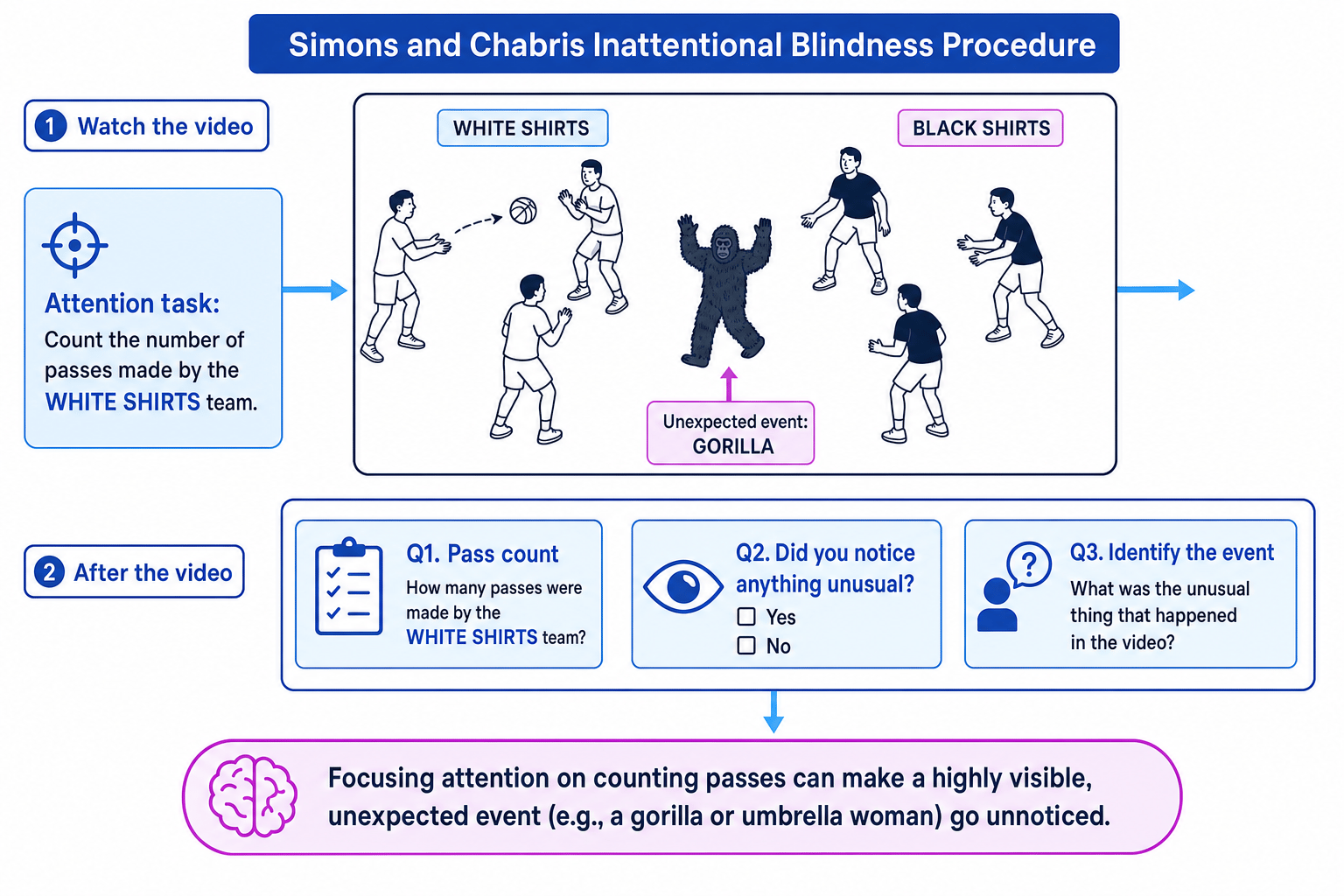
Participants watched a short video of two teams of three players passing basketballs. One team wore white shirts and the other wore black shirts.
There were two types of video display:
- In the transparent condition, people and objects were superimposed, so they appeared partly see-through.
- In the opaque condition, the video looked more like a normal real-world scene, with people blocking each other from view.
The unexpected event was either:
- a person in a gorilla costume, or
- a woman carrying an umbrella.
Procedure
Participants were told to watch the basketball video and count passes made by one team. In the easy condition, they counted the total number of passes. In the hard condition, they had to keep separate counts of bounce passes and aerial passes, increasing cognitive load, meaning the mental demand of the task.
After the video, participants were asked for their pass count and then asked whether they had noticed anything unusual. If they said yes, they were asked to identify what they had seen.
4. Results
The headline finding was striking: many participants failed to notice the unexpected event, even though it was visible on the screen.
Key results:
- Overall, about 54% noticed the unexpected event, meaning about 46% missed it.
- Participants were more likely to notice the event in the opaque condition than in the transparent condition.
- Participants were more likely to notice the event during the easy task than during the hard task.
- The umbrella woman was noticed more often than the gorilla overall.
- The gorilla was more likely to be noticed by participants attending to the black-shirted team than by those attending to the white-shirted team, supporting the role of visual similarity.
- In control conditions where participants were not doing the counting task, the unexpected event was noticed far more reliably, showing that the event itself was visible.
Do not say the gorilla was hidden
The point of the study is not that the gorilla was hard to see. The event was visible; many participants missed it because their attention was occupied by the counting task.
5. Conclusions
Simons and Chabris concluded that people can fail to notice unexpected visual events when their attention is engaged elsewhere. This supports the idea that perception is not simply a recording of everything in front of us.
The study also showed that noticing is affected by the demands of the task. When the task was harder, participants were less likely to notice the unexpected event. Similarity also mattered: events that shared features with what participants were attending to were more likely to be detected.
The take-home conclusion
Attention is selective and limited, so conscious awareness depends not just on what is visible, but on what you are attending to.
6. Evaluation: AO3
Strengths
A major strength is the high level of control. The researchers controlled the video, the instructions, the questions, and the conditions. This improves reliability, meaning the study can be repeated in a consistent way.
The study also has strong internal validity, meaning it is fairly good at showing a cause-and-effect relationship. Because the researchers manipulated task difficulty, attended team, event type, and display type, they could see how these factors affected noticing.
Another strength is usefulness. The findings help explain real-world failures of attention, such as drivers missing pedestrians, radiologists missing unexpected medical abnormalities, or security staff overlooking unusual events while searching for specific targets.
Weaknesses
One weakness is the sample. Harvard undergraduates are a narrow group, so the study has limited population validity, meaning the findings may not generalise equally well to all ages, cultures, or occupations.
The task also has limited ecological validity, meaning it may not fully represent real-life attention. Counting basketball passes in a video is not the same as driving, policing, or navigating a busy street. However, the study is still more realistic than many static attention tasks because it uses a moving scene with multiple people.
There may also be issues with self-report. The researchers measured noticing by asking participants what they had seen. It is possible that some participants had a vague awareness but could not describe it clearly.
Building a balanced validity point
- Identify the controlled feature: all participants watched standardised videos and answered similar questions.
- Link this to internal validity: differences in noticing can be more confidently linked to the manipulated conditions, such as task difficulty.
- Balance it with ecological validity: the video task is artificial, so we should be cautious when generalising directly to complex real-world settings.
- Finish with a judgement: the study is strong for testing causal factors in attention, but weaker for representing every real-life attention failure.
Ethics
Using the BPS Code of Ethics as a benchmark, the study involved mild deception because participants were not told in advance that an unexpected event would appear. This was necessary because warning them would have destroyed the purpose of the study.
The ethical risk was low because watching a basketball video is unlikely to cause harm. However, participants should have been debriefed, given the right to withdraw their data, and treated confidentially.
Deception is not automatically unethical
In psychology, deception can be acceptable if it is justified, causes minimal harm, and is followed by a clear debrief.
7. Link to the Attention theme and Cognitive area
This study fits the Attention theme because it investigates how selective attention affects conscious awareness.
It also fits the Cognitive area because it studies an internal mental process: attention. Since attention cannot be observed directly, Simons and Chabris inferred it from behaviour, especially whether participants noticed and reported the unexpected event.
This supports psychology as a science because the study used controlled conditions, measurable outcomes, and quantitative results.
8. Comparison with Moray (1959)
The paired classic study for this theme is Moray (1959), which investigated auditory attention using dichotic listening. In a dichotic listening task, different messages are played into each ear, and participants usually shadow one message while ignoring the other.
Similarities:
- Both studies investigate selective attention.
- Both show that unattended information is often missed.
- Both use controlled experimental procedures.
- Both infer cognitive processes from observable responses.
Differences:
- Moray studied auditory attention, while Simons and Chabris studied visual attention.
- Moray used spoken messages through headphones, while Simons and Chabris used a dynamic basketball video.
- Moray found that personally meaningful information, such as a participant’s own name, could sometimes break through attention filters.
- Simons and Chabris found that visual similarity, task difficulty, and display type affected whether an unexpected event was noticed.
A strong comparison point is that Simons and Chabris arguably has higher ecological validity because the scene is dynamic and visual, closer to everyday attention than listening to artificial headphone messages. However, Moray’s procedure may have stronger control over exactly what information was presented to each ear.
Essay comparison shortcut
For comparison questions, use one similarity and one difference, then make each one psychological: link it to attention, method, validity, or usefulness.
In the exam
- For AO1, tell the story in order: background, aim, design, sample, materials, procedure, results, conclusions.
- For AO3, avoid generic evaluation. Link every point to this study, such as the Harvard sample, the counting task, or the unexpected gorilla event.
- For comparison with Moray, focus on modality: Moray shows selective attention in hearing, while Simons and Chabris shows it in vision.
Check yourself
- What is the difference between inattentional blindness and simply not being able to see something?
- Name two independent variables in Simons and Chabris’ study.
- Give one similarity and one difference between Simons and Chabris (1999) and Moray (1959).
