What you'll learn
- How Bandura, Ross and Ross studied observational learning using the Bobo doll.
- The full “story” of the study: background, method, results and conclusions.
- How to evaluate Bandura et al. using validity, reliability, ethics and sampling issues.
- How to compare Bandura (1961) with its paired contemporary study, Chaney et al. (2004).
Big picture: why this study matters
Bandura et al. (1961) is a classic core study in the Developmental area of psychology, under the theme External influences on children’s behaviour.
The key question is simple but important:
Can children learn aggressive behaviour just by watching someone else behave aggressively?
This matters because it links to everyday concerns about children copying behaviour from adults, older children, television, games or online content.
Aggression
Aggression means behaviour intended to harm, damage or intimidate. In this study, aggression was measured through behaviours such as hitting, kicking, verbal insults and aggressive play with toys.
Background: from behaviourism to social learning
Before Bandura, many psychologists explained learning through behaviourism.
Behaviourism
Behaviourism is the view that behaviour is learned through direct experiences, especially rewards and punishments. For example, a child may repeat a behaviour if it is rewarded.
Bandura argued that this was not enough. Children do not only learn by being rewarded or punished themselves. They can also learn by watching other people.
Social learning theory
Social learning theory is Bandura’s explanation that behaviour can be learned by observing and imitating others, especially if the person being watched is seen as a model.
A model is a person whose behaviour is observed and potentially copied. In this study, the model was an adult who behaved either aggressively or non-aggressively in front of a child.
The core idea
Bandura et al. showed that children can acquire new aggressive behaviours through observational learning, without being directly rewarded for those behaviours.
Key social learning terms
Observational learning
Observational learning means learning by watching another person’s behaviour.
In Bandura’s study, children watched an adult interact with toys. Some children saw the adult attack a Bobo doll. Later, the children were given the chance to play in a room containing similar toys.
Imitation
Imitation means copying the behaviour of a model.
Bandura was especially interested in whether children would copy the adult’s specific aggressive actions and words, such as hitting the Bobo doll with a mallet or saying phrases like “Sock him!”
Identification
Identification means feeling similar to, or wanting to be like, a model. Bandura predicted that children might be more likely to imitate a same-sex model because that model may seem more relevant to them.
Applying observational learning to a new situation
A child watches an older sibling shout at a games console and throw the controller. Later, the child shouts and throws a toy when frustrated.
- Identify the model: the older sibling is the model because the child observed their behaviour.
- Identify the observed behaviour: shouting and throwing the controller are aggressive or destructive behaviours.
- Check whether there is imitation: the child later copies similar shouting and throwing.
- Link to Bandura: the child did not need to be directly rewarded; the behaviour may have been learned through observation.
Aim of Bandura et al. (1961)
The study aimed to investigate whether children would imitate aggressive behaviour shown by an adult model.
More specifically, Bandura wanted to see whether:
- children exposed to an aggressive model would show more aggression than children exposed to a non-aggressive model or no model;
- children would imitate same-sex models more than opposite-sex models;
- boys would show more aggression than girls, especially physical aggression.
Method: telling the story
Design
This was a laboratory experiment.
Laboratory experiment
A laboratory experiment is a study carried out in a controlled setting where the researcher manipulates an independent variable and measures its effect on a dependent variable.
The main independent variables were:
- type of model: aggressive model, non-aggressive model or no model;
- sex of model: male or female;
- sex of child: boy or girl.
The main dependent variable was the amount and type of aggression shown by the child in the final playroom.
The study used a matched participants design. Before the main study, children were rated for their normal level of aggression, then distributed across conditions so the groups were similar at the start.
Matched participants design
A matched participants design is where different participants are placed in different conditions, but they are matched on important characteristics first, such as age, sex or baseline aggression.
Sample
The sample was 72 children from Stanford University Nursery School:
- 36 boys and 36 girls;
- aged between 37 and 69 months;
- mean age of about 52 months.
This was a fairly narrow sample: young American children from one nursery linked to a university.
Do not call the sample representative
Bandura’s sample was useful for studying young children in a controlled way, but it was not representative of all children. It was small, culturally limited and drawn from one nursery school.
Materials and apparatus
The key materials included:
- a Bobo doll, which is an inflatable doll that springs back when hit;
- a mallet;
- aggressive toys, such as dart guns;
- non-aggressive toys, such as crayons, dolls, tea sets and toy animals;
- a one-way mirror for observation.
Procedure
The procedure had three main stages.
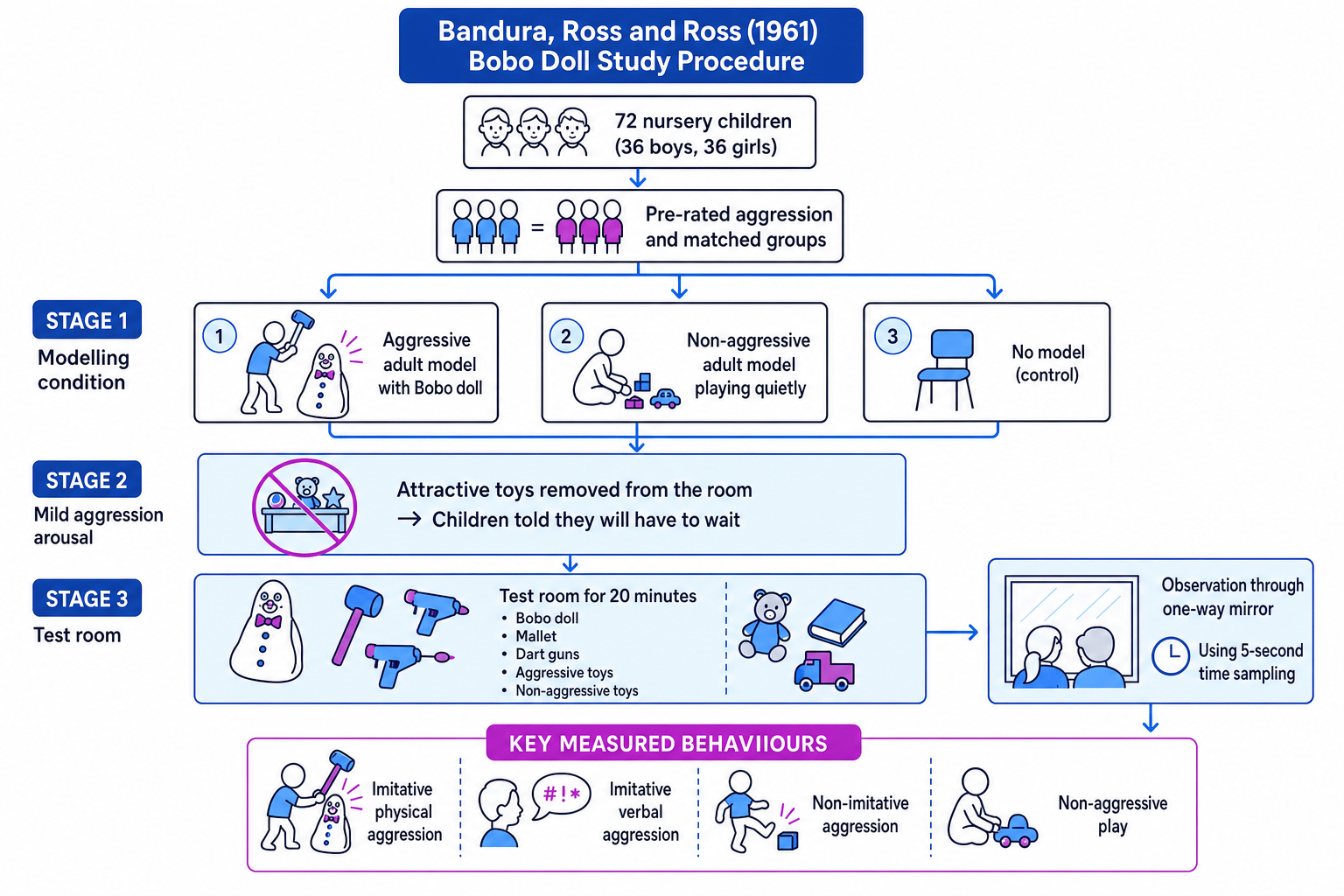
Stage 1: modelling
Each child was taken individually into a room.
In the aggressive model condition, the adult model attacked the Bobo doll physically and verbally. For example, the model hit it with a mallet, punched it, kicked it and used aggressive phrases.
In the non-aggressive model condition, the adult played quietly and ignored the Bobo doll.
In the control condition, there was no model.
Stage 2: mild aggression arousal
Children were then taken to another room with attractive toys. After a short time, they were told these toys were reserved for other children.
This was designed to create mild frustration, so the researchers could see how children behaved when they had some reason to be irritated.
Stage 3: test for imitation
Children were then taken to a final room containing aggressive and non-aggressive toys, including the Bobo doll.
They were observed for 20 minutes through a one-way mirror. Their behaviour was recorded using time sampling.
Time sampling
Time sampling is an observational method where behaviour is recorded at set time intervals. In Bandura et al., behaviour was recorded in 5-second intervals.
The researchers recorded behaviours such as:
- imitative physical aggression;
- imitative verbal aggression;
- non-imitative aggression;
- non-aggressive play.
Results
The main findings were clear.
Children who had watched the aggressive model showed more aggressive behaviour than children in the non-aggressive or control conditions.
They also copied specific behaviours shown by the model, such as hitting the Bobo doll with the mallet and using aggressive phrases.
Boys showed more physical aggression than girls overall. Children were also influenced by the sex of the model, with boys especially likely to imitate a male aggressive model.
Girls did show aggression too, but the pattern was less strongly physical and was affected by the sex of the model and the type of aggression measured.
The main result
The aggressive model did not just increase general excitement. Children copied specific aggressive actions and words, which supports the idea of learning through imitation.
Conclusions
Bandura et al. concluded that children can learn aggressive behaviour through observing adult models.
This supports social learning theory because the children were not directly rewarded for behaving aggressively. Instead, they copied behaviour they had seen.
The study also suggests that children’s behaviour is shaped by external influences, such as adults, family members, peers and potentially media figures.
AO3 evaluation
Strengths
High control
Because this was a laboratory experiment, Bandura could control many variables.
For example, the model’s behaviour was standardised, the toys were controlled, and children were observed for the same amount of time. This makes it easier to argue that the model’s behaviour caused differences in the children’s aggression.
Matched participants
Children were matched for baseline aggression before being allocated to conditions. This reduced the chance that one group was already more aggressive before the experiment began.
Good AO3 phrasing
A strong evaluation point often follows this structure: point → evidence from the study → consequence for validity or reliability.
Reliability
The procedure was standardised and behaviour was recorded systematically. This improves reliability, meaning the study could be repeated in a similar way.
Reliability
Reliability means consistency. A reliable study produces similar results when repeated, or when measured by different observers using the same coding system.
The use of behavioural categories and time sampling helped make the observations more objective than casual impressions.
Weaknesses
Low ecological validity
The study took place in an artificial lab setting. Hitting an inflatable Bobo doll is not the same as hurting a real person.
Ecological validity
Ecological validity refers to how well a study reflects real-life settings and behaviours.
The Bobo doll is designed to be hit and bounce back, so children may have seen the situation as a game rather than real aggression.
Demand characteristics
Children may have guessed what adults expected them to do. After seeing an adult hit the Bobo doll, they may have thought this was acceptable or encouraged in that room.
Demand characteristics
Demand characteristics are cues in a study that lead participants to guess the aim and change their behaviour.
This matters because the children’s behaviour may not fully reflect natural aggression.
Limited population validity
The sample came from one nursery school in the USA. The findings may not generalise to:
- older children;
- children from other cultures;
- children from different social backgrounds;
- children in more natural family or school settings.
Population validity
Population validity refers to how far findings can be generalised from the sample studied to the wider target population.
Ethical issues
By modern standards, there are clear ethical concerns. The children were exposed to aggressive behaviour and then mildly frustrated. This raises issues of protection from harm, especially because they were young children.
Parents likely gave consent, but the children themselves may not have fully understood the study or their right to withdraw.
BPS Code of Ethics
The BPS Code of Ethics guides psychologists to protect participants through principles such as respect, responsibility, competence and integrity. In studies with children, protection from harm and valid consent are especially important.
A balanced answer should also note that the study was relatively short, the children were observed in a nursery context, and serious long-term harm was not demonstrated.
Debates and wider issues
Nature versus nurture
Bandura supports the nurture side because aggression is shown as something children can learn from the environment.
However, this does not prove biology is irrelevant. Boys showed more physical aggression, which could reflect biological factors, social gender expectations, or both.
Individual versus situational explanations
The study supports a situational explanation because children’s behaviour changed depending on what model they saw.
But individual differences still mattered, which is why Bandura matched children on previous aggression.
Psychology as a science
Bandura et al. has scientific strengths: controlled variables, systematic observation and quantitative data.
However, the artificial setting may reduce real-world validity, so you should not evaluate it as “perfectly scientific”.
Social sensitivity
The study is socially sensitive because it links children’s aggression to adult and media models. This can influence debates about parenting, television violence and responsibility for children’s behaviour.
Comparison with Chaney et al. (2004)
The paired contemporary study for this theme is Chaney et al. (2004), which investigated the Funhaler, a spacer device designed to improve young children’s use of asthma medication.
Similarities
Both studies are in the Developmental area and show that children’s behaviour can be shaped by external influences.
Bandura focused on imitation of role models, while Chaney focused on positive reinforcement: the Funhaler made correct inhaler use more enjoyable through built-in toys and feedback.
Both studies are useful because they help adults understand how to influence children’s behaviour.
Differences
Bandura was a highly controlled laboratory experiment, while Chaney was more applied and closer to a real-world health setting.
Bandura measured aggressive play directly through observation. Chaney relied more on parent reports about children’s medication use, which may be affected by social desirability or memory.
Ethically, Chaney is less problematic because it aimed to improve children’s health. Bandura is more ethically debatable because it exposed children to aggression.
Comparing Bandura and Chaney
If asked to compare the two studies for the theme of external influences:
- Choose a shared theme: both studies show that children’s behaviour can be changed by the environment.
- Identify the learning mechanism in each study: Bandura shows observational learning, whereas Chaney shows reinforcement through an enjoyable device.
- Add an evaluative contrast: Bandura has stronger control but lower ecological validity; Chaney is more useful in real life but may rely on less objective self-report data.
How to use this study in essays
For AO1, tell the story clearly: aim, sample, design, procedure, results and conclusions.
For AO2, apply social learning theory to a new scenario. For example, if a child copies aggression from a sibling, parent or media character, use terms like model, observation, imitation and identification.
For AO3, evaluate using:
- validity: laboratory setting and Bobo doll artificiality;
- reliability: standardised procedure and time sampling;
- ethics: exposure to aggression and frustration;
- sampling bias: young children from one Stanford nursery;
- usefulness: understanding media influence and aggressive role models.
In the exam
- For description questions, write the study like a story: background → method → results → conclusions.
- For evaluation, always link your point to a consequence, such as “this lowers ecological validity” or “this improves reliability”.
- For comparison with Chaney et al. (2004), focus on the shared theme of external influences, then contrast observational learning with reinforcement.
Check yourself
- Why does Bandura et al. support social learning theory rather than simple behaviourism?
- What are two reasons the Bobo doll procedure may lack ecological validity?
- How is Bandura et al. similar to and different from Chaney et al. (2004)?
