What you'll learn
- How Moray used dichotic listening and shadowing to study selective auditory attention.
- The “story” of the study: background, method, results, conclusions.
- How to evaluate Moray using validity, reliability, ethics, sampling and usefulness.
- How Moray compares with the paired contemporary attention study: Simons and Chabris (1999).
Big picture: attention in the Cognitive area
Moray (1959) is a classic core study in the Cognitive area of psychology. Cognitive psychologists study internal mental processes, such as attention, memory, perception and thinking. Because these processes cannot be seen directly, researchers infer them from behaviour — for example, what a participant reports hearing.
Selective attention
Selective attention is the process of focusing on one source of information while ignoring other competing information.
Moray was interested in auditory attention, meaning attention to sounds, especially speech. His study asks a very everyday question: when you focus on one conversation, how much of the “ignored” conversation still gets processed?
Background: the cocktail party problem
Imagine you are at a busy party. You are listening to your friend, but there are other conversations around you. Usually, you ignore most of them — until someone says your name. This is called the cocktail party effect.
Moray built on earlier research by Cherry (1953), who found that people could shadow one spoken message while ignoring another, but they remembered very little about the ignored message beyond basic physical features such as whether the voice changed.
Dichotic listening and shadowing
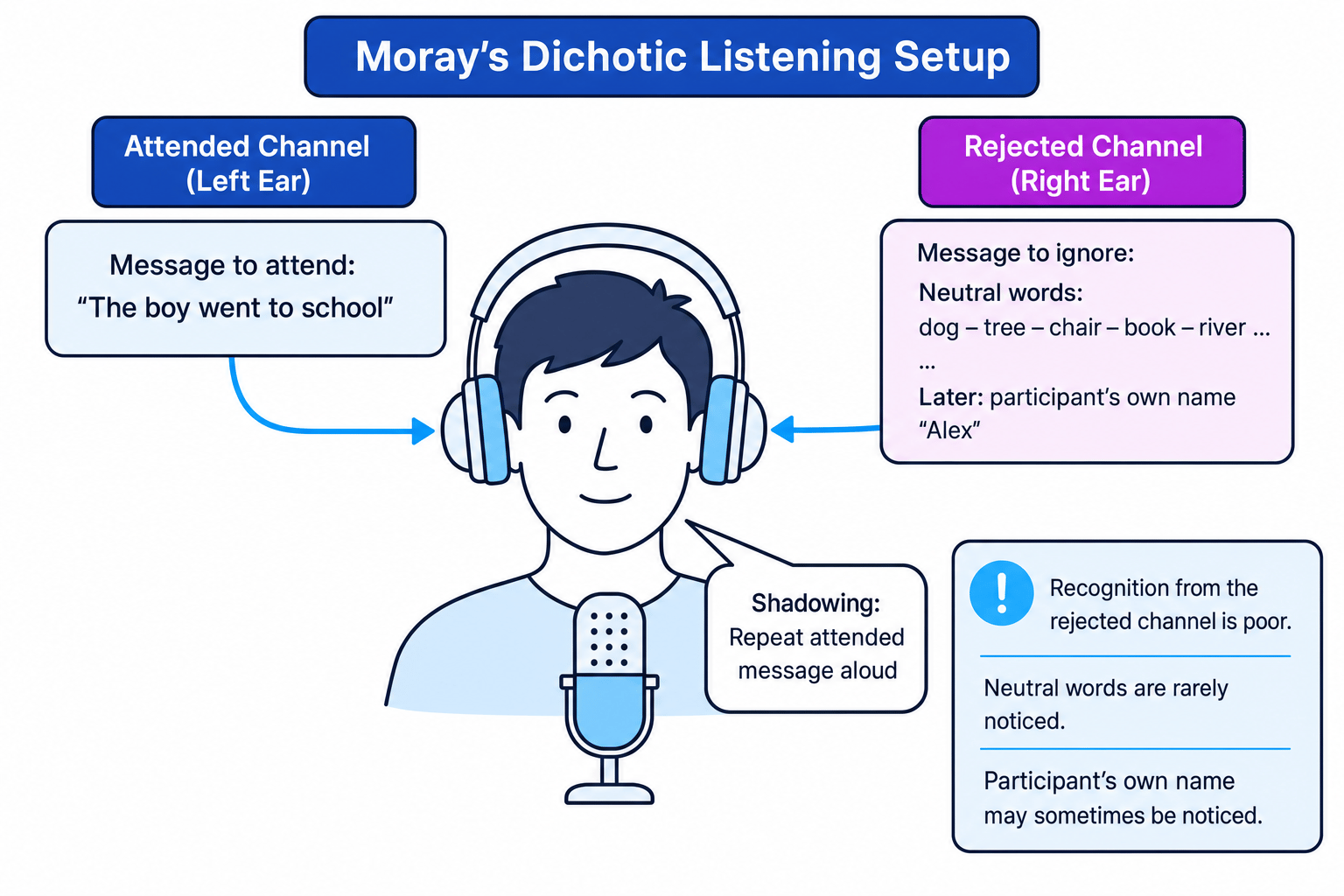
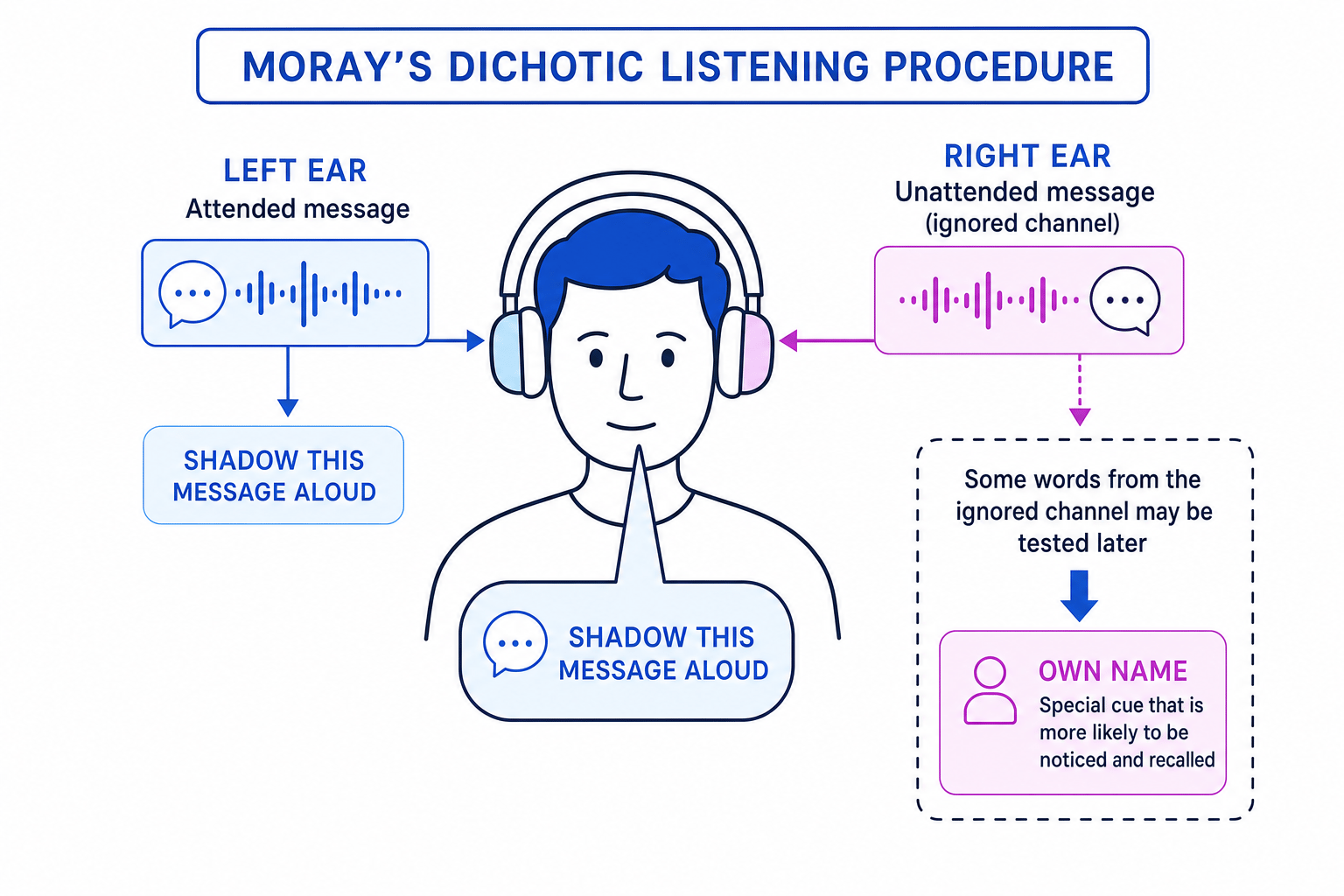
Dichotic listening is a procedure where different sounds are played into each ear at the same time. Shadowing means repeating one message aloud as you hear it, which forces you to keep attention on that message.
Aim of Moray’s study
Moray wanted to investigate what happens to information in the rejected message, meaning the message the participant is told to ignore.
More specifically, he asked:
- Can people recognise neutral information from the rejected message?
- Can personally important information, such as the participant’s own name, break through?
- Do instructions help people notice information in the rejected message?
The core issue
Moray tested whether attention works like a strict filter that blocks ignored speech completely, or whether some meaningful information can still get through.
Method: how the study was done
Design
Moray carried out a series of laboratory experiments. A laboratory experiment is a controlled study where the researcher manipulates an independent variable, the factor being changed, and measures a dependent variable, the outcome.
Much of the procedure used a repeated measures logic, meaning the same participants experienced more than one condition. This helps reduce participant differences, such as some people simply having better hearing or memory than others.
Sample
Moray used small opportunity samples of adults, mainly students and research workers. Participants were expected to have normal hearing and to be able to follow spoken English.
This matters for evaluation because the sample was not large or representative of the wider population.
Materials and apparatus
Moray used:
- headphones for dichotic listening;
- recorded spoken messages;
- prose passages and word lists;
- digits in some conditions;
- the participant’s own name as an affective cue.
Affective cue
An affective cue is information that has personal or emotional significance for the participant, such as their own name.
Procedure: the three linked experiments
Experiment 1: neutral material in the rejected message
Participants shadowed one message while a neutral message was played to the other ear. A short list of simple words was repeated many times — commonly described as 35 repetitions — in the rejected ear.
Afterwards, participants were tested to see whether they could recognise material from the rejected message.
Experiment 2: the participant’s own name
Participants again shadowed an attended message while ignoring the other ear. In the rejected message, Moray inserted affective material, especially the participant’s own name.
The key question was whether this personally meaningful cue would be noticed even though it was in the ignored channel.
Experiment 3: instructions and digits
Participants shadowed one message while digits were presented in the messages. Moray investigated whether giving instructions to listen out for digits would help participants report digits from the rejected message.
This tested whether people could simply “try harder” to monitor the unattended ear.
Results
Experiment 1 results
Participants showed little or no recognition of the neutral material from the rejected message. Even repeated exposure did not make the ignored words easy to recognise.
This supports the idea that unattended speech receives very limited processing.
Experiment 2 results
A key finding was that 4 out of 12 participants noticed their own name in the rejected message.
This is important because it shows the rejected message was not completely blocked. Some personally significant information could break through.
Interpreting the own-name result
-
Convert the result into a proportion: 4 participants noticed their own name out of 12 participants in total.
-
Calculate the percentage: 412×100≈33.3%\frac{4}{12} \times 100 \approx 33.3\%124×100≈33.3%.
-
Interpret the result carefully: Moray did not show that everyone hears their own name, but he did show that personally meaningful information is more likely to break through than neutral material.
Experiment 3 results
Digits were reported much more accurately from the attended message than from the rejected message. Instructions to attend to digits did not greatly improve processing of the rejected channel.
This suggests attention has a limited capacity. You cannot fully process both auditory streams just because you have been told to.
Conclusions
Moray concluded that most unattended auditory information is not processed for meaning. However, the attentional filter is not absolute: highly meaningful information, especially your own name, may be detected.
This finding challenges a very strict version of Broadbent’s filter model, which suggested unattended information is filtered out early based mainly on physical features. Moray’s results fit better with the idea that unattended information may be weakened rather than completely blocked — an idea later developed in attenuation theories of attention.
Do not overstate the own-name effect
Avoid writing “participants always noticed their own name.” In Moray’s study, only some participants noticed it, so the safer conclusion is that personally meaningful cues can sometimes break through selective attention.
Applying Moray to a new situation
Imagine you are revising in a café while your friend talks to you. A stranger at the next table repeats a random word several times, but later says your name.
Applying Moray to a noisy café
-
Identify the attended channel: you are mainly focusing on your friend’s speech, so that is the message being attended to.
-
Identify the rejected channel: the stranger’s conversation is unattended, like Moray’s rejected message.
-
Apply Experiment 1: repeated neutral words from the stranger are unlikely to be remembered because neutral unattended material is poorly processed.
-
Apply Experiment 2: your own name is more likely to capture attention because it is personally meaningful, but Moray’s result means this is not guaranteed.
Evaluation: AO3 points
Strength: high control and reliability
Moray’s study had strong control, meaning the researcher could standardise what participants heard and when they heard it. This improves reliability, which means the procedure could be repeated in a similar way to check whether the same pattern of results appears again.
The use of headphones and recorded messages made the study more scientific because the auditory input was carefully controlled.
Strength: useful evidence about selective attention
Moray’s study is useful because it helps explain real-life situations such as hearing your name in a crowd, missing announcements when focused on a task, or designing warning systems that need to capture attention.
It also contributed to theories of attention by showing that ignored information is not always completely blocked.
Weakness: low ecological validity
Ecological validity means how well a study reflects real-life behaviour. Moray’s task was artificial: wearing headphones and shadowing speech aloud is not the same as naturally listening at a party or in a classroom.
However, the basic issue — focusing on one sound while ignoring another — does resemble everyday listening.
Weakness: sample bias
The sample was small and mainly made up of students or research workers. Sample bias means the participants may not represent the wider population.
For example, students may be more used to verbal tasks or laboratory settings. The findings may not generalise fully to children, older adults, people with hearing difficulties, or people from different language backgrounds.
Weakness: validity of the shadowing task
Internal validity means whether the study really measures what it claims to measure. Shadowing does force participants to attend, but it may also create an extra memory and speech-production load. Participants might fail to report rejected information partly because they are busy repeating the attended message aloud.
So, poor recall of the rejected message may reflect both selective attention and the demands of the task.
Ethics
Using modern BPS Code of Ethics principles, Moray’s study is relatively low risk. There was no obvious physical or psychological harm.
However, full informed consent may be limited if participants were not told the exact purpose in advance, especially in the own-name condition. A good modern version would include consent, the right to withdraw, confidentiality, and a debrief explaining why the rejected message was important.
Comparison with Simons and Chabris (1999)
The paired contemporary study for the Attention theme is Simons and Chabris (1999), which investigated inattentional blindness. Inattentional blindness is failing to notice an unexpected visible event because attention is focused elsewhere. Participants watched a basketball video and counted passes; many failed to notice a person in a gorilla costume.
Similarities
Both studies show that attention is selective and limited. Moray showed this in hearing, while Simons and Chabris showed it in vision.
Both used controlled tasks and measured whether participants noticed unattended information. This makes them useful for the Cognitive area because both infer mental processes from observable responses.
Differences
Moray studied auditory attention using dichotic listening and shadowing. Simons and Chabris studied visual attention using a video-based task.
Moray found that personally meaningful information, such as your name, can sometimes break through. Simons and Chabris found that even a very unusual visual event can be missed if attention is focused on a demanding task.
Moray’s task is more artificial because shadowing into headphones is unusual. Simons and Chabris’ basketball video is also controlled, but it may feel more like real visual attention because watching moving scenes is more familiar.
Link to the key theme and area
Attention theme
Moray is important for the theme of Attention because it demonstrates selective attention experimentally. It shows that attention protects us from overload, but it also means we miss a lot of information.
Cognitive area
The study fits the Cognitive area because it investigates internal processing. Moray could not directly observe attention, so he inferred it from behaviours such as shadowing accuracy, recognition, and reports of noticing one’s own name.
Essay memory hook
For Moray, remember the sequence: neutral words ignored, own name sometimes noticed, instructions not enough.
In the exam
-
For AO1, tell the study as a clear story: background, aim, method, results, conclusions.
-
For AO2, apply the logic of attended versus rejected channels to the scenario you are given.
-
For AO3, balance the evaluation: use control and reliability as strengths, then ecological validity, sample bias and ethics as limitations.
Check yourself
- Why does the own-name finding challenge a strict early-filter explanation of attention?
- What is the difference between the attended message and the rejected message?
- How is Moray similar to, and different from, Simons and Chabris (1999)?