What you'll learn
- What reductionism and holism mean in A-Level Psychology.
- How to spot different levels of explanation in studies and scenarios.
- How OCR core studies can illustrate both sides of the debate.
- How to write AO1, AO2 and AO3 points about this debate in essays.
Start point: what is a debate?
A debate in psychology is an ongoing argument about the best way to explain behaviour. Debates do not usually have one “correct” answer. Instead, you need to show that you understand both sides, apply them to research, and evaluate their usefulness.
For reductionism/holism, the key question is:
Should psychologists explain behaviour by breaking it into smaller parts, or by looking at the whole person in context?
Levels of explanation
Psychologists can explain the same behaviour at different levels. A level of explanation is the “scale” at which you explain something.
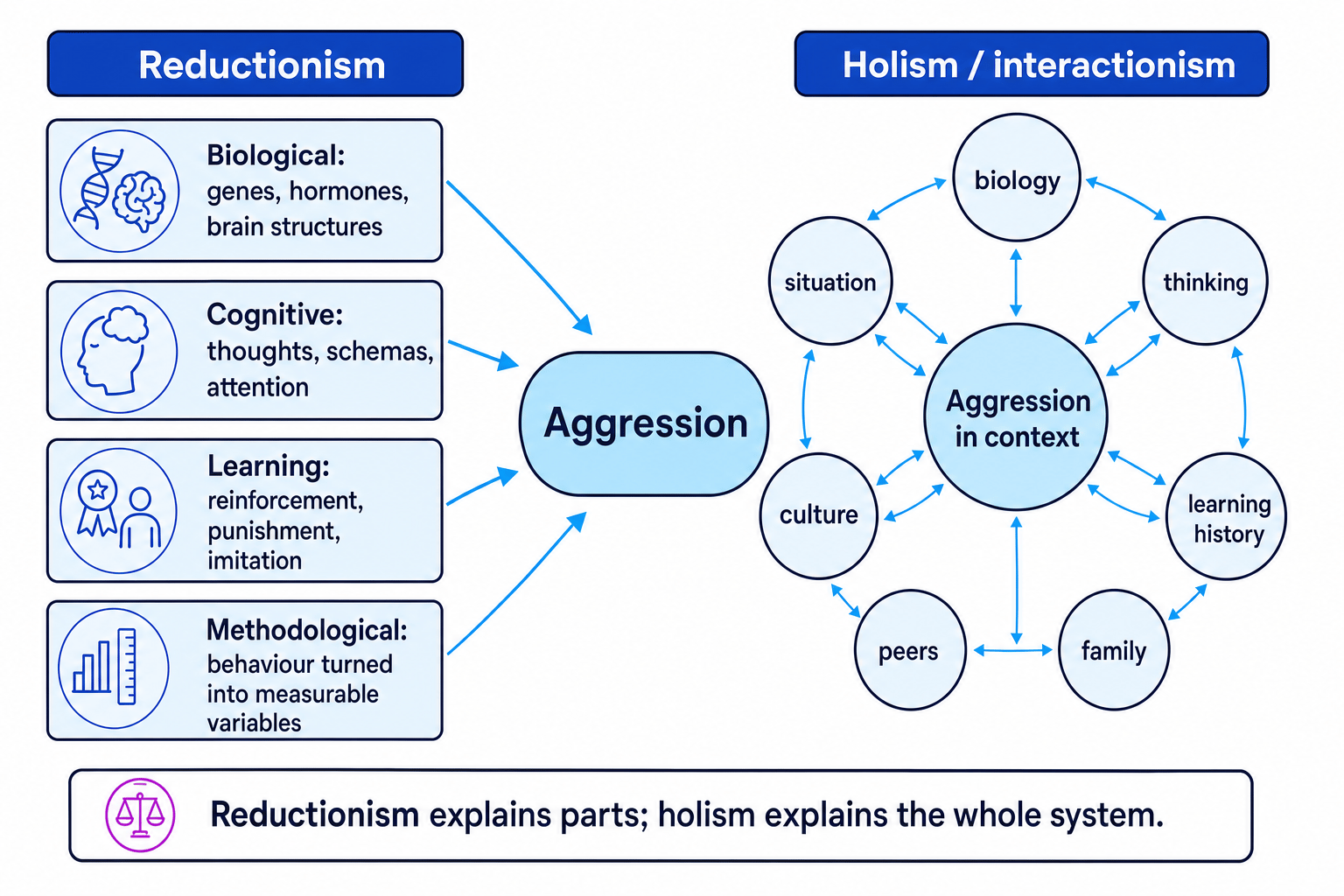
For example, aggression could be explained using:
- Biology: genes, hormones, brain structures.
- Cognition: thoughts, schemas, attention, memory.
- Learning: reinforcement, punishment, imitation.
- Social context: authority, culture, norms, relationships.
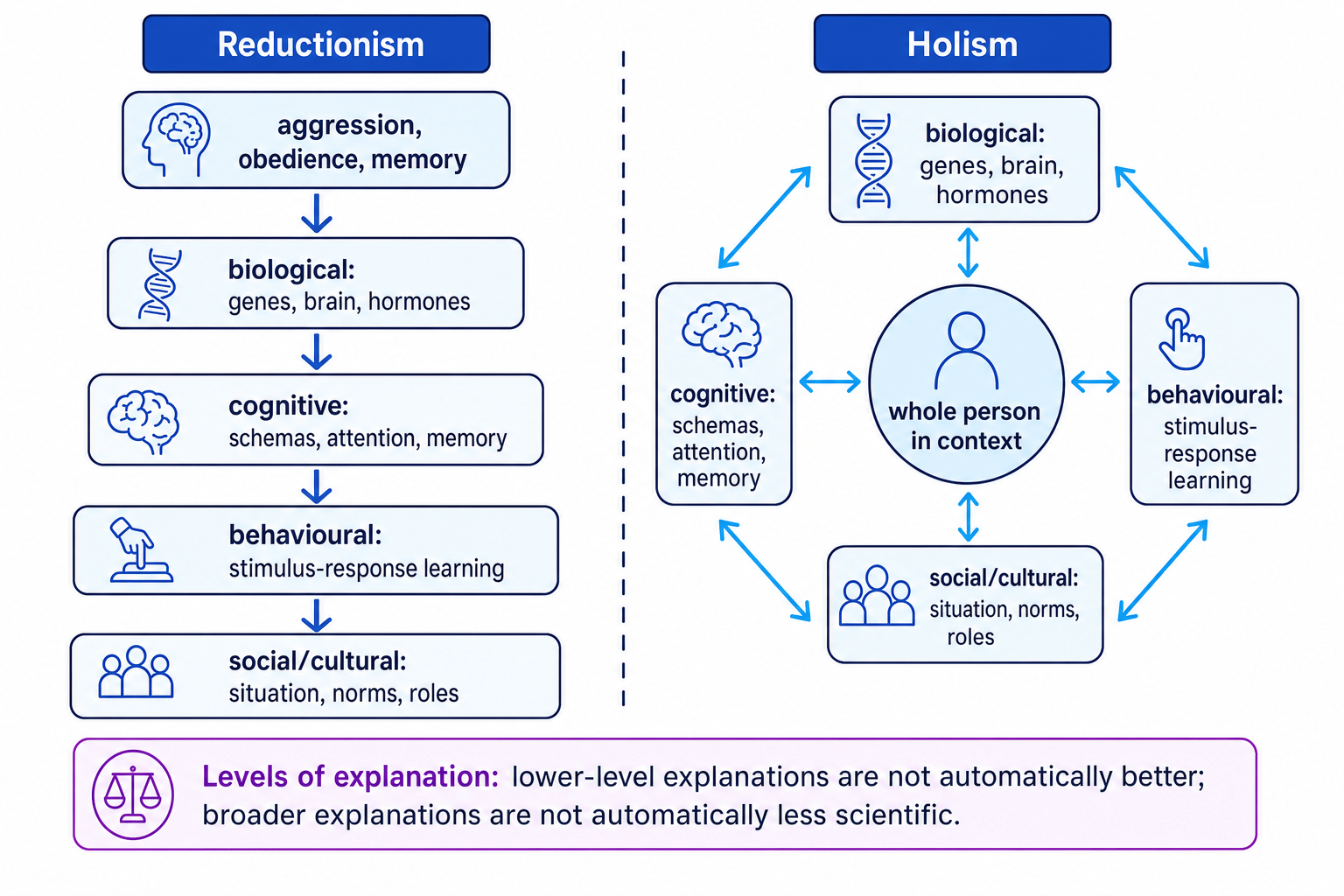
Levels of explanation
A level of explanation is the type of factor used to explain behaviour, such as biological, cognitive, behavioural, social or cultural factors.
The central issue
Reductionism favours explaining behaviour through smaller parts or simpler processes. Holism favours explaining behaviour as part of a whole system, where context and interaction matter.
Reductionism
Reductionism
Reductionism is the view that complex behaviour can be explained by breaking it down into smaller, simpler components.
A reductionist explanation might say: “Obedience is caused by the presence of an authority figure,” or “Memory distortion is caused by leading questions.” These explanations are not automatically wrong. In fact, they are often clear, testable and useful.
Types of reductionism
Biological reductionism explains behaviour through genes, hormones, brain structures or nervous-system activity. For example, Sperry’s split-brain research (1968) explained differences in verbal and visual-spatial performance through the separation of the brain hemispheres.
Environmental or behaviourist reductionism explains behaviour through learning from the environment, such as reinforcement, punishment or imitation. Bandura et al. (1961) reduced aggressive behaviour to social learning processes, especially observing and imitating a model.
Cognitive reductionism explains behaviour through mental processes such as memory, attention or schemas. Loftus and Palmer (1974) reduced eyewitness memory distortion to the effect of leading questions, especially the verb used in the critical question.
Methodological reductionism happens when researchers simplify behaviour into measurable variables so it can be studied scientifically.
Operationalisation
To operationalise a variable means to define it in a clear, measurable way. For example, “aggression” might be measured as the number of physical or verbal aggressive acts shown towards a Bobo doll.
Why reductionism can be useful
Reductionism helps psychologists create controlled studies. If you isolate one variable, you can test whether it affects behaviour. This improves internal validity, which means confidence that the independent variable caused the change in the dependent variable.
Reductionism also links to research methods. Complex behaviour may be reduced to nominal, ordinal or interval data, then summarised using mode, median, mean, range, variance or standard deviation. Data can also be displayed using bar charts, histograms, line graphs, pie charts and scatter diagrams.
Inferential testing is also reductionist because it turns evidence into a decision about probability. OCR methods links include tests such as Mann-Whitney U, Wilcoxon Signed Ranks, Chi-square, Binomial Sign test and Spearman’s Rho. Choosing between them depends on design, level of measurement and whether the data are testing a difference, association or correlation. Researchers then compare calculated values with critical values from tables, often using a significance level such as p<0.05p < 0.05p<0.05, while trying to avoid Type I and Type II errors.
Why methods links matter
Reductionism is not just a theory issue. Every time a researcher turns behaviour into scores, percentages, fractions, ratios or statistical decisions, they are simplifying real life to make it measurable.
Weaknesses of reductionism
The main criticism is that reductionism can oversimplify behaviour. Human behaviour often comes from interacting factors, not one isolated cause.
For example, Bandura et al. (1961) showed that children can imitate aggression, but real-world aggression is also affected by temperament, family stress, culture, peer groups and moral beliefs. A simple learning explanation may miss these wider influences.
Reductionist does not mean useless
Do not write as if reductionism is always bad. A reductionist explanation can be scientific, testable and practically useful. The evaluation point is that it may be incomplete, not necessarily wrong.
Holism
Holism
Holism is the view that behaviour should be understood as a whole, including the interaction between biological, cognitive, social, cultural and personal factors.
A holistic explanation argues that the “whole person” matters. For example, you might not fully understand obedience by looking only at authority. You may also need personality, culture, previous experiences, social norms, fear, moral beliefs and the specific situation.
A key holistic idea is emergence. An emergent property is something that appears when parts interact, but cannot be fully understood by examining each part separately. For example, a conversation is more than just individual words; its meaning depends on tone, relationship and context.
Research that can support holism
Freud’s case study of Little Hans (1909) is often seen as more holistic because it considered Hans’ family relationships, fears, unconscious conflicts and development over time. However, it can also be criticised for reducing behaviour to psychosexual conflict, so it is not purely holistic.
Bocchiaro et al. (2012) can be used to discuss a more rounded approach to obedience, disobedience and whistle-blowing. The study still used a controlled procedure, but the topic itself involves moral decision-making, social pressure and individual courage.
Lee et al. (1997) is useful for cultural holism. Children’s evaluations of lying and truth-telling were affected by cultural norms, showing that behaviour cannot always be understood without social context.
Strengths and weaknesses of holism
Holism often has stronger ecological validity, meaning it may reflect real-life behaviour more closely. It is especially useful in clinical, social and developmental psychology, where context matters.
However, holistic explanations can be harder to test scientifically. If an explanation includes everything — biology, childhood, culture, personality and situation — it may become vague. It can also be harder to identify cause and effect.
Classifying a core study explanation
-
In Sperry (1968), the key explanation is that behaviour changed depending on which brain hemisphere received visual information. This places the explanation mainly at the biological level.
-
Because the study focuses on brain structure and lateralisation, it is reductionist: complex experiences such as perception and language are explained through separated neural systems.
-
A holistic evaluation would add that everyday cognition involves brain systems working with attention, language, context and personal meaning. So Sperry gives a powerful mechanism, but not a complete account of ordinary conscious experience.
Different positions within the debate
You do not have to treat the debate as only two extremes. There are several positions.
Hard reductionism
Hard reductionism argues that behaviour can ultimately be explained by one basic level, often biology. For example, someone might claim that criminal behaviour is “really” caused by genes or brain abnormalities.
This is precise, but it risks ignoring responsibility, social inequality, learning history and culture.
Soft reductionism
Soft reductionism accepts that breaking behaviour into parts is useful, but does not claim that one level explains everything. This is often the strongest exam position because it is balanced.
For example, Loftus and Palmer (1974) show that leading questions affect memory, but this does not mean all eyewitness error is caused only by wording. Stress, attention, time delay and individual differences may also matter.
Holistic or interactionist explanations
An interactionist explanation combines levels. For example, depression may involve genetic vulnerability, brain chemistry, negative thinking patterns, stressful life events and social support. This is close to a holistic approach because it focuses on how factors work together.
Best essay position
A strong conclusion is often: reductionism is useful for controlled research and practical interventions, but holistic or interactionist explanations are usually better for understanding complex real-world behaviour.
Core study anchors
| Study | How it links to reductionism/holism | AO3 and ethics angle |
|---|---|---|
| Milgram (1963) | Situationally reductionist: obedience was explained largely through authority, setting and procedure. | High control and usefulness, but serious BPS issues around deception, distress and right to withdraw. |
| Bocchiaro et al. (2012) | Looks at obedience, disobedience and whistle-blowing, allowing more social and moral complexity. | Still uses deception, so debriefing and protection from harm are important. |
| Loftus and Palmer (1974) | Cognitive reductionism: memory distortion was linked to leading verbs and post-event information. | Controlled and replicable, but artificial film clips may reduce ecological validity. |
| Bandura et al. (1961) | Behaviourist/social-learning reductionism: aggression was linked to observing a model. | Ethical concern: children were exposed to aggressive behaviour. |
| Baron-Cohen et al. (1997) | Cognitive/neuropsychological reductionism: autism was linked to theory of mind performance on the Eyes Task. | Socially sensitive: researchers must avoid stigma and overgeneralising autistic people. |
| Freud (1909) | More holistic because it considers development, family context and unconscious meaning. | Low reliability and researcher bias; also ethical issues around consent and interpretation of a child’s behaviour. |
Applications
Reductionist approaches are useful when you need a clear intervention. For example, biological explanations of depression can support drug treatments, while behaviourist explanations can support token economies or behaviour modification.
Holistic approaches are useful when a single intervention is not enough. In clinical psychology, a biopsychosocial approach considers biological, psychological and social factors together. This can lead to more personalised support.
In education, a reductionist approach might focus on reinforcement to improve behaviour. A holistic approach would also consider home life, peer relationships, teacher expectations, culture and self-esteem.
Social sensitivity
Reductionist explanations can become socially sensitive if they label groups as biologically or psychologically “deficient”. Under the BPS Code, psychologists should show respect, responsibility, competence and integrity when researching or applying such explanations.
Similarities and differences with other debates
| Debate | Link to reductionism/holism |
|---|---|
| Nature/nurture | Biological reductionism often links to nature. Behaviourist reductionism often links to nurture. Holism often argues for interaction. |
| Freewill/determinism | Reductionist explanations are often deterministic because they focus on causes. Holistic explanations may allow more room for personal agency. |
| Individual/situational | A situational explanation can still be reductionist if it explains behaviour through one situational factor. Holism combines person and situation. |
| Psychology as a science | Reductionism supports control, measurement and objectivity. Holism may improve validity but can be harder to test. |
| Ethnocentrism | Holism is more likely to consider culture. Reductionism may overgeneralise findings from one sample or culture. |
Writing it as AO1, AO2 and AO3
For AO1, define reductionism and holism, then describe types such as biological, environmental, cognitive and methodological reductionism.
For AO2, apply the debate to a study or scenario. Ask: Which level of explanation is being used? What is being ignored? Would a whole-person explanation improve it?
For AO3, evaluate. Reductionism is scientific, controlled and useful, but may be oversimplified. Holism is realistic and valid, but may be less testable and less precise.
In the exam
- Name the level of explanation before you evaluate it: biological, cognitive, behavioural, social or cultural.
- Use named studies with years where possible, such as Milgram (1963), Bandura et al. (1961), Sperry (1968) or Loftus and Palmer (1974).
- Balance your conclusion: reductionism helps scientific control and application, while holism helps explain complex behaviour in real-life contexts.
Check yourself
- Can you explain why Loftus and Palmer (1974) is a reductionist study?
- What would a holistic explanation of obedience include beyond authority?
- How is reductionism/holism different from nature/nurture?