What you'll learn
- What psychologists mean by free will and determinism.
- The main positions: hard determinism, soft determinism, and free will.
- How OCR core studies can illustrate different sides of the debate.
- How to compare this debate with other debates such as nature/nurture, reductionism/holism, and individual/situational explanations.
The basic issue: are we choosing, or are we caused?
The freewill/determinism debate asks a simple but deep question: to what extent is human behaviour freely chosen, and to what extent is it caused by factors outside our control?
In psychology, this matters because psychologists often try to explain, predict, and sometimes change behaviour. If behaviour is caused, then psychology can search for patterns and causes. If behaviour is freely chosen, prediction becomes harder, but personal responsibility becomes more central.
Free will
Free will is the idea that people can make conscious choices and are not completely controlled by internal or external forces. It links closely to agency, which means a person’s capacity to act intentionally and make decisions.
Determinism
Determinism is the view that behaviour is caused by forces outside a person’s conscious control, such as biology, learning, the social situation, or unconscious motives.
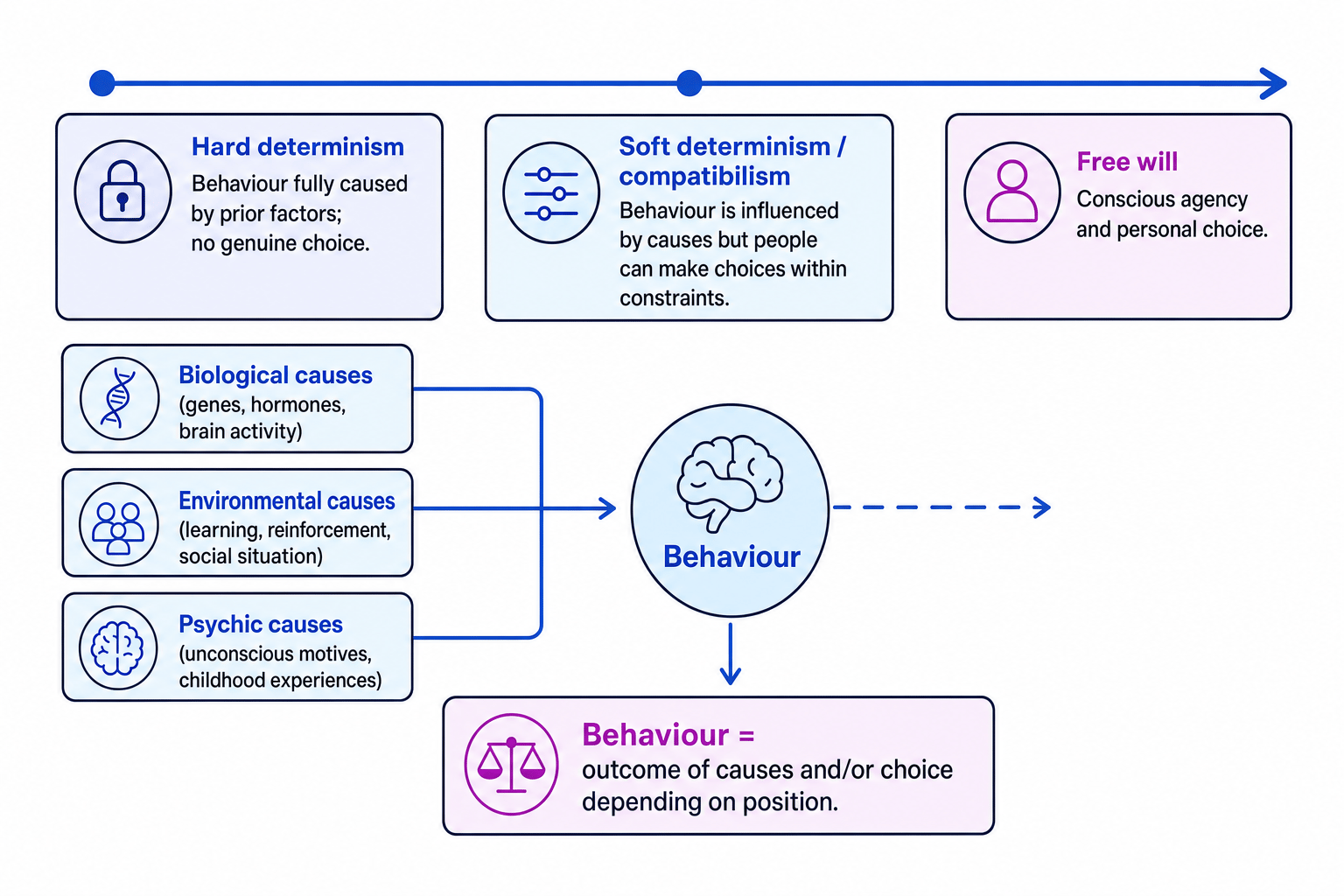
It is helpful to see the debate as a continuum, not just two extreme boxes.
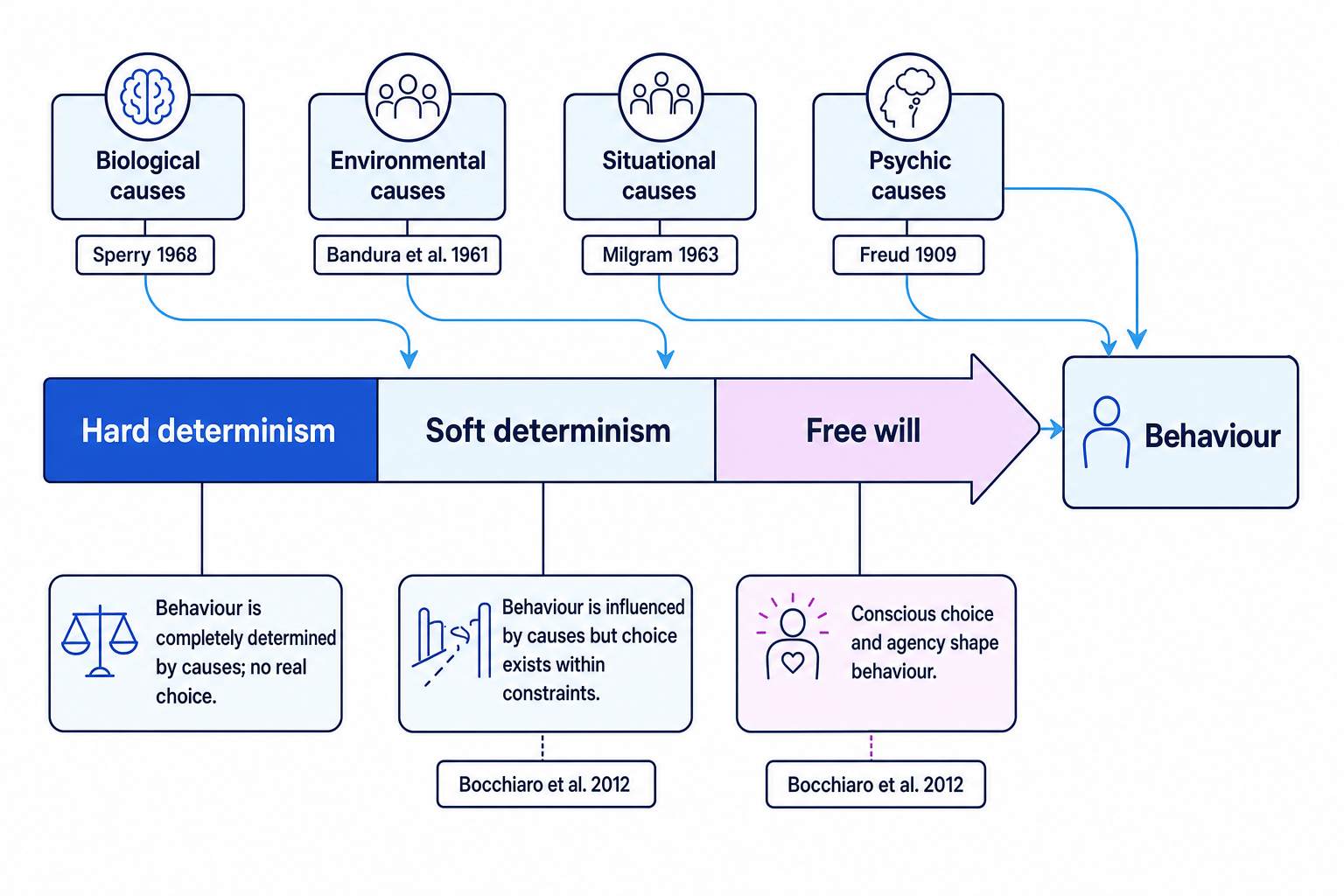
Hard determinism
Hard determinism is the strongest deterministic position. It argues that all behaviour is caused by prior factors, so genuine free choice is an illusion.
For example, a hard determinist might argue that obedience in Milgram’s 1963 study was caused by situational pressures: the authority figure, the Yale setting, the prods, and the gradual increase in shock levels. The participant may have felt they were choosing, but their behaviour was strongly shaped by the situation.
Hard determinism
Hard determinism is the view that all behaviour has a cause and that free will does not truly exist.
Types of determinism
Determinism comes in different forms depending on what kind of cause is emphasised.
| Type of determinism | Main idea | Example in psychology |
|---|---|---|
| Biological determinism | Behaviour is caused by genes, hormones, neurotransmitters, brain structures, or nervous-system activity. | Sperry 1968 showed that split-brain patients’ responses were shaped by hemispheric specialisation. |
| Environmental determinism | Behaviour is caused by learning, reinforcement, punishment, role models, or social situations. | Bandura et al. 1961 showed children imitated aggressive behaviour from an adult model. |
| Psychic determinism | Behaviour is caused by unconscious conflicts, childhood experiences, and hidden motives. | Freud 1909 explained Little Hans’ phobia through unconscious psychosexual conflict. |
Core idea
Determinism does not always mean “biology made me do it”. In psychology, causes can be biological, environmental, social, cognitive, or unconscious.
Classifying a deterministic explanation
A researcher says: “A child becomes aggressive because they observe aggressive adults being rewarded, then imitate that behaviour.”
- The proposed cause is not genes or brain structure; it is observing and imitating a model.
- The explanation links behaviour to learning from the environment, especially reinforcement and role models.
- This is therefore an example of environmental determinism, and it fits well with Bandura et al. 1961.
Free will
A free-will position argues that people can make meaningful choices. This is especially important in humanistic psychology, associated with psychologists such as Carl Rogers and Abraham Maslow, who emphasised personal growth, self-awareness, and choice.
Free will is also important in everyday life. Legal systems, school rules, and moral judgements often assume that people could have acted differently.
Humanistic psychology
Humanistic psychology is an approach that emphasises personal growth, conscious experience, self-determination, and the belief that people can choose how to develop.
A free-will interpretation of Bocchiaro, Zimbardo and Van Lange 2012 might focus on the fact that some participants disobeyed the authority figure and some became whistle-blowers. Even though the situation created pressure to obey, not everyone responded in the same way.
Free will does not mean random behaviour
Free will is not the claim that behaviour has no reasons at all. It means the person has some conscious control over their decision, rather than being completely controlled by forces outside awareness.
Soft determinism: the middle position
Soft determinism, also called compatibilism, is often the most balanced position for A-Level evaluation. It accepts that behaviour is influenced by causes, but argues that people may still make choices within limits.
For example, Milgram’s participants were clearly influenced by the authority figure and setting, but 35% did not continue to 450 volts. Similarly, in Bocchiaro et al. 2012, most participants obeyed, but some resisted. This suggests behaviour is constrained rather than mechanically fixed.
Soft determinism
Soft determinism is the view that behaviour is influenced by internal and external causes, but people can still exercise some choice within those constraints.
Applying soft determinism to obedience
Use Milgram 1963 and Bocchiaro et al. 2012 to support a soft determinist view.
- Milgram’s findings suggest situational causes matter: 65% of participants went to 450 volts, showing that an authority figure and formal setting can powerfully influence obedience.
- However, Milgram also found that 35% did not go to 450 volts, so the situation did not determine identical behaviour in every participant.
- Bocchiaro et al. 2012 also showed variation: many obeyed, but some disobeyed or whistle-blew, suggesting participants were not completely controlled by authority.
- A soft determinist conclusion is strongest: obedience is shaped by social pressure, but individuals may still exercise agency.
Research illustrating the debate
Milgram 1963: situational determinism
Milgram 1963 investigated obedience to authority. Participants believed they were giving electric shocks to a learner. The study showed that ordinary people could obey destructive orders under pressure from an authority figure.
This illustrates situational determinism, because behaviour was strongly influenced by the context: the laboratory, the experimenter’s authority, the gradual shock generator, and verbal prods.
Ethically, Milgram raises issues under the BPS Code of Human Research Ethics, especially protection from harm, valid consent, deception, and right to withdraw. These ethical issues matter for the debate because deterministic research can involve manipulating powerful pressures on participants.
Bandura et al. 1961: environmental determinism
Bandura, Ross and Ross 1961 found that children exposed to an aggressive adult model were more likely to imitate aggressive acts towards a Bobo doll. This supports environmental determinism because behaviour was influenced by observed models.
However, not every child behaved identically. This weakens a hard determinist conclusion and supports a softer view: social learning increases the likelihood of behaviour, rather than guaranteeing it.
Sperry 1968: biological determinism
Sperry 1968 studied split-brain patients whose corpus callosum had been severed. The research showed that behaviour and verbal reports could depend on which hemisphere received information.
This supports biological determinism because brain structure affected conscious experience and behaviour. However, it would be too extreme to claim that brain structure explains all behaviour in everyday life.
Freud 1909: psychic determinism
Freud’s 1909 study of Little Hans explained a child’s phobia of horses through unconscious conflict. This illustrates psychic determinism because behaviour is explained as caused by unconscious motives rather than conscious choice.
AO3 evaluation is important here: Freud’s case study method was rich in detail but low in generalisability, and the interpretation is difficult to test scientifically.
Applications of the debate
Criminal behaviour
A deterministic view can be useful in explaining offending. For example, biological explanations might focus on brain differences, while environmental explanations might focus on upbringing, peer influence, or reinforcement.
This can support rehabilitation, because if behaviour has causes, interventions can target those causes. However, it may reduce perceived personal responsibility.
Mental health
Deterministic approaches can lead to treatments. Biological determinism supports drug therapies; environmental determinism supports behaviour therapies; psychic determinism supports psychoanalytic therapy.
A free-will or humanistic approach may instead focus on self-understanding, personal responsibility, and the client’s capacity to choose change.
Education and behaviour management
Environmental determinism is applied in schools through reinforcement systems, praise, sanctions, and modelling. These assume behaviour can be shaped by consequences and role models.
Application sentence starter
A strong AO2 sentence often starts: “This explanation would interpret the behaviour as caused by…” Then specify the cause: biology, learning, situation, unconscious conflict, or conscious choice.
AO3: strengths and weaknesses
Strengths of determinism
Determinism supports psychology as a science, because it encourages researchers to look for cause-and-effect relationships. If behaviour has causes, it can be studied systematically and predictions can be made.
It also has practical value. For example, if aggression is partly learned, then interventions can reduce exposure to aggressive models or reward prosocial behaviour.
Weaknesses of determinism
Hard determinism can be criticised for being too simplistic. Human behaviour is complex, and people do not always respond in the same way to the same situation.
It may also be ethically and socially sensitive. If we say a person’s behaviour was “determined”, this may reduce responsibility for harmful actions. On the other hand, it may also reduce blame for people experiencing mental illness or addiction.
Strengths of free will
Free will fits with everyday experience: people often feel they deliberate, make decisions, and choose between alternatives. It also supports ideas of moral responsibility.
Humanistic psychology can be positive and empowering because it treats people as active agents rather than passive products of causes.
Weaknesses of free will
Free will is difficult to test scientifically. If someone says, “I chose freely,” it is hard to prove that the choice was not influenced by unconscious motives, biology, or the situation.
A strong free-will view may also ignore real constraints, such as poverty, trauma, mental illness, social pressure, or brain injury.
Similarities and differences with other debates
Nature/nurture
The nature/nurture debate asks whether behaviour is mainly influenced by biological inheritance or environmental experience. It overlaps with determinism because nature can support biological determinism, while nurture can support environmental determinism.
The difference is that nature/nurture asks what kind of cause matters, while freewill/determinism asks whether behaviour is caused or chosen.
Reductionism/holism
Reductionism explains behaviour by breaking it into smaller parts, such as genes, neurons, or reinforcement schedules. Deterministic explanations are often reductionist.
Holism looks at the whole person and context. Soft determinism is often more holistic because it accepts several influences plus some agency.
Individual/situational debate
The individual/situational debate asks whether behaviour is best explained by personal factors or the situation. Milgram 1963 is a classic example of a situational explanation of obedience.
This overlaps with determinism because situational explanations often imply that behaviour is caused by external pressures.
Best essay judgement
For many OCR essays, the most defensible conclusion is not “free will wins” or “determinism wins”. A stronger judgement is that behaviour is influenced by causes, but the extent of choice varies across behaviours, situations, and individuals.
In the exam
- Define both sides clearly before evaluating: free will means conscious agency; determinism means behaviour is caused by internal or external forces.
- Use named research accurately, such as Milgram 1963 for situational determinism, Bandura et al. 1961 for environmental determinism, Sperry 1968 for biological determinism, and Freud 1909 for psychic determinism.
- For AO3, avoid one-sided answers: weigh usefulness, scientific status, ethics, responsibility, and whether soft determinism gives the most balanced conclusion.
Check yourself
- What is the difference between hard determinism and soft determinism?
- How could Milgram 1963 be used to support situational determinism?
- Why is the freewill/determinism debate similar to, but not the same as, the nature/nurture debate?