What you'll learn
- What conservation behaviours are, including recycling, energy saving and water saving.
- How the cognitive approach explains recycling through attitudes, beliefs, intentions and perceived control.
- What Lord (1994) did in the key research on message and source strategies.
- How to apply one technique for increasing recycling or other conservation behaviour in an AO2/AO3-friendly way.
1. Big picture: what are conservation behaviours?
Conservation behaviours are actions that reduce waste or protect natural resources. In environmental psychology, they include:
- recycling paper, plastic, glass or food waste
- reusing items instead of throwing them away
- reducing energy use, such as switching off lights
- reducing water use, such as taking shorter showers
- choosing lower-waste or lower-carbon options
Conservation behaviour
A conservation behaviour is any behaviour that reduces the use of resources, reduces waste, or helps protect the environment.
Recycling is a useful example because it is easy to observe: people either place items in the correct recycling system or they do not. However, recycling is not just about knowledge. People may know recycling is “good” but still fail to do it if it is inconvenient, confusing, not a habit, or not socially encouraged.
The attitude-behaviour gap
People can hold positive environmental attitudes but still not recycle. Cognitive explanations must therefore consider beliefs, intentions, confidence, habits and situational barriers.
2. Why this topic is cognitive
The cognitive approach focuses on internal mental processes, such as beliefs, attitudes, intentions, decision-making and interpretation of messages.
Cognitive approach
The cognitive approach explains behaviour by looking at mental processes: how people think about information, evaluate choices, form intentions and make decisions.
For recycling, the cognitive approach asks questions like:
- Does the person believe recycling is worthwhile?
- Do they think people like them recycle?
- Do they understand what goes in each bin?
- Do they believe they can recycle easily?
- Does the message come from a source they trust?
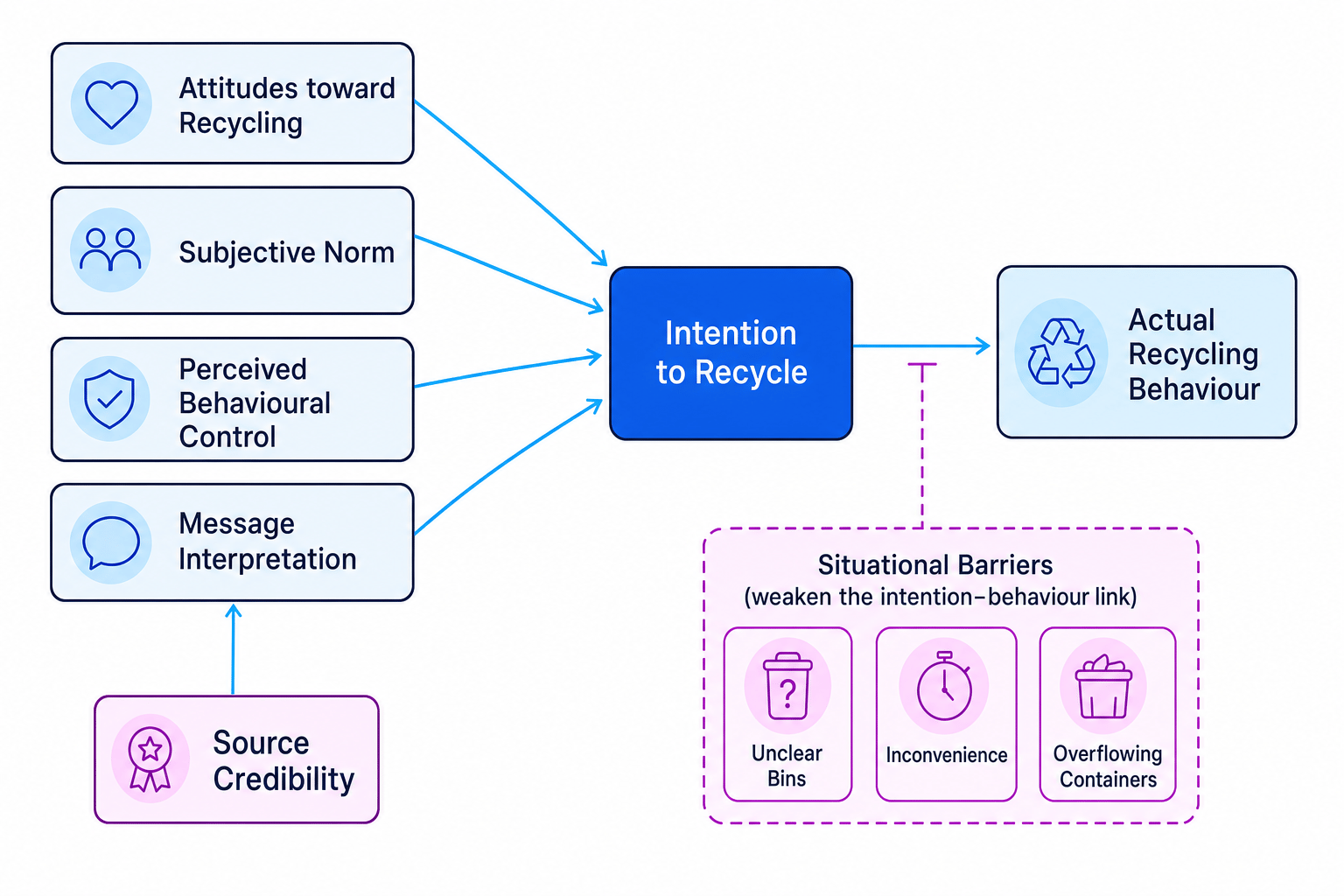
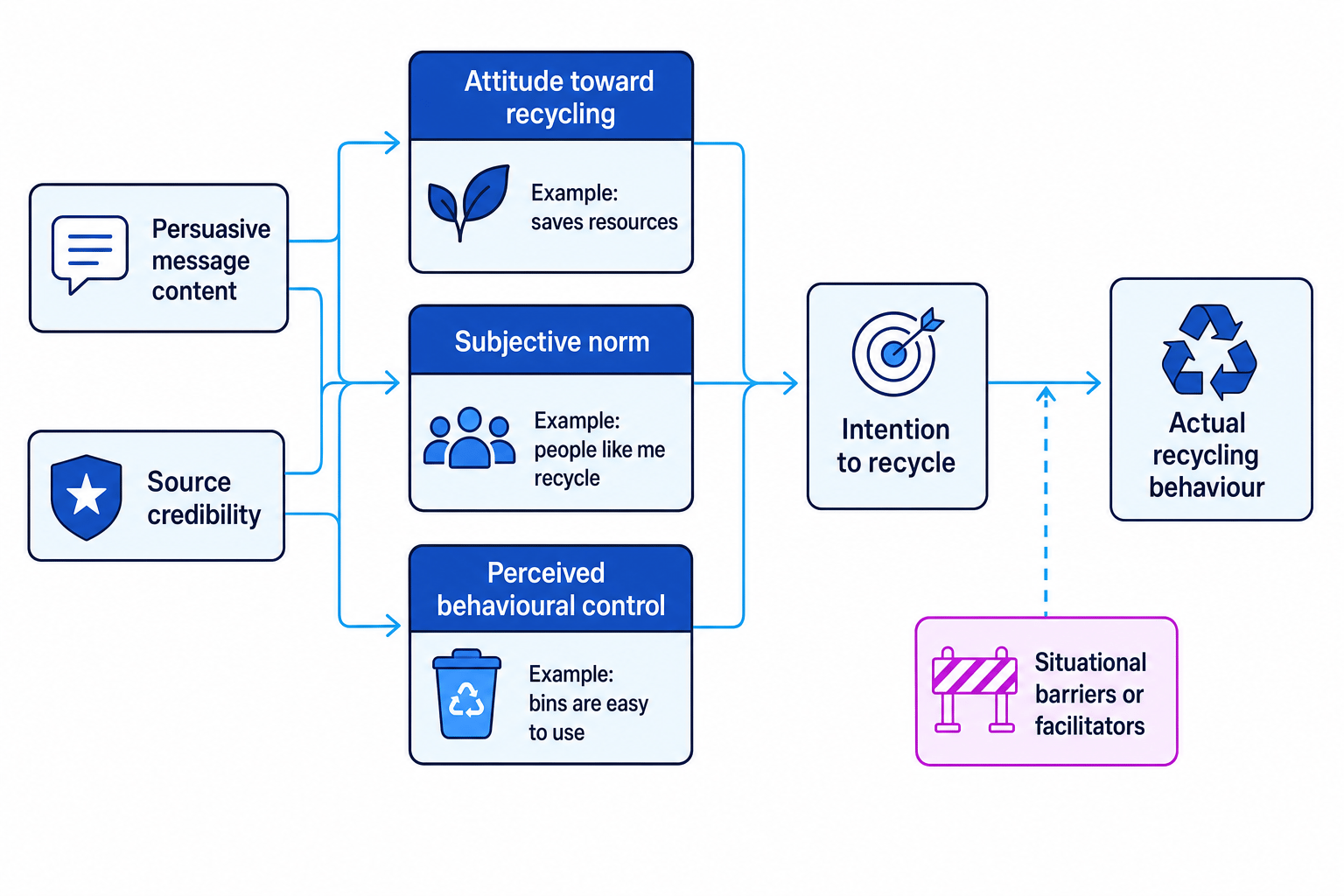
A simple way to organise this is using ideas from the Theory of Planned Behaviour, which argues that behaviour is often predicted by intention. Intention is shaped by attitude, perceived social pressure and perceived control.
Attitude
An attitude is a person’s positive or negative evaluation of something. For recycling, this might be “recycling is important because it saves resources” or “recycling is annoying and pointless”.
Subjective norm
A subjective norm is a person’s perception of what other people expect or normally do. If you think your friends, family or neighbours recycle, you may be more likely to see recycling as normal.
Perceived behavioural control
Perceived behavioural control means how easy or difficult someone believes the behaviour is. Even if someone wants to recycle, they may not do it if the bins are far away, labels are unclear, or they are unsure what can be recycled.
Perceived behavioural control
Perceived behavioural control is a person’s belief about whether they are capable of carrying out a behaviour and whether the situation makes it easy or difficult.
Applying the cognitive model to low recycling
A college notices that many students put recyclable bottles in general waste bins.
-
Identify the likely cognitive barrier. If students say “I’m never sure which bin to use”, the main issue is perceived behavioural control, not attitude.
-
Match the intervention to the barrier. A guilt-based message about pollution may not solve the problem, because students already may believe recycling matters. Clear bin labels and simple instructions target the control problem more directly.
-
Add a norm or source cue. A message such as “Most students in this building recycle bottles correctly” could strengthen the subjective norm, especially if it comes from a trusted student environmental group.
-
Predict the behavioural outcome. Recycling should increase if the intervention makes the behaviour feel easier and more normal, but it may fail if bins are still poorly placed or overflowing.
Assuming knowledge is enough
Do not write that people will recycle simply because they are told recycling is good. OCR answers need the link between cognition and behaviour: beliefs, intention, confidence, source credibility and barriers.
3. Factors influencing recycling and conservation
Knowledge and beliefs
People are more likely to conserve resources if they understand the consequences of waste and believe their own behaviour makes a difference. However, knowledge is usually necessary rather than sufficient.
For example, knowing that paper can be recycled does not guarantee that someone will separate it correctly. The person also needs a clear system, motivation and confidence.
Social norms
A social norm is a shared expectation about how people should behave. Recycling can become more likely when people see it as normal in their school, street, family or workplace.
Norm messages can be powerful because they reduce the feeling that conservation is unusual or pointless. A message like “Most households on this road recycle food waste each week” suggests that recycling is the standard behaviour.
Habits, prompts and feedback
A habit is an automatic behaviour built up through repetition. Recycling becomes easier when it is part of a routine, such as rinsing a bottle and placing it in the same bin every time.
A prompt is a cue that reminds someone to act at the moment the behaviour is needed. Examples include signs above bins, stickers on light switches, or shower timers.
Feedback means giving people information about their behaviour or progress. For example, a workplace might display “This floor recycled 20 bags of paper this week”.
Message and source strategies
This is the key link to Lord (1994).
Message strategy and source strategy
A message strategy is the way persuasive information is framed or presented. A source strategy is the choice of who delivers or is associated with that message.
A recycling message might emphasise:
- environmental benefits, such as saving resources
- personal responsibility, such as “your actions matter”
- social norms, such as “people in this community recycle”
- practical instructions, such as “empty, rinse, recycle”
- losses from not recycling, such as increased landfill
The source also matters. A message may be more persuasive if it comes from someone seen as credible, trustworthy, expert, similar to the audience, or part of the local community.
Source credibility
Source credibility means how far the audience sees the communicator as trustworthy, knowledgeable and believable.
This fits cognitive psychology because people do not passively receive messages. They interpret them. A credible source may make people process the message more positively or accept it as more reliable.
Message plus source
For this topic, keep asking: what is being said, and who is saying it? Lord (1994) is about both parts of persuasion.
4. Key research: Lord (1994)
Lord’s study is the named key research for this sub-topic: Lord (1994), “Motivating recycling behaviour: A quasi-experimental investigation of message and source strategies.”
Aim
Lord aimed to investigate whether recycling behaviour could be increased by using different persuasive communication strategies. The study focused on the effect of the message and the source of that message on actual recycling behaviour.
Method
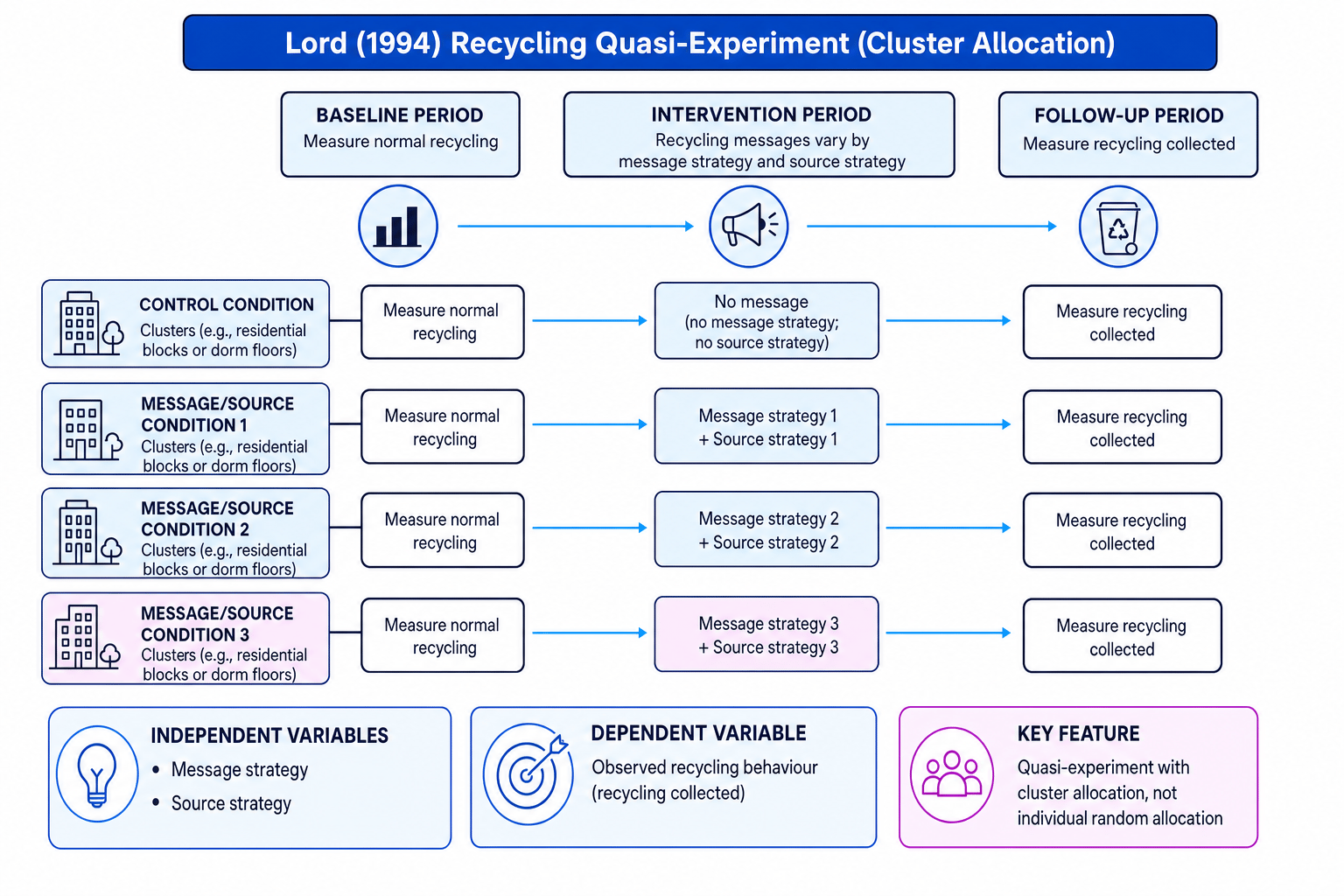
Lord used a quasi-experiment in a real-world setting.
Quasi-experiment
A quasi-experiment is a study where the researcher investigates the effect of an independent variable but does not have full random allocation of individual participants to conditions, often because the study takes place in a natural setting.
In broad terms, Lord compared groups or clusters exposed to different recycling communications. The independent variables were the message strategy and source strategy. The dependent variable was observed recycling behaviour, such as the amount or rate of recycling collected.
Results
Lord found that recycling behaviour was influenced by the communication strategy. In other words, recycling was not fixed: it could be changed by altering how the behaviour was presented and who appeared to be encouraging it.
The important exam point is that message content and source characteristics affected real recycling behaviour, not just people’s self-reported attitudes.
Conclusions
Lord concluded that persuasive communication can be used to motivate conservation behaviour. This supports the cognitive idea that people’s decisions are influenced by how they process information, evaluate sources and form intentions.
Lord’s main takeaway
Lord (1994) shows that recycling can be increased by carefully designing persuasive messages and considering the credibility or relevance of the message source.
5. Evaluating Lord (1994)
Strengths
Lord’s study has good ecological validity because it took place in a real-life recycling context. Participants were not just answering hypothetical questions; their actual recycling behaviour was measured.
The study is also useful because it has clear real-world applications. Councils, schools, universities and workplaces can use message and source strategies to increase recycling and other conservation behaviours.
Measuring behaviour rather than only attitudes is another strength. Self-report questionnaires can suffer from social desirability bias, where people claim to be more environmentally responsible than they really are.
Weaknesses
Because Lord used a quasi-experimental design, there may have been less control over extraneous variables. For example, groups may have differed before the intervention in environmental concern, access to bins, local habits or motivation.
The sample and setting may limit generalisability. A strategy that works in one community, organisation or culture may not work equally well elsewhere. This raises possible issues of sampling bias and ethnocentrism if findings are applied too widely.
The study also may not prove long-term behaviour change. A message can produce a short-term increase in recycling, but habits may fade if prompts are removed or if the recycling system remains inconvenient.
Ethics
From a BPS ethics perspective, this type of field research is usually low risk, but researchers still need to consider consent, privacy and debriefing. If recycling is measured at group level, individual privacy is better protected. However, participants should not be deceived in a way that causes distress or unfair monitoring.
Causality is limited
Lord’s study can suggest that message and source strategies influence recycling, but because it is quasi-experimental, it is harder to rule out all pre-existing group differences.
6. Application: using persuasion to increase conservation
One practical technique is a targeted persuasive message from a credible source. This can be used for recycling, saving energy, reducing water use or cutting food waste.
A good intervention should:
- target a specific behaviour, not just “be greener”
- use a clear and relevant message
- come from a trusted or relatable source
- reduce confusion by giving simple instructions
- make the desired behaviour feel normal
- measure actual behaviour afterwards
For example, a council trying to increase food-waste recycling could send a message from a local community leader and waste-management expert. The message might say: “Most households in your area now use the food-waste caddy. Put fruit peel, leftovers and tea bags in the small green caddy every day.”
This targets attitudes, norms and perceived control at the same time.
Designing a recycling campaign
A school wants students to recycle more plastic bottles at lunchtime.
-
Define the target behaviour precisely. “Recycle more” is too vague, so the target becomes: students place empty plastic bottles in the blue recycling bins after lunch.
-
Identify the main cognitive barrier. If students are unsure which bin to use, the campaign should focus on clear instructions and confidence. If students think nobody bothers, it should focus on social norms.
-
Choose the message strategy. A useful message could combine a norm and a simple instruction: “Most students recycle their bottles here — empty bottles go in the blue bin.”
-
Choose the source strategy. The message may be more persuasive if it comes from the student council or a popular sixth-form group, because students may see them as relatable and trustworthy.
-
Plan how to judge success. The school could compare the number of bottles in recycling bins before and after the campaign, rather than relying only on students saying they recycle.
7. AO1, AO2 and AO3 focus
AO1: describe
For AO1, you need accurate knowledge. Define conservation behaviour, explain the cognitive approach, and describe Lord’s aim, method, results and conclusions.
AO2: apply
For AO2, apply the ideas to a new situation. If the scenario is about low recycling, decide whether the main issue is attitude, norm, perceived control, habit, message or source credibility.
AO3: evaluate
For AO3, discuss strengths and weaknesses. Strong evaluation points include ecological validity, usefulness, observed behaviour, quasi-experimental control issues, generalisability, sampling bias, ethics and the attitude-behaviour gap.
In the exam
-
For Lord (1994), structure your answer around message strategy, source strategy and observed recycling behaviour.
-
In application questions, do not just say “give people information”. Explain which cognition you are targeting: attitude, norm, intention or perceived control.
-
In evaluation, balance usefulness with limitations: persuasive messages can work, but only if practical barriers such as unclear bins or inconvenience are also addressed.
Check yourself
- What is the difference between a message strategy and a source strategy?
- Why might someone with a positive attitude toward recycling still fail to recycle?
- How could you apply Lord (1994) to increase water conservation in a school or workplace?