What you'll learn
- What cognitive ergonomics is and why it matters in workplaces.
- How cognitive overload can lead to errors, stress and slower decisions.
- Why being observed at work can change behaviour and affect research validity.
- How Drews and Doig (2014) used a configural display to improve ICU nurses’ monitoring of patients.
The big picture: ergonomics in environmental psychology
Environmental psychology studies how physical and social environments affect behaviour, thoughts and emotions. Ergonomics, also called human factors, is about designing environments, tools and systems around human abilities and limitations.
In this sub-topic, the focus is cognitive ergonomics: how workplace design affects attention, memory, decision-making and mental workload.
Ergonomics / human factors
Ergonomics is the study and design of tools, tasks and environments so that they fit human users, reducing error, discomfort and unnecessary mental or physical effort.
Cognitive ergonomics
Cognitive ergonomics focuses on mental processes such as perception, attention, memory, decision-making and problem-solving in human–technology systems.
Human-centred design
A well-designed workplace should not just look efficient on paper. It should match how people actually notice information, remember it, prioritise it and act under pressure.
Cognitive overload
Cognitive load means the amount of mental effort a task requires. Cognitive overload happens when the demands of a task exceed a person’s available mental capacity.
In workplaces, overload can happen when someone has to monitor too many displays, remember too much information, switch between tasks quickly, or make high-stakes decisions while tired or stressed.
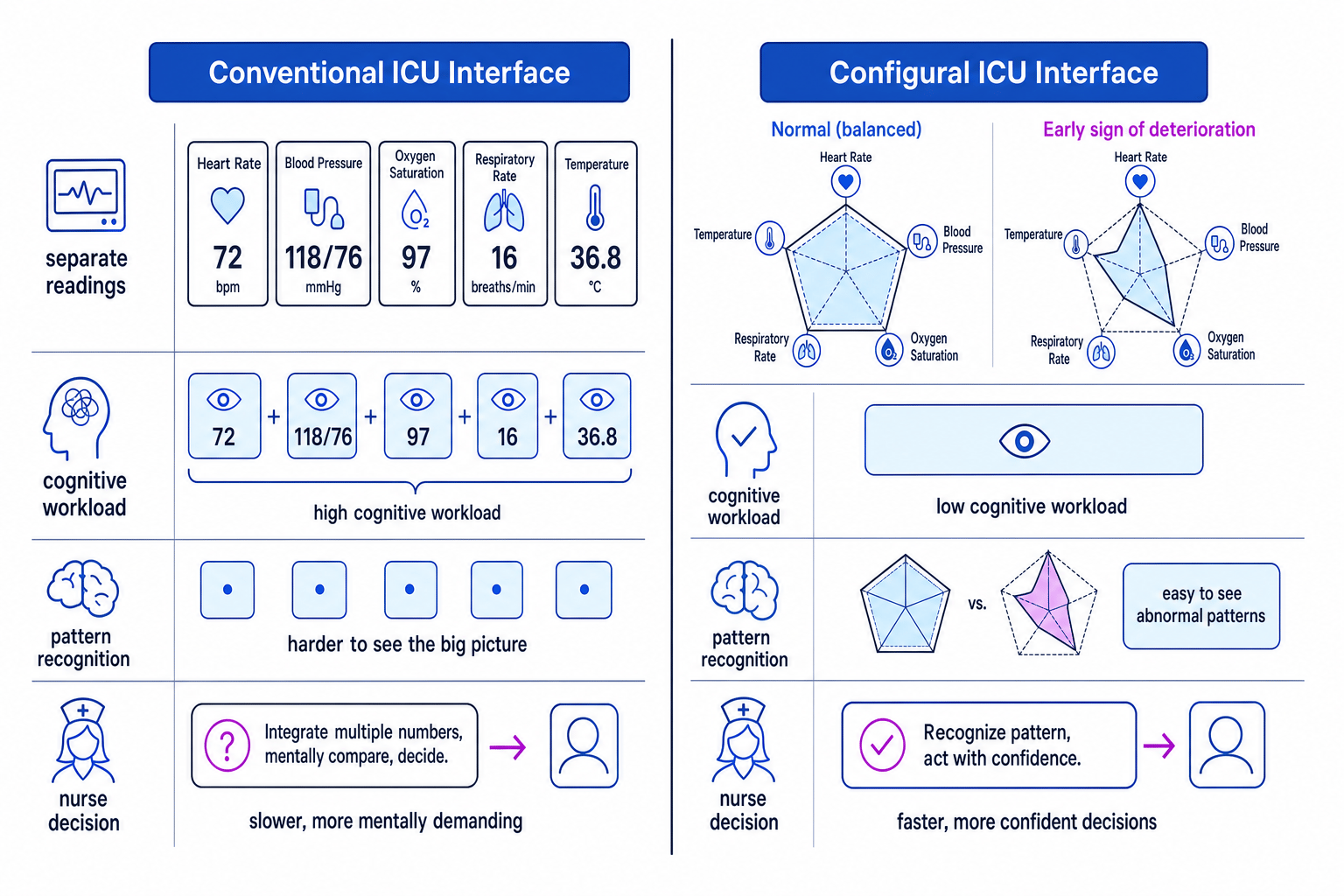
For example, an intensive care unit nurse may need to monitor heart rate, oxygen saturation, blood pressure, respiratory rate and medication levels at the same time. If these are shown as separate numbers, the nurse must mentally combine them to judge whether the patient is improving or deteriorating.
Cognitive overload
Cognitive overload occurs when the amount or complexity of information to be processed is greater than the person’s attentional and working-memory capacity.
Spotting cognitive overload in an ICU task
-
Identify what the worker must process: the nurse must monitor several vital signs, compare them with normal ranges, notice changes over time and decide whether action is needed.
-
Decide whether the information is integrated or scattered: if each vital sign is shown separately, the nurse must mentally combine separate readings, increasing working-memory demand.
-
Predict the likely effect: under time pressure, this may lead to slower decisions, missed deterioration, false alarms or stress.
-
Suggest an ergonomic improvement: combine related information into a display that makes the overall patient pattern easier to perceive at a glance.
More information is not always better
Do not assume that adding more data automatically improves decisions. If information is poorly organised, it can increase cognitive overload and make performance worse.
Observation in the workplace
Observation can be useful in workplace research because it allows psychologists or designers to see what workers actually do, rather than relying only on what they say they do. This can reveal interruptions, unsafe shortcuts, confusing layouts or communication problems.
However, observation can also change behaviour. Workers may become more careful, more anxious, or more likely to follow formal procedures when they know they are being watched.
Hawthorne effect
The Hawthorne effect is a change in behaviour caused by people knowing that they are being observed or studied.
This matters for ergonomics because a workplace may appear safer or more efficient during an observation than it really is day-to-day. It also raises ethical issues, especially if monitoring is constant, hidden, or used to punish workers rather than improve the system.
Judging whether observation may affect behaviour
-
Compare normal behaviour with observed behaviour: if staff know a researcher is watching, they may follow safety rules more strictly than usual.
-
Identify which outcome could be distorted: error rates, speed of work, communication style and stress levels might all change.
-
Apply this to validity: the observation may have lower ecological validity if it no longer reflects the ordinary workplace.
-
Improve the design: use transparent consent, observe over a longer period so workers become used to it, and focus on improving systems rather than blaming individuals.
Ethics link
For AO3, connect workplace observation to the BPS principles of respect, competence, responsibility and integrity: workers should know what data is collected, why it is collected, and how confidentiality will be protected.
Key research: Drews and Doig (2014)
The named study for this topic is Drews and Doig (2014), “Evaluation of a configural vital sign display for intensive care unit nurses.”
This is applied cognitive research because it investigates how display design affects nurses’ interpretation of patient information.
Background to the study
In intensive care units, nurses must monitor patients whose condition may change quickly. Traditional vital-sign displays often present separate numerical readings. The problem is that the nurse has to integrate these readings mentally.
Drews and Doig investigated whether a configural display could make this easier.
Configural display
A configural display presents several pieces of related information as one overall visual pattern, so that users can detect meaningful changes from the shape or configuration rather than reading each value separately.
The idea is that humans are often good at noticing patterns. If normal patient status creates a balanced shape, then deterioration may create a visible distortion.
Aim
Drews and Doig aimed to evaluate whether a configural vital-sign display would help ICU nurses interpret patient status more effectively than a conventional display.
The main issue was whether display design could reduce cognitive workload and support quicker, more accurate clinical decisions.
Method
This was a controlled simulation study using qualified intensive care nurses. Nurses were asked to interpret patient information presented through different display formats.
The independent variable was the type of display, such as a conventional numerical display compared with a configural display. The dependent variables included measures such as accuracy of interpretation, speed or efficiency of response, confidence, and perceived workload.
Because the study used a simulation rather than real patients, it allowed the researchers to control what information appeared and compare performance across display types without putting patients at risk.
Results and conclusions
Overall, the configural display was intended to support pattern recognition and reduce the mental effort of integrating separate vital signs. Drews and Doig found evidence that better-designed displays can support nurses’ understanding of patient state and reduce cognitive demands.
The conclusion is not simply “technology is better”. The stronger conclusion is that technology designed around human cognition can improve performance in complex workplaces.
Why the study matters
Drews and Doig show that errors in high-pressure workplaces are not just caused by individual workers. They can be caused by systems that overload attention and memory.
Do not remove the human expert
A configural display does not replace nursing judgement. It supports expert decision-making by presenting information in a form that is easier to perceive and integrate.
Evaluating Drews and Doig (2014)
Strengths
A major strength is usefulness. The research has clear real-world application in healthcare, where better monitoring could help nurses notice patient deterioration earlier.
It also has strong scientific control compared with observing real ICU emergencies. A simulation allows researchers to present the same patient scenarios to different nurses, making display conditions easier to compare.
The study is also relevant to the cognitive area of psychology because it focuses on attention, perception and decision-making.
Weaknesses
A key weakness is that a simulation may not fully capture the emotional pressure, interruptions, teamwork and fatigue of a real ICU. This limits ecological validity.
There may also be sample limitations. ICU nurses are a specialised group, so findings may not generalise to all healthcare workers or to other workplaces without further testing.
Another issue is novelty. A new display may initially seem harder because users are unfamiliar with it, or it may seem better because it is interesting and attracts attention. Longer-term research would be needed to see whether benefits remain after routine use.
Ethics
The study is ethically safer than testing new displays during real emergencies. No patient care is put at risk in a simulation.
However, researchers still need informed consent, confidentiality, the right to withdraw, and sensitivity to professional reputation. Nurses’ performance data should not be used to shame individuals.
Application: designing better workplaces
Ergonomic research can be applied by redesigning workplaces so that important information is clear, interruptions are managed, and observation is ethical.
A good workplace design should:
- reduce unnecessary memory demands;
- group related information together;
- make abnormal states easy to detect;
- prioritise warnings so workers are not overwhelmed by alarms;
- test designs with real users before full implementation;
- use observation to improve systems, not just monitor individuals.
Example application: ICU monitoring station
A hospital could redesign an ICU monitoring station using Drews and Doig’s principles. Instead of showing only separate numbers, the system could include a configural display that shows the patient’s overall physiological state. A distorted shape could signal deterioration, while detailed numerical values remain available for expert checking.
This supports both fast pattern recognition and precise clinical judgement.
Designing a safer control-room dashboard
-
Identify the cognitive demand: the operator must monitor several systems at once, notice abnormal patterns and decide which problem needs action first.
-
Reduce scattered attention: combine related indicators into grouped displays, so the operator does not have to search across several screens.
-
Make priorities visible: use an alarm hierarchy so urgent safety problems stand out more than routine updates.
-
Evaluate the design: test the dashboard with real workers using realistic scenarios, measuring errors, decision time, workload and user feedback.
AO2 application formula
For a novel scenario, write: workplace demand → cognitive problem → ergonomic redesign → expected effect on behaviour.
How to structure essay answers
For AO1, describe the background concepts: cognitive overload, observation, ergonomics and configural displays.
For AO2, apply those ideas to the workplace scenario in the question. Be specific: say exactly what feature of the workplace causes overload and exactly how you would redesign it.
For AO3, evaluate using validity, ethics, usefulness, sampling, ecological validity, reductionism and the individual/situational debate.
A strong debate link is individual versus situational explanations. Ergonomics shifts attention away from blaming workers and towards improving the situation in which they work.
In the exam
-
If asked about Drews and Doig (2014), organise your answer as aim, method, results/conclusion, evaluation.
-
In application questions, do not just say “make it easier to use”; name the cognitive process affected, such as attention, working memory, pattern recognition or decision-making.
-
For evaluation, balance usefulness with limitations: simulations are controlled and ethical, but may lack the pressure and complexity of a real workplace.
Check yourself
-
What is cognitive overload, and why might it occur in an intensive care unit?
-
How does a configural display reduce the mental work needed to interpret vital signs?
-
Why can workplace observation be useful but also ethically and methodologically problematic?
