What you'll learn
- What makes a subject “scientific”, including objectivity, falsifiability, control and replication.
- Why some psychological research looks very scientific, while other research is harder to fit into a scientific model.
- How research methods, statistics and graphs support psychology’s claim to be a science.
- How to use AO1, AO2 and AO3 when writing essays on this debate.
The big question: can psychology be a science?
Psychology studies the mind and behaviour. That immediately creates a challenge: behaviour can be observed, but thoughts, feelings and intentions often have to be inferred from what people say or do.
Natural sciences such as biology and chemistry often study things that can be measured directly. Psychology sometimes does this too, for example measuring brain activity, reaction times or test scores. But it also studies experiences like memory, obedience, prejudice, attachment and mental illness, which are more difficult to measure objectively.
Psychology as a science
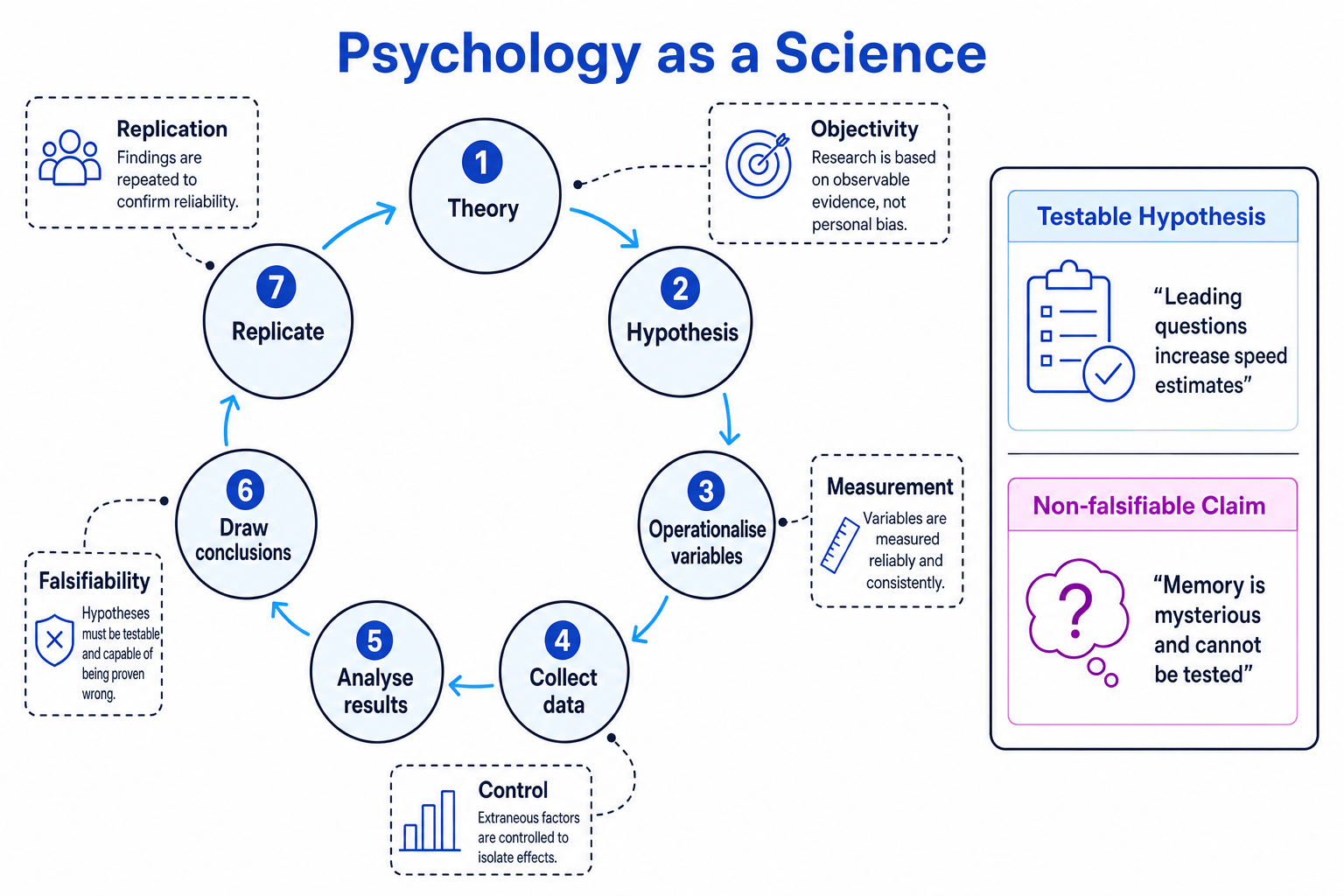
The psychology as a science debate asks whether psychological research can follow scientific principles, such as objectivity, control, measurement, hypothesis testing, replication and falsifiability, when investigating human behaviour and mental processes.
Core issue
The strongest answer is usually balanced: some psychology is highly scientific, especially controlled experiments and biological research, but not all psychological topics are easy to study using the same methods as natural science.
What makes research scientific?
Empirical evidence
Empirical evidence
Empirical evidence is evidence gathered through direct observation, measurement or experience, rather than through opinion or speculation.
Psychology often uses empirical evidence. For example, Loftus and Palmer (1974) did not simply guess that leading questions affect memory; they measured participants’ speed estimates after different verb conditions such as “hit” or “smashed”.
Objectivity
Objectivity
Objectivity means researchers aim to minimise personal bias so that findings are based on evidence rather than the researcher’s opinions, expectations or values.
Psychology improves objectivity through standardised procedures, operationalised variables and statistical analysis. For example, Bandura et al. (1961) used behaviour categories to record children’s aggression towards the Bobo doll.
However, complete objectivity is difficult because psychologists make choices about what to measure, how to interpret behaviour and which theories to use.
Operationalisation
Operationalisation
Operationalisation means defining a variable clearly enough that it can be measured. For example, “aggression” might be operationalised as the number of physical or verbal aggressive acts shown in a set time period.
This is crucial in psychology because many concepts, such as obedience, anxiety or memory, are not directly visible.
Judging whether a variable is operationalised
-
Decide whether the concept is directly measurable. “Stress” is too broad on its own because it could mean physical symptoms, emotional feelings or behaviour.
-
Turn the concept into an observable measure. A researcher might define stress as a score on a standardised stress questionnaire.
-
Check whether another researcher could repeat the measurement. If the same questionnaire and scoring system are used, the measure is more objective and replicable.
Control and standardisation
A controlled procedure keeps important conditions the same for all participants, so the researcher can be more confident that changes in behaviour are caused by the independent variable.
In Milgram (1963), the setting, verbal prods and shock generator were standardised. This made the study easier to replicate and helped create strong control. But it also raised ethical issues because participants were deceived and experienced stress.
Replication
Replication
Replication means repeating a study to see whether the same findings are obtained again. If findings replicate, they are more reliable.
Bocchiaro et al. (2012) can be compared with Milgram because both investigated obedience and disobedience, but in different contexts. Replication does not always mean copying a study exactly; it can also mean testing whether a general effect appears in a new situation.
Falsifiability
Falsifiability
Falsifiability means a theory or hypothesis can, in principle, be shown to be false by evidence.
A scientific claim must make clear predictions. For example, “leading questions influence memory estimates” can be tested. A vague claim such as “people remember things strangely because memory is mysterious” is not very scientific because it does not clearly say what evidence would count against it.
The scientific method in psychology
Psychologists often move through a cycle: theory, hypothesis, operationalisation, data collection, analysis, conclusion and replication.
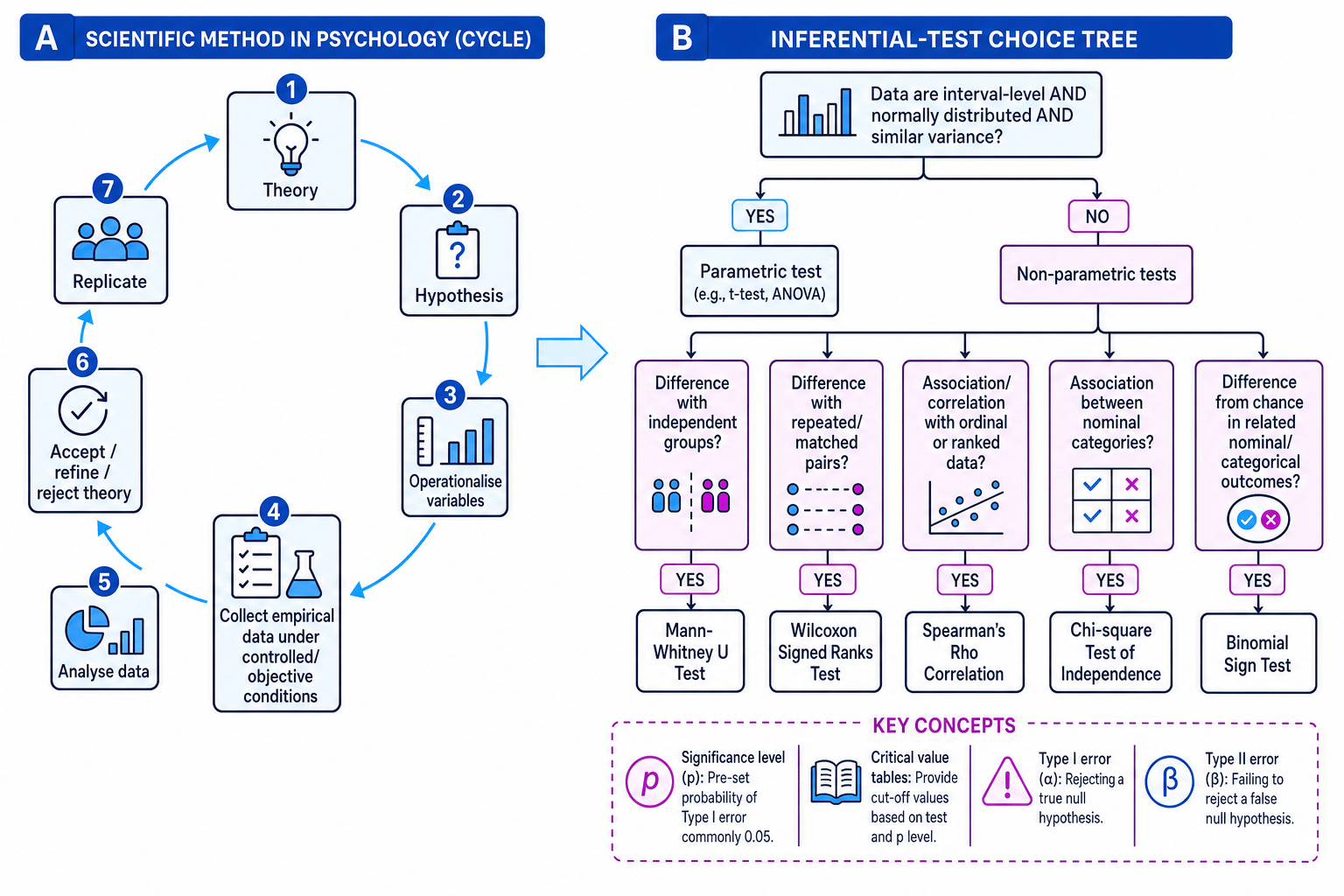
The diagram also shows why statistics matter. Scientific psychology does not just describe behaviour; it asks whether patterns are strong enough to be unlikely due to chance.
Research methods and statistics as part of science
Levels of measurement
Levels of measurement
Levels of measurement describe how numerical data are organised. Nominal data are categories, ordinal data are ranked, and interval data use equal intervals between scores.
- Nominal data: categories, such as “obeyed” or “disobeyed”.
- Ordinal data: ordered scores, such as ranks from most aggressive to least aggressive.
- Interval data: equal units, such as scores on a standardised test where the distance between scores is meaningful.
Descriptive statistics
Descriptive statistics summarise data.
- Mode: the most frequent score or category.
- Median: the middle score when data are ordered.
- Mean: the arithmetic average.
- Range: highest score minus lowest score.
- Variance: how spread out scores are around the mean.
- Standard deviation: a measure of spread around the mean.
- Ratios, percentages and fractions: useful for comparing proportions, such as the percentage of participants who obeyed.
Choosing an average
Use the mode for nominal data, the median for skewed or ordinal data, and the mean when interval data are suitable and extreme scores are not a major problem.
Graphs and diagrams
Different graphs suit different data:
- Bar chart: compares separate categories.
- Histogram: shows frequency of continuous data grouped into intervals.
- Line graph: shows change over time or across ordered conditions.
- Pie chart: shows proportions of a whole.
- Scatter diagram: shows the relationship between two co-variables in a correlation.
Inferential statistics
Inferential statistics
Inferential statistics are tests used to decide whether a pattern in data is likely to be a real effect or could have occurred by chance.
Psychologists usually compare an observed value from a statistical test with a critical value from a statistical table. The table depends on the test used, sample size, whether the hypothesis is one-tailed or two-tailed, and the chosen significance level.
A common significance level is p = 0.05. This means the researcher accepts a 5% probability of finding a significant result by chance if the null hypothesis is actually true.
Key symbols you may see include:
=means equal to.<means less than.>means greater than.<<means much less than.>>means much greater than.∞means infinity.~can mean approximately or distributed as, depending on context.
Choosing a statistical test
For OCR, you should know the named non-parametric tests and when they are used:
- Mann-Whitney U: difference test, independent groups, ordinal data or non-parametric conditions.
- Wilcoxon Signed Ranks: difference test, repeated measures or matched pairs, ordinal data or non-parametric conditions.
- Chi-square: association between nominal categories.
- Binomial Sign test: difference from chance or between related nominal outcomes.
- Spearman’s Rho: correlation/association using ranked or ordinal data.
A parametric test is suitable when the data are interval level, approximately normally distributed, and the groups have similar variance. Parametric tests are often more powerful, but only when their assumptions are met.
Choosing a statistical test
-
Identify the research aim. If a psychologist wants to know whether two unrelated groups differ in obedience scores, this is a difference question, not a correlation.
-
Identify the design. If each participant is in only one group, the design is independent groups.
-
Identify the level and assumptions. If the obedience scores are ordinal ranks, or the data do not meet parametric assumptions, a non-parametric test is needed.
-
Match the criteria to the test. A difference with independent groups using ordinal or non-parametric data requires Mann-Whitney U.
Mixing up significance and importance
A statistically significant result is not automatically a big or useful effect. It means the result is unlikely to be due to chance at the chosen significance level.
Type I and Type II errors
Type I and Type II errors
A Type I error is a false positive: rejecting the null hypothesis when it is actually true. A Type II error is a false negative: failing to reject the null hypothesis when there really is an effect.
A very strict significance level reduces the risk of a Type I error but can increase the risk of a Type II error.
Positions within the debate
Position 1: psychology can be scientific
This position argues that psychology can use controlled experiments, objective measurement, standardised procedures and statistical testing.
Sperry (1968), for example, used a highly controlled split-brain procedure to investigate hemispheric lateralisation. Visual information was presented to one hemisphere at a time, making the study precise and replicable. This supports psychology’s scientific status, especially within the biological area.
Loftus and Palmer (1974) also supports this position because it used a controlled laboratory experiment, manipulated the verb in a question, and measured speed estimates quantitatively.
Position 2: psychology is not fully scientific
This position argues that people are too complex, conscious and socially influenced to be studied in exactly the same way as objects in natural science.
For example, Milgram’s participants may have responded to demand characteristics, the authority of Yale University, or the unusual laboratory setting. This means the study may not perfectly reflect everyday obedience.
Similarly, Bandura et al. (1961) measured aggression in a controlled setting, but hitting a Bobo doll may not be the same as real-life aggression.
Position 3: psychology should use multiple methods
A balanced view is that psychology is partly scientific but should not rely only on laboratory experiments. Case studies, interviews, observations and qualitative data can be useful when studying complex experience.
For example, a purely quantitative study might tell us how many people obeyed, but qualitative data may help explain why they obeyed.
Best essay position
A strong answer usually argues that psychology is a science when it uses systematic, objective and testable methods, but its subject matter means validity, ethics and interpretation are harder than in many natural sciences.
Applying the debate to core studies
Milgram (1963)
Milgram’s obedience study used standardised prods, a controlled setting and quantitative obedience rates. This supports psychology as scientific. However, it involved deception, lack of fully informed consent and potential psychological harm, so it raises BPS ethical concerns around respect, responsibility and integrity.
Bocchiaro et al. (2012)
Bocchiaro et al. studied obedience, disobedience and whistleblowing in a more contemporary context. It used standardised instructions and quantitative comparisons between predicted and actual behaviour. This shows how scientific methods can test socially relevant behaviour.
Loftus and Palmer (1974)
This study is a strong example of experimental control. The independent variable was the verb used in the critical question, and the dependent variable was the speed estimate. However, artificial video clips reduce ecological validity.
Bandura et al. (1961)
Bandura’s Bobo doll study used observation categories and controlled conditions, supporting objectivity and reliability. Ethically, though, exposing children to aggressive models raises concerns about protection from harm.
Similarities and differences with other debates
Reductionism versus holism
Science often encourages reductionism, where complex behaviour is broken into measurable parts. This helps control and measurement, but may ignore the whole person and their context.
Nature versus nurture
Scientific psychology can study both biological influences and environmental influences. For example, Sperry (1968) supports biological explanations, while Bandura (1961) supports learning from the environment.
Freewill versus determinism
Scientific explanations often look for causes of behaviour, which can seem deterministic. For example, social learning theory explains aggression through observation and reinforcement. But human choice and meaning can be harder to capture scientifically.
Usefulness and ethics
Scientific methods can make psychology useful because findings can inform therapy, education, policing and policy. But scientific value does not remove ethical responsibility. Research must still follow BPS principles: respect, competence, responsibility and integrity.
Validity, reliability, ethnocentrism and sampling bias
Scientific research should be reliable and valid, but psychology often uses restricted samples. Milgram used American male volunteers, and many classic studies used Western participants. This creates possible ethnocentrism and sampling bias, limiting generalisability.
AO1, AO2 and AO3 for essays
AO1: describe
Define science and explain principles such as objectivity, operationalisation, falsifiability, control, replication and hypothesis testing.
AO2: apply
Use details from a source or study. For example, if a scenario describes a researcher using standardised instructions and a statistical test, link this to objectivity and scientific control.
AO3: evaluate
Judge strengths and limitations. You might discuss internal validity, ecological validity, reliability, ethics, reductionism, usefulness, and whether the study can be replicated.
In the exam
-
Start with a clear position: psychology can be scientific, but its subject matter creates special problems.
-
Use named studies precisely, such as Milgram (1963), Bocchiaro et al. (2012), Loftus and Palmer (1974), Sperry (1968) or Bandura et al. (1961).
-
For evaluation, balance scientific strengths such as control and replication against weaknesses such as ethics, artificiality, sampling bias and reduced validity.
Check yourself
- Why is operationalisation especially important in psychology?
- Which features of Loftus and Palmer (1974) make it scientific, and which features limit its validity?
- How would you choose between Mann-Whitney U, Wilcoxon Signed Ranks, Chi-square, Binomial Sign test and Spearman’s Rho?