What you'll learn
- What socially sensitive research is and why it matters in psychology.
- How to analyse sensitive research before, during and after it is carried out.
- How to use OCR core studies, such as Milgram (1963) and Bandura et al. (1961), to illustrate the debate.
- How to build balanced AO1, AO2 and AO3 essay answers.
Why this debate matters
Psychology investigates people’s behaviour, thoughts, emotions and relationships. That means research can affect not only the individual participants, but also whole groups in society.
Some topics are especially sensitive: obedience, aggression, gender, ethnicity, intelligence, mental health, sexuality, criminal behaviour, family life and disability. Research in these areas can be useful, but it can also create stigma, stereotypes or unfair treatment if handled badly.
Socially sensitive research
Socially sensitive research is psychological research that may have important social consequences for participants or for the wider group they represent. These consequences can occur during the study, after publication, or when findings are applied by others.
A key name for this debate is Sieber and Stanley (1988). They argued that researchers should think carefully about the social consequences of their work, especially the research question, method, interpretation and use of findings.
The central issue
The debate is not simply “should sensitive topics be banned?” It is about whether the benefits of research justify the risks, and how psychologists can reduce harm while still producing useful knowledge.
Socially sensitive research and ethics are linked — but not identical
Ethics focuses on how participants are treated in the study. This includes valid consent, protection from harm, confidentiality, right to withdraw and debriefing.
Social sensitivity is broader. It asks what might happen to society after the research is interpreted, reported or applied. For example, a study might treat participants ethically but still produce findings that are used to stereotype a group.
The British Psychological Society, or BPS, expects psychologists to act with respect, competence, responsibility and integrity. These principles matter strongly in socially sensitive research because researchers must think beyond “Can I collect this data?” and ask “What could this data do?”
Only writing about consent and debrief
In exam answers, do not reduce socially sensitive research to ordinary ethical issues. Consent and debrief are relevant, but you also need to discuss wider consequences, such as stigma, discrimination, policy misuse and media misinterpretation.
The stages of conducting socially sensitive research
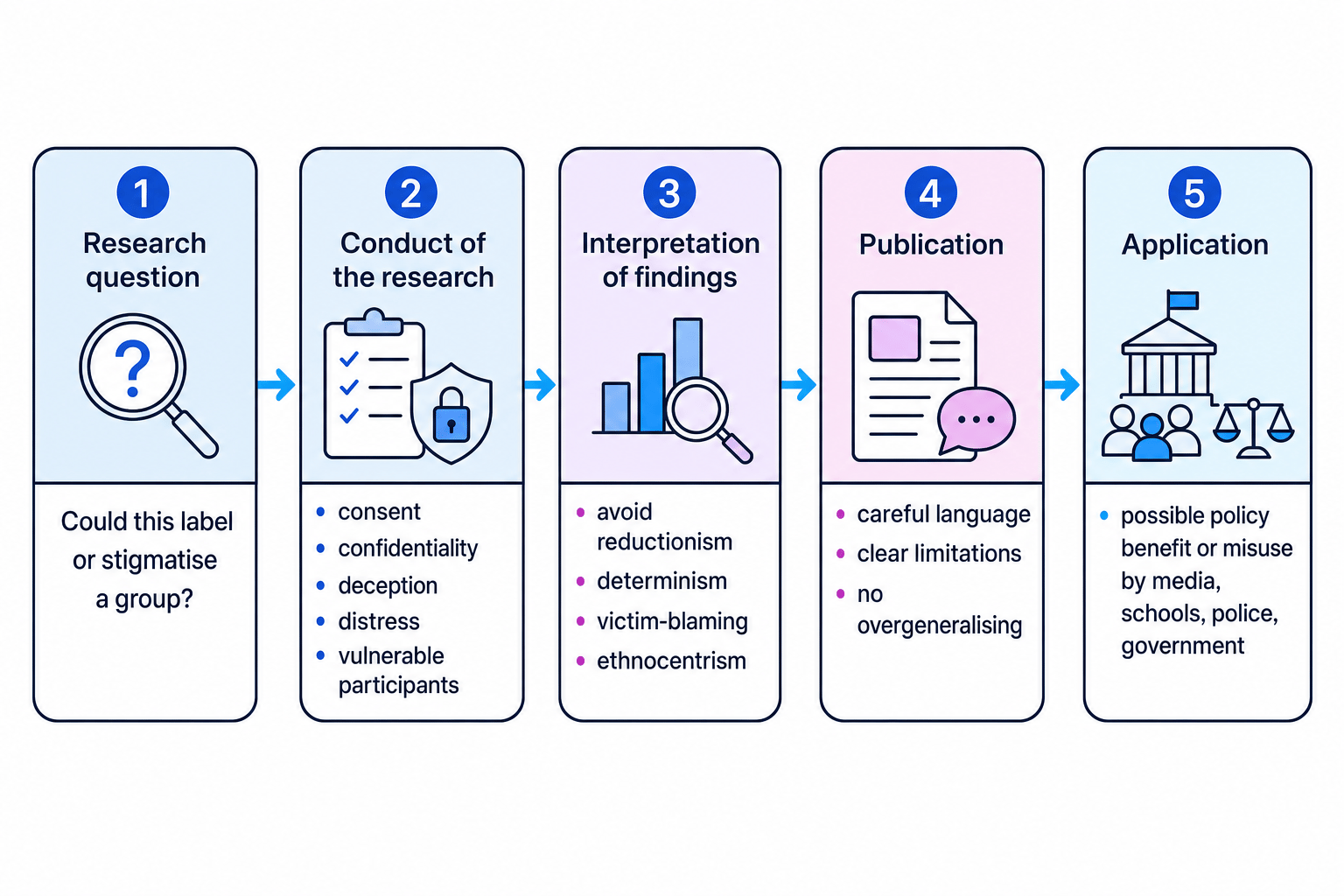
A useful way to think about this debate is as a process: the researcher must make responsible choices at every stage.
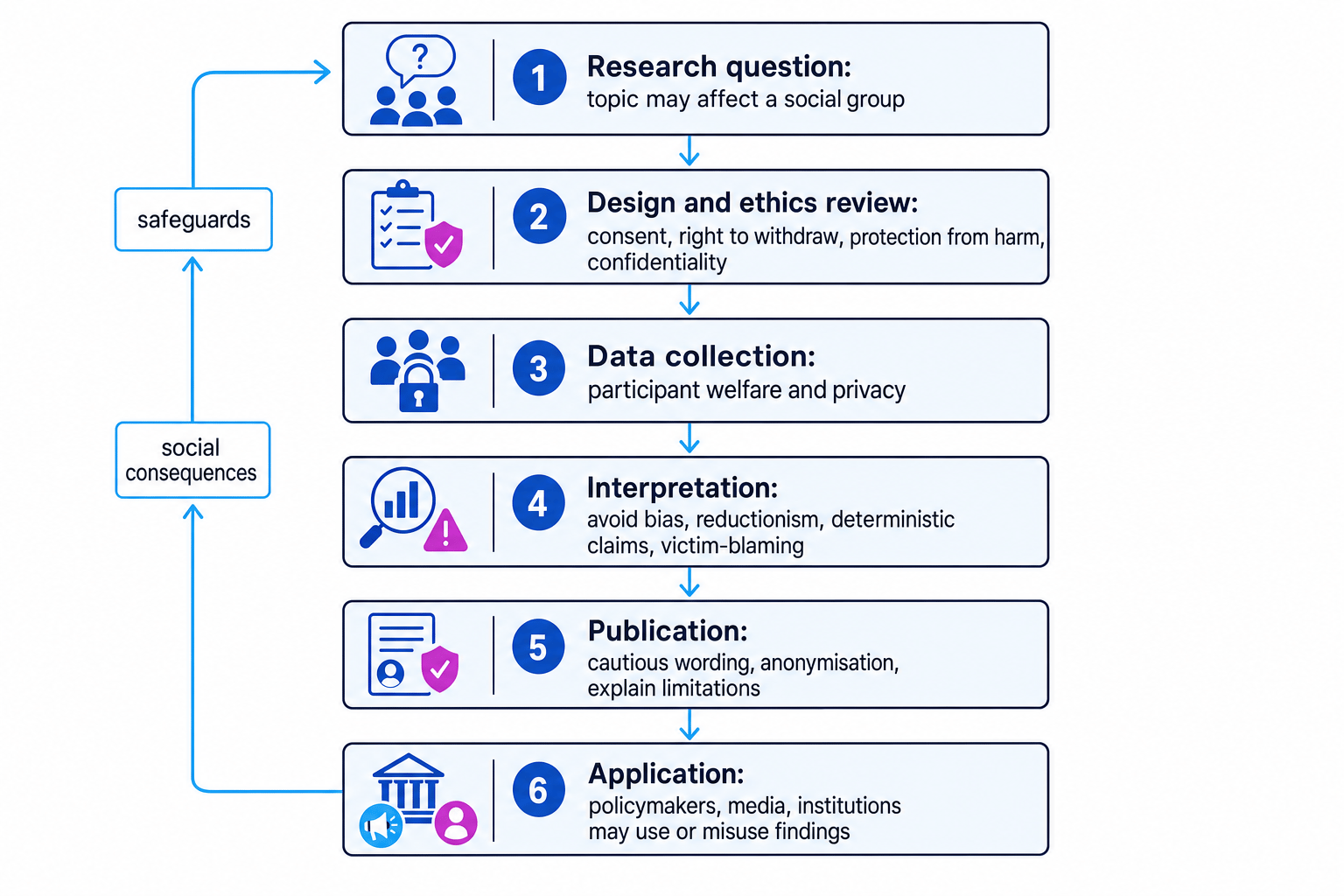
1. The research question
The research question is what the psychologist is trying to investigate. A question becomes socially sensitive if it could affect how a group is viewed or treated.
For example, asking whether one social group is “more aggressive” than another could lead to stereotyping. Asking how authority affects obedience may be sensitive too, but it may also help society understand harmful behaviour.
2. The conduct of the research
The conduct of research means how the study is carried out. Sensitive studies may involve vulnerable participants, private information, deception, distress or unequal power relationships.
Researchers should use safeguards such as anonymising data, gaining valid consent where possible, allowing withdrawal, giving support after the study and having an ethics committee review the design.
3. Interpretation of findings
Interpretation means explaining what the results suggest. This is a major danger point in socially sensitive research.
A researcher should avoid:
- Reductionism: explaining complex behaviour too narrowly, such as reducing crime only to biology.
- Determinism: implying people have no choice or cannot change.
- Victim-blaming: suggesting disadvantaged groups are responsible for their own difficulties.
- Ethnocentrism: treating one culture’s behaviour as the universal standard.
4. Publication and application
Publication means making findings available, usually through journals, books, teaching, media or policy reports.
Application means using findings in real life, such as in education, policing, therapy, law or government policy. This can be positive, but findings can also be misused.
Judging whether a proposal is socially sensitive
A psychologist proposes to compare aggression scores in children from two neighbourhoods and publish which neighbourhood is “more aggressive”.
-
Identify who could be affected. The children are directly involved, but the wider neighbourhoods could also be affected because the results may label one community negatively.
-
Consider the possible harm. If one area is described as “more aggressive”, schools, police, parents or the media might treat those children as risky or badly behaved.
-
Consider safeguards. The researcher could anonymise locations, avoid ranking communities publicly, measure environmental factors, and explain that aggression is influenced by many variables rather than fixed group traits.
-
Reach a balanced judgement. The study may be socially sensitive, but it is not automatically wrong. It becomes more acceptable if it is designed and reported in a way that reduces stigma and increases usefulness.
Different positions in the debate
Position 1: Conduct sensitive research, but with safeguards
This position argues that difficult topics should not be ignored. Research can expose injustice, improve treatments, challenge prejudice and guide policy.
For example, research into eyewitness testimony, such as Loftus and Palmer (1974), is socially important because it shows that memory can be distorted by leading questions. This could worry people because it suggests eyewitnesses may be unreliable, but it has helped improve police interviewing and legal procedures.
Position 2: Restrict or avoid research if the risks are too high
This position argues that some research questions can do more harm than good. Findings about group differences, criminality, intelligence or parenting may be used to discriminate, even if the researcher did not intend this.
A major concern is that scientific findings often appear authoritative. If the public sees a psychological claim as “proven”, it may be harder to challenge harmful stereotypes.
Position 3: A middle position — be reflexive and socially responsible
A strong A-Level answer usually takes this balanced position. Reflexivity means researchers actively reflect on their own assumptions, power and possible impact.
This approach says psychologists should:
- consult affected groups where appropriate
- justify why the research matters
- use careful and respectful language
- report limitations clearly
- avoid overgeneralising from small or biased samples
- consider how findings might be used by media, institutions or governments
A balanced judgement
A good phrase to remember: socially sensitive research is not automatically unethical, but it requires extra justification, extra safeguards and extra caution in interpretation.
Core studies that illustrate socially sensitive research
Milgram (1963): obedience to authority
Milgram (1963) investigated whether ordinary people would obey an authority figure and give what they believed were electric shocks to another person. This is socially sensitive because it suggests destructive obedience may occur in everyday people under certain conditions.
The study also raised ethical concerns: deception, distress and pressure to continue. However, Milgram argued that the findings were useful because they helped explain obedience in real-world contexts, including harmful authority systems.
Applying the debate to Milgram (1963)
-
Start with the direct ethical issue. Participants were deceived and many showed visible distress, so the conduct of the study raises concerns about protection from harm and valid consent.
-
Add the wider social sensitivity. The findings imply that ordinary people may obey destructive authority, which could be disturbing and could affect how people view human nature.
-
Balance this with usefulness. The study has helped psychologists understand obedience, authority, responsibility and institutional power.
-
Evaluate the safeguards and limits. Milgram debriefed participants and followed up with them, but modern BPS standards would expect stronger protection from harm. Also, the sample was limited, so the findings should not be overgeneralised to all people.
Bocchiaro et al. (2012): disobedience and whistleblowing
Bocchiaro et al. (2012) studied obedience, disobedience and whistleblowing in a more modern context. Participants were asked to support a study involving sensory deprivation, even though it seemed unethical.
This research is socially sensitive because it explores whether people challenge unethical authority. It has useful applications for workplaces, schools and institutions where whistleblowing may prevent harm. However, it still involved deception and possible discomfort, so ethical safeguards and debriefing were essential.
Bandura, Ross and Ross (1961): transmission of aggression
Bandura et al. (1961) showed children an adult model behaving aggressively or non-aggressively towards a Bobo doll. Children exposed to the aggressive model later showed more imitative aggression.
This is socially sensitive because it suggests children can learn aggression from adult models. The findings have implications for parenting, education, media violence and child protection. However, the research could also be misused to blame parents or oversimplify aggression.
Loftus and Palmer (1974): eyewitness testimony
Loftus and Palmer (1974) investigated how leading questions affect memory of a car accident. Their study is socially sensitive because it has implications for courts, police questioning and witness credibility.
The usefulness is clear: it supports more careful interviewing. The risk is that people may overstate the findings and assume all eyewitness testimony is worthless, which would be an overgeneralisation.
Sperry (1968): split-brain research
Sperry (1968) studied people whose brain hemispheres had been separated to treat severe epilepsy. This research involved a very small and unusual sample, so confidentiality and dignity were especially important.
The study is useful because it improved understanding of hemispheric lateralisation, but researchers must avoid treating rare patients as curiosities or making exaggerated claims about “left-brained” and “right-brained” people.
Similarities and differences with other debates
Ethics
Socially sensitive research is closely linked to the ethics debate, but it goes further. Ethics asks whether participants were treated properly. Social sensitivity asks what the research may do to groups, institutions and society.
Usefulness
This debate overlaps strongly with usefulness. Sensitive research may be justified if it leads to real benefits, such as better legal procedures, safer workplaces or improved mental health support.
Nature/nurture and determinism
Research can be socially sensitive when it appears to suggest behaviour is caused by biology, upbringing or social background. Biological explanations may seem deterministic, while environmental explanations may blame parents, schools or communities.
Ethnocentrism
If research is based mainly on one culture but applied to all people, it may become socially sensitive. It can make other cultures appear abnormal or inferior.
Reductionism and holism
Sensitive findings are especially risky when complex behaviour is reduced to one factor. A holistic approach, considering biological, cognitive, social and cultural influences, can reduce unfair conclusions.
Findings can be misused
Even when a study is well designed and ethically approved, researchers cannot fully control how journalists, politicians, organisations or the public use the findings. This is why cautious wording and clear limitations are essential.
How to write about this in essays
For AO1, describe the debate clearly. Define socially sensitive research, explain that it involves wider social consequences, and outline stages such as the research question, conduct, interpretation, publication and application.
For AO2, apply the debate to a study or scenario. Ask: Who might be affected? What harm could happen? What benefits might come from the research? What safeguards would reduce risk?
For AO3, evaluate. A balanced answer should include both sides: socially sensitive research can be harmful if it creates stigma or discrimination, but it can also be valuable because it informs policy, challenges prejudice and improves practice.
Saying socially sensitive research is always bad
Avoid writing as if sensitive research should never be conducted. Many important areas of psychology are sensitive. The stronger argument is that these studies need careful planning, ethical review and responsible communication.
In the exam
-
Define socially sensitive research, then immediately go beyond ordinary ethics by discussing wider social consequences.
-
Use named research accurately, such as Milgram (1963), Bocchiaro et al. (2012), Bandura et al. (1961) or Loftus and Palmer (1974).
-
Make a balanced judgement: weigh possible harm against usefulness, and explain how safeguards could reduce risk.
Check yourself
- How is socially sensitive research different from a standard ethical issue?
- Why might Milgram’s obedience study be seen as both socially risky and socially useful?
- What safeguards could a researcher use when studying a topic linked to stigma or discrimination?