What you'll learn
- What the psychodynamic perspective says causes behaviour.
- Freud’s key concepts: the unconscious, id, ego, superego, defence mechanisms, and psychosexual stages.
- How research such as Freud’s Little Hans case study (1909) illustrates the perspective.
- How to evaluate the perspective and compare it with the behaviourist perspective.
Starting point: what is a perspective?
A perspective is a broad way of explaining human behaviour. In OCR H567, you need to know what each perspective assumes, how research illustrates it, its strengths and weaknesses, its applications, and how it compares with the other perspective.
Psychodynamic perspective
The psychodynamic perspective is the approach, mainly associated with Sigmund Freud, that explains behaviour as the result of unconscious mental forces, early childhood experiences, and conflict between different parts of the personality.
The word dynamic matters: Freud saw the mind as full of competing forces. Behaviour is not always what it seems on the surface; it may be a visible sign of hidden conflict.
The central claim
Psychodynamic psychologists argue that behaviour is strongly influenced by the unconscious mind, especially conflicts and experiences from childhood that the person may not be aware of.
Freud’s model of the mind
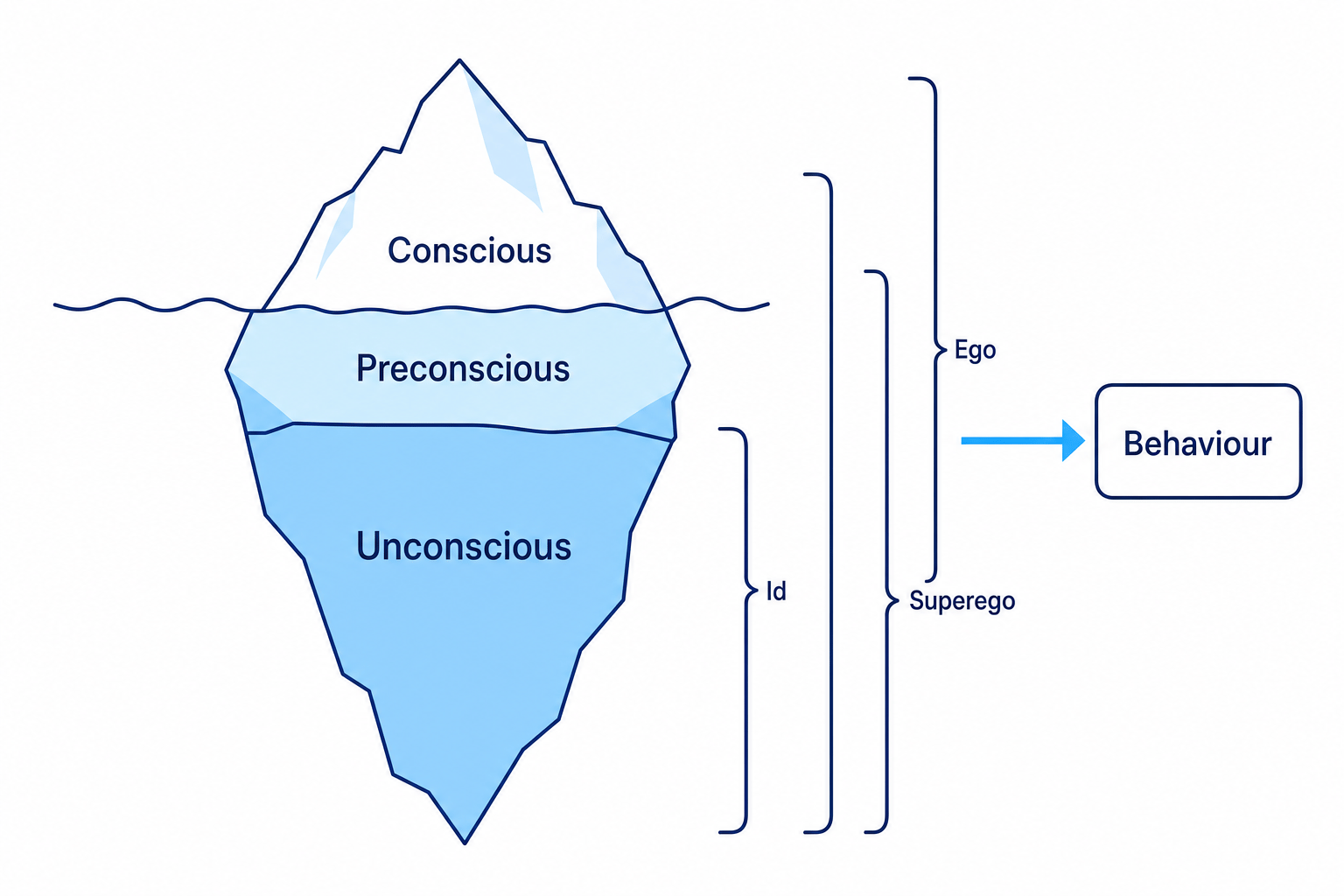
Freud divided the mind into three levels.
Conscious, preconscious and unconscious
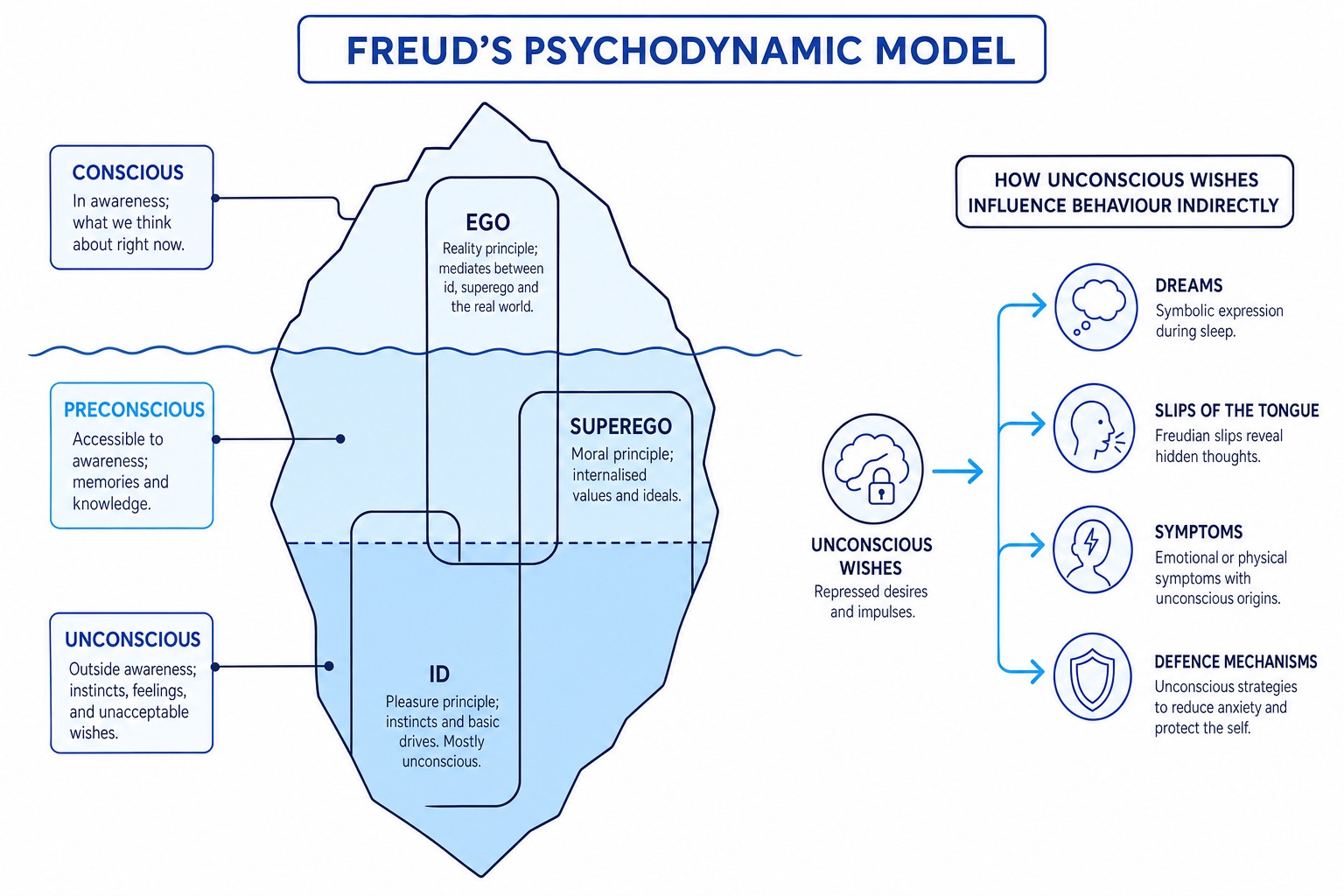
The conscious mind contains thoughts and feelings you are aware of right now. The preconscious mind contains information you are not currently thinking about but could bring into awareness, such as your old primary school teacher’s name. The unconscious mind contains wishes, fears, memories, instincts and conflicts that are outside awareness but still influence behaviour.
Freud often described the mind like an iceberg: the visible part is small, while the larger hidden part below the surface has the greatest influence.
Psychic determinism
Psychic determinism is the idea that behaviour is not random: even dreams, slips of the tongue and symptoms have causes in the unconscious mind.
This makes the perspective strongly determinist, meaning it sees behaviour as caused by forces outside a person’s conscious control. It is not saying people never make choices, but it does argue that free will is limited by unconscious motives.
The structure of personality
Freud also proposed three interacting parts of the personality.
The id
The id is the primitive, instinctive part of personality. It operates according to the pleasure principle, meaning it seeks immediate satisfaction of desires such as hunger, aggression and pleasure. Freud believed the id is present from birth and is mostly unconscious.
The ego
The ego is the rational part of personality. It operates according to the reality principle, meaning it tries to satisfy the id’s desires in a socially acceptable and realistic way.
The superego
The superego is the moral part of personality. It develops through socialisation and contains internalised rules, values and ideals. It can produce guilt when the person behaves in a way that breaks these internal standards.
When the id, ego and superego clash, the person experiences anxiety. The ego then uses defence mechanisms to manage that anxiety.
Defence mechanisms
Defence mechanisms are unconscious strategies used by the ego to reduce anxiety and protect the person from threatening thoughts or feelings.
Common defence mechanisms include:
- Repression: pushing threatening thoughts into the unconscious.
- Denial: refusing to accept reality because it is too upsetting.
- Displacement: redirecting feelings from a threatening target to a safer one.
- Projection: attributing your own unacceptable feelings to someone else.
Applying defence mechanisms to a fear
A student has intense anger towards a parent but feels guilty about it. They start snapping at a younger sibling instead.
- The unacceptable feeling is identified as anger towards the parent, which threatens the superego because the student believes they “should” respect the parent.
- The ego reduces anxiety by using displacement: the anger is redirected away from the threatening target and towards a safer person.
- The behaviour is therefore explained as a compromise between the id’s aggressive impulse, the superego’s guilt, and the ego’s attempt to manage conflict.
Do not make it only about sex
Freud did emphasise sexual and aggressive instincts, but an exam answer on the psychodynamic perspective should be broader: unconscious conflict, childhood, the id/ego/superego, defence mechanisms, and therapy are all important.
Childhood and psychosexual development
Freud believed adult personality is shaped by early childhood. He proposed psychosexual stages, which are stages of development where pleasure-seeking energy, called libido, focuses on different areas of the body.
The main stages are:
- Oral stage: pleasure focuses on the mouth.
- Anal stage: pleasure focuses on control and toilet training.
- Phallic stage: children become aware of sex differences and family relationships.
- Latency stage: sexual impulses are less obvious.
- Genital stage: mature sexual relationships develop.
A fixation is when development becomes stuck at a stage because of too much or too little satisfaction. Freud argued this could affect adult personality.
For example, fixation at the oral stage might be linked to dependency or smoking, while fixation at the anal stage might be linked to extreme orderliness or messiness. These claims are difficult to test scientifically, so they are useful for AO1 description but need careful AO3 evaluation.
Research illustrating the perspective: Freud’s Little Hans (1909)
Freud’s best-known child case study is Little Hans, the pseudonym for Herbert Graf, a five-year-old boy with a fear of horses.
Freud did not work with Hans directly for most of the case. Hans’s father observed him and wrote to Freud. Freud interpreted Hans’s horse phobia as a sign of unconscious conflict during the phallic stage.
Freud argued that Hans experienced the Oedipus complex, which means a boy’s unconscious desire for his mother and rivalry with his father. Hans’s fear of horses was interpreted as displacement: the fear of his father was redirected onto horses, which were a safer object to fear consciously.
Why it illustrates psychodynamic ideas
Little Hans illustrates several defining principles:
- Behaviour can have an unconscious meaning.
- Childhood experiences shape later emotional problems.
- Symptoms, such as phobias, may be symbolic.
- Case studies can produce detailed qualitative evidence.
Evaluation of Little Hans
The study has strengths because it gives rich, detailed insight into one child’s behaviour. It also generated ideas about phobias, childhood anxiety and unconscious conflict.
However, there are major weaknesses. A case study is an in-depth investigation of one person or small group, so it may have low population validity, meaning the findings may not generalise to other people. Freud’s interpretation may also show researcher bias, where the researcher’s expectations influence the conclusions.
There are reliability issues too. Reliability means consistency: if another researcher studied Hans, they might not interpret the evidence in the same way. There are also validity concerns. Validity means whether a study measures or explains what it claims to. Hans may simply have learned to fear horses after frightening experiences with them, which would fit a behaviourist explanation more easily.
Ethically, Freud’s study predates the modern British Psychological Society Code of Ethics, but you can still evaluate it using today’s standards. Hans was a child, so fully informed consent is difficult. The case involved sensitive family material, and although a pseudonym was used, confidentiality and protection from psychological harm are still relevant concerns.
Evaluating Little Hans
- The evidence came mainly from Hans’s father, so the data may be affected by parental interpretation rather than being a neutral record of behaviour.
- Freud interpreted the horse phobia as displacement from unconscious fear of the father, but a simpler alternative is that Hans learned the fear through direct experience or observation.
- Because the study focused on one child, it has low population validity; it cannot prove that all phobias come from unconscious childhood conflict.
- A balanced AO3 judgement would say the study is useful for illustrating psychodynamic concepts, but weak as scientific evidence for a general theory of phobias.
Applications of the psychodynamic perspective
The main application is psychoanalysis, Freud’s talking therapy designed to bring unconscious conflicts into awareness.
A therapist might use:
- Free association: the client says whatever comes into their mind without censorship.
- Dream analysis: the therapist interprets dreams as symbolic expressions of unconscious wishes.
- Transference: the client redirects feelings from important people in their life onto the therapist.
- Insight: the client becomes aware of unconscious conflicts, which may reduce symptoms.
Modern psychodynamic therapy is often shorter and less intense than classic psychoanalysis, but it still focuses on unconscious patterns, early relationships and emotional insight.
AO2 application shortcut
If a scenario describes a symptom with no obvious conscious cause, you can apply the psychodynamic perspective by asking: “What unconscious conflict, childhood experience, or defence mechanism might this behaviour express?”
Strengths of the perspective
One strength is that the psychodynamic perspective takes the whole person seriously. It considers emotions, childhood, relationships and hidden motives, so it can be more holistic than approaches that focus only on observable behaviour.
It has also been highly useful. Psychodynamic ideas influenced counselling, psychotherapy, attachment theory, personality research and mental health treatment.
Another strength is that modern psychology does accept that some mental processes are unconscious. For example, people can be influenced by automatic thoughts and implicit memories. However, this does not automatically prove Freud’s specific ideas about the id or psychosexual stages.
Weaknesses of the perspective
A major weakness is that many psychodynamic concepts are difficult to test. If a person denies an unconscious wish, Freud could say this denial is itself a defence mechanism. This makes the theory hard to falsify, meaning hard to prove wrong.
The perspective is also often criticised as reductionist, meaning it may reduce complex behaviour to unconscious drives and childhood conflict. It can underplay current social situations, conscious decision-making and biological factors.
There are cultural and gender concerns too. Freud’s theory was based largely on patients from a particular time and culture, so it may be ethnocentric, meaning it may generalise from one culture as if it applies to all people.
Comparison with the behaviourist perspective
The behaviourist perspective explains behaviour as learned from the environment through processes such as association, reinforcement and punishment. It focuses on observable behaviour rather than unconscious mental life.
| Comparison point | Psychodynamic perspective | Behaviourist perspective |
|---|---|---|
| Main cause of behaviour | Unconscious conflict and childhood experiences | Learning from the environment |
| Type of determinism | Internal psychic determinism | Environmental determinism |
| Evidence | Often case studies and clinical observations | Often controlled experiments |
| Treatment | Insight through therapy | Behaviour change through learning principles |
| View of childhood | Early experiences shape personality | Early learning shapes behaviour |
The two perspectives are similar because both are deterministic and both see early experience as important. They are different because psychodynamic explanations focus on hidden internal conflict, while behaviourist explanations focus on observable learning.
Comparing explanations of a phobia
A person has a severe fear of dogs but cannot clearly explain why.
- A psychodynamic explanation would treat the dog fear as a possible symbol of unconscious anxiety, perhaps using displacement from a more threatening conflict.
- A behaviourist explanation would focus on learning, such as being bitten, seeing someone else panic, or being rewarded with attention when avoiding dogs.
- For AO3, the behaviourist account may be easier to test because it refers to observable events, while the psychodynamic account may explain deeper emotional meaning but is harder to verify.
In the exam
- For AO1, define the perspective clearly and use key terms: unconscious, childhood, id, ego, superego and defence mechanisms.
- For AO2, apply the theory to the scenario rather than just describing Freud; link behaviour to unconscious conflict, early experience or anxiety reduction.
- For AO3, balance usefulness and depth against weak scientific testability, case-study evidence, bias, ethics and limited generalisability.
- When comparing, make the contrast explicit: psychodynamic means internal unconscious conflict; behaviourist means observable learning from the environment.
Check yourself
- How would Freud explain a symptom that seems irrational, such as a phobia with no obvious cause?
- What are two strengths and two weaknesses of using Little Hans as evidence?
- How is the psychodynamic perspective similar to and different from the behaviourist perspective?